Warm up & Skill
Rowing technique
WOD
Work time =’s rest time
15 minute AMRAP
300m row repeats


Warm up & Skill
Rowing technique
WOD
Work time =’s rest time
15 minute AMRAP
300m row repeats
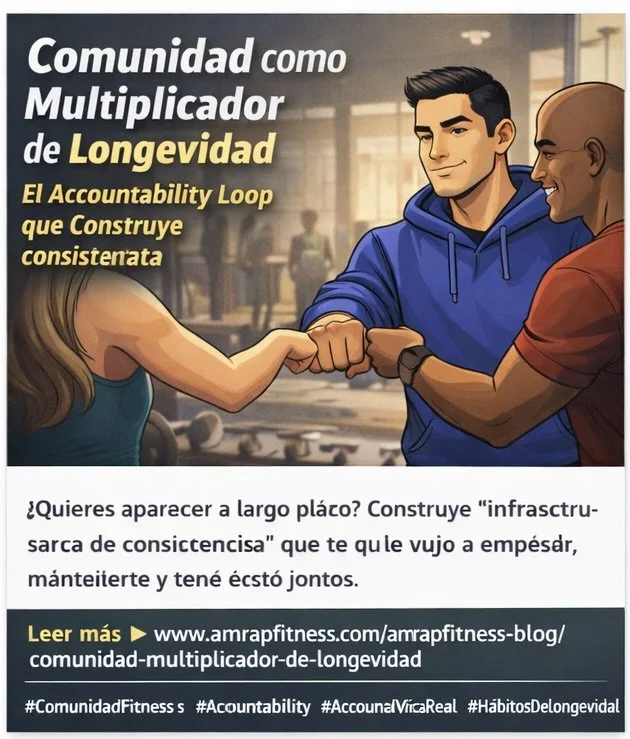
Es adherencia.
Porque la mayoría no pierde salud por no saber qué hacer.
La pierde porque no pudo mantenerlo cuando la vida se puso pesada.
Y el factor que decide si sigues o no no suele ser motivación.
Es tu infraestructura.
Esta entrada trata de una palanca de longevidad que casi nadie entrena como habilidad:
comunidad — no como “extra bonito,” sino como tu sistema para mantenerte constante cuando el estrés sube.
La mayoría no “abandona.”
Desaparece.
No es dramático. No lo anuncia.
Simplemente deja de aparecer.
Primero:
“Esta semana está imposible.”
Luego:
“Empiezo el lunes.”
Luego:
“Solo estoy cansado.”
Y pasan meses.
Lo peor no es perder entrenos.
Lo peor es la historia que crece en el silencio:
“Tal vez ya no soy esa persona.”
Así se erosiona la identidad.
No por una gran falla.
Por aislamiento.
Verdad de coaching: La mayoría no falla por falta de interés.
Falla porque no tiene estructura que lo sostenga cuando se resbala.
La comunidad es esa estructura.
Comunidad no es:
motivación vacía
una selfie
una frase bonita
Comunidad es infraestructura de comportamiento.
Es la red que hace más fácil repetir hábitos saludables.
En longevidad, comunidad significa:
accountability
pertenencia
refuerzo de identidad
regulación emocional
resiliencia bajo estrés
Si suena “suave,” entiende esto:
Tu sistema nervioso y tus hábitos están conectados.
Cuando te sientes solo, estresado y no visto, decides diferente.
Cuando te sientes apoyado y anclado, decides diferente.
Eso es humano.
La evidencia es tan fuerte que es tema de salud pública.
Una revisión meta-analítica ampliamente citada encontró que relaciones sociales más fuertes se asocian con mejor supervivencia, y que el aislamiento se asocia con mayor riesgo de mortalidad.
Meta-análisis posteriores también respaldan que la soledad y el aislamiento social son factores de riesgo significativos de mortalidad.
Traducción:
La conexión no es lujo.
Es un factor de longevidad.
No porque los amigos sean magia.
Sino porque la conexión afecta:
fisiología del estrés
conductas de salud
adherencia
sueño
salud mental
Y el resultado final:
si sigues apareciendo.
Después de los 40 suele pasar algo silencioso:
menos amistades cercanas
más responsabilidades
menos tiempo
más estrés
más vergüenza cuando fallas
Y entonces intentas hacerlo solo.
Pero el mundo adulto no recompensa el aislamiento.
El aislamiento lo hace todo más difícil:
entrenar pesa más
comer bien se complica
el sueño se rompe
el estrés sube
Y el humano bajo estrés busca alivio rápido:
comida, alcohol, pantalla, evitación.
La comunidad no elimina estrés.
Cambia qué haces con el estrés.
Te da un lugar al cual volver.
Dos personas pueden tener el mismo plan.
Una se mantiene.
La otra desaparece.
La diferencia rara vez es inteligencia.
Suele ser:
apoyo
identidad
accountability
pertenencia
La gente no necesita más “secretos.”
Necesita un puente para mantenerse conectada con la versión que está construyendo.
Mientras más fácil sea aparecer, más aparecerás.
Fricción:
demasiadas decisiones
demasiadas plataformas
demasiada complejidad
Profesionales simplifican.
Un horario. Un lugar. Un canal.
Los hábitos se sostienen cuando se sienten parte de quién eres.
En soledad, la identidad se negocia.
En comunidad, se refuerza:
“Nosotros entrenamos.”
“Nosotros aparecemos.”
“Nosotros no desaparecemos.”
No necesitas 10 personas.
Necesitas estructura.
CMV = el mínimo apoyo que mejora adherencia:
1 punto grupal semanal
1 compañero de accountability
1 horario por defecto
Elige uno:
texto
DM
app
Uno.
Días: lunes + jueves
Mensaje:
“Listo ✅”
“No listo — lo hago hoy a las 7.”
Sin ensayos.
Mismos días. Misma hora.
Menos decisiones. Más adherencia.
“Semana difícil. No estoy bien. Necesito un plan mínimo.”
“Hoy hago: caminata 20 min + proteína + agua. Cuenta.”
Esto corta vergüenza.
La vergüenza mata hábitos.
Ejemplo:
2 sesiones de fuerza
2 sesiones Zona 2
caminatas 7–10 min después de comer
proteína en cada comida
En semanas buenas sumas.
En semanas duras sostienes identidad.
Porque reduce fricción.
No decides. Apareces.
Y te da:
pertenencia
presión positiva
refuerzo
Reduce:
fatiga de decisión
aislamiento
vergüenza
Un buen grupo no solo te hace entrenar.
Te hace sentir humano otra vez.
No desaparecer
Cambiar vergüenza por datos
Proteger un ancla
Hacerlo solo → CMV
Muchas plataformas → un canal
Esperar motivación → horario por defecto
Vergüenza → rescate de dos mensajes
Círculo no alineado → buscar uno nuevo
Cuando hay estrés, ¿me aíslo?
¿Alguien notaría si desaparezco dos semanas?
¿Tengo horario y lugar por defecto?
¿Tengo un compañero de accountability?
¿Tengo un plan mínimo para semanas malas?
No es juicio.
Es construcción.
La comunidad no solo te mantiene constante.
Te mantiene humano.
Te da un lugar para volver.
Y la capacidad de volver es lo que separa:
“Me caí.”
de
“Me golpeó la vida — y regresé.”
Eso es longevidad.
No perfección.
Capacidad de retorno.
Holt-Lunstad J, Smith TB, Layton JB. Social Relationships and Mortality Risk: A Meta-analytic Review. PLOS Medicine. 2010. https://journals.plos.org/plosmedicine/article?id=10.1371/journal.pmed.1000316
Holt-Lunstad J, Smith TB, Baker M, Harris T, Stephenson D. Loneliness and Social Isolation as Risk Factors for Mortality: A Meta-Analytic Review. Perspectives on Psychological Science. 2015. https://pubmed.ncbi.nlm.nih.gov/25910392/
National Academies of Sciences, Engineering, and Medicine. Social Isolation and Loneliness in Older Adults: Opportunities for the Health Care System. 2020. https://nap.nationalacademies.org/catalog/25663/social-isolation-and-loneliness-in-older-adults-opportunities-for-the
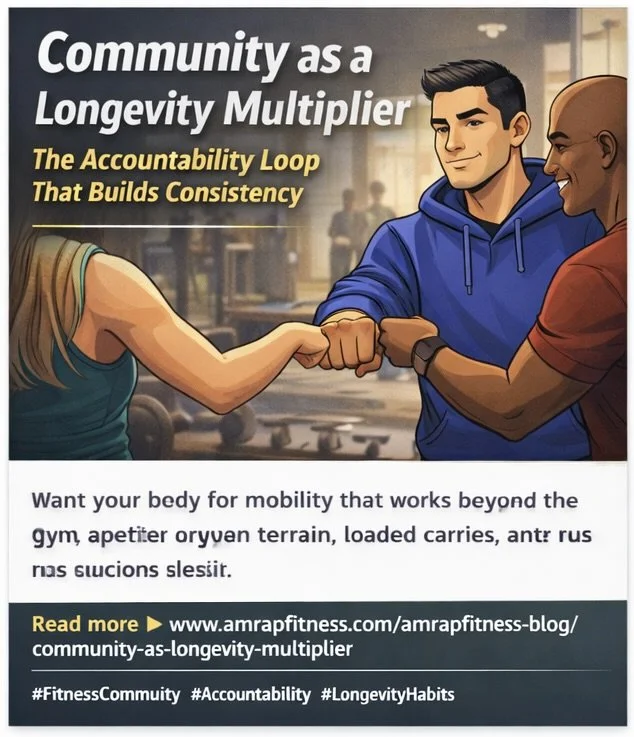
It’s an adherence game.
Most people don’t lose health because they didn’t know what to do.
They lose health because they couldn’t keep doing it when life got heavy.
And the biggest factor that decides whether you keep going isn’t your motivation.
It’s your infrastructure.
This entry is about a longevity lever that almost nobody trains like a skill:
community — not as a “nice extra,” but as your system for staying consistent when stress rises.
Because life doesn’t test your health on calm weeks.
It tests it on chaotic ones.
And when life is chaotic, the person with the best plan doesn’t always win.
The person with the best support structure wins.
Most adults don’t “quit.”
They vanish.
It’s not dramatic. They don’t announce it.
They just stop showing up.
First it’s:
“This week is crazy.”
Then it’s:
“I’ll start Monday.”
Then it’s:
“I’m just tired.”
Then months go by.
And the worst part isn’t the missed workouts.
The worst part is the story that grows inside the silence:
“Maybe I’m not that person anymore.”
That’s how identity erodes.
Not through one big failure.
Through isolation.
Here’s the coaching truth:
Most people don’t fail because they don’t care.
They fail because they have no structure that catches them when they slip.
Community is that structure.
Community is not:
a hype speech
a group selfie
a motivational quote
Community is behavioral infrastructure.
It’s the network that makes healthy behavior easier to repeat.
In longevity terms, community is:
accountability
belonging
identity reinforcement
emotional regulation
resilience during stress
If that sounds “soft,” understand this:
Your nervous system is not separate from your habits.
When you feel alone, stressed, and unseen, you make different decisions.
When you feel supported, anchored, and part of something, you make different decisions.
That is not philosophy.
That’s human biology and human behavior.
The evidence base is strong enough that it’s become a major public health discussion.
A widely cited meta-analytic review found that stronger social relationships are associated with better survival, while social isolation is associated with higher mortality risk.
Later meta-analytic work also supports that loneliness and social isolation are significant risk factors for mortality.
Translation:
Connection isn’t a luxury.
It’s a longevity factor.
Not because friends are magical.
Because social connection affects:
stress physiology
health behaviors
adherence
sleep
inflammation-related pathways
mental health
And the ultimate outcome:
whether you keep showing up.
After 40, many people experience a quiet shift:
fewer close friendships
more responsibilities
less time
more stress
more shame when they slip
And then they try to do health alone.
But the adult world doesn’t reward isolation.
Isolation makes everything harder:
training feels heavier
eating well feels more complicated
sleep slips
stress rises
And then people do what humans do under stress:
They reach for the fastest relief.
Food. Alcohol. Scrolling. Avoidance.
Community doesn’t remove stress.
It changes what you do with stress.
It gives you a place to return to.
I’ve coached long enough to see a pattern:
Two people can have the same training plan.
One stays consistent.
One disappears.
The difference is rarely intelligence.
It’s usually:
support
identity
accountability
belonging
People don’t need more “secrets.”
They need a way to stay connected to the version of themselves they’re trying to become.
Community is that bridge.
This is a simple, professional framework.
Not complicated. Not cute.
Repeatable.
The easier it is to show up, the more you will show up.
Friction looks like:
too many scheduling decisions
too many platforms
too much complexity
Professionals simplify.
They choose:
one time
one place
one channel
People keep habits that match their identity.
When you’re alone, identity becomes negotiable.
When you’re in a community, identity becomes reinforced:
“We train.”
“We show up.”
“We don’t disappear.”
This is why group culture matters.
Not because it’s trendy.
Because it protects behavior during stress.
You don’t need 10 people.
You need a structure.
Minimum viable community is the smallest support loop that reliably improves adherence.
For most adults, MVC is:
one weekly group touchpoint
one accountability partner
one default training time
That’s it.
Choose one:
text
Instagram DM
a coaching app
One.
Because fragmentation kills adherence.
This is the most powerful low-cost lever.
Check-in days: Monday + Thursday
Check-in message:
“Done ✅”
“Not done — doing it tonight at 7.”
That’s it.
No essays.
The goal is behavior, not explanation.
Same days. Same hour. Same plan.
Default reduces decision fatigue.
Default reduces excuses.
Default is professional.
When someone is slipping, they don’t need advice.
They need a bridge back.
Here is the two-message rescue tool.
“Having a rough week. I’m not okay. I need a minimum plan.”
“Today I’ll do: 20-minute walk + protein + water. That counts.”
This prevents shame.
And shame is the silent habit killer.
If your health plan only works on perfect weeks, it’s not a plan.
It’s a fantasy.
So we build a default week that works at 70% life capacity.
2 strength sessions (full-body)
2 Zone 2 sessions (conversational pace)
daily 7–10 minute walks after meals
protein at every meal
Then on good weeks, you can add.
On hard weeks, you keep the identity alive.
That’s longevity.
Group training works because it reduces friction.
You don’t decide.
You show up.
It also increases:
social reinforcement
positive pressure
belonging
And it lowers:
decision fatigue
isolation
shame
A good group doesn’t just make you train.
It makes you feel like a person again.
That matters.
When stress rises, isolation increases.
So we use rules.
If you miss a day, you check in.
Instead of: “I’m failing.”
You say: “My sleep is low and my stress is high. I’m running the minimum plan.”
In high stress, keep one anchor no matter what:
your Monday strength session
your morning walk
your evening wind-down
One anchor keeps identity alive.
Fix: build MVC.
Fix: one channel.
Fix: default schedule.
Fix: two-message rescue.
Fix: join a new circle (online counts).
Answer honestly:
When stress hits, do I isolate?
Would anyone notice if I disappeared for two weeks?
Do I have a default training time and place?
Do I have one accountability partner?
Do I have a minimum plan for bad weeks?
Your answers aren’t judgment.
They’re your next build.
Community doesn’t just keep you consistent.
It keeps you human.
It gives you a place to return to.
And the ability to return is what separates:
“I fell off.”
from
“I got hit — and I came back.”
That’s longevity.
Not perfection.
Return capacity.
Holt-Lunstad J, Smith TB, Layton JB. Social Relationships and Mortality Risk: A Meta-analytic Review. PLOS Medicine. 2010. https://journals.plos.org/plosmedicine/article?id=10.1371/journal.pmed.1000316
Holt-Lunstad J, Smith TB, Baker M, Harris T, Stephenson D. Loneliness and Social Isolation as Risk Factors for Mortality: A Meta-Analytic Review. Perspectives on Psychological Science. 2015. https://pubmed.ncbi.nlm.nih.gov/25910392/
National Academies of Sciences, Engineering, and Medicine. Social Isolation and Loneliness in Older Adults: Opportunities for the Health Care System. 2020. https://nap.nationalacademies.org/catalog/25663/social-isolation-and-loneliness-in-older-adults-opportunities-for-the
Warm up
2 minutes double unders
Dips
Pull ups
GHD sit ups
GHD back ext
OHS
Skill
HSPU
WOD
“Mary”
20 minute AMRAP (partner TAG)
5 HSPU
10 pistols
15 pull ups
Warm up
400m run
Inversion to skin the cat to inverted pike 3 pulls
Candlestick to standup
Work front lever
Skill
Weighted ring dips & L-sits
WOD
Part#1
7 minutes to find you 3 rep max ring dip
Part#2
3 efforts of max effort L-sit