
Community as a Longevity Multiplier: The “Consistency Infrastructure” Most People Ignore
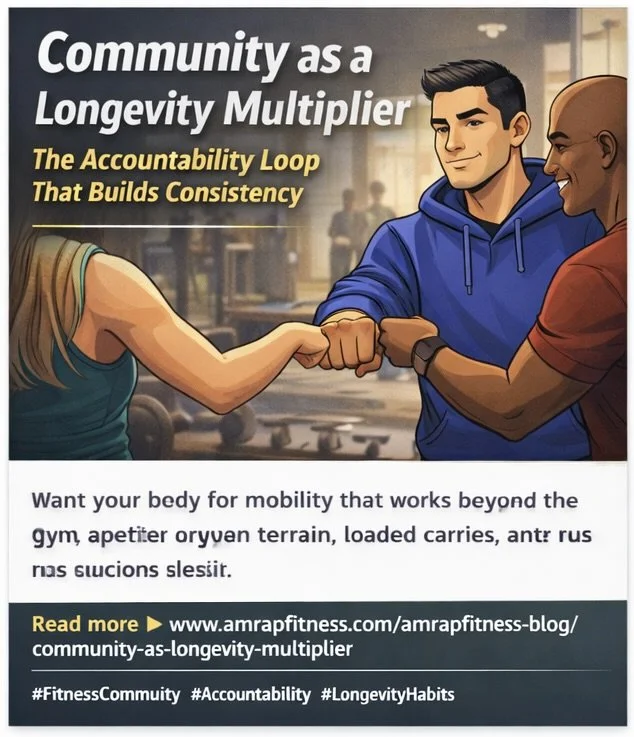
Longevity isn’t only a physiology game.
It’s an adherence game.
Most people don’t lose health because they didn’t know what to do.
They lose health because they couldn’t keep doing it when life got heavy.
And the biggest factor that decides whether you keep going isn’t your motivation.
It’s your infrastructure.
This entry is about a longevity lever that almost nobody trains like a skill:
community — not as a “nice extra,” but as your system for staying consistent when stress rises.
Because life doesn’t test your health on calm weeks.
It tests it on chaotic ones.
And when life is chaotic, the person with the best plan doesn’t always win.
The person with the best support structure wins.
Opening Device: The Quiet Way People Disappear
Most adults don’t “quit.”
They vanish.
It’s not dramatic. They don’t announce it.
They just stop showing up.
First it’s:
“This week is crazy.”
Then it’s:
“I’ll start Monday.”
Then it’s:
“I’m just tired.”
Then months go by.
And the worst part isn’t the missed workouts.
The worst part is the story that grows inside the silence:
“Maybe I’m not that person anymore.”
That’s how identity erodes.
Not through one big failure.
Through isolation.
Here’s the coaching truth:
Most people don’t fail because they don’t care.
They fail because they have no structure that catches them when they slip.
Community is that structure.
What “Community” Really Means in a Longevity Context
Community is not:
a hype speech
a group selfie
a motivational quote
Community is behavioral infrastructure.
It’s the network that makes healthy behavior easier to repeat.
In longevity terms, community is:
accountability
belonging
identity reinforcement
emotional regulation
resilience during stress
If that sounds “soft,” understand this:
Your nervous system is not separate from your habits.
When you feel alone, stressed, and unseen, you make different decisions.
When you feel supported, anchored, and part of something, you make different decisions.
That is not philosophy.
That’s human biology and human behavior.
The Science Signal: Social Connection Predicts Survival
The evidence base is strong enough that it’s become a major public health discussion.
A widely cited meta-analytic review found that stronger social relationships are associated with better survival, while social isolation is associated with higher mortality risk.
Later meta-analytic work also supports that loneliness and social isolation are significant risk factors for mortality.
Translation:
Connection isn’t a luxury.
It’s a longevity factor.
Not because friends are magical.
Because social connection affects:
stress physiology
health behaviors
adherence
sleep
inflammation-related pathways
mental health
And the ultimate outcome:
whether you keep showing up.
Why This Matters After 40
After 40, many people experience a quiet shift:
fewer close friendships
more responsibilities
less time
more stress
more shame when they slip
And then they try to do health alone.
But the adult world doesn’t reward isolation.
Isolation makes everything harder:
training feels heavier
eating well feels more complicated
sleep slips
stress rises
And then people do what humans do under stress:
They reach for the fastest relief.
Food. Alcohol. Scrolling. Avoidance.
Community doesn’t remove stress.
It changes what you do with stress.
It gives you a place to return to.
Coaching Reality: Consistency Has More to Do With People Than Programs
I’ve coached long enough to see a pattern:
Two people can have the same training plan.
One stays consistent.
One disappears.
The difference is rarely intelligence.
It’s usually:
support
identity
accountability
belonging
People don’t need more “secrets.”
They need a way to stay connected to the version of themselves they’re trying to become.
Community is that bridge.
The AMRAP “Consistency Infrastructure” Model
This is a simple, professional framework.
Not complicated. Not cute.
Repeatable.
Principle 1 — Reduce Friction
The easier it is to show up, the more you will show up.
Friction looks like:
too many scheduling decisions
too many platforms
too much complexity
Professionals simplify.
They choose:
one time
one place
one channel
Principle 2 — Build Identity Reinforcement
People keep habits that match their identity.
When you’re alone, identity becomes negotiable.
When you’re in a community, identity becomes reinforced:
“We train.”
“We show up.”
“We don’t disappear.”
This is why group culture matters.
Not because it’s trendy.
Because it protects behavior during stress.
Principle 3 — Use “Minimum Viable Community” (MVC)
You don’t need 10 people.
You need a structure.
Minimum viable community is the smallest support loop that reliably improves adherence.
For most adults, MVC is:
one weekly group touchpoint
one accountability partner
one default training time
That’s it.
Tactical Tool #1: The Minimum Viable Community Plan (MVC)
Step 1 — Pick ONE primary channel
Choose one:
text
WhatsApp
Instagram DM
a coaching app
One.
Because fragmentation kills adherence.
Step 2 — Build a 2-person accountability loop
This is the most powerful low-cost lever.
Check-in days: Monday + Thursday
Check-in message:
“Done ✅”
“Not done — doing it tonight at 7.”
That’s it.
No essays.
The goal is behavior, not explanation.
Step 3 — Create a default training slot
Same days. Same hour. Same plan.
Default reduces decision fatigue.
Default reduces excuses.
Default is professional.
Tactical Tool #2: The “Two-Message Rescue” (When You’re Slipping)
When someone is slipping, they don’t need advice.
They need a bridge back.
Here is the two-message rescue tool.
Message 1 (send to your partner/coach)
“Having a rough week. I’m not okay. I need a minimum plan.”
Message 2 (the minimum plan)
“Today I’ll do: 20-minute walk + protein + water. That counts.”
This prevents shame.
And shame is the silent habit killer.
Tactical Tool #3: The “Default Week” Template
If your health plan only works on perfect weeks, it’s not a plan.
It’s a fantasy.
So we build a default week that works at 70% life capacity.
Default week example
2 strength sessions (full-body)
2 Zone 2 sessions (conversational pace)
daily 7–10 minute walks after meals
protein at every meal
Then on good weeks, you can add.
On hard weeks, you keep the identity alive.
That’s longevity.
Why Group Training Works (Beyond “Motivation”)
Group training works because it reduces friction.
You don’t decide.
You show up.
It also increases:
social reinforcement
positive pressure
belonging
And it lowers:
decision fatigue
isolation
shame
A good group doesn’t just make you train.
It makes you feel like a person again.
That matters.
The Anti-Isolation Rules (For High-Stress Seasons)
When stress rises, isolation increases.
So we use rules.
Rule 1 — No disappearing
If you miss a day, you check in.
Rule 2 — Replace shame with data
Instead of: “I’m failing.”
You say: “My sleep is low and my stress is high. I’m running the minimum plan.”
Rule 3 — Protect one anchor
In high stress, keep one anchor no matter what:
your Monday strength session
your morning walk
your evening wind-down
One anchor keeps identity alive.
Common Mistakes (and the Professional Fix)
Mistake 1: Trying to do it all alone
Fix: build MVC.
Mistake 2: Too many platforms
Fix: one channel.
Mistake 3: Waiting for motivation
Fix: default schedule.
Mistake 4: Shame after slipping
Fix: two-message rescue.
Mistake 5: Social circle doesn’t match goals
Fix: join a new circle (online counts).
Self-Assessment (Reader Tool)
Answer honestly:
When stress hits, do I isolate?
Would anyone notice if I disappeared for two weeks?
Do I have a default training time and place?
Do I have one accountability partner?
Do I have a minimum plan for bad weeks?
Your answers aren’t judgment.
They’re your next build.
Closing: Community Is a Recovery Strategy
Community doesn’t just keep you consistent.
It keeps you human.
It gives you a place to return to.
And the ability to return is what separates:
“I fell off.”
from
“I got hit — and I came back.”
That’s longevity.
Not perfection.
Return capacity.
Resources (English)
Holt-Lunstad J, Smith TB, Layton JB. Social Relationships and Mortality Risk: A Meta-analytic Review. PLOS Medicine. 2010. https://journals.plos.org/plosmedicine/article?id=10.1371/journal.pmed.1000316
Holt-Lunstad J, Smith TB, Baker M, Harris T, Stephenson D. Loneliness and Social Isolation as Risk Factors for Mortality: A Meta-Analytic Review. Perspectives on Psychological Science. 2015. https://pubmed.ncbi.nlm.nih.gov/25910392/
National Academies of Sciences, Engineering, and Medicine. Social Isolation and Loneliness in Older Adults: Opportunities for the Health Care System. 2020. https://nap.nationalacademies.org/catalog/25663/social-isolation-and-loneliness-in-older-adults-opportunities-for-the