Thursday
Warm up
600m run
CTB pull-ups
Strict ring dips to true support
KBS
OHS
Skill
Bar muscle-ups
WOD
Complete the following:
1K row
50 pistols
15 bar muscle-ups


Thursday
Warm up
600m run
CTB pull-ups
Strict ring dips to true support
KBS
OHS
Skill
Bar muscle-ups
WOD
Complete the following:
1K row
50 pistols
15 bar muscle-ups
Wednesday
Warm up
Broad jumps
Plate runs
Pull ups
Dips
OHS
Skill
Transitions
WOD
5 rounds of:
400m run
25 TTB
25 KBS
Tuesday
Warm up
Hang power clean technique
Skill
HSPU
WOD
15-minute AMRAP
HSPU 3-6-9-12-15-18-21-24…
Hang power clean 3-6-9-12-15-18-21-24…
Monday
Warm up & Skill
Pose running drills
-Stationary pulling
-Partner pulling drill
-Partner falling drill
-Follow the hand
-Partner pulling reinforcement
WOD
Part#1
6-minute max distance run
Part#2
4-minute max distance row
Part#3
2-minute max effort double unders
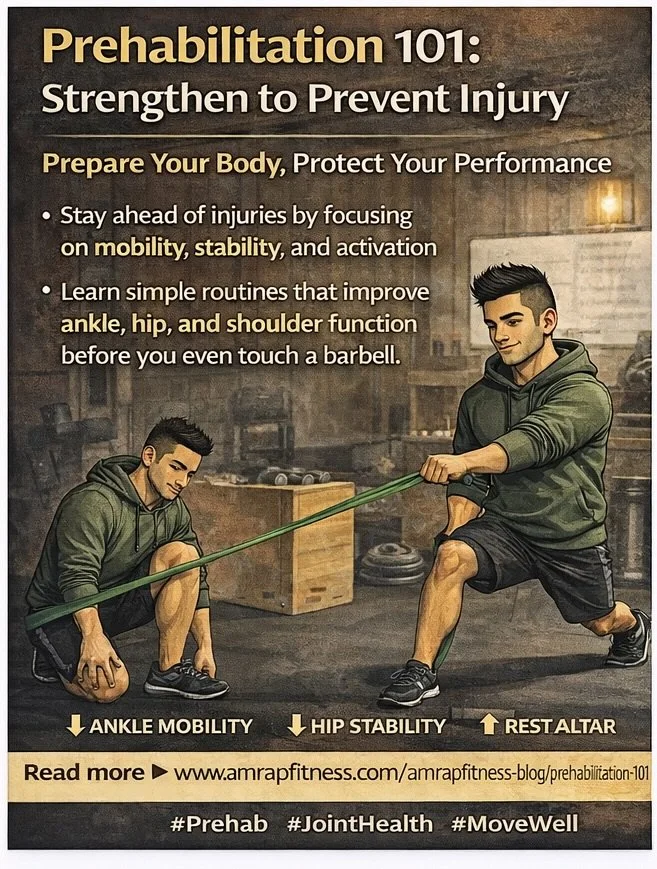
The goal is to build a body that can handle life—and still train tomorrow.
Most adults don’t lose consistency because they “quit.”
They lose consistency because something starts talking:
an achy knee
a cranky shoulder
a low back that tightens up when stress is high
an ankle that feels unstable on uneven ground
And once your body feels unpredictable, you start training with fear.
Fear changes your movement. Fear makes you cautious. Caution becomes avoidance. Avoidance becomes deconditioning.
That’s the real injury spiral.
Prehabilitation is how you interrupt it.
Not with random stretches. Not with gimmicks.
With a repeatable system that:
builds joint capacity
restores control
strengthens end ranges
and keeps your main training safe and productive
This is a pillar intro entry. Later we’ll do deeper posts on:
shoulders (overhead integrity)
knees (patellar tendon + quad capacity)
hips (rotation + stability)
back (bracing + anti-rotation)
ankles/feet (foundation)
But today we build the foundation.
Most injuries don’t start as injuries.
They start as whispers.
A little irritation during warm-up. A tightness that shows up after sitting. A pinch when you reach. A knee that feels “hot” after conditioning.
And the adult brain does what it always does:
“I’ll just push through.”
Sometimes that works.
But many times, that whisper becomes a pattern.
Then a limitation.
Then a full stop.
The problem is not that you’re weak.
The problem is that your training only has one gear:
work harder.
Prehabilitation adds the missing gears:
prepare, reinforce, restore.
Prehab is proactive capacity-building.
It’s not rehab.
Rehab is what you do after you’re hurt.
Prehab is what you do so you don’t get hurt—or so the small whispers don’t become seasons.
A professional definition:
Prehab = targeted strength + control + tissue tolerance work that supports your main training and reduces injury risk.
It’s the “maintenance program” that keeps you trainable.
After 40, the margin for error shrinks.
Not because you’re fragile.
Because:
recovery windows are tighter
stress load is higher
sleep is sometimes inconsistent
old injuries exist
joint tissues don’t love sudden spikes
So the question becomes:
Can I train hard enough to progress without creating flare-ups?
Prehab helps you do exactly that.
It makes your training feel safer.
And when training feels safer, you do it more.
Consistency wins.
No single protocol guarantees you’ll never get injured.
But the evidence is clear on a few important themes:
Resistance training improves tissue capacity, function, and resilience across populations.
Many overuse problems come from training load that increases too fast (volume/intensity/frequency spikes) relative to the tissue’s current tolerance.
In sport and training contexts, injury prevention tends to work best when it includes multiple elements (strength, neuromuscular control, load management, and movement skill).
Coaching translation: Prehab isn’t one exercise. It’s a system built on:
capacity
control
and smart load progression
A prehab program fails when it’s complicated.
A prehab program wins when it is:
short
specific
repeatable
and attached to your training schedule
We’re going to run prehab in three layers.
This is what you do even on busy days.
This is what you do before training.
This is where tissues actually adapt.
Pick 3 movements and rotate them.
Calf raise slow: 1 x 15
Tibialis raise: 1 x 15
90/90 hip switches: 1 x 8/side
Open books (T-spine): 1 x 6/side
Band pull-aparts: 1 x 20
Scap push-ups: 1 x 10
Dead bug: 1 x 8/side
Rule: This should feel like joint hygiene, not a workout.
This is the “insurance policy” before you load.
Foot/ankle wake-up
single-leg balance: 20–30 sec/side
Hip control
split squat iso hold (light): 20–30 sec/side
Trunk brace
Pallof press: 8–10/side
Shoulder positioning
band face pulls: 12–15
Professional rule: If you can’t control the pattern unloaded, don’t load it heavy.
This is where prehab becomes adaptation.
Run 2–3 rounds.
1) Backward sled drag (or backward walk) — 30–60 sec
knee-friendly quad capacity
2) Suitcase carry — 30–45 sec/side
trunk stiffness + spine protection
3) Step-downs — 6–8/side
knee/hip control
4) Band external rotation — 12–15/side
shoulder integrity
5) Hip airplane (supported) — 4–6/side
hip stability + rotational control
Finish: 5 minutes easy walk.
If you’re not sure where to start, start here:
If the foot can’t adapt, everything above pays.
If hips are unstable, knees and back get angry.
If shoulder control is missing, pressing becomes risky.
Prehab is simply giving these areas what they need:
strength
control
tolerance
The most powerful injury-prevention tool is not a band exercise.
It’s a smart training plan.
Two professional rules:
Don’t spike load. Increase only one variable at a time (load, reps, sets, frequency).
Deload before you’re forced to. Every 4–8 weeks, reduce volume 30–50%.
Prehab without load management is like flossing while eating candy all day.
Good, but incomplete.
Prehab is not ignoring pain.
Modify if:
pain changes your movement
pain increases across the session
pain lingers and escalates week to week
A professional doesn’t prove toughness.
A professional protects consistency.
Fix: strength + control + end-range work.
Fix: prehab is weekly maintenance.
Fix: prehab supports training; it doesn’t replace it.
Fix: daily minimum + warm-up block + weekly capacity session.
Answer honestly:
Do small aches become big problems for me?
Do I feel stable stepping down off curbs/stairs?
Do my shoulders feel secure overhead?
Does my back tighten when I carry or rotate?
Do I have a weekly plan that builds capacity—or do I wait for pain?
Your answers aren’t judgment.
They’re direction.
The best athletes in the world do prehab.
Not because they’re fragile.
Because they understand something most adults learn the hard way:
Longevity requires maintenance.
Prehab is the maintenance.
It’s how you protect the body that carries your life.
Gabbett TJ. The training—injury prevention paradox: should athletes be training smarter and harder? Br J Sports Med. 2016. https://pubmed.ncbi.nlm.nih.gov/26758673/
Behm DG, et al. Resistance training and health outcomes across lifespan (review). 2017. https://pubmed.ncbi.nlm.nih.gov/28959731/
Lauersen JB, et al. The effectiveness of exercise interventions to prevent sports injuries: systematic review and meta-analysis. 2014. https://pubmed.ncbi.nlm.nih.gov/24100287/