Warm up
KB around the world
KB Russian swing
H2H swing
American swing
Release
Wall ball sub
Skill
KB wall ball sub
WOD
5 rounds of:
15 jump lunges
15 KB wall ball sub
Run 200m
Rest 3 minutes

Warm up
KB around the world
KB Russian swing
H2H swing
American swing
Release
Wall ball sub
Skill
KB wall ball sub
WOD
5 rounds of:
15 jump lunges
15 KB wall ball sub
Run 200m
Rest 3 minutes
Tuesday
Warm up & Skill
Power clean technique
WOD
EMOTM for 15 minutes
3 power cleans
4 burpees over the bar
Warm up
Net climbs
Planche push ups
Work the front lever
Hollow rocks
GHD back ext
Skill
Muscle ups
WOD
7 rounds of:
30 seconds work followed by 1 minute of rest
-Muscle-ups
-box jumps
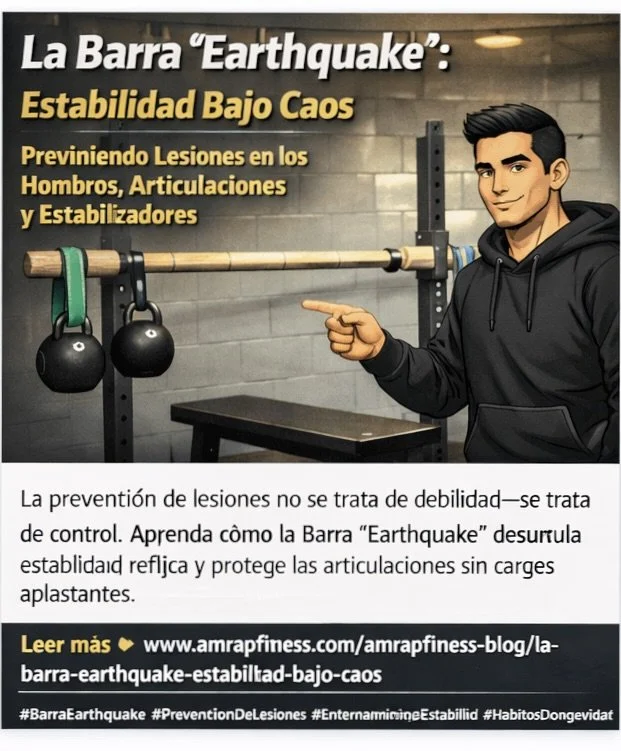
(Serie AMRAP de Longevidad — Entrada Pilar “Introducción” #1)
Es mantenerte entrenable.
La meta no es vivir de PRs. La meta es tener:
articulaciones fuertes
posiciones estables
y un sistema nervioso capaz de seguir apareciendo
Porque lo que más rompe la consistencia no es falta de ganas.
Es una molestia. Un “tirón.” Un hombro inseguro. Una espalda que se tensa.
Y cuando el cuerpo se siente impredecible, se muere la constancia.
Por eso hoy presento una de mis herramientas favoritas para construir estabilidad que se transfiere:
la Earthquake Bar.
No como truco. No como circo.
Como método profesional para entrenar:
bracing reflejo
integridad de hombro
rigidez del tronco en movimiento
fuerza “amigable” para las articulaciones
Esta es una entrada pilar de introducción. Luego haremos profundizaciones: press, squat, carries y programación. Primero, base.
Mucha gente cree que la estabilidad es algo que “tienes o no tienes.”
Pero es una habilidad.
La notas cuando falta:
sacas la barra y el hombro “busca” posición
presionas y un lado tiembla
haces squat y el tronco se mueve lo suficiente para que la espalda se sienta expuesta
cargas y se abren las costillas y se tensa el cuello
Nada dramático.
Solo lo suficiente para decirte:
“Si entreno así, algo se va a quejar.”
La Earthquake Bar entrena la capa que a muchos adultos les falta:
estabilidad ante pequeñas perturbaciones.
Porque la vida real es perturbación:
alguien te empuja
el piso es irregular
la carga es incómoda
estás cansado
giras
te mueves rápido
La longevidad se prepara para eso.
La Earthquake Bar forma parte del sistema BandBell “Bamboo/Earthquake”, diseñado alrededor del concepto de Oscillating Kinetic Energy (OKE) — la idea de que una carga oscilante/inestable crea una demanda de estabilización diferente a una barra rígida. (roguefitness.com)
Lo clave es simple:
la barra es ligera
la carga suele colgarse con bandas/suspensión para que oscile
pequeños errores se amplifican
Entonces tu cuerpo debe resolverlo con:
mejor posición del hombro
más rigidez del tronco
bracing reflejo
trayectoria más limpia
No se trata de levantar más.
Se trata de levantar mejor.
Muchas lesiones en adultos entrenados no vienen de un evento dramático.
Vienen de pequeñas pérdidas de posición repetidas bajo fatiga.
hombro que se va hacia adelante
costillas que se abren
tronco que colapsa
La Earthquake Bar crea un entorno controlado donde practicas:
“Mantenerme organizado cuando la carga intenta sacarme de posición.”
Eso es prevención que se transfiere.
Aclaración profesional:
La Earthquake Bar es un implemento específico.
La investigación suele hablar de cargas inestables, dispositivos oscilantes y principios de entrenamiento con inestabilidad.
Eso sigue siendo relevante.
Un estudio del bench press con una configuración de carga inestable reportó mayor activación de musculatura estabilizadora comparado con una condición estable. (pubmed.ncbi.nlm.nih.gov)
Una revisión sobre entrenamiento con inestabilidad señala mayor activación del tronco, y que el rendimiento máximo puede reducirse comparado con superficies/condiciones estables. (pmc.ncbi.nlm.nih.gov)
Estudios con flexi-bar/flexible-bar han evaluado activación de estabilizadores del hombro y cambios agudos en función/propriocepción. (pmc.ncbi.nlm.nih.gov)
Conclusión de coaching: La Earthquake Bar no reemplaza fuerza pesada. Es una herramienta para construir el “pegamento” que hace la fuerza más segura.
Estabilidad es habilidad.
Buscamos rigidez sin tensión (cuello relajado).
Menos carga, más calidad.
Úsala donde la gente se rompe: press, bracing, carries.
Empieza más ligero de lo que crees.
No persigas dolor.
Para antes de perder control.
Progresa lento.
Apilar costillas sobre pelvis (exhala suave)
Intención de “separar la barra” (lats activos)
Movimiento suave (sin ego)
Si la barra tiembla demasiado:
estás muy pesado
o vas muy rápido
Queremos oscilación controlada.
floor press: 3 x 6–8
front hold squat: 3 x 5–6
farmer carry: 3–4 x 20–30 s
press ligero: 4 x 5
front squat hold: 4 x 3–5
suitcase carry: 4 x 20–30 s/lado
overhead hold: 3–5 x 10–20 s
waves de 3 reps limpias
complejos de carries
Regla: es condimento, no el plato.
como primer (5–8 min)
como accesorio (12–18 min)
como día de deload / articulaciones
Ideal para:
adultos que se sienten inestables
regreso de molestias
atletas que necesitan bracing y hombro sólido
No es el primer paso para:
lesión aguda sin alta médica
dolor no controlado
personas que no dominan posiciones básicas con carga estable
2x/semana por 4 semanas
Floor press — 3 x 6
Front hold squat (ligero) — 3 x 5
Suitcase carry — 4 x 20 s/lado
Reglas:
para 2 reps antes de perder forma
tempo suave
si el temblor se vuelve caos, baja carga
¿El hombro “busca” posición al presionar?
¿Pierdo costillas (flare) bajo carga?
¿Mi tronco se mueve cuando me canso?
¿Puedo cargar unilateral sin inclinarme?
¿Después del warm-up me siento más estable o más tenso?
No es juicio. Es mapa.
La meta no es vivir en inestabilidad.
La meta es construir reserva de estabilidad para que:
la fuerza pesada sea más segura
la vida real se sienta más fácil
tus articulaciones dejen de sentirse como un riesgo
Usada bien, la Earthquake Bar enseña:
“Cuando todo tiembla, yo me organizo.”
Eso es longevidad.
Descripción del sistema BandBell/Earthquake y el concepto de Oscillating Kinetic Energy (OKE). (roguefitness.com)
Ostrowski SJ, et al. Efecto de una carga inestable en musculatura primaria y estabilizadora durante el press de banca. 2017. (pubmed.ncbi.nlm.nih.gov)
Behm DG, et al. Entrenamiento de resistencia con inestabilidad a lo largo del continuo del ejercicio (revisión). 2013. (pmc.ncbi.nlm.nih.gov)
Chung SH, et al. Comparación de activación de músculos estabilizadores del hombro durante ejercicios con flexi-bar. 2015. (pmc.ncbi.nlm.nih.gov)
de Lima Boarati E, et al. Efecto agudo del ejercicio con barra flexible en músculos escapulotorácicos, propiocepción y fatiga. 2020. (pubmed.ncbi.nlm.nih.gov)
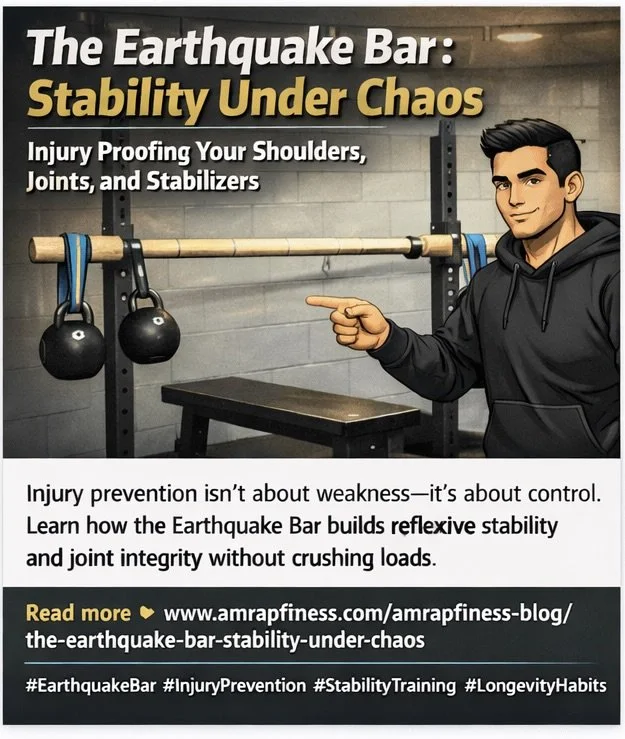
It’s about staying trainable.
The goal isn’t “PRs forever.” The goal is strong joints, stable positions, and a nervous system that can keep showing up.
Because the most common way adults lose momentum isn’t a lack of desire.
It’s a tweak. A flare-up. A shoulder that feels sketchy. A spine that tightens up. A knee that complains.
And once the body starts feeling unpredictable, consistency dies.
That’s why I’m introducing one of my favorite tools for building stability that transfers:
The Earthquake Bar.
Not as a gimmick. Not as a circus act.
As a professional method for training:
reflexive bracing
shoulder integrity
trunk stiffness under movement
joint-friendly strength exposure
This is the pillar “intro” entry. Down the road, we’ll do deep dives on pressing, squatting, carries, and programming. But first, we build the foundation.
A lot of people think stability is something you either have… or you don’t.
But stability is a skill.
You notice it when it’s missing:
You unrack a bar, and your shoulders feel like they’re “searching” for position.
You press, and one side shakes.
You squat, and your trunk shifts just enough to make your low back feel exposed.
You do a carry, and your ribs flare and your neck tightens.
Nothing catastrophic.
Just enough to tell you:
“If I keep training like this, something is going to complain.”
The Earthquake Bar trains the exact layer most adults are missing:
stability under small disturbances.
Because real life is disturbance.
A kid bumps into you. A step is uneven. A load is awkward. You’re tired. You rotate. You move fast.
Longevity training prepares you for that.
The Earthquake Bar is part of the BandBell “Bamboo/Earthquake” bar system designed around Oscillating Kinetic Energy (OKE) — the idea that an oscillating/unstable load creates a different stabilization demand than a rigid barbell. (roguefitness.com)
Mechanically, the “magic” is simple:
the bar itself is light
load is typically hung with bands or suspended so it can oscillate
small movement errors get amplified
So your body must solve the problem by creating:
better shoulder positioning
better trunk stiffness
better reflexive bracing
smoother bar path
This is not about lifting heavier.
It’s about lifting smarter.
Most injuries in trained adults aren’t from one dramatic event.
They’re from repeated small losses of position under fatigue.
A shoulder that drifts forward. A rib cage that flares. A trunk that collapses. A knee that caves.
The Earthquake Bar creates a controlled environment where you practice:
“Stay organized when the load tries to pull you out of position.”
That’s injury prevention that transfers.
Because life does the same thing.
Let’s be clear and professional:
The Earthquake Bar itself is a specific implement.
Most peer-reviewed research talks about unstable loads, oscillating devices, and instability training principles.
That’s still highly relevant to why this tool works.
A bench press study examining an “unstable load” setup found increased activation of stabilizing musculature compared to a typical stable bar setup. (pubmed.ncbi.nlm.nih.gov)
Translation: If the load is less stable, your body recruits more stabilization to control it.
A well-cited review on instability resistance training notes that unstable conditions tend to increase trunk activation, while maximal strength/power expression may be lower compared to stable conditions. (pmc.ncbi.nlm.nih.gov)
Translation: Instability tools are not for maximal strength PRs. They’re for improving control and stability.
Research on flexi-bar/flexible-bar oscillation exercises has examined shoulder stabilization muscle activity. (pmc.ncbi.nlm.nih.gov)
Translation: Oscillatory demands can meaningfully stimulate shoulder stabilizers.
Coaching conclusion: The Earthquake Bar isn’t a replacement for heavy strength training. It’s a strategic tool for building the “glue” that makes heavy training safer.
This is how pros use it:
You don’t “try to be stable.” You train stability with constraints.
We want organized bracing. Not a clenched neck. Not breath-holding panic.
If the bar is shaking and your rib cage is flaring, you’re already too heavy.
Earthquake Bar shines for:
pressing patterns
overhead stability exposures
squat pattern bracing
carries
warm-up potentiation (low doses)
Start lighter than you think. If it looks easy, that’s the point. Quality first.
No pain chasing. This is joint integrity work. Pain is not the metric.
Stop sets before you get sloppy. We’re training clean reps under disturbance. Not fatigue failure.
Use bands/suspension correctly. If you set it up in a way that makes the load dangerously unpredictable, you missed the point.
Progress slowly. Instability is already intensity. Don’t stack instability + maximal fatigue.
exhale softly to bring ribs down
keep sternum from flaring
pull the bar apart lightly (intent)
feel lats engage
smooth tempo
controlled touchpoints
too much load
too fast tempo
too much ego
We want controlled oscillation, not chaos.
We’re going to progress one variable at a time.
Goal: learn control.
Earthquake Bar floor press: 3 x 6–8 (easy)
Earthquake Bar goblet squat (or front hold): 3 x 5–6 (easy)
Farmer carry (light): 3–4 x 20–30 sec
Frequency: 1–2x/week
Goal: bring it into your main patterns.
Bench press variation (light): 4 x 5
Front squat hold (short sets): 4 x 3–5
Suitcase carry: 4 x 20–30 sec/side
Frequency: 1–2x/week
Goal: stability reserve.
Overhead hold (light, crisp): 3–5 sets of 10–20 sec
Pressing wave: 6–8 sets of 3 (very clean)
Carry complexes: farmer → suitcase → front carry
Frequency: 1x/week (or as warm-up micro-dose)
Rule: The Earthquake Bar is a spice, not the whole meal.
Use it before heavy pressing or squatting. Low dose. High quality.
Example:
2 x 8 floor press
2 x 20 sec carry
Use it after your main strength lift.
Example:
4 x 5 Earthquake Bar press
4 x 20–30 sec suitcase carry
Great for deload weeks.
adults who feel “unstable” under load
people returning from shoulder/back flare-ups
athletes who need trunk stiffness and shoulder integrity
lifters who want joint-friendly strength exposure
acute injury (get cleared)
uncontrolled pain
people who can’t yet maintain basic positions under stable load
We earn instability.
2x/week for 4 weeks
Earthquake Bar floor press — 3 x 6 (easy)
Earthquake Bar front hold squat (light) — 3 x 5
Suitcase carry — 4 x 20 sec/side
Rules:
stop 2 reps before form breaks
keep tempo smooth
if shaking gets wild, reduce load
Answer honestly:
Do my shoulders feel “searchy” when I press?
Do I lose rib position under load (flare/arch)?
Does my trunk shift when I get tired?
Can I stabilize one-sided loads (suitcase carry) without leaning?
Do I feel more stable after warm-ups — or more tense?
Your answers aren’t judgment. They’re the roadmap.
The goal isn’t to live in instability.
The goal is to build stability reserve so that:
heavy training feels safer
real life feels easier
your joints stop feeling like a liability
The Earthquake Bar is a tool.
Used correctly, it teaches your body:
“When the world gets shaky, I stay organized.”
That’s longevity.
BandBell / Rogue product overview describing the Earthquake/Bamboo bars and Oscillating Kinetic Energy (OKE). (roguefitness.com)
Ostrowski SJ, et al. Effect of an Unstable Load on Primary and Stabilizing Musculature During the Bench Press. J Strength Cond Res. 2017. (pubmed.ncbi.nlm.nih.gov)
Behm DG, et al. Instability Resistance Training Across the Exercise Continuum. 2013 (review). (pmc.ncbi.nlm.nih.gov)
Chung SH, et al. Comparisons of shoulder stabilization muscle activities during flexi-bar exercise (study). 2015. (pmc.ncbi.nlm.nih.gov)
de Lima Boarati E, et al. Acute effect of flexible bar exercise on scapulothoracic muscle activity, proprioception, and fatigue. 2020. (pubmed.ncbi.nlm.nih.gov)