
The Earthquake Bar: Stability Under Chaos (Injury Prevention That Actually Transfers)
(AMRAP Longevity Series — Pillar Intro #1)
Longevity isn’t just about getting stronger.
It’s about staying trainable.
The goal isn’t “PRs forever.” The goal is strong joints, stable positions, and a nervous system that can keep showing up.
Because the most common way adults lose momentum isn’t a lack of desire.
It’s a tweak. A flare-up. A shoulder that feels sketchy. A spine that tightens up. A knee that complains.
And once the body starts feeling unpredictable, consistency dies.
That’s why I’m introducing one of my favorite tools for building stability that transfers:
The Earthquake Bar.
Not as a gimmick. Not as a circus act.
As a professional method for training:
reflexive bracing
shoulder integrity
trunk stiffness under movement
joint-friendly strength exposure
This is the pillar “intro” entry. Down the road, we’ll do deep dives on pressing, squatting, carries, and programming. But first, we build the foundation.
Opening Device: The Moment You Realize “Stable” Isn’t Automatic
A lot of people think stability is something you either have… or you don’t.
But stability is a skill.
You notice it when it’s missing:
You unrack a bar, and your shoulders feel like they’re “searching” for position.
You press, and one side shakes.
You squat, and your trunk shifts just enough to make your low back feel exposed.
You do a carry, and your ribs flare and your neck tightens.
Nothing catastrophic.
Just enough to tell you:
“If I keep training like this, something is going to complain.”
The Earthquake Bar trains the exact layer most adults are missing:
stability under small disturbances.
Because real life is disturbance.
A kid bumps into you. A step is uneven. A load is awkward. You’re tired. You rotate. You move fast.
Longevity training prepares you for that.
What the Earthquake Bar Is (and Why It’s Different)
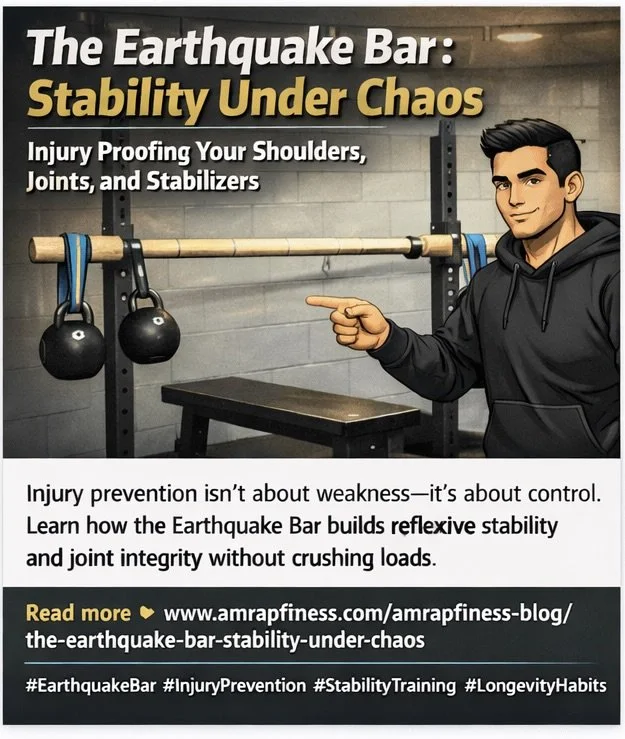
The Earthquake Bar is part of the BandBell “Bamboo/Earthquake” bar system designed around Oscillating Kinetic Energy (OKE) — the idea that an oscillating/unstable load creates a different stabilization demand than a rigid barbell. (roguefitness.com)
Mechanically, the “magic” is simple:
the bar itself is light
load is typically hung with bands or suspended so it can oscillate
small movement errors get amplified
So your body must solve the problem by creating:
better shoulder positioning
better trunk stiffness
better reflexive bracing
smoother bar path
This is not about lifting heavier.
It’s about lifting smarter.
Why This Matters for Injury Prevention
Most injuries in trained adults aren’t from one dramatic event.
They’re from repeated small losses of position under fatigue.
A shoulder that drifts forward. A rib cage that flares. A trunk that collapses. A knee that caves.
The Earthquake Bar creates a controlled environment where you practice:
“Stay organized when the load tries to pull you out of position.”
That’s injury prevention that transfers.
Because life does the same thing.
The Science Signal (What Evidence Supports the Concept)
Let’s be clear and professional:
The Earthquake Bar itself is a specific implement.
Most peer-reviewed research talks about unstable loads, oscillating devices, and instability training principles.
That’s still highly relevant to why this tool works.
1) Unstable loads can increase stabilizer activation
A bench press study examining an “unstable load” setup found increased activation of stabilizing musculature compared to a typical stable bar setup. (pubmed.ncbi.nlm.nih.gov)
Translation: If the load is less stable, your body recruits more stabilization to control it.
2) Instability training increases core demand, but usually reduces max force
A well-cited review on instability resistance training notes that unstable conditions tend to increase trunk activation, while maximal strength/power expression may be lower compared to stable conditions. (pmc.ncbi.nlm.nih.gov)
Translation: Instability tools are not for maximal strength PRs. They’re for improving control and stability.
3) Oscillating/vibration-style shoulder tools show meaningful shoulder stabilization activation
Research on flexi-bar/flexible-bar oscillation exercises has examined shoulder stabilization muscle activity. (pmc.ncbi.nlm.nih.gov)
Translation: Oscillatory demands can meaningfully stimulate shoulder stabilizers.
Coaching conclusion: The Earthquake Bar isn’t a replacement for heavy strength training. It’s a strategic tool for building the “glue” that makes heavy training safer.
The Earthquake Bar Philosophy
This is how pros use it:
Principle 1 — Stability is a skill, not a vibe
You don’t “try to be stable.” You train stability with constraints.
Principle 2 — The goal is stiffness without strain
We want organized bracing. Not a clenched neck. Not breath-holding panic.
Principle 3 — Lower load, higher quality
If the bar is shaking and your rib cage is flaring, you’re already too heavy.
Principle 4 — Use it where people break
Earthquake Bar shines for:
pressing patterns
overhead stability exposures
squat pattern bracing
carries
warm-up potentiation (low doses)
Safety Rules (Non-Negotiables)
Start lighter than you think. If it looks easy, that’s the point. Quality first.
No pain chasing. This is joint integrity work. Pain is not the metric.
Stop sets before you get sloppy. We’re training clean reps under disturbance. Not fatigue failure.
Use bands/suspension correctly. If you set it up in a way that makes the load dangerously unpredictable, you missed the point.
Progress slowly. Instability is already intensity. Don’t stack instability + maximal fatigue.
Coaching Cues (How to Make It Work)
The “Stack” cue (ribs over pelvis)
exhale softly to bring ribs down
keep sternum from flaring
The “screw” cue (shoulder stability)
pull the bar apart lightly (intent)
feel lats engage
The “quiet” cue (reduce chaos)
smooth tempo
controlled touchpoints
If the bar is shaking violently, that’s usually a sign of:
too much load
too fast tempo
too much ego
We want controlled oscillation, not chaos.
The Earthquake Bar Progression Ladder
We’re going to progress one variable at a time.
Level 1 — Introduction (2–3 weeks)
Goal: learn control.
Earthquake Bar floor press: 3 x 6–8 (easy)
Earthquake Bar goblet squat (or front hold): 3 x 5–6 (easy)
Farmer carry (light): 3–4 x 20–30 sec
Frequency: 1–2x/week
Level 2 — Integration (3–6 weeks)
Goal: bring it into your main patterns.
Bench press variation (light): 4 x 5
Front squat hold (short sets): 4 x 3–5
Suitcase carry: 4 x 20–30 sec/side
Frequency: 1–2x/week
Level 3 — Performance (ongoing)
Goal: stability reserve.
Overhead hold (light, crisp): 3–5 sets of 10–20 sec
Pressing wave: 6–8 sets of 3 (very clean)
Carry complexes: farmer → suitcase → front carry
Frequency: 1x/week (or as warm-up micro-dose)
Rule: The Earthquake Bar is a spice, not the whole meal.
Where It Fits in a Weekly Plan
Option A — Warm-up primer (5–8 minutes)
Use it before heavy pressing or squatting. Low dose. High quality.
Example:
2 x 8 floor press
2 x 20 sec carry
Option B — Dedicated accessory block (12–18 minutes)
Use it after your main strength lift.
Example:
4 x 5 Earthquake Bar press
4 x 20–30 sec suitcase carry
Option C — Joint-friendly strength day (standalone)
Great for deload weeks.
Who This Is For (and Who It’s Not For)
Great fit:
adults who feel “unstable” under load
people returning from shoulder/back flare-ups
athletes who need trunk stiffness and shoulder integrity
lifters who want joint-friendly strength exposure
Not the first step:
acute injury (get cleared)
uncontrolled pain
people who can’t yet maintain basic positions under stable load
We earn instability.
The Earthquake Bar Starter Protocol
2x/week for 4 weeks
Earthquake Bar floor press — 3 x 6 (easy)
Earthquake Bar front hold squat (light) — 3 x 5
Suitcase carry — 4 x 20 sec/side
Rules:
stop 2 reps before form breaks
keep tempo smooth
if shaking gets wild, reduce load
Self-Assessment
Answer honestly:
Do my shoulders feel “searchy” when I press?
Do I lose rib position under load (flare/arch)?
Does my trunk shift when I get tired?
Can I stabilize one-sided loads (suitcase carry) without leaning?
Do I feel more stable after warm-ups — or more tense?
Your answers aren’t judgment. They’re the roadmap.
Closing: Train the Skill That Keeps You Training
The goal isn’t to live in instability.
The goal is to build stability reserve so that:
heavy training feels safer
real life feels easier
your joints stop feeling like a liability
The Earthquake Bar is a tool.
Used correctly, it teaches your body:
“When the world gets shaky, I stay organized.”
That’s longevity.
Resources (English)
BandBell / Rogue product overview describing the Earthquake/Bamboo bars and Oscillating Kinetic Energy (OKE). (roguefitness.com)
Ostrowski SJ, et al. Effect of an Unstable Load on Primary and Stabilizing Musculature During the Bench Press. J Strength Cond Res. 2017. (pubmed.ncbi.nlm.nih.gov)
Behm DG, et al. Instability Resistance Training Across the Exercise Continuum. 2013 (review). (pmc.ncbi.nlm.nih.gov)
Chung SH, et al. Comparisons of shoulder stabilization muscle activities during flexi-bar exercise (study). 2015. (pmc.ncbi.nlm.nih.gov)
de Lima Boarati E, et al. Acute effect of flexible bar exercise on scapulothoracic muscle activity, proprioception, and fatigue. 2020. (pubmed.ncbi.nlm.nih.gov)