Warm up
2 minutes double unders
Wall climbs
Strict pull-ups
OH lunges
TTR
GHD back ext
Skill
Shoulder to overhead
WOD
100 double unders
75 weighted push-ups W/25 M/45
50 shoulder to overhead W/95 M/135

Warm up
2 minutes double unders
Wall climbs
Strict pull-ups
OH lunges
TTR
GHD back ext
Skill
Shoulder to overhead
WOD
100 double unders
75 weighted push-ups W/25 M/45
50 shoulder to overhead W/95 M/135
Warm up
Farmers walk
KBS
Wall ball shots
Seal walk
Skill
HSPU & Deadlifts
WOD
5 rounds of:
7 HSPU
2 Deadlifts
Official CF warm up
Sampson stretch
OHS
Dips
Pull ups
GHD sit ups
GHD back ext
Skill
DB burpees
WOD
12 minute AMRAP
7 DB burpees
10 yard plate push
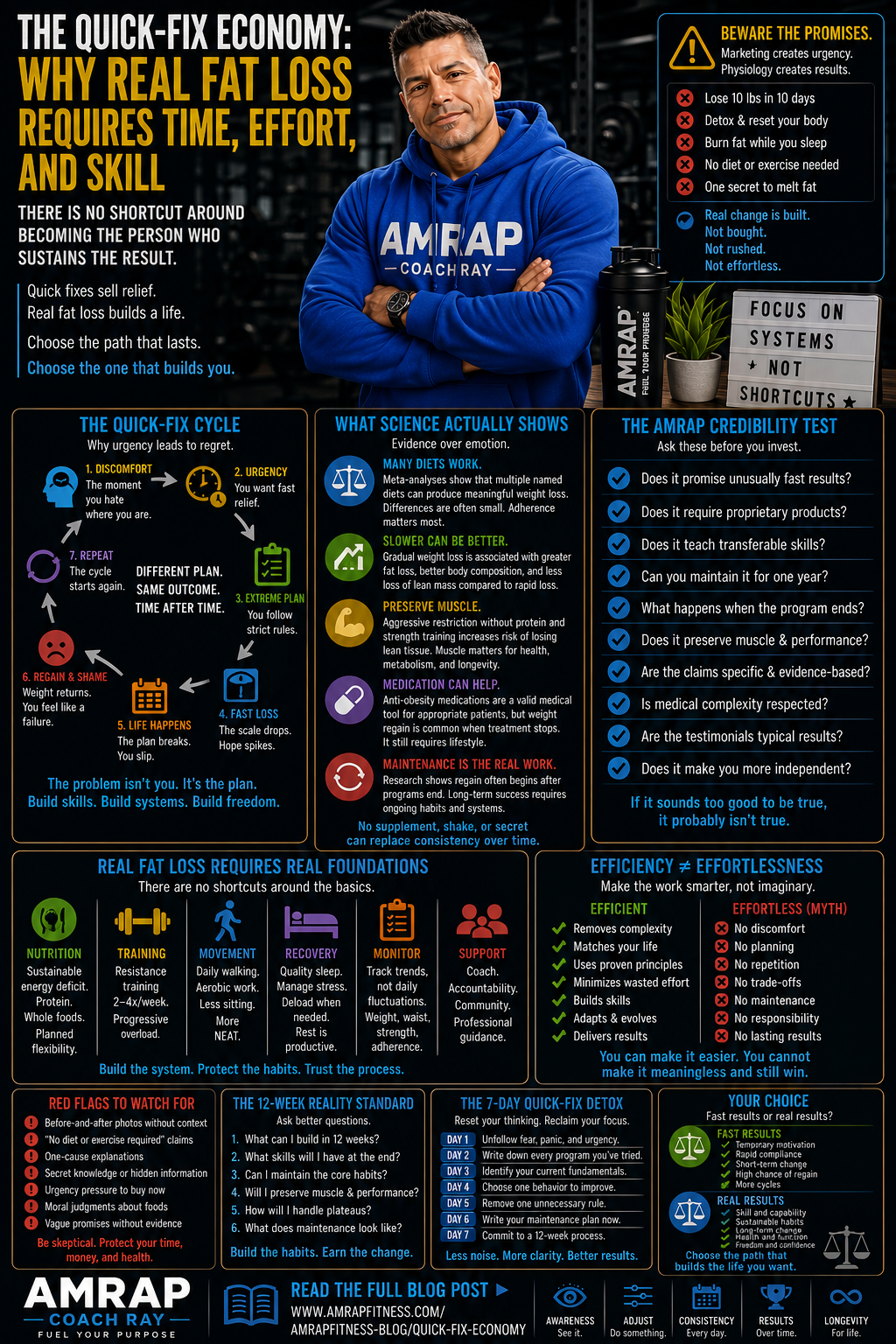
AMRAP Real-Life Fat-Loss Series — Entry 5 of 6
It is usually selling relief from the work.
That is why it is so powerful.
People do not usually buy extreme diets, detoxes, miracle supplements, or 21-day transformations because they are foolish.
They buy them because they are tired.
Tired of:
feeling uncomfortable in their body
starting over
watching the scale move slowly
trying to understand conflicting advice
feeling behind
comparing themselves with people online
working hard without seeing immediate change
Then someone offers an easier answer:
lose weight without changing your life
burn fat while you sleep
reset your metabolism
drop ten pounds in ten days
use one product instead of building habits
follow one extreme challenge and finally be finished
The message is seductive because it removes the hardest part:
time.
It also removes:
uncertainty
patience
repetition
skill-building
responsibility
At least temporarily.
But the body does not care about marketing.
It responds to:
energy balance
nutrition quality
resistance training
movement
sleep
recovery
medication when appropriate
consistency over time
There are more efficient ways to make progress.
There are smarter ways.
There are medically supervised treatments that can help appropriate patients.
But there is no credible system in which permanent results require no effort, no behavioral change, no follow-through, and no maintenance.
That is not negativity.
That is physiology.
It usually appears when you are most vulnerable.
Maybe you just saw a photo of yourself you did not like.
Maybe your clothes feel tighter.
Maybe the scale increased.
Maybe your doctor expressed concern.
Maybe you have been trying for months and feel frustrated.
Then the advertisement appears:
“Transform your body in 14 days.”
The before-and-after images are dramatic.
The testimonials sound certain.
The rules are simple.
Buy this.
Eliminate that.
Follow the plan exactly.
The promise creates a rush of hope.
You think:
“This could finally be it.”
So you begin.
For several days, you are intensely focused.
You eat very little.
You remove entire food groups.
You sweat more.
You drink the product.
You follow the challenge.
The scale drops quickly.
You feel successful.
Then life returns.
Work becomes busy.
Hunger increases.
Energy declines.
The plan becomes harder to follow.
Eventually, you eat something outside the rules.
Then another thing.
Soon the program is over.
The weight begins returning.
And the most damaging part is not the regain.
It is the conclusion you draw:
“I failed again.”
But perhaps you did not fail the plan.
Perhaps the plan was designed to create rapid compliance—not lasting capability.
Quick fixes succeed in the marketplace because they solve an emotional problem immediately.
They create:
certainty
urgency
hope
structure
a clear beginning
the fantasy of a fast ending
Real change is less dramatic.
It sounds like:
repeat basic meals
build strength gradually
walk consistently
sleep more
tolerate slower progress
adjust portions
manage stress
continue after imperfect days
That does not sound exciting.
But it is much closer to how durable change actually works.
The quick-fix industry understands something important:
People often want relief before they want education.
So it sells relief.
The problem is that relief without skill often expires.
These words are often confused.
An efficient plan:
removes unnecessary complexity
matches your schedule
uses proven principles
minimizes wasted effort
gives you clear priorities
adapts to your needs
produces results with the least necessary burden
An effortless promise suggests:
no discomfort
no planning
no repeated action
no tradeoffs
no maintenance
no personal responsibility
Efficiency is professional.
Effortlessness is usually marketing.
A skilled coach should make the process clearer, safer, and more manageable.
A skilled coach cannot remove the need for:
showing up
practicing
making decisions
recovering
repeating the plan
The goal is not to eliminate effort.
It is to ensure the effort produces something valuable.
People often argue that one named diet is uniquely powerful.
But research comparing popular dietary approaches has repeatedly found that multiple diets can produce weight loss, with differences between named programs often being relatively modest.
A large meta-analysis found meaningful weight loss with both low-carbohydrate and low-fat diets, while differences among specific named diets were small. The practical conclusion was that adherence matters greatly when choosing a dietary approach.
That does not mean every diet is equally:
nutritious
appropriate
safe
sustainable
suitable for every medical condition
It means no brand name overrides the need for sustained implementation.
Commercial programs can help some people, particularly when they provide structure, counseling, accountability, and ongoing support. But evidence for many commercial approaches is limited, and outcomes vary considerably.
The professional message is not:
“Nothing works.”
It is:
“Many approaches can work, but none are exempt from adherence, maintenance, and individual fit.”
Fast early scale loss is one of the strongest selling tools in the quick-fix economy.
But early weight change is not always equivalent to fat loss.
It may reflect:
reduced glycogen
reduced glycogen-associated water
lower sodium intake
less food in the digestive tract
dehydration
some fat loss
possibly some lean-tissue loss
This is especially common when someone suddenly:
cuts carbohydrates
cuts calories dramatically
reduces sodium
fasts
eliminates large amounts of food
The scale may move rapidly.
The body-fat change may be much smaller.
That does not mean the scale loss is fake.
It means it is being interpreted incorrectly.
The person believes:
“I found the secret.”
But much of the immediate change may be temporary fluid and fuel change.
When normal eating returns, some weight returns rapidly.
That is then misinterpreted as instant fat gain.
The result is panic and another round of restriction.
The fastest rate is not always the best rate.
A systematic review and meta-analysis comparing gradual and rapid weight loss found advantages for gradual loss in several body-composition and metabolic outcomes, including fat mass, body-fat percentage, and resting metabolic rate.
That does not mean slow loss is universally superior in every clinical situation.
People with greater body mass or urgent medical needs may use more intensive approaches under professional supervision.
The larger principle is:
Speed should not be judged independently of quality.
Ask:
Was muscle preserved?
Was the plan nutritionally adequate?
Was hunger manageable?
Was training maintained?
Was the method medically appropriate?
Can the person continue the necessary habits?
What happens after the initial phase?
A result is only as valuable as the system that sustains it.
Many rapid-loss programs focus only on total body weight.
They celebrate the number without asking what was lost.
Aggressive energy restriction—especially without adequate protein, resistance training, and recovery—can increase the risk of losing lean tissue.
That matters because muscle supports:
strength
mobility
glucose management
joint protection
metabolic function
aging resilience
independence
A person may become lighter while also becoming:
weaker
more fatigued
less physically capable
more vulnerable to regain
That is not high-quality fat loss.
It is incomplete progress.
The goal should be:
Lose fat. Preserve muscle. Improve function. Build a life that can maintain the result.
The word detox is powerful because it suggests that the body has accumulated something harmful that one product or short protocol can remove.
Your body already has systems that process and eliminate substances, including the:
liver
kidneys
lungs
gastrointestinal tract
skin
This does not mean nutrition is irrelevant.
Good nutrition supports normal physiology.
Adequate hydration matters.
Reducing alcohol, smoking, and excessive ultra-processed intake may improve health.
But a juice, tea, powder, or cleanse does not erase months or years of habits.
A short restrictive plan may reduce body weight.
It may also reduce:
glycogen
water
digestive contents
energy intake
That is not the same as “removing toxins.”
Whenever a product uses vague language, ask:
Which toxin?
How was it measured?
What organ system is supposedly failing?
What evidence shows this product removes it?
What happens when the product is discontinued?
Specific claims should require specific evidence.
Supplements can have legitimate uses.
They may help address:
documented deficiencies
performance needs
convenience
medically relevant nutrition gaps
But many products are sold as substitutes for:
nutrition
training
sleep
adherence
That is where the problem begins.
A supplement may play a small supporting role.
It cannot consistently compensate for:
excessive energy intake
very low activity
poor sleep
chronic stress
no strength training
repeated inconsistency
Professional coaching places supplements near the top of the pyramid.
The foundation remains:
food
training
movement
recovery
consistency
This topic requires precision.
Evidence-based anti-obesity medication can be an appropriate medical treatment for certain patients.
Obesity is a chronic, multifactorial disease—not simply a character flaw.
Modern obesity care may include:
behavioral intervention
nutrition
physical activity
medication
metabolic or bariatric procedures
The appropriate combination depends on the individual.
Medication is not automatically a shortcut.
For appropriate patients, it may:
reduce appetite
improve weight management
improve health markers
make behavioral changes more achievable
But medication still requires:
medical oversight
attention to nutrition
muscle-preserving resistance training
adequate protein when appropriate
monitoring of side effects
long-term planning
Research following withdrawal of semaglutide found that participants regained a substantial portion of prior weight loss after treatment ended, reinforcing that obesity often requires ongoing management rather than a temporary intervention.
The honest message is neither:
“Medication is cheating.”
nor
“Medication removes the need for lifestyle.”
The honest message is:
Medication may be a valuable tool, but every tool requires a complete treatment plan.
No one should start, stop, or change prescribed medication without the clinician managing it.
Weight-loss maintenance is difficult partly because the body does not respond neutrally to weight loss.
After losing weight, people may experience:
increased hunger
lower energy expenditure
stronger food drive
reduced body size requiring fewer calories
environmental pressure
old habits returning
These forces do not prove that maintenance is impossible.
They prove that maintenance is an active phase.
It requires:
continued structure
self-monitoring
physical activity
strength training
consistent food patterns
realistic expectations
support
Research reviews show that weight regain commonly begins after interventions end, but lifestyle programs can still produce meaningful long-term benefit, and some weight loss may remain years later.
The lesson is not:
“Why try?”
It is:
“Do not build a plan that ends the moment you reach the goal.”
The restart cycle often looks like this:
Discomfort becomes intolerable.
Urgency rises.
An extreme plan begins.
Weight drops quickly.
Hunger and fatigue increase.
Life interrupts the plan.
Old eating returns.
Weight returns.
Shame grows.
Another extreme plan begins.
The person believes the problem is lack of discipline.
But the deeper problem may be that every plan was designed around:
urgency
restriction
perfection
temporary compliance
rather than:
skills
environment
maintenance
flexibility
identity
The solution is not to become more extreme.
It is to become more strategic.
Before committing money, time, or health to a program, ask these questions.
A specific dramatic promise should increase your scrutiny.
Ask whether the method still works without purchasing the company’s:
powder
tea
drops
patch
meal replacements
supplements
At the end, will you understand:
portions
protein
meal structure
hunger
training
recovery
maintenance
Or will you only know how to follow that company’s rules?
You may not need to remain in a fat-loss phase for one year.
But could the underlying habits continue?
A credible program should explain maintenance before the diet begins.
Look for:
resistance training
adequate nutrition
recovery
appropriate rate of loss
Be cautious with words like:
melt
flush
reset
detox
ignite
eliminate
effortless
without measurable definitions.
A credible program should not tell people to ignore:
physicians
medications
diagnoses
contraindications
mental-health concerns
A dramatic transformation may be real.
That does not mean it represents the average participant.
Good coaching should eventually make you more capable.
A poor system makes you permanently dependent on the product.
Be cautious when you see:
Missing information may include:
time frame
lighting
posture
hydration
medication
surgery
previous training history
percentage of participants achieving that outcome
Permanent fat loss without any meaningful change in energy balance or treatment is not a credible general promise.
Claims that all weight gain is caused by one hormone, one toxin, one food, or one habit are usually oversimplified.
Credible physiology is not usually hidden from every physician, dietitian, researcher, and professional except one online marketer.
“Buy in the next hour” is a sales strategy, not scientific evidence.
A plan that labels people “clean” or “toxic” based on foods may create fear rather than skill.
Real fat loss does not require misery.
But it does require participation.
The body must use more energy than it stores over time.
The deficit does not need to be extreme.
It needs to exist consistently enough to produce change.
Protein helps support:
satiety
muscle retention
recovery
Strength training gives the body a reason to preserve muscle.
Walking and aerobic work support:
energy expenditure
fitness
metabolic health
recovery
Poor recovery can make:
hunger
cravings
adherence
training
more difficult.
Progress is not linear.
A durable program responds to trends instead of reacting emotionally.
Fat is tissue.
Changing tissue takes time.
People hear that results require work and assume that means suffering.
It does not.
Hard work can mean:
planning meals
stopping at a reasonable portion
training when motivation is low
going to bed instead of scrolling
walking consistently
returning after an imperfect day
asking for help
accepting slower progress
Punishment looks like:
starvation
excessive exercise
training through injury
guilt
compensating for meals
using shame as motivation
The goal is disciplined effort.
Not self-destruction.
A realistic starting structure:
protein-centered meals
mostly nutrient-dense foods
portions aligned with goals
planned flexibility
hydration
resistance training two to four times weekly
progressive overload
joint-appropriate exercise selection
daily walking
reduced prolonged sitting
aerobic work according to capacity
protected sleep opportunity
stress-management practices
deloads when needed
weekly average weight
waist measurements
strength and performance
energy, hunger, and adherence
coach
accountability partner
clinician
dietitian
appropriate medical treatment
The system is not flashy.
That is one reason it works.
Instead of asking:
“What can I lose in ten days?”
Ask:
“What can I build in twelve weeks?”
In twelve weeks, you can potentially build:
consistent training
reliable meal structure
improved strength
better work capacity
better hydration
improved sleep habits
meaningful fat loss
a more accurate understanding of your body
More importantly, you can build evidence that you are capable of continuing.
That matters more than temporary intensity.
A credible coach should not promise:
a specific result for everyone
effortless transformation
medication changes
permanent results without maintenance
immunity from plateaus
A credible coach should help you:
set realistic expectations
understand the process
preserve muscle
organize training
build nutrition skills
adjust to your life
identify patterns
navigate difficult weeks
become increasingly independent
The coach’s job is not to sell fantasy.
It is to help you execute reality better.
Correction: Evaluate muscle retention, performance, health, and maintainability.
Correction: Ask what skills remain after the product is gone.
Correction: Give a sound plan enough time to produce a meaningful trend.
Correction: View it as one potential tool within comprehensive medical care.
Correction: Design maintenance during the fat-loss phase.
Correction: Review the system, identify the breakdown, and rebuild without moral judgment.
Correction: Track waist, strength, energy, habits, and health markers—not only the scale.
Not a food detox.
A marketing detox.
For seven days:
Unfollow accounts that repeatedly trigger panic, shame, or urgency.
Write down every product or program you have tried.
Record:
what worked temporarily
what failed
what skill you actually kept
Identify your current fat-loss fundamentals.
Are you consistently:
eating protein
training
walking
sleeping
monitoring portions
Choose one behavior to improve.
Not ten.
One.
Remove one unnecessary rule.
Examples:
never eating after a certain time
fearing all carbohydrates
labeling one food as the cause of everything
Write your maintenance plan now.
What habits would continue after the weight is lost?
Commit to a 12-week process.
Evaluate trends, not daily emotion.
Answer honestly:
Am I attracted to plans mainly because they promise speed?
Have I repeatedly lost weight without learning how to maintain it?
Do I understand what creates my energy deficit?
Am I preserving muscle through strength training and adequate nutrition?
Does my plan survive weekends, stress, travel, and imperfect days?
What happens when my current program ends?
Am I buying hope—or building skill?
Do I change plans before the previous plan has enough time to work?
Is my approach medically appropriate?
Could I continue the core habits for one year?
Your answers are not judgment.
They are protection against another cycle.
The truth is not that fat loss must be miserable.
It does not.
The truth is that durable fat loss requires you to become more capable.
You learn to:
plan
train
recover
manage hunger
organize your environment
tolerate imperfection
return after disruption
distinguish facts from marketing
maintain what you build
A product can help.
A medication can help.
A coach can help.
A structured program can help.
But none of those tools can build a life you never practice living.
You do not need maximum suffering.
You do not need punishment.
You do not need perfection.
You do need:
honest effort
intelligent structure
enough time
repetition
adjustment
patience
The quick fix sells the fantasy that you can skip becoming the person who sustains the result.
Real coaching helps you become that person.
There may be faster tools.
There may be better tools.
There may be medical tools.
But there is no permanent result without a permanent system.
Stop asking:
“How quickly can I finish?”
Start asking:
“What am I willing to build, practice, and maintain?”
That question may not produce the fastest advertisement.
It produces a much better life.
Johnston BC, et al. Comparison of Weight Loss Among Named Diet Programs in Overweight and Obese Adults: A Meta-analysis. JAMA. 2014. Multiple dietary approaches produced weight loss, while differences among named diets were relatively modest.
Ashtary-Larky D, et al. Effects of Gradual Weight Loss Versus Rapid Weight Loss on Body Composition and Metabolic Outcomes: A Systematic Review and Meta-analysis. 2020. Gradual loss showed advantages in several measures, including fat mass, body-fat percentage, and resting metabolic rate.
Gudzune KA, et al. Efficacy of Commercial Weight-Loss Programs: An Updated Systematic Review. Annals of Internal Medicine. 2015. Evidence varied substantially across commercial programs.
Tsai AG, Wadden TA. Systematic Review: An Evaluation of Major Commercial Weight Loss Programs in the United States. 2005. The review reported high attrition and substantial regain in many commercial programs.
Machado AM, et al. Understanding Weight Regain After a Nutritional Weight-Loss Intervention: Systematic Review and Meta-analysis. 2022. Lifestyle interventions retained some benefit, though regain commonly began after the intervention ended.
Hartmann-Boyce J, et al. Long-Term Effect of Weight Regain Following Behavioral Weight Management Programs on Cardiometabolic Disease Incidence and Risk. 2023. Health benefits may persist for years after program completion, though they decline as weight is regained.
Wilding JPH, et al. Weight Regain and Cardiometabolic Effects After Withdrawal of Semaglutide: The STEP 1 Trial Extension. 2022. Participants regained a substantial portion of prior weight loss after treatment withdrawal, illustrating the chronic nature of weight management.
Elmaleh-Sachs A, et al. Obesity Management in Adults: A Review. JAMA. 2023. Evidence-based care may include behavioral, nutritional, physical-activity, pharmacologic, and surgical interventions according to individual need.
CrossFit warm up
Sampson stretch
OHS
Dips
GHD sit ups
GHD back ext
Pull ups
Skill
Movement standards
WOD
Fight gone bad
3 rounds of:
5 minutes of work followed by one minute rest
-Wallball
-Sumo deadlift high pull
-Box jumps
-Push press
-Row for calories