Wednesday
Warm up
400 run
Inchworm with push up
Seal walk 20 yards
Pull over to support
Strict CTB pull ups
OHS
Skill
DB snatch
WOD
3 rounds of:
400m DB run
5 weighted pull ups
10 DB snatches

Wednesday
Warm up
400 run
Inchworm with push up
Seal walk 20 yards
Pull over to support
Strict CTB pull ups
OHS
Skill
DB snatch
WOD
3 rounds of:
400m DB run
5 weighted pull ups
10 DB snatches
Tuesday
Warm up
Plate push 20 yards
DB farmers walk W/50 M/80
Stone squat
Planche push-ups
Strict TTB
Skill
Deadlift
WOD
5 rounds of:
7 HSPU
3 deadlifts
Monday
Warm up
2 minutes double unders
P-bar walk
GHD Back ext
Hollow rocks
Net climbs
OHS
Skill
Prowler push
Partner WOD
12-minute AMRAP
20m prowler push repeats W/90 M/140
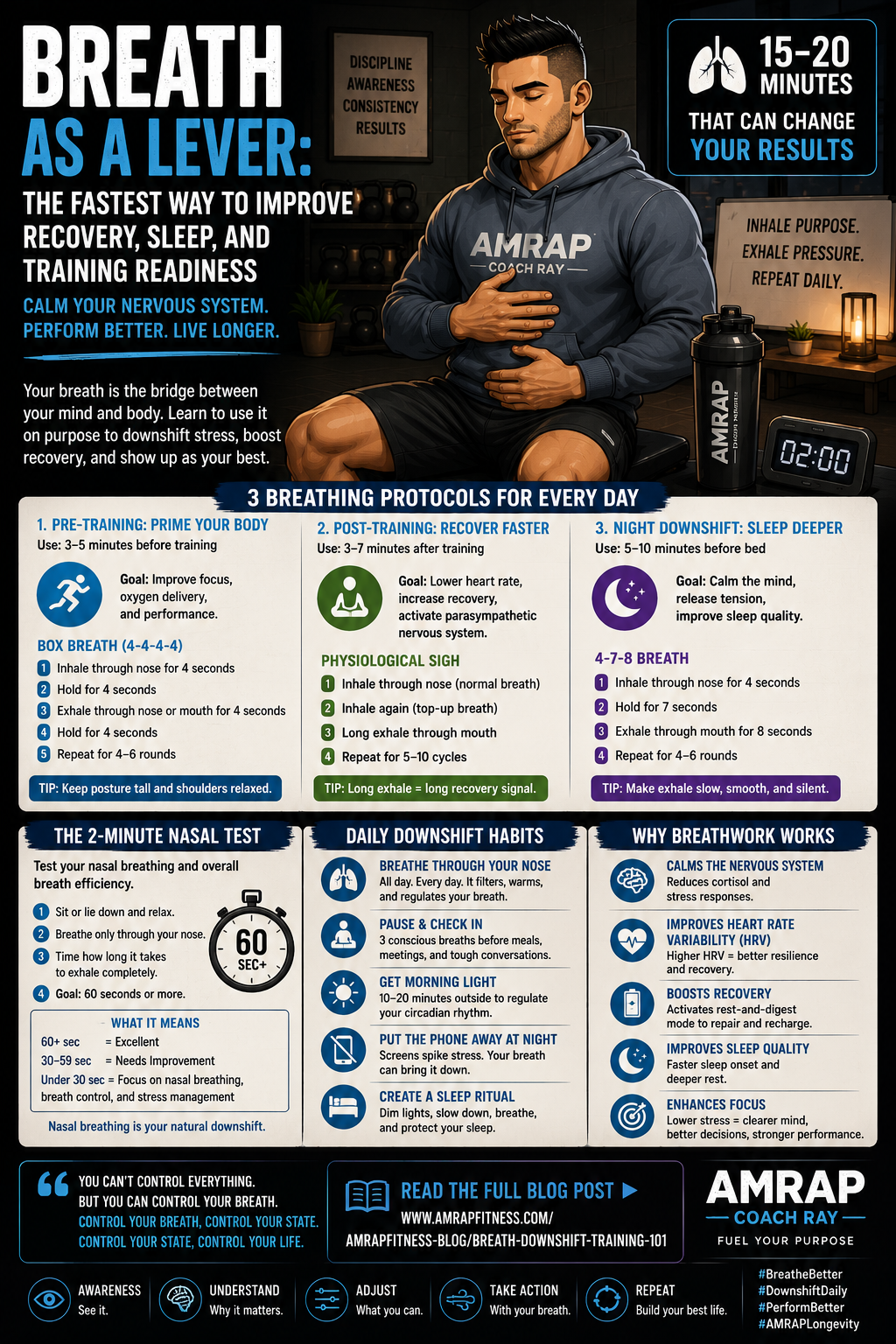
(AMRAP Longevity Series — Post 4)
A lot of people think recovery is:
sleep
stretching
supplements
ice baths
sauna
Those can help.
But there’s a deeper recovery lever that controls everything upstream:
your ability to downshift your nervous system.
Because you can’t “out-supplement” a nervous system that stays in fight‑or‑flight.
If you stay revved up:
sleep gets lighter
your heart rate stays higher
cravings rise
pain sensitivity increases
training feels harder
recovery takes longer
And then you start living in a loop:
stress → poor sleep → worse recovery → worse decisions → more stress
This post is about a tool that breaks the loop fast:
breathing as a skill.
Not breathwork as a trend.
Breathing as a performance system:
for training readiness
for recovery
for sleep
for stress resilience
Later deep dives will cover:
breath training for endurance
asthma and breath constraints
breathwork for anxiety
CO2 tolerance protocols
nasal breathing progression
Today, we build the foundation.
You know that feeling:
You did everything.
You trained.
You worked.
You handled your responsibilities.
You’re tired.
But you can’t fall asleep.
Or you fall asleep and wake up wired at 2:00 a.m.
Your mind runs.
Your chest feels tight.
Your jaw is tense.
And the next day you feel like you’re pushing your body through mud.
People interpret this as:
“I’m falling apart.”
But a lot of the time it’s simpler:
your nervous system never downshifted.
Breathing is one of the quickest ways to change that state.
Not because breathing is magic.
Because breathing is one of the few systems you can control that directly influences your autonomic state.
Think of your nervous system like a car.
alert
reactive
ready to perform
higher heart rate
higher breathing rate
Useful for:
training
competition
intense work
emergencies
calm
recovery
digestion
sleep readiness
Useful for:
restoration
recovery
emotional regulation
The problem is not up‑shift.
The problem is living up‑shifted all day.
A lot of adults spend:
mornings rushing
afternoons under pressure
evenings scrolling
nights wired
Then they wonder why recovery feels hard.
Breathing training teaches your body:
“We can downshift on command.”
That’s a longevity advantage.
Breathing is not just oxygen.
Breathing is:
ventilation (air movement)
gas exchange
CO2 tolerance
ribcage mechanics
diaphragm function
autonomic signaling
And here’s the part most people miss:
CO2 tolerance often drives the urge to breathe more than low oxygen.
That means when you’re stressed or breathing shallowly all day, your system can become more sensitive, and you feel:
air hunger
tight chest
“I can’t get a deep breath”
Breath training addresses this by improving control, rhythm, and tolerance.
Controlled slow breathing has been studied for effects on heart rate variability (HRV) and autonomic regulation—often showing shifts consistent with improved parasympathetic activity in some contexts.
Breathing patterns can affect arousal, perceived stress, and anxiety symptoms in various interventions, especially when paired with relaxation or mindfulness techniques.
Nasal breathing tends to slow airflow, increase resistance slightly, and can promote diaphragmatic patterns in many people—useful for downshifting (not a moral rule; a tool).
Important professional note:
Breathwork is not a replacement for medical care for panic disorders, asthma, or cardiovascular issues—but it is a powerful skill for many people.
We’re going to make this tactical.
You’ll have:
a 2‑minute tool you can use anytime
a post‑training protocol
a night downshift protocol
a readiness test to know when to push vs protect
Goal: turn down arousal without needing perfect conditions.
Sit tall or lie down.
Inhale through the nose for ~4 seconds.
Exhale slowly for ~6–8 seconds.
Repeat for 2 minutes.
Key rule: exhale longer than inhale.
Why it works:
Longer exhale can cue a downshift response and reduces the “rev.”
This is the fastest recovery skill you can build.
Most people finish training and immediately:
rush to work
jump in the car
check the phone
They never signal “session complete.”
So the nervous system stays up.
1 minute easy walk
2–4 minutes slow breathing (4 in / 6–8 out)
shoulders relaxed
jaw unclenched
This improves recovery quality because you stop carrying training arousal into the day.
This is the sleep protector.
Environment (1 minute): dim lights, phone face down.
Breathing (4 minutes): nasal inhale 4 sec, exhale 8 sec.
One line (1 minute): “Tomorrow can wait. Tonight I recover.”
Simple.
Repeatable.
Effective.
This is the cleanest “am I ready?” tool.
Walk for 6 minutes at an easy pace.
Try to breathe through your nose.
If nasal breathing feels calm → you’re likely in a good state.
If nasal breathing feels impossible at an easy pace → you may be stressed, under‑recovered, or pushing too hard.
This test is not about ego.
It’s about signals.
Here’s the truth:
A calm body performs better.
Because a calm body:
recovers faster between sets
maintains better technique
tolerates discomfort without panic
sleeps better
has fewer cravings
Breathing doesn’t replace strength training.
It makes strength training more usable.
On high stress days, you don’t need more intensity.
You need more regulation.
2 minutes downshift mid‑day
post‑training reset if you train
night downshift before bed
That’s it.
Small doses. Big effect.
Fix: keep it mechanical and repeatable.
Fix: practice daily when calm so you can access it when stressed.
Fix: focus on smooth, quiet breathing and long exhales.
Fix: 2 minutes daily beats 30 minutes once.
Answer honestly:
Do I feel “wired but tired” at night?
Does my breathing get shallow when stressed?
Do I carry training arousal into the day?
Do I have a reliable downshift ritual?
Can I calm myself without needing a perfect environment?
Your answers aren’t judgment.
They’re your leverage points.
Longevity isn’t only about what you can lift.
It’s about the nervous system you live in.
Breathing is the skill that lets you choose:
when to push
and when to recover
So you can train for decades.
Not weeks.
Lehrer PM, Gevirtz R. Heart rate variability biofeedback: how and why it works. (Foundational work on breathing rhythm and autonomic regulation.)
Zaccaro A, et al. How breath-control can change your life: a systematic review on psycho-physiological correlates of slow breathing. Frontiers in Human Neuroscience. 2018.
Russo MA, et al. The physiological effects of slow breathing in the healthy human. (Review literature on autonomic effects.)
Jerath R, et al. Physiology of long pranayamic breathing: neural respiratory elements. (Mechanistic discussion of breath and nervous system.)
TEAM Saturday
Partner warm up
MB chest pass
MB hip toss
MB back to back hand off
MB sit ups
Skill
Movement standards
WOD
Beast 12
For Time:
25 Walking lunge steps
20 Pull-ups
50 Box jumps, 20''
20 Double-unders
25 Ring dips
20 Knees to elbows
30 Kettlebell swings, 2 pood
30 Sit-ups
20 DB Hang squat cleans, 35#
25 Back extensions,
30 Wall ball shots, 20#
3 Rope climb ascents