Thursday
Warm up
Power jumps
OH walking lunges
Push ups
Super rocks
Rollback reach (three directions in straddle)
Skill
Speed pull ups
WOD
EMOTM for 12 minutes
3 speed pull ups
3 thrusters

Thursday
Warm up
Power jumps
OH walking lunges
Push ups
Super rocks
Rollback reach (three directions in straddle)
Skill
Speed pull ups
WOD
EMOTM for 12 minutes
3 speed pull ups
3 thrusters
Wednesday
Warm up
2 minutes of double unders
Seal walk
Mountain climber complex (straight on/R/L/R hip/L hip)
OHS
Dips
Pull ups
Skill
Push press
WOD
7 rounds of:
20 seconds of work followed by 40 seconds of rest
-TTR
-Push press W/65 M/95
-Burpees
Tuesday
Warm up
KB around the world
Russian swings
H2H swings
Release swings
Wall Ball substitute
Skill
Move through movement standards
WOD
Tabata the following
-KBS
-Row for watts
-Wall ball
-Double unders
Monday
Warm up
Plate push
Net climb
OHS
Strict TTB
Back ext
Skill
Movement standards
WOD
EMOTM for 15 minutes
-3 pull ups/CTB pull ups
-3 push ups/ chest slap push ups
-4 air squats/ pistols
(AMRAP Longevity Series — Post 2 )
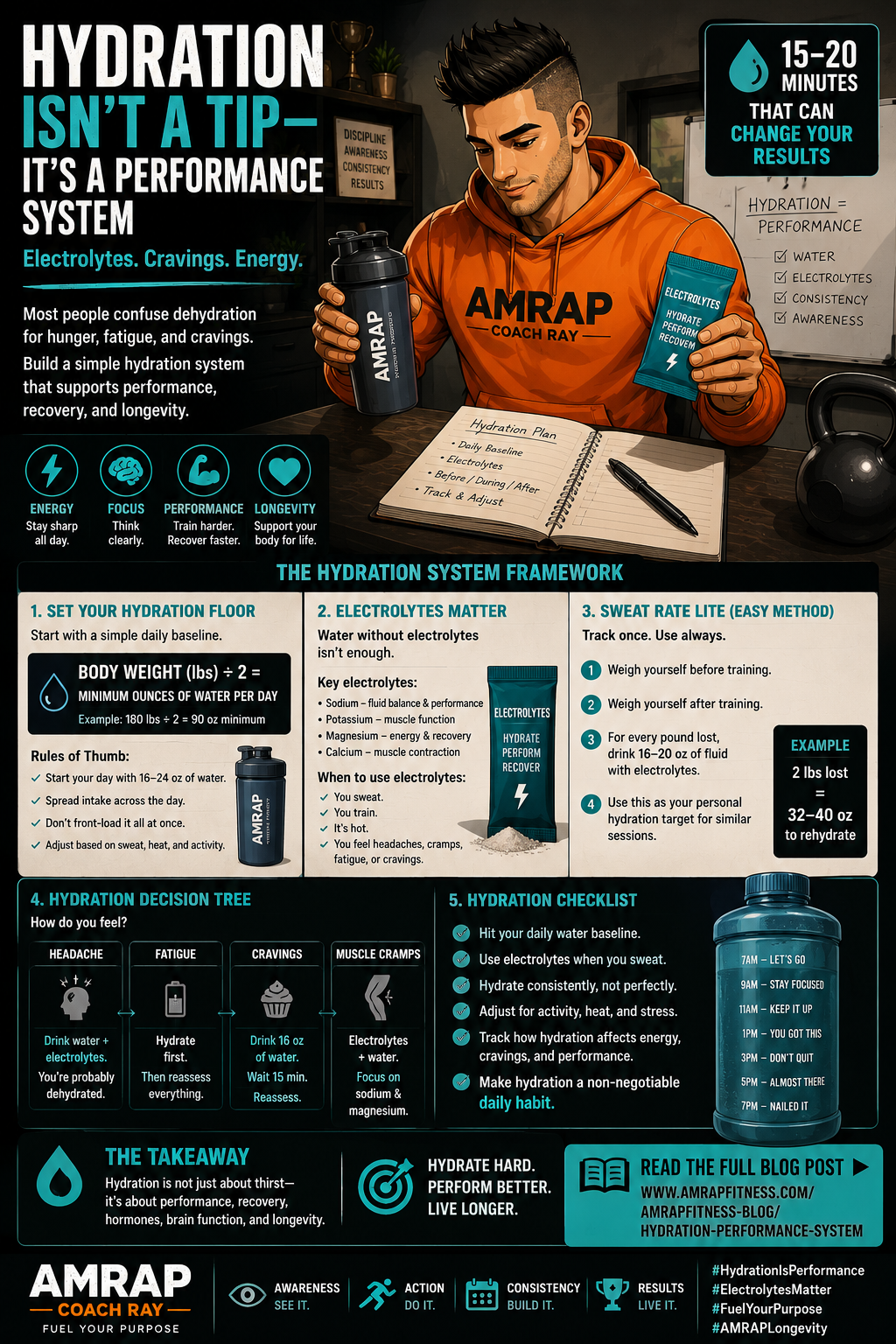
Hydration is one of the most misunderstood levers in fitness.
Most people treat it like a wellness afterthought:
“I’ll drink more water.”
“I forgot today.”
“I’ll do better tomorrow.”
But hydration is not just about avoiding thirst.
It affects:
energy stability
training performance
appetite and cravings
digestion
headaches
blood pressure responses
sleep quality (yes, both too little and too late)
recovery and soreness perception
And for adults training hard—especially after 40—hydration is often the difference between:
“My body feels capable.”
and
“I feel heavy, foggy, and behind.”
This is a pillar-style foundation post. Later we’ll go deeper into:
hydration for early-morning training
summer heat protocols
hydration for fat loss and appetite control
hydration and blood pressure considerations
hydration for endurance vs strength training
Today we build the system.
You know the feeling.
You wake up and something is off.
Not sick.
Not injured.
Just… flat.
Your head feels slightly tight.
Your energy is low, but your body feels wired.
Your coffee doesn’t really work.
Your workout feels harder than it should.
Your appetite feels strange—either nonexistent or wildly snacky.
And you tell yourself:
“I’m just tired.”
Sometimes that’s true.
But a lot of the time it’s simpler:
You’re under-hydrated and under-salted relative to your life and training.
Not dramatically.
Not dangerously.
Just enough to degrade performance, mood, and decision-making.
That “just enough” is where adults lose consistency.
Because when you feel off, you make different choices:
you skip training
you snack more
you reach for sugar
you avoid movement
you spiral
Hydration is not a cure for everything.
But it is one of the cheapest ways to reduce unnecessary friction.
Hydration is not just “water.”
Hydration is a balance between:
fluid (water)
electrolytes (especially sodium; also potassium, magnesium)
losses (sweat, breathing, urine)
timing (when you drink matters)
If you drink a ton of water but don’t replace electrolytes after heavy sweating, you can still feel:
fatigued
crampy
headachey
low energy
If you take electrolytes but don’t drink enough fluid, you can still feel:
sluggish
thirsty
constipated
This is why “drink more water” is often not specific enough.
We need a system.
Research reviews consistently note that dehydration around ~2% of body mass loss can impair physical performance, and some effects may occur earlier depending on the person, environment, and task.
Dehydration can negatively impact alertness, concentration, and perceived effort. In real life, that means you feel like training costs more.
Sodium is the major electrolyte lost in sweat. Replacing sodium can support fluid retention and reduce symptoms like headaches, fatigue, and “flat” training days for people who sweat a lot.
(We’ll cite key references at the end.)
This is the system I want you to use.
It’s simple.
It’s repeatable.
And it prevents 80% of hydration problems before they start.
A hydration floor is the minimum you hit even on busy days.
Not a perfect target.
A baseline.
2–3 liters/day for many adults is a common starting point (individual needs vary)
if you train hard, sweat heavily, live in heat, or consume more caffeine, your needs increase
Instead of obsessing over the “perfect number,” use this:
Your urine color should be pale yellow most of the day (not crystal clear constantly, not dark).
That’s a practical signal.
Most people “catch up” at night.
Then they wake up to pee.
Then sleep breaks.
Then appetite rises.
Then the cycle repeats.
So we manage timing:
Bottle 1: morning (within 60–90 minutes of waking)
Bottle 2: midday (before 3 p.m.)
Bottle 3: late afternoon/early evening (not right before bed)
If you train early, your Bottle 1 becomes essential.
Electrolytes are not mandatory for everyone.
But if you sweat heavily, train early, train hard, or live in heat, they often change the entire quality of your day.
frequent headaches
“flat” workouts despite sleep
heavy sweating
salt cravings
dizziness on standing
muscle cramping (not always electrolytes, but sometimes)
feeling worse after drinking lots of plain water
add sodium + fluid around training
This can be done via:
electrolyte packets
salted water with lemon
salty foods paired with water
Important medical note: If you have hypertension, kidney disease, heart disease, or are on medications affecting fluid balance, electrolyte and sodium targets should be discussed with your clinician.
You do not need a lab to get useful hydration data.
Here’s the simple version.
Weigh yourself before training (naked or consistent clothing).
Train.
Note how much you drank.
Weigh yourself after training.
If you’re down 1 lb, that’s roughly ~16 oz (~0.5 L) fluid loss.
If you’re down 2 lbs, that’s roughly ~32 oz (~1 L) fluid loss.
This gives you a rough sense of your sweat loss.
Then your goal becomes:
Replace most of that over the next few hours with water + sodium.
Not all at once.
Not right before bed.
Over time.
This is the practical tool.
If no → drink water first.
If yes → add electrolytes.
If yes → drink water + electrolytes before more caffeine.
If you feel snacky + headachey + foggy → hydrate first, then decide.
This single habit reduces a ton of unnecessary overeating.
Many people confuse thirst and depletion for hunger.
Not always.
But often enough that it matters.
When you are under-hydrated:
your perceived effort increases
your mood stability drops
your cravings rise
your brain looks for fast relief
Water and electrolytes do not “burn fat.”
But they reduce the friction that makes fat loss harder.
Because they stabilize energy and decision-making.
If you train early, you are starting the day dehydrated.
Everyone does.
You’ve been breathing for hours.
You likely haven’t had fluid.
So the morning strategy is:
12–20 oz water upon waking
add electrolytes if you sweat heavily or train intensely
coffee comes after the first water, not before
This reduces:
headaches
“flat” training
early-day fatigue
Hydration helps sleep when it’s earlier.
Hydration hurts sleep when you catch up at night.
Stop heavy fluid intake 60–90 minutes before bed (adjust for your body).
If you wake up nightly to pee, this often improves your sleep quality.
Fix: thirst is late for many adults. Use the floor + timing system.
Fix: spread it across the day.
Fix: water first, caffeine second.
Fix: match electrolytes to sweat + symptoms.
Fix: cramps can be fatigue, conditioning, loading errors, or hydration. Use the decision tree.
Hydration floor: 2–3 L (adjust for body size, sweat, climate)
Bottle 1 morning, Bottle 2 midday, Bottle 3 late afternoon
12–20 oz water before training
electrolytes if heavy sweat / heat / high intensity
replace losses over next hours
reduce heavy drinking 60–90 minutes before bed
Answer honestly:
Do I start most days under-hydrated?
Do I rely on caffeine to feel normal?
Do I get headaches or feel flat after training?
Do I sweat heavily and never replace electrolytes?
Do I snack more on days my hydration is poor?
Do I wake up at night to pee because I “caught up” late?
Your answers aren’t judgment.
They’re the system you need.
Hydration is not sexy.
But it is one of the fastest ways to improve:
how you feel in your body
how you train
how you recover
how stable your appetite is
It reduces unnecessary friction.
And the entire longevity game is about reducing friction so you can stay consistent for decades.
Hydration isn’t a tip.
It’s a performance system.
Sawka MN, et al. Exercise and Fluid Replacement. American College of Sports Medicine Position Stand. 2007. (Classic foundational guidance on hydration and performance.)
Cheuvront SN, Kenefick RW. Dehydration: physiology, assessment, and performance effects. 2014. (Review of dehydration and performance/cognition.)
Shirreffs SM. Hydration and performance. 2005. (Overview of hydration, sweat loss, and performance impacts.)
EFSA Panel. Dietary Reference Values for water. 2010. (General population guidance on water intake ranges.)
Maughan RJ, et al. The effects of sodium ingestion on hydration status and performance (reviewed evidence across contexts). 2019.