Monday
Warm up & Skill
-Stroke technique
-Pacing drill
WOD
3 rounds of:
Row 1 K
30 burpees
Run 800m
*20 minute time cap*


Monday
Warm up & Skill
-Stroke technique
-Pacing drill
WOD
3 rounds of:
Row 1 K
30 burpees
Run 800m
*20 minute time cap*
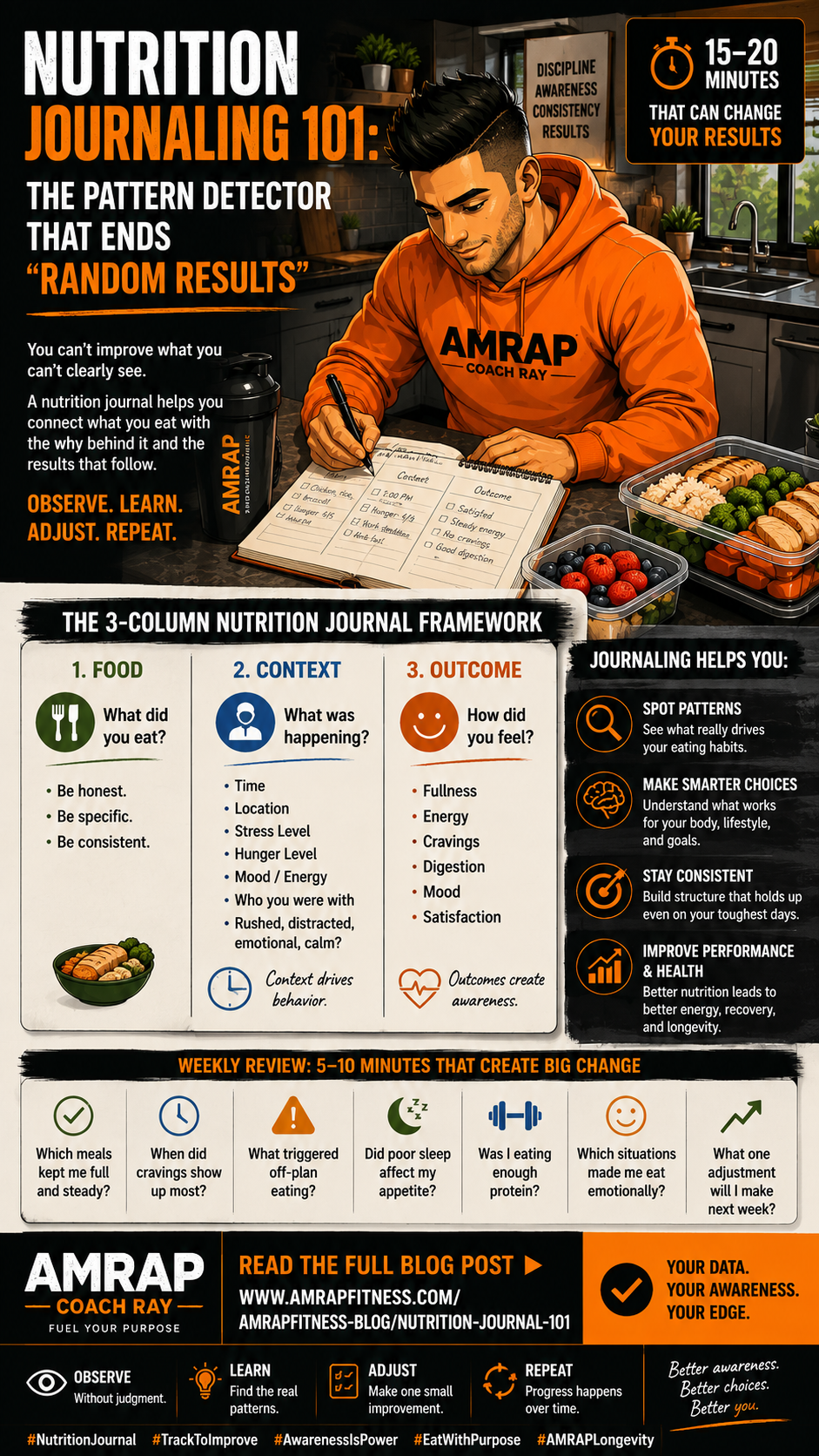
(AMRAP Longevity Series — Pillar Intro #7)
You need better awareness.
Most adults do not struggle with nutrition because they are lazy, undisciplined, or incapable of change.
They struggle because eating is rarely just about food.
It is about:
stress
schedule
sleep
emotions
convenience
hunger signals
cravings
energy crashes
habits built under pressure
And when those forces are not being tracked, nutrition starts to feel random.
You have a good day.
Then a rough night.
Then stress hits.
Then your meals slip.
Then your cravings spike.
Then you feel like you are “off track” again.
And somewhere in the middle of all of that, a lot of people start believing something damaging:
“I just can’t stay consistent.”
That usually is not true.
What is true is this:
You cannot improve what you cannot clearly see.
That is where nutrition journaling becomes powerful.
Not as punishment.
Not as obsessive calorie policing.
Not as another rigid system that makes life harder.
But as a tool for spotting patterns, building awareness, and making nutrition more stable inside a real adult life.
This is a pillar introduction post.
Later, we can go deeper into:
appetite tracking
binge trigger detection
emotional eating patterns
meal structure for fat loss
meal structure for muscle gain
journaling for blood sugar stability
journaling for digestion and food tolerance
But first, we build the foundation correctly.
A lot of nutrition breakdowns do not happen because someone “doesn’t care.”
They happen during a normal, human week.
It starts small.
You sleep poorly on Sunday night.
Monday is stressful.
You skip breakfast because you are rushing.
By late morning, you are hungrier than usual.
Lunch happens quickly and without much thought.
By afternoon, cravings are louder.
By evening, your willpower is thin.
Then dinner turns into grazing.
Then grazing turns into, “I already blew it.”
And now the week feels compromised.
The strange part is that from the outside, it can look like a food problem.
But when you zoom out, it is often a pattern problem.
The food was the final expression.
The real drivers were:
poor sleep
schedule disruption
under-eating earlier in the day
stress load
lack of structure
If you never track these things, you will blame your character for what is actually a repeatable chain reaction.
A nutrition journal helps you catch the chain.
And once you can see the chain, you can break it.
Let’s define it clearly.
A nutrition journal is not just a food log.
It is not merely writing down:
chicken
rice
yogurt
almonds
That may be part of it.
But the deeper purpose of nutrition journaling is this:
To connect what you eat with the conditions around it and the outcome that follows it.
That means a real nutrition journal tracks three things:
What you ate
What was happening when you ate
How you felt afterward
That is the difference between “tracking food” and actually learning from your nutrition.
Because if all you record is calories or macros, you may know what happened, but not why it happened.
And if you do not understand the “why,” you will keep repeating the same cycle.
After 40, the game changes.
Not because the body is broken.
Not because progress is impossible.
Not because metabolism is doomed.
But because the margin for error gets smaller.
Why?
Because adult life usually carries:
more responsibilities
more stress
less room for careless recovery
more old habits
more emotional load
less tolerance for extreme dieting
That means nutrition cannot rely on:
willpower alone
perfectly timed meals
unrealistic restrictions
all-or-nothing discipline
It has to rely on awareness + structure.
And journaling gives you both.
It shows you:
when hunger is actually hunger
when cravings are stress-driven
when low energy is under-fueling
when evening overeating started with a missed meal six hours earlier
when poor sleep is making appetite louder
when emotional strain is changing food behavior
This is a major reason nutrition journaling becomes a longevity skill.
Because the goal is not simply to lose weight.
The goal is to build a way of eating that remains stable under pressure.
A lot of people say they want better nutrition.
But when asked simple questions, they often do not know the answers:
What time of day do you get the most cravings?
Which meals leave you satisfied the longest?
What situations make you eat too fast?
What foods trigger a “keep going” feeling?
What happens to your appetite after poor sleep?
Do you undereat during the day and overeat at night?
Are your hunger signals predictable or chaotic?
Do weekends change your structure dramatically?
That is not an insult.
It just means the person is operating without data.
And without data, every nutrition conversation feels emotional.
With data, the conversation becomes practical.
You move from:
“Why am I like this?”
to:
“Here is the pattern. Let’s adjust it.”
That shift matters.
Because shame keeps people stuck.
Awareness moves people forward.
One of the most consistently supported ideas in behavior change research is that self-monitoring works.
When people track a behavior, several things happen:
awareness increases
impulsive behavior becomes more visible
small choices become more deliberate
patterns can be identified
accountability improves
Self-monitoring has long been used in behavior-change programs because it helps bridge the gap between intention and action.
In nutrition specifically, food journaling has been associated with:
improved dietary awareness
greater adherence to nutrition goals
better long-term behavior insight
more successful weight-management patterns in many interventions
Why?
Because tracking creates feedback.
And feedback changes behavior.
Not perfectly.
Not instantly.
But meaningfully.
A nutrition journal helps you stop treating your eating like a mystery.
Now let’s keep this professional and practical.
A nutrition journal should not become another stressful job.
If it is too detailed, people quit.
If it is too vague, it becomes useless.
The best system is simple enough to sustain, but detailed enough to reveal patterns.
Here is the AMRAP approach:
For each meal, snack, or eating event, record:
What did you eat?
Keep it simple:
eggs, toast, berries
Greek yogurt, oats, banana
chicken bowl with rice and vegetables
protein bar and coffee
handfuls of snacks while cooking
The point is not to be perfect.
The point is to be honest.
What was happening?
This is where most people learn the most.
Track:
time
location
stress level
hunger level
who you were with
whether you were rushed, calm, distracted, or emotional
Examples:
“Ate quickly in the car”
“Very stressed from work”
“Not that hungry, just tired”
“Skipped lunch, starving by dinner”
“Watching TV and kept snacking”
This column is gold.
Because context often drives behavior more than knowledge.
What happened after?
Track:
fullness
satisfaction
cravings
energy
digestion
mood
Examples:
“Satisfied for 3 hours”
“Still wanted something sweet”
“Energy crash 1 hour later”
“Ate too fast, uncomfortable”
“Felt stable and clear”
“This meal triggered more snacking”
This is where the learning happens.
A nutrition journal is not just a record.
It is a pattern detector.
Here are the main patterns you want to identify.
When are you truly hungry?
Do you get hungry:
at predictable times?
only after long gaps?
more intensely after poor sleep?
more emotionally at night?
You are trying to distinguish:
real physiological hunger
from
convenience eating
stress eating
boredom eating
reward eating
Which meals actually work for you?
A good meal usually creates:
satiety
stable energy
less snacking
fewer cravings
better mood control
A poor meal often leads to:
hunger quickly returning
energy crash
sugar cravings
mindless snacking later
This tells you which meals should become your defaults.
What situations make you go off course?
Common triggers include:
sleep deprivation
conflict
work pressure
skipped meals
social environments
unplanned evenings
eating while distracted
restrictive thinking
The goal is not to avoid life.
The goal is to recognize which conditions make your nutrition more fragile.
How does recovery affect your eating?
One of the biggest blind spots in nutrition is that a lot of food behavior is actually recovery behavior.
If you sleep poorly:
hunger may rise
cravings may rise
emotional regulation may drop
If you are highly stressed:
decision-making weakens
comfort-seeking increases
structure gets harder
Journaling lets you connect recovery to nutrition instead of pretending they are separate.
This matters.
If journaling becomes a tool for self-attack, people stop being honest.
Then the journal becomes useless.
The mindset has to be:
Observe, do not condemn.
Your journal is not there to tell you that you are good or bad.
It is there to answer:
What happened?
Why did it happen?
What should change?
That is the standard.
A professional does not shame data.
A professional uses data.
Daily tracking matters.
But the weekly review is where nutrition journaling becomes strategic.
Once per week, spend 5–10 minutes asking:
Which meals kept me full and steady?
When did cravings show up most?
What triggered off-plan eating?
Did poor sleep affect my appetite?
Was I eating enough protein?
Did I go too long without eating?
Which situations made me eat emotionally?
What one adjustment would improve next week?
This turns your journal into a coaching tool.
Without the weekly review, you are just collecting information.
With the weekly review, you are learning.
If you want to keep it simple, these are the five highest-value things to record.
Not because you need perfection.
But because long gaps often explain later overeating.
Was there a meaningful protein source?
This matters because protein often supports:
satiety
muscle retention
recovery
more stable eating behavior
Rate it simply:
1 = not hungry
2 = lightly hungry
3 = appropriately hungry
4 = very hungry
5 = starving
This helps expose whether you are eating proactively or reactively.
Simple scale:
low
moderate
high
This often explains more than people expect.
Did the meal leave you:
satisfied
still craving
overly full
tired
energized
bloated
calm
wanting more?
This is the most important question:
What did that meal do?
Most nutrition spirals follow a predictable sequence.
It often looks like this:
poor sleep
rushed morning
skipped or small breakfast
excessive hunger later
fast lunch
low satisfaction
afternoon cravings
emotional fatigue
overeating at night
guilt
restriction the next morning
repeat
Without journaling, this feels like failure.
With journaling, it becomes visible as a sequence.
And once you see the sequence, you can intervene earlier.
For example:
improve breakfast protein
plan a more stable lunch
reduce long gaps
recognize that poor sleep is a high-risk day
use a pre-planned “default meal” when stressed
This is how journaling changes results.
It does not just document the spiral.
It helps prevent the spiral.
One of the smartest outcomes of journaling is this:
You discover which meals reliably work.
Those become your default meals.
Default meals reduce decision fatigue.
They are meals you can count on when life is busy.
A good default meal is:
easy to prepare
high in protein
satisfying
consistent
realistic
Examples might include:
Greek yogurt, oats, berries, whey
eggs, potatoes, fruit
chicken, rice, vegetables
lean beef bowl with potatoes and salad
protein smoothie plus fruit and nut butter
Journaling helps you identify:
which defaults keep you stable
which meals are unreliable
which combinations support your goals best
That is powerful.
Because the more stressful life gets, the more valuable dependable defaults become.
That defeats the purpose.
Your difficult days contain the most useful data.
If it takes too long, you will stop.
Simple wins.
That creates dishonesty and avoidance.
The goal is insight, not shame.
Food without context misses the real lesson.
If you do not look for patterns, you are just writing things down.
Here is the practical version.
Meal / Snack:
What I ate:
Time:
When I ate:
Hunger Level (1–5):
Context:
Where was I?
How stressed was I?
Was I rushed, distracted, emotional, calm, social, tired?
Outcome:
How full was I?
Was I satisfied?
How was my energy?
Any cravings afterward?
Any digestive issues?
1-Line Note:
“This meal left me feeling ______.”
This week I noticed:
My biggest hunger trigger was:
My biggest craving trigger was:
My most satisfying meal was:
My least satisfying meal was:
My highest-risk time of day was:
My recovery/nutrition connection was:
One thing I will improve next week is:
That is enough.
You do not need complexity.
You need clarity.
Answer honestly:
Do I know what situations make my nutrition fall apart?
Do I know which meals keep me most satisfied?
Do I understand the difference between hunger and stress cravings?
Do I know how poor sleep affects my eating?
Do I have any consistent record of what works for me?
Do I eat in response to patterns I have never actually tracked?
Am I blaming myself for problems I have not objectively examined?
Your answers are not judgment.
They are direction.
A nutrition journal does not make you rigid.
It makes you aware.
It does not turn you into someone obsessed with food.
It turns you into someone who understands your own behavior.
That is a major difference.
Because when you understand:
your hunger
your triggers
your stable meals
your risky situations
your recovery-food connection
…nutrition stops feeling random.
And when nutrition stops feeling random, consistency becomes more possible.
Not because you finally found more discipline.
But because you finally found more clarity.
That is what top-tier coaching does.
It does not just tell people what to eat.
It helps them understand why they eat the way they do—and how to improve it with intelligence, honesty, and structure.
That is the value of nutrition journaling.
And that is why it belongs in a longevity system.
Burke LE, Wang J, Sevick MA. Self-monitoring in weight loss: a systematic review of the literature. Journal of the American Dietetic Association. 2011.
Michie S, Richardson M, Johnston M, et al. The Behavior Change Technique Taxonomy (v1) of 93 hierarchically clustered techniques. Annals of Behavioral Medicine. 2013.
Harkin B, Webb TL, Chang BP, et al. Does monitoring goal progress promote goal attainment? A meta-analysis of the experimental evidence. Psychological Bulletin. 2016.
Hollis JF, Gullion CM, Stevens VJ, et al. Weight loss during the intensive intervention phase of the Weight-Loss Maintenance Trial. American Journal of Preventive Medicine. 2008.
Wing RR, Phelan S. Long-term weight loss maintenance. The American Journal of Clinical Nutrition. 2005.

Most people think consistency is the secret.
Consistency matters.
But after 40, the real edge is this:
Consistency + feedback.
Because if you train consistently but never measure anything, you can spend months working hard and still wonder:
“Why am I not getting stronger?”
“Why do I feel beat up?”
“Why do I keep stalling?”
“Why do I flare up every few weeks?”
That’s not a motivation problem.
That’s a data problem.
Your body is giving you feedback every day.
A training journal is simply the tool that lets you hear it clearly.
This is a pillar intro entry. Later we’ll deep dive:
journaling for nutrition
journaling for mental health/stress
advanced performance tracking (velocity, HR, readiness)
But first we build the foundation.
A lot of adults hit a frustrating season.
They’re showing up. They’re trying.
But the results feel random.
Some weeks feel strong. Some weeks feel heavy.
Then one day:
your shoulder feels irritated for no reason
your back tightens on a warm-up set
your conditioning feels like it vanished
And you ask:
“What changed?”
Here’s what makes it worse:
Most people can’t answer.
They don’t know if:
volume crept up
intensity was too frequent
sleep dropped for two weeks
protein was low
stress was high
recovery was missing
They only know they feel off.
A journal turns “I feel off” into:
“Here’s the pattern.”
And patterns are fixable.
A training journal is not a diary.
It’s not a place to write motivation quotes.
A training journal is a performance feedback loop.
It answers 3 questions:
What did I do?
How did it feel?
What happened next?
If you can answer those, you can coach yourself.
If you can’t, you’re guessing.
And guessing is expensive after 40.
When you’re younger, you can often get away with:
chaos
inconsistent sleep
sloppy progression
pushing too hard too often
Your recovery buffer is bigger.
After 40, the buffer shrinks because life load rises.
Work. Family. Stress. Responsibilities.
That means the margin for error is smaller.
Not because you’re fragile.
Because you’re human.
So you need a system that tells you early:
“You’re trending toward fatigue.”
“You need a deload.”
“Your intensity is too frequent.”
“Your sleep is breaking your recovery.”
That’s what journaling does.
In behavior change research, self-monitoring is one of the most consistently effective behavior change techniques.
When people track behavior, adherence improves because:
awareness increases
accountability increases
patterns become visible
In physical activity interventions, self-monitoring (like logs or tracking tools) is frequently associated with improved outcomes compared to no tracking.
Coaching translation: When you measure the thing, the thing improves.
Not by magic.
By attention.
We keep it simple.
A journal fails when it’s too complicated.
A journal succeeds when it takes:
2 minutes during training
60 seconds after training
5 minutes once per week
That’s it.
Record:
exercises
sets x reps
load
rest time (optional)
Record how hard it felt.
RPE 7 = 3 reps left
RPE 8 = 2 reps left
RPE 9 = 1 rep left
Most longevity training should live around:
RPE 7–9 (with control)
not RPE 10 constantly
Record 1–2 lines:
sleep quality (1–5)
stress (1–5)
soreness (1–5)
This is where patterns get revealed.
If you only write numbers, you miss the lesson.
Once per week (5 minutes), answer:
What moved up this week? (strength, volume, pace)
What felt worse? (sleep, joints, mood)
What was my biggest limiter? (stress, sleep, food)
What do I change next week?
This is how you avoid repeating the same mistakes for years.
You don’t need to track everything.
Track what drives decisions.
Pick 1–2 anchors:
squat/hinge
press
pull
Track either:
load
reps
or total volume
One simple marker:
Zone 2 pace for 30 minutes
or heart rate at a set pace
Rate 0–3:
0 = nothing
1 = awareness
2 = pain changes movement
3 = stop/modify
Pain isn’t shame.
Pain is data.
Not perfect sleep. Consistency.
One line:
“felt springy”
“felt heavy”
“stressed”
That’s enough.
Most plateaus are not mysterious.
They’re one of these:
You’re not progressively increasing.
Fix:
add 1 rep per set
or add 2.5–5 lbs
or add one set
Progress is buried under fatigue.
Fix:
deload 1 week
cut volume 30–50%
keep movement quality
Sleep and stress are killing adaptation.
Fix:
run the minimum plan
reduce intensity frequency
protect sleep window
Not enough protein/energy.
Fix:
protein at every meal
stable meal structure
A journal helps you identify which one is true.
Without a journal, you blame yourself.
If you see any of these trends for 7–10 days, you adjust:
performance dropping in 2+ sessions
soreness staying high
sleep quality low
irritations rising
motivation turning into dread
Adjustment options:
deload
reduce volume
swap intensity for Zone 2
run joint-friendly tools (sled, carries, controlled tempo)
Longevity athletes don’t wait until they break.
They adjust early.
Date:
Focus:
Warm-up:
Lift 1:
Lift 2:
Type:
Time/pace:
Hardest set RPE:
Sleep (1–5):
Stress (1–5):
Soreness (1–5):
Joint flags (0–3):
“Today I felt ______.”
Win:
Limiter:
Next week adjustment:
That’s enough to create results.
Fix: track less, review weekly.
Fix: the hard weeks are where journals matter most.
Fix: keep most work 1–3 reps shy of failure.
Fix: sleep/stress/soreness notes are mandatory.
Answer honestly:
Can I explain why I improved last month?
Do I know what makes me regress?
Do I have a deload trigger — or do I wait for injury?
Do I know my weekly volume trends?
Do I track recovery signals or only weights?
Your answers aren’t judgment.
They’re your next upgrade.
A training journal is not extra work.
It’s the tool that prevents wasted work.
It keeps you:
consistent
progressing
and protected
Because it teaches you:
How to train like a professional inside a real adult life.
Michie S, et al. The Behavior Change Technique Taxonomy (v1) — self-monitoring as a core technique. 2013. https://pubmed.ncbi.nlm.nih.gov/23793917/
Burke LE, et al. Self-monitoring in weight loss and behavior change (review). 2011. https://pubmed.ncbi.nlm.nih.gov/21813517/
Harkin B, et al. Goal setting and self-monitoring interventions improve outcomes (meta-analysis). 2016. https://pubmed.ncbi.nlm.nih.gov/26737985/
Conroy DE, et al. Wearable/monitoring and behavior change evidence (review). 2014. https://pubmed.ncbi.nlm.nih.gov/24917627/

La mayoría cree que el secreto es la constancia.
La constancia importa.
Pero después de los 40, la ventaja real es:
Constancia + retroalimentación.
Porque si entrenas constante pero no mides nada, puedes pasar meses trabajando duro y seguir preguntándote:
“¿Por qué no estoy más fuerte?”
“¿Por qué me siento destruido?”
“¿Por qué me estanco?”
“¿Por qué me duele algo cada pocas semanas?”
Eso no es falta de motivación.
Es un problema de datos.
Tu cuerpo te da señales todos los días.
El diario es la herramienta que te permite escucharlas.
Esta es una entrada pilar. Luego profundizaremos:
diario para nutrición
diario para salud mental/estrés
seguimiento avanzado (HR, readiness, etc.)
Primero: base.
Muchos adultos llegan a una temporada frustrante.
Aparecen. Intentan.
Pero los resultados se sienten aleatorios.
Semanas fuertes. Semanas pesadas.
Y un día:
el hombro se irrita “de la nada”
la espalda se tensa en el calentamiento
la condición desaparece
Y preguntas:
“¿Qué cambió?”
Lo peor es que la mayoría no puede responder.
No sabe si:
subió el volumen
la intensidad fue muy frecuente
bajó el sueño
faltó proteína
subió el estrés
Solo sabe que algo está mal.
El diario convierte “me siento mal” en:
“Aquí está el patrón.”
Y los patrones se corrigen.
No es un diario emocional.
Es un ciclo de retroalimentación.
Responde 3 preguntas:
¿Qué hice?
¿Cómo se sintió?
¿Qué pasó después?
Si puedes responder eso, puedes auto-coacharte.
Si no, estás adivinando.
Y adivinar sale caro después de los 40.
Cuando eres más joven, puedes sobrevivir:
caos
mal sueño
progresión desordenada
intensidad excesiva
Después de los 40, la carga de vida sube:
trabajo
familia
estrés
La tolerancia a errores baja.
No por fragilidad.
Por realidad.
Necesitas un sistema que te avise temprano:
“vas hacia fatiga”
“necesitas deload”
“demasiada intensidad”
“el sueño está matando la recuperación”
Eso hace el diario.
En investigación de cambio de conducta, el auto-monitoreo es una de las técnicas más efectivas.
Cuando registras, mejora la adherencia porque:
sube la conciencia
sube la responsabilidad
se ven patrones
Traducción:
Cuando mides, mejoras.
No por magia.
Por atención.
Un diario falla si es complicado.
Un diario funciona si toma:
2 min durante
60 s después
5 min semanal
ejercicios
series x reps
carga
RPE 7 = 3 reps
RPE 8 = 2 reps
RPE 9 = 1 rep
La mayoría del trabajo de longevidad debería vivir 1–3 reps antes del fallo.
1–2 líneas:
sueño (1–5)
estrés (1–5)
dolor/soreness (1–5)
Aquí se ven patrones.
¿Qué subió esta semana?
¿Qué empeoró?
¿Cuál fue el limitante?
¿Qué ajusto la próxima semana?
Progreso de lift principal
Marcador de condición
Bandera de dolor (0–3)
Consistencia de sueño
Señal corporal (1 línea)
poca progresión → agrega reps/carga/serie
fatiga escondiendo progreso → deload
poco sueño/alto estrés → mínimo plan
poca energía/proteína → estructura
Sin diario culpas tu carácter.
Con diario ajustas el sistema.
Si por 7–10 días:
baja rendimiento
sube soreness
baja sueño
suben molestias
aparece dread
Ajustas temprano.
Sesión:
Fecha:
Enfoque:
Trabajo:
Lift 1:
Lift 2:
Condición:
Tipo:
Tiempo/ritmo:
RPE + Notas:
RPE más alto:
Sueño (1–5):
Estrés (1–5):
Soreness (1–5):
Articulaciones (0–3):
Resumen 1 línea: “Hoy me sentí ______.”
Revisión semanal:
Victoria:
Limitante:
Ajuste:
muy complicado → simplifica
solo registras cuando vas bien → registra en semanas duras
fallar siempre → 1–3 reps antes
ignorar contexto → sueño/estrés obligatorios
¿Puedo explicar por qué mejoré el mes pasado?
¿Sé qué me hace retroceder?
¿Tengo disparador de deload?
¿Sé mi tendencia de volumen semanal?
¿Registro recuperación o solo pesos?
El diario no es trabajo extra.
Evita trabajo desperdiciado.
Te mantiene:
constante
progresando
protegido
Te enseña a entrenar como profesional dentro de una vida real.
Michie S, et al. Taxonomía de Técnicas de Cambio de Conducta (v1) — el auto-monitoreo como técnica clave. 2013. https://pubmed.ncbi.nlm.nih.gov/23793917/
Burke LE, et al. Auto-monitoreo en pérdida de peso y cambio de conducta (revisión). 2011. https://pubmed.ncbi.nlm.nih.gov/21813517/
Harkin B, et al. Metaanálisis: metas + auto-monitoreo mejoran resultados. 2016. https://pubmed.ncbi.nlm.nih.gov/26737985/
Conroy DE, et al. Evidencia de monitoreo (wearables) y cambio de conducta (revisión). 2014. https://pubmed.ncbi.nlm.nih.gov/24917627/
TEAM Saturday
Warm up
Net climbs
OH lunges single arm DB/KB
Push-up complex
TTR
Super rocks
Skill
Movement standards
Team WOD
Complete the following:
50 weighted ring dips
50 weighted pull-ups
100 Strict TTB
100 OHS W/65 M/95