
Nutrition Journaling 101: The Pattern Detector That Ends “Random Results”
(AMRAP Longevity Series — Pillar Intro #7)
You do not need more guilt around food.
You need better awareness.
Most adults do not struggle with nutrition because they are lazy, undisciplined, or incapable of change.
They struggle because eating is rarely just about food.
It is about:
stress
schedule
sleep
emotions
convenience
hunger signals
cravings
energy crashes
habits built under pressure
And when those forces are not being tracked, nutrition starts to feel random.
You have a good day.
Then a rough night.
Then stress hits.
Then your meals slip.
Then your cravings spike.
Then you feel like you are “off track” again.
And somewhere in the middle of all of that, a lot of people start believing something damaging:
“I just can’t stay consistent.”
That usually is not true.
What is true is this:
You cannot improve what you cannot clearly see.
That is where nutrition journaling becomes powerful.
Not as punishment.
Not as obsessive calorie policing.
Not as another rigid system that makes life harder.
But as a tool for spotting patterns, building awareness, and making nutrition more stable inside a real adult life.
This is a pillar introduction post.
Later, we can go deeper into:
appetite tracking
binge trigger detection
emotional eating patterns
meal structure for fat loss
meal structure for muscle gain
journaling for blood sugar stability
journaling for digestion and food tolerance
But first, we build the foundation correctly.
Opening Device: The Week That “Shouldn’t” Have Gone Sideways
A lot of nutrition breakdowns do not happen because someone “doesn’t care.”
They happen during a normal, human week.
It starts small.
You sleep poorly on Sunday night.
Monday is stressful.
You skip breakfast because you are rushing.
By late morning, you are hungrier than usual.
Lunch happens quickly and without much thought.
By afternoon, cravings are louder.
By evening, your willpower is thin.
Then dinner turns into grazing.
Then grazing turns into, “I already blew it.”
And now the week feels compromised.
The strange part is that from the outside, it can look like a food problem.
But when you zoom out, it is often a pattern problem.
The food was the final expression.
The real drivers were:
poor sleep
schedule disruption
under-eating earlier in the day
stress load
lack of structure
If you never track these things, you will blame your character for what is actually a repeatable chain reaction.
A nutrition journal helps you catch the chain.
And once you can see the chain, you can break it.
What Nutrition Journaling Actually Is
Let’s define it clearly.
A nutrition journal is not just a food log.
It is not merely writing down:
chicken
rice
yogurt
almonds
That may be part of it.
But the deeper purpose of nutrition journaling is this:
To connect what you eat with the conditions around it and the outcome that follows it.
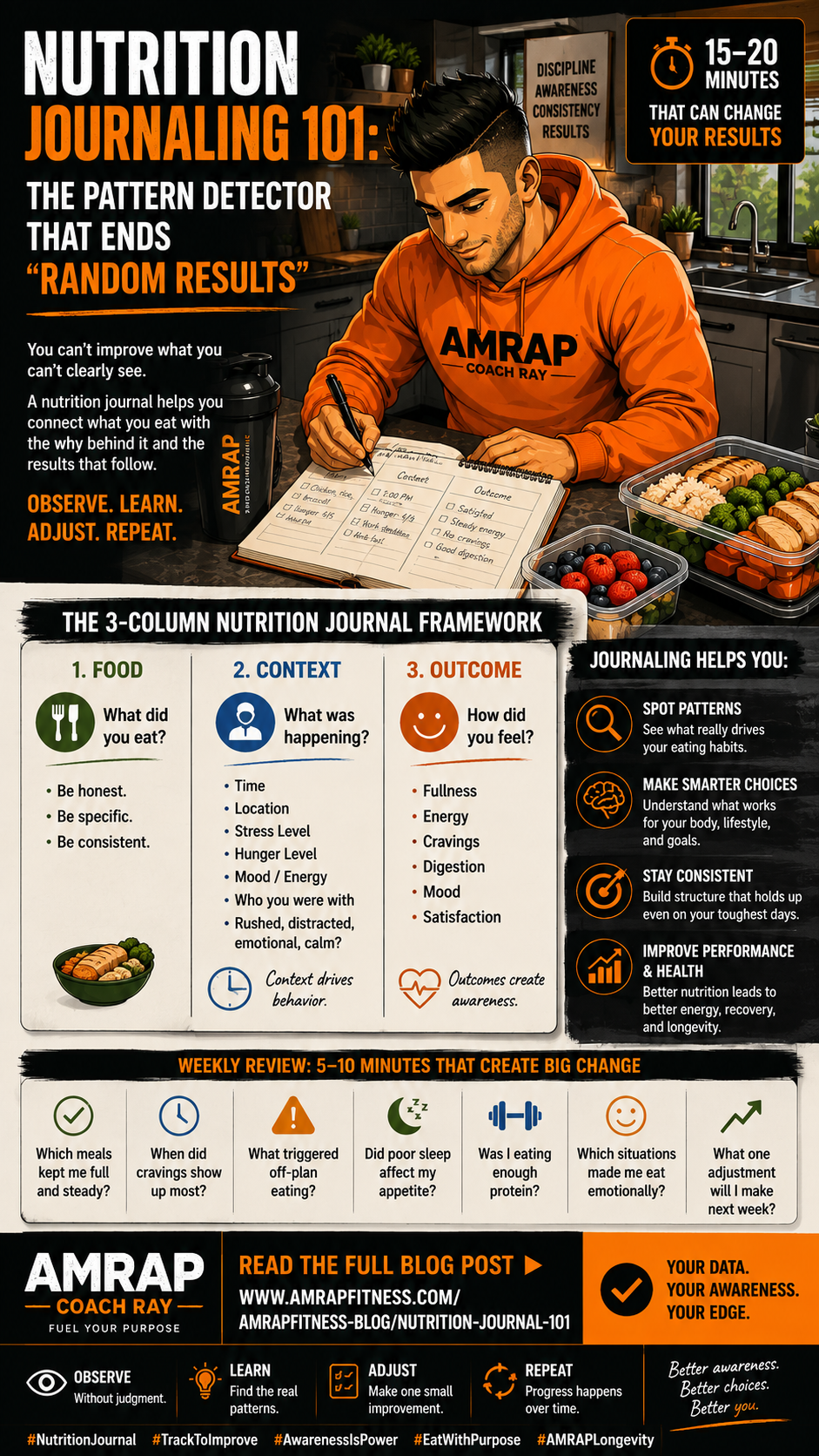
That means a real nutrition journal tracks three things:
What you ate
What was happening when you ate
How you felt afterward
That is the difference between “tracking food” and actually learning from your nutrition.
Because if all you record is calories or macros, you may know what happened, but not why it happened.
And if you do not understand the “why,” you will keep repeating the same cycle.
Why This Matters More After 40
After 40, the game changes.
Not because the body is broken.
Not because progress is impossible.
Not because metabolism is doomed.
But because the margin for error gets smaller.
Why?
Because adult life usually carries:
more responsibilities
more stress
less room for careless recovery
more old habits
more emotional load
less tolerance for extreme dieting
That means nutrition cannot rely on:
willpower alone
perfectly timed meals
unrealistic restrictions
all-or-nothing discipline
It has to rely on awareness + structure.
And journaling gives you both.
It shows you:
when hunger is actually hunger
when cravings are stress-driven
when low energy is under-fueling
when evening overeating started with a missed meal six hours earlier
when poor sleep is making appetite louder
when emotional strain is changing food behavior
This is a major reason nutrition journaling becomes a longevity skill.
Because the goal is not simply to lose weight.
The goal is to build a way of eating that remains stable under pressure.
The Real Problem: Most People Are Guessing
A lot of people say they want better nutrition.
But when asked simple questions, they often do not know the answers:
What time of day do you get the most cravings?
Which meals leave you satisfied the longest?
What situations make you eat too fast?
What foods trigger a “keep going” feeling?
What happens to your appetite after poor sleep?
Do you undereat during the day and overeat at night?
Are your hunger signals predictable or chaotic?
Do weekends change your structure dramatically?
That is not an insult.
It just means the person is operating without data.
And without data, every nutrition conversation feels emotional.
With data, the conversation becomes practical.
You move from:
“Why am I like this?”
to:
“Here is the pattern. Let’s adjust it.”
That shift matters.
Because shame keeps people stuck.
Awareness moves people forward.
The Science Signal: Why Self-Monitoring Works
One of the most consistently supported ideas in behavior change research is that self-monitoring works.
When people track a behavior, several things happen:
awareness increases
impulsive behavior becomes more visible
small choices become more deliberate
patterns can be identified
accountability improves
Self-monitoring has long been used in behavior-change programs because it helps bridge the gap between intention and action.
In nutrition specifically, food journaling has been associated with:
improved dietary awareness
greater adherence to nutrition goals
better long-term behavior insight
more successful weight-management patterns in many interventions
Why?
Because tracking creates feedback.
And feedback changes behavior.
Not perfectly.
Not instantly.
But meaningfully.
A nutrition journal helps you stop treating your eating like a mystery.
The AMRAP Nutrition Journal System
Now let’s keep this professional and practical.
A nutrition journal should not become another stressful job.
If it is too detailed, people quit.
If it is too vague, it becomes useless.
The best system is simple enough to sustain, but detailed enough to reveal patterns.
Here is the AMRAP approach:
The 3-Column Journal
For each meal, snack, or eating event, record:
Column 1 — Meal / Food
What did you eat?
Keep it simple:
eggs, toast, berries
Greek yogurt, oats, banana
chicken bowl with rice and vegetables
protein bar and coffee
handfuls of snacks while cooking
The point is not to be perfect.
The point is to be honest.
Column 2 — Context
What was happening?
This is where most people learn the most.
Track:
time
location
stress level
hunger level
who you were with
whether you were rushed, calm, distracted, or emotional
Examples:
“Ate quickly in the car”
“Very stressed from work”
“Not that hungry, just tired”
“Skipped lunch, starving by dinner”
“Watching TV and kept snacking”
This column is gold.
Because context often drives behavior more than knowledge.
Column 3 — Outcome
What happened after?
Track:
fullness
satisfaction
cravings
energy
digestion
mood
Examples:
“Satisfied for 3 hours”
“Still wanted something sweet”
“Energy crash 1 hour later”
“Ate too fast, uncomfortable”
“Felt stable and clear”
“This meal triggered more snacking”
This is where the learning happens.
What You Are Actually Looking For
A nutrition journal is not just a record.
It is a pattern detector.
Here are the main patterns you want to identify.
1. Hunger Patterns
When are you truly hungry?
Do you get hungry:
at predictable times?
only after long gaps?
more intensely after poor sleep?
more emotionally at night?
You are trying to distinguish:
real physiological hunger
fromconvenience eating
stress eating
boredom eating
reward eating
2. Meal Structure Patterns
Which meals actually work for you?
A good meal usually creates:
satiety
stable energy
less snacking
fewer cravings
better mood control
A poor meal often leads to:
hunger quickly returning
energy crash
sugar cravings
mindless snacking later
This tells you which meals should become your defaults.
3. Trigger Patterns
What situations make you go off course?
Common triggers include:
sleep deprivation
conflict
work pressure
skipped meals
social environments
unplanned evenings
eating while distracted
restrictive thinking
The goal is not to avoid life.
The goal is to recognize which conditions make your nutrition more fragile.
4. Recovery Patterns
How does recovery affect your eating?
One of the biggest blind spots in nutrition is that a lot of food behavior is actually recovery behavior.
If you sleep poorly:
hunger may rise
cravings may rise
emotional regulation may drop
If you are highly stressed:
decision-making weakens
comfort-seeking increases
structure gets harder
Journaling lets you connect recovery to nutrition instead of pretending they are separate.
The Professional Rule: Do Not Journal to Judge Yourself
This matters.
If journaling becomes a tool for self-attack, people stop being honest.
Then the journal becomes useless.
The mindset has to be:
Observe, do not condemn.
Your journal is not there to tell you that you are good or bad.
It is there to answer:
What happened?
Why did it happen?
What should change?
That is the standard.
A professional does not shame data.
A professional uses data.
The Weekly Review: Where the Real Value Shows Up
Daily tracking matters.
But the weekly review is where nutrition journaling becomes strategic.
Once per week, spend 5–10 minutes asking:
Weekly Nutrition Review Questions
Which meals kept me full and steady?
When did cravings show up most?
What triggered off-plan eating?
Did poor sleep affect my appetite?
Was I eating enough protein?
Did I go too long without eating?
Which situations made me eat emotionally?
What one adjustment would improve next week?
This turns your journal into a coaching tool.
Without the weekly review, you are just collecting information.
With the weekly review, you are learning.
The 5 Most Important Things to Track
If you want to keep it simple, these are the five highest-value things to record.
1. Meal Timing
Not because you need perfection.
But because long gaps often explain later overeating.
2. Protein Presence
Was there a meaningful protein source?
This matters because protein often supports:
satiety
muscle retention
recovery
more stable eating behavior
3. Hunger Level Before Eating
Rate it simply:
1 = not hungry
2 = lightly hungry
3 = appropriately hungry
4 = very hungry
5 = starving
This helps expose whether you are eating proactively or reactively.
4. Stress Level
Simple scale:
low
moderate
high
This often explains more than people expect.
5. Outcome After Eating
Did the meal leave you:
satisfied
still craving
overly full
tired
energized
bloated
calm
wanting more?
This is the most important question:
What did that meal do?
The “Nutrition Spiral” and How Journaling Stops It
Most nutrition spirals follow a predictable sequence.
It often looks like this:
poor sleep
rushed morning
skipped or small breakfast
excessive hunger later
fast lunch
low satisfaction
afternoon cravings
emotional fatigue
overeating at night
guilt
restriction the next morning
repeat
Without journaling, this feels like failure.
With journaling, it becomes visible as a sequence.
And once you see the sequence, you can intervene earlier.
For example:
improve breakfast protein
plan a more stable lunch
reduce long gaps
recognize that poor sleep is a high-risk day
use a pre-planned “default meal” when stressed
This is how journaling changes results.
It does not just document the spiral.
It helps prevent the spiral.
The Best Use of a Nutrition Journal: Building Default Meals
One of the smartest outcomes of journaling is this:
You discover which meals reliably work.
Those become your default meals.
Default meals reduce decision fatigue.
They are meals you can count on when life is busy.
A good default meal is:
easy to prepare
high in protein
satisfying
consistent
realistic
Examples might include:
Greek yogurt, oats, berries, whey
eggs, potatoes, fruit
chicken, rice, vegetables
lean beef bowl with potatoes and salad
protein smoothie plus fruit and nut butter
Journaling helps you identify:
which defaults keep you stable
which meals are unreliable
which combinations support your goals best
That is powerful.
Because the more stressful life gets, the more valuable dependable defaults become.
Common Mistakes in Nutrition Journaling
Mistake 1: Tracking only when you “do well”
That defeats the purpose.
Your difficult days contain the most useful data.
Mistake 2: Making the journal too detailed
If it takes too long, you will stop.
Simple wins.
Mistake 3: Using the journal to punish yourself
That creates dishonesty and avoidance.
The goal is insight, not shame.
Mistake 4: Ignoring context
Food without context misses the real lesson.
Mistake 5: Never reviewing the data
If you do not look for patterns, you are just writing things down.
The AMRAP Nutrition Journal Template
Here is the practical version.
Daily Entry Template
Meal / Snack:
What I ate:
Time:
When I ate:
Hunger Level (1–5):
Context:
Where was I?
How stressed was I?
Was I rushed, distracted, emotional, calm, social, tired?
Outcome:
How full was I?
Was I satisfied?
How was my energy?
Any cravings afterward?
Any digestive issues?
1-Line Note:
“This meal left me feeling ______.”
Weekly Review Template
This week I noticed:
My biggest hunger trigger was:
My biggest craving trigger was:
My most satisfying meal was:
My least satisfying meal was:
My highest-risk time of day was:
My recovery/nutrition connection was:
One thing I will improve next week is:
That is enough.
You do not need complexity.
You need clarity.
Self-Assessment
Answer honestly:
Do I know what situations make my nutrition fall apart?
Do I know which meals keep me most satisfied?
Do I understand the difference between hunger and stress cravings?
Do I know how poor sleep affects my eating?
Do I have any consistent record of what works for me?
Do I eat in response to patterns I have never actually tracked?
Am I blaming myself for problems I have not objectively examined?
Your answers are not judgment.
They are direction.
Closing: A Nutrition Journal Gives You Control Back
A nutrition journal does not make you rigid.
It makes you aware.
It does not turn you into someone obsessed with food.
It turns you into someone who understands your own behavior.
That is a major difference.
Because when you understand:
your hunger
your triggers
your stable meals
your risky situations
your recovery-food connection
…nutrition stops feeling random.
And when nutrition stops feeling random, consistency becomes more possible.
Not because you finally found more discipline.
But because you finally found more clarity.
That is what top-tier coaching does.
It does not just tell people what to eat.
It helps them understand why they eat the way they do—and how to improve it with intelligence, honesty, and structure.
That is the value of nutrition journaling.
And that is why it belongs in a longevity system.
Resources
Burke LE, Wang J, Sevick MA. Self-monitoring in weight loss: a systematic review of the literature. Journal of the American Dietetic Association. 2011.
Michie S, Richardson M, Johnston M, et al. The Behavior Change Technique Taxonomy (v1) of 93 hierarchically clustered techniques. Annals of Behavioral Medicine. 2013.
Harkin B, Webb TL, Chang BP, et al. Does monitoring goal progress promote goal attainment? A meta-analysis of the experimental evidence. Psychological Bulletin. 2016.
Hollis JF, Gullion CM, Stevens VJ, et al. Weight loss during the intensive intervention phase of the Weight-Loss Maintenance Trial. American Journal of Preventive Medicine. 2008.
Wing RR, Phelan S. Long-term weight loss maintenance. The American Journal of Clinical Nutrition. 2005.