Wednesday
Warm up & Skill
C & J
WOD
Complete the following:
7 minutes to find your 1 rep max C & J
Then…
3 rounds of:
30 double unders
Bar pull over to support to bar muscle up, 3 reps

Wednesday
Warm up & Skill
C & J
WOD
Complete the following:
7 minutes to find your 1 rep max C & J
Then…
3 rounds of:
30 double unders
Bar pull over to support to bar muscle up, 3 reps
Tuesday
Warm up
400m run
Net climb
OHS
Hollow rocks
Skill
Weighted pull-ups and dips
WOD
3 rounds of:
200m plate run (W/#25 M/#45)
3 weighted pull-ups
3 weighted dips
Warm up & Skill
Snatch technique
WOD
15 minutes to find your MAX load for complex
Snatch complex
-3 power snatches
-3 OHS
-3 drop snatches
-3 squat snatches
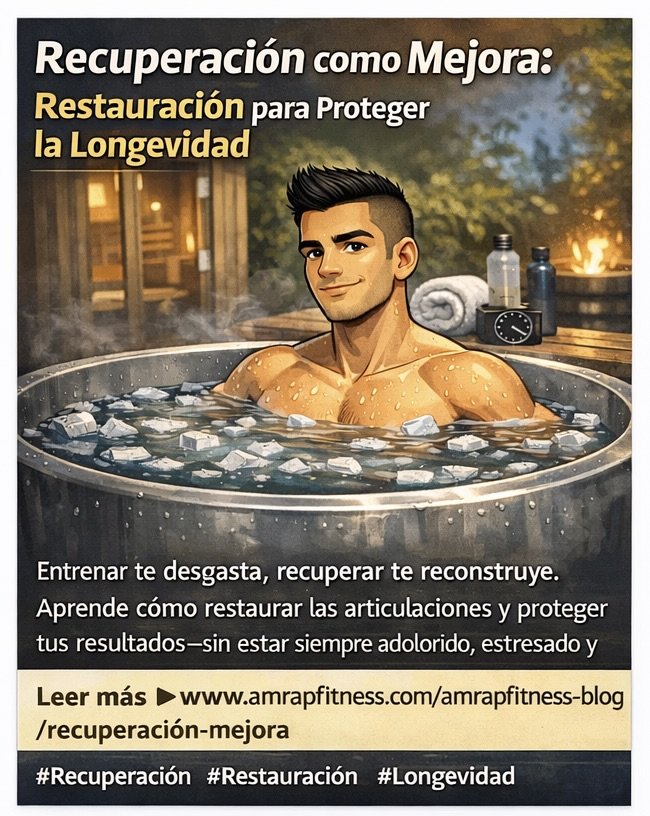
Se rompe por entrenar sin suficiente capacidad de restauración.
La mayoría de adultos no necesita más intensidad.
Necesita una mejor relación con la recuperación.
Porque longevidad no es ser el más duro del gimnasio.
Longevidad es ser la persona que puede:
entrenar por décadas
mantenerse con pocas molestias
sostener energía
manejar estrés
volver después de temporadas difíciles
Eso se llama:
restauración.
Y es diferente a “descansar.”
Esta es una entrada pilar (introducción) — para que luego podamos profundizar sin repetir.
Mucha gente intenta resolver fatiga con esfuerzo.
Se siente pesado, con niebla mental e irritable…
y empuja más.
Otro entreno. Menos calorías. Más cafeína.
Y por un rato funciona.
Hasta que deja de funcionar.
Entonces el cuerpo manda señales:
el sueño se vuelve ligero
el apetito se hace más fuerte
los antojos suben
las molestias duran
el humor se acorta
la motivación se vuelve fricción
Y aparece una idea peligrosa:
“Tal vez ya no soy disciplinado.”
No.
La mayoría de las veces no es falta de disciplina.
Es baja recuperación.
Y la solución no es “suavidad.”
Es profesionalismo.
Capacidad de regresar a tu nivel normal después de estrés.
Es expandir tu “buffer.”
Diferencia entre:
“Sobrevivo una semana dura.” vs.
“Una semana dura me destruye.”
No buscamos solo descanso.
Construimos un sistema que te hace difícil de agotar.
Muchos creen que necesitan mejor rutina.
Pero su base ya está cargada:
estrés crónico
sueño inconsistente
poca proteína/fibra
poco movimiento diario
demasiado sentado
demasiada pantalla
carga emocional
Y encima entrenan.
Entrenar es un estresor (bueno).
Pero estrés + estrés + estrés sin restauración =
quiebre.
Por eso atletas profesionales recuperan como si fuera trabajo.
Si quieres resultados de longevidad, recuperar debe ser identidad.
Una declaración de consenso sobre síndrome de sobreentrenamiento enfatiza que el entrenamiento exitoso requiere sobrecarga y recuperación adecuada, y que la combinación de exceso de carga con recuperación insuficiente puede llevar a maladaptación. (pubmed.ncbi.nlm.nih.gov)
La evidencia meta-analítica apoya que la inmersión en agua fría puede reducir dolor muscular y mejorar la percepción de recuperación, aunque algunas discusiones señalan posibles efectos sobre adaptaciones de fuerza si se usa de forma crónica tras entrenamiento de resistencia. (pmc.ncbi.nlm.nih.gov)
Datos prospectivos en hombres finlandeses encontraron que mayor frecuencia de sauna se asocia con menor riesgo de eventos cardiovasculares fatales y mortalidad total. (pubmed.ncbi.nlm.nih.gov)
Traducción de coaching: Herramientas ayudan, pero los fundamentos (sueño, manejo de carga, nutrición, movimiento) son la base.
protege ventana de sueño
estabiliza hora de despertar
rutina de bajada repetible
no quemarte
deloads
volumen controlado
1–3 repeticiones antes del fallo la mayoría de días
proteína suficiente
energía suficiente
hidratación + electrolitos
caminatas 7–10 min después de comer
caminata corta tras bloques de estrés
sauna
inmersión fría
movilidad + respiración
masaje/tejido blando
calidad de sueño
energía
dolor/malestar muscular-articular
Si 2 de 3 son ≤2 (de 1–5): entrenas, pero reduces el costo.
Cada 4–8 semanas:
reduce volumen 30–50%
mantén calidad
Sales con ganas de entrenar.
Usar herramientas para justificar exceso de carga
Tratar el agotamiento como medalla
Regla de longevidad:
Entrena lo suficiente para progresar. Recupera lo suficiente para durar.
2 sesiones de fuerza (cortas)
2 sesiones Zona 2
caminatas diarias 7–10 min
proteína en cada comida
ancla de despertar
¿Despierto restaurado o ya atrasado?
¿Las molestias duran más de lo normal?
¿Dependo de cafeína para sentirme normal?
¿Bajo estrés entreno más duro o recupero más inteligente?
¿Tengo plan de deload o espero a romperme?
No es juicio.
Es ruta.
Recuperación no es algo que “pasa.”
Es algo que construyes.
Un cuerpo restaurado:
entrena con constancia
tolera estrés
maneja contratiempos
envejece con confianza
Eso es salud a largo plazo.
Meeusen R, et al. Prevención, diagnóstico y tratamiento del síndrome de sobreentrenamiento (consenso ECSS/ACSM). 2013. (pubmed.ncbi.nlm.nih.gov)
Xiao F, et al. Inmersión en agua fría tras ejercicio y recuperación de fatiga: evidencia sistemática/meta-analítica (2023). (pmc.ncbi.nlm.nih.gov)
Cain T, et al. Efectos de la inmersión en agua fría en salud y bienestar: meta-análisis (2025). (journals.plos.org)
Roberts LA, et al. Agua fría y recuperación de función muscular tras ejercicio de fuerza (2014). (journals.physiology.org)
Laukkanen T, et al. Sauna y riesgo de eventos cardiovasculares fatales y mortalidad total (2015). (pubmed.ncbi.nlm.nih.gov)
Laukkanen JA, et al. Beneficios cardiovasculares y de salud del sauna (revisión, 2018). (mayoclinicproceedings.org)
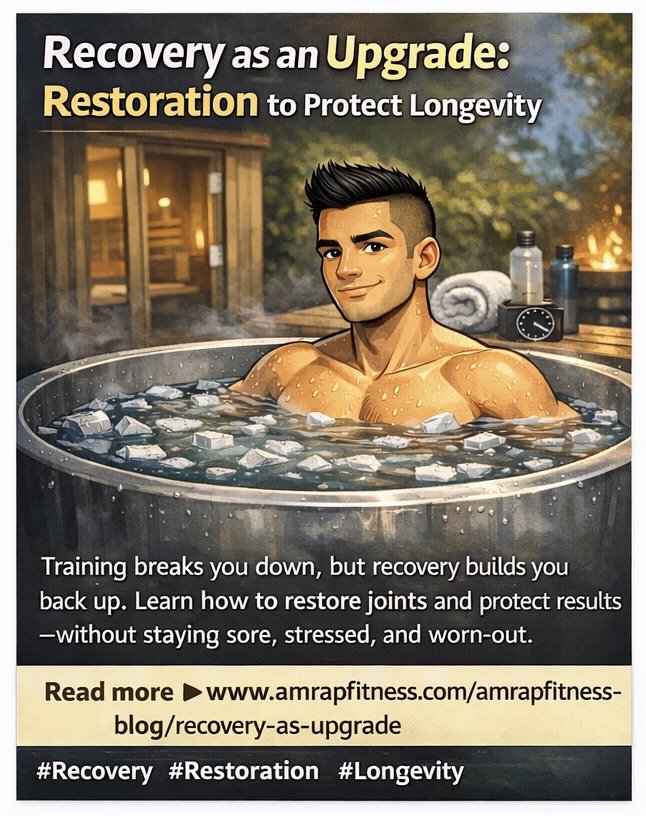
It breaks because you train without enough restoration capacity.
Most adults don’t need more intensity.
They need a better relationship with recovery.
Because longevity isn’t about being the toughest person in the gym.
Longevity is about being the person who can:
train for decades
stay pain-resilient
maintain energy
manage stress
and come back after hard seasons
That ability has a name:
restoration.
And it’s different from “rest.”
This is a pillar intro entry — meaning we’ll build a foundation here so we can deep-dive later without repeating ourselves.
Most people try to solve fatigue with effort.
They feel heavy, foggy, and irritable… so they push harder.
They add another workout. They cut more calories. They drink more caffeine.
And for a little while, it works.
Until it doesn’t.
Then the body starts sending signals:
sleep gets lighter
appetite gets louder
cravings get sharper
aches linger
mood gets shorter
motivation turns into friction
And then the person starts believing something dangerous:
“Maybe I’m just not disciplined anymore.”
No.
Most of the time, they’re not undisciplined.
They’re under-recovered.
And the solution isn’t softness.
It’s professionalism.
Recovery is your ability to bounce back from stressors.
Workout stress. Work stress. Life stress.
Restoration is what expands your “buffer.”
It’s the difference between:
“I can survive a hard week.” vs.
“A hard week wipes me out.”
So we’re not just chasing rest.
We’re building a system that makes you harder to exhaust.
A lot of people think they need a better workout plan.
But the real issue is that their baseline is already taxed:
chronic stress
inconsistent sleep
under-eating protein/fiber
low daily movement
too much sitting
too much screen time
emotional load
Then they layer training on top.
Training is a stressor. A healthy stressor.
But stress + stress + stress without restoration becomes…
breakdown.
This is why professional athletes don’t train hard every day.
They train hard strategically — and they recover like it’s part of the job.
If you want longevity results, recovery has to become part of your identity.
A joint consensus statement on overtraining syndrome emphasizes that successful training requires overload and adequate recovery, and that excessive overload combined with insufficient recovery can contribute to maladaptation. (pubmed.ncbi.nlm.nih.gov)
Meta-analytic evidence indicates cold water immersion after strenuous exercise can reduce soreness and improve perceived recovery, though some discussions raise concerns about potential interference with certain strength adaptations if used chronically after resistance training. (pmc.ncbi.nlm.nih.gov)
Prospective cohort data from Finnish men found higher sauna frequency was associated with lower risks of fatal cardiovascular outcomes and all-cause mortality. (pubmed.ncbi.nlm.nih.gov)
Coaching translation: Recovery tools can help — but the fundamentals (sleep, load management, nutrition, movement) are the foundation.
This is the “operating system.”
We’ll use it forever.
If sleep is unstable, everything is harder.
Your rule:
protect a sleep window
stabilize wake time as often as possible
build a repeatable downshift routine
Sleep is the strongest recovery multiplier you have.
Most overuse issues come from:
too much intensity
too much volume
too little recovery
Professional rule: You don’t “earn” burnout. You prevent it.
Tools:
deload weeks
volume caps
stop 1–3 reps shy of failure most days
Recovery isn’t just sleep.
It’s tissue repair.
That requires:
adequate protein
enough total energy
hydration + electrolytes
When people under-eat, their soreness lingers and motivation drops.
Walking is not a fat-loss gimmick.
It’s nervous system hygiene.
7–10 minutes after meals
short walks after stressful blocks
These can help, but they’re not replacements.
Examples:
sauna (heat exposure)
cold plunge / cold water immersion
mobility + breathwork
massage / soft tissue work
We use these strategically.
If you don’t measure it, you’ll confuse:
low motivation with
low recovery
So we track simple signals.
Rate each 1–5:
Sleep quality
Energy
Muscle/joint soreness
If two of three are ≤2: you train, but you reduce cost.
That’s anti-fragile.
A recovery day is not a throwaway.
It’s a build day.
20–30 min easy walk
8–10 min mobility (hips/ankles/T-spine)
conversational pace
finish feeling better
dim lights
slow nasal breathing
longer exhale
journal 3 lines: “what went well / what can wait / one gratitude”
A deload is not weakness.
It’s how you bank adaptation.
Simple deload rule (every 4–8 weeks):
reduce volume ~30–50%
keep some intensity but fewer sets
focus on quality reps
The goal is to exit the deload feeling hungry to train.
Not relieved.
Ice baths, sauna, massage — none of these fix chronic overload.
If your training identity requires you to be crushed, that identity will eventually break.
Longevity is a different standard:
Train hard enough to progress. Recover hard enough to last.
When stress spikes, your goal is not PRs.
Your goal is continuity.
Minimum plan:
2 strength sessions (short)
2 Zone 2 sessions
daily 7–10 min walks
protein at every meal
protect wake time anchor
That’s how you survive a season.
Answer honestly:
Do I wake up restored or already behind?
Does soreness linger longer than it should?
Do I rely on caffeine to feel normal?
When stress hits, do I train harder—or recover smarter?
Do I have a deload strategy, or do I wait until I break?
Your answers aren’t judgment.
They’re your upgrade path.
Recovery is not something you hope happens.
It’s something you build.
A restored body:
trains more consistently
tolerates stress better
handles setbacks without spiraling
ages with more confidence
That is healthspan.
That is longevity.
Meeusen R, et al. Prevention, Diagnosis, and Treatment of the Overtraining Syndrome: Joint Consensus Statement (ECSS/ACSM). 2013. (pubmed.ncbi.nlm.nih.gov)
Xiao F, et al. Effects of cold water immersion after exercise on fatigue recovery: systematic review/meta-analytic evidence (2023). (pmc.ncbi.nlm.nih.gov)
Cain T, et al. Effects of cold-water immersion on health and wellbeing: PLOS ONE meta-analysis (2025). (journals.plos.org)
Roberts LA, et al. Cold water immersion and recovery of muscle function after resistance exercise (2014). (journals.physiology.org)
Laukkanen T, et al. Sauna bathing and risk of fatal cardiovascular events and all-cause mortality (2015). (pubmed.ncbi.nlm.nih.gov)
Laukkanen JA, et al. Cardiovascular and Other Health Benefits of Sauna Bathing (review, 2018). (mayoclinicproceedings.org)