Recovery & Restoration: The Most Undervalued Longevity Skill (And How to Build It)
(AMRAP Longevity Series — Pillar Intro #2)
Your body doesn’t break because you train.
It breaks because you train without enough restoration capacity.
Most adults don’t need more intensity.
They need a better relationship with recovery.
Because longevity isn’t about being the toughest person in the gym.
Longevity is about being the person who can:
train for decades
stay pain-resilient
maintain energy
manage stress
and come back after hard seasons
That ability has a name:
restoration.
And it’s different from “rest.”
This is a pillar intro entry — meaning we’ll build a foundation here so we can deep-dive later without repeating ourselves.
Opening Device: When “More Effort” Stops Working
Most people try to solve fatigue with effort.
They feel heavy, foggy, and irritable… so they push harder.
They add another workout. They cut more calories. They drink more caffeine.
And for a little while, it works.
Until it doesn’t.
Then the body starts sending signals:
sleep gets lighter
appetite gets louder
cravings get sharper
aches linger
mood gets shorter
motivation turns into friction
And then the person starts believing something dangerous:
“Maybe I’m just not disciplined anymore.”
No.
Most of the time, they’re not undisciplined.
They’re under-recovered.
And the solution isn’t softness.
It’s professionalism.
Recovery vs. Restoration (The Definitions That Change Everything)
Recovery = returning to baseline
Recovery is your ability to bounce back from stressors.
Workout stress. Work stress. Life stress.
Restoration = increasing your capacity to recover
Restoration is what expands your “buffer.”
It’s the difference between:
“I can survive a hard week.” vs.
“A hard week wipes me out.”
So we’re not just chasing rest.
We’re building a system that makes you harder to exhaust.
The Longevity Problem: Modern Adults Live in a Recovery Deficit
A lot of people think they need a better workout plan.
But the real issue is that their baseline is already taxed:
chronic stress
inconsistent sleep
under-eating protein/fiber
low daily movement
too much sitting
too much screen time
emotional load
Then they layer training on top.
Training is a stressor. A healthy stressor.
But stress + stress + stress without restoration becomes…
breakdown.
This is why professional athletes don’t train hard every day.
They train hard strategically — and they recover like it’s part of the job.
If you want longevity results, recovery has to become part of your identity.
The Science Signal: What the Evidence Supports
1) Overload requires adequate recovery
A joint consensus statement on overtraining syndrome emphasizes that successful training requires overload and adequate recovery, and that excessive overload combined with insufficient recovery can contribute to maladaptation. (pubmed.ncbi.nlm.nih.gov)
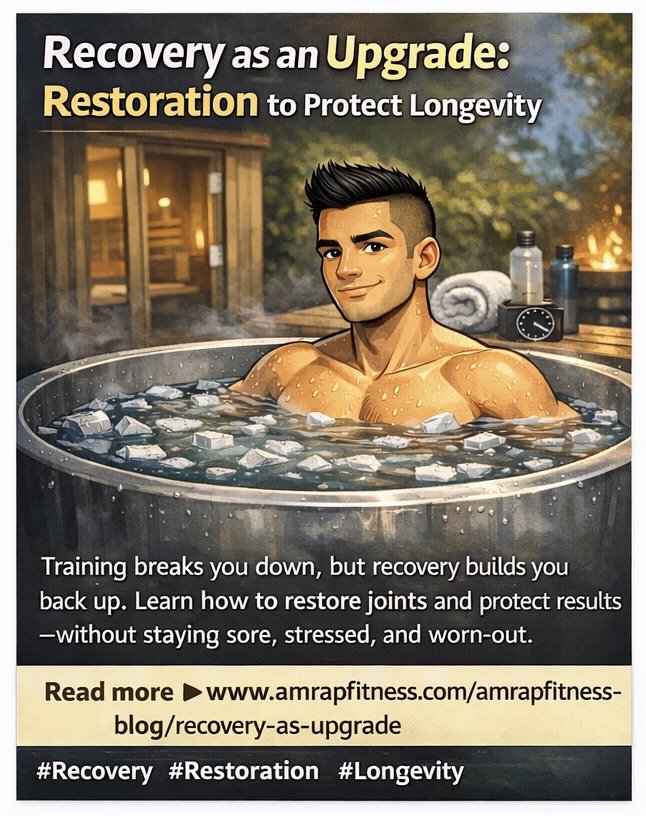
2) Cold water immersion can reduce soreness and improve perceived recovery (with caveats)
Meta-analytic evidence indicates cold water immersion after strenuous exercise can reduce soreness and improve perceived recovery, though some discussions raise concerns about potential interference with certain strength adaptations if used chronically after resistance training. (pmc.ncbi.nlm.nih.gov)
3) Sauna bathing is associated with lower cardiovascular and all-cause mortality risk in cohort studies
Prospective cohort data from Finnish men found higher sauna frequency was associated with lower risks of fatal cardiovascular outcomes and all-cause mortality. (pubmed.ncbi.nlm.nih.gov)
Coaching translation: Recovery tools can help — but the fundamentals (sleep, load management, nutrition, movement) are the foundation.
The AMRAP Restoration Framework (The 5 Levers)
This is the “operating system.”
We’ll use it forever.
Lever 1 — Sleep Rhythm (Not Perfect Sleep)
If sleep is unstable, everything is harder.
Your rule:
protect a sleep window
stabilize wake time as often as possible
build a repeatable downshift routine
Sleep is the strongest recovery multiplier you have.
Lever 2 — Load Management (Train Hard, Don’t Live Hard)
Most overuse issues come from:
too much intensity
too much volume
too little recovery
Professional rule: You don’t “earn” burnout. You prevent it.
Tools:
deload weeks
volume caps
stop 1–3 reps shy of failure most days
Lever 3 — Nutrition as Recovery
Recovery isn’t just sleep.
It’s tissue repair.
That requires:
adequate protein
enough total energy
hydration + electrolytes
When people under-eat, their soreness lingers and motivation drops.
Lever 4 — Daily Movement (NEAT as a Downshift)
Walking is not a fat-loss gimmick.
It’s nervous system hygiene.
7–10 minutes after meals
short walks after stressful blocks
Lever 5 — Restoration Tools (Optional, Not Mandatory)
These can help, but they’re not replacements.
Examples:
sauna (heat exposure)
cold plunge / cold water immersion
mobility + breathwork
massage / soft tissue work
We use these strategically.
The Pro Rule: Recovery Must Be Measurable
If you don’t measure it, you’ll confuse:
low motivation with
low recovery
So we track simple signals.
The “3-Point Recovery Check” (daily, 30 seconds)
Rate each 1–5:
Sleep quality
Energy
Muscle/joint soreness
If two of three are ≤2: you train, but you reduce cost.
That’s anti-fragile.
The Recovery Day Playbook (What to Do Instead of “Nothing”)
A recovery day is not a throwaway.
It’s a build day.
Option A — Restoration Walk + Mobility (30–40 min)
20–30 min easy walk
8–10 min mobility (hips/ankles/T-spine)
Option B — Zone 2 Recovery (25–40 min)
conversational pace
finish feeling better
Option C — Nervous System Downshift (12 minutes)
dim lights
slow nasal breathing
longer exhale
journal 3 lines: “what went well / what can wait / one gratitude”
Deloading 101 (The Longevity Multiplier People Skip)
A deload is not weakness.
It’s how you bank adaptation.
Simple deload rule (every 4–8 weeks):
reduce volume ~30–50%
keep some intensity but fewer sets
focus on quality reps
The goal is to exit the deload feeling hungry to train.
Not relieved.
Two Common Recovery Traps
Trap 1: Using recovery tools to justify excessive training
Ice baths, sauna, massage — none of these fix chronic overload.
Trap 2: Treating exhaustion like a badge
If your training identity requires you to be crushed, that identity will eventually break.
Longevity is a different standard:
Train hard enough to progress. Recover hard enough to last.
The “Hard Week Protocol” (When Life Hits)
When stress spikes, your goal is not PRs.
Your goal is continuity.
Minimum plan:
2 strength sessions (short)
2 Zone 2 sessions
daily 7–10 min walks
protein at every meal
protect wake time anchor
That’s how you survive a season.
Self-Assessment (Reader Tool)
Answer honestly:
Do I wake up restored or already behind?
Does soreness linger longer than it should?
Do I rely on caffeine to feel normal?
When stress hits, do I train harder—or recover smarter?
Do I have a deload strategy, or do I wait until I break?
Your answers aren’t judgment.
They’re your upgrade path.
Closing: Restoration Is a Skill
Recovery is not something you hope happens.
It’s something you build.
A restored body:
trains more consistently
tolerates stress better
handles setbacks without spiraling
ages with more confidence
That is healthspan.
That is longevity.
Resources
Meeusen R, et al. Prevention, Diagnosis, and Treatment of the Overtraining Syndrome: Joint Consensus Statement (ECSS/ACSM). 2013. (pubmed.ncbi.nlm.nih.gov)
Xiao F, et al. Effects of cold water immersion after exercise on fatigue recovery: systematic review/meta-analytic evidence (2023). (pmc.ncbi.nlm.nih.gov)
Cain T, et al. Effects of cold-water immersion on health and wellbeing: PLOS ONE meta-analysis (2025). (journals.plos.org)
Roberts LA, et al. Cold water immersion and recovery of muscle function after resistance exercise (2014). (journals.physiology.org)
Laukkanen T, et al. Sauna bathing and risk of fatal cardiovascular events and all-cause mortality (2015). (pubmed.ncbi.nlm.nih.gov)
Laukkanen JA, et al. Cardiovascular and Other Health Benefits of Sauna Bathing (review, 2018). (mayoclinicproceedings.org)