Warm up
600m run
Broad jumps
Inversion to skin the cat to lower
Bar pull over to support
OHS
Skill
Review movement standards
WOD
“Barbra”
5 rounds of:
20 pull ups
30 push ups
40 sit ups
50 air squats
3 minutes rest


Warm up
600m run
Broad jumps
Inversion to skin the cat to lower
Bar pull over to support
OHS
Skill
Review movement standards
WOD
“Barbra”
5 rounds of:
20 pull ups
30 push ups
40 sit ups
50 air squats
3 minutes rest
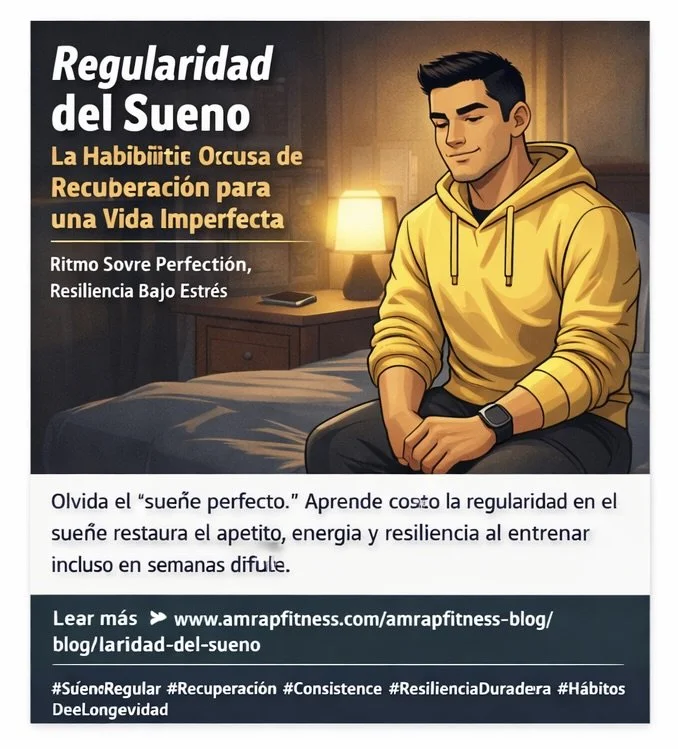
Se construye con cómo te recuperas de la vida.
Y recuperarse no es solamente “dormir más.”
Para adultos reales — padres, cuidadores, maestros, dueños de negocio, personas bajo presión — el enemigo no siempre es dormir poco.
El enemigo es el sueño caótico.
Porque el caos no solo te cansa. Te vuelve:
más hambriento
más reactivo
más inflamable
más sensible al dolor
más propenso a saltarte entrenos
más propenso a perseguir azúcar y cafeína
Y convierte una semana normal en una lucha para sentirte tú.
Esta entrada trata sobre la habilidad que te protege incluso cuando la vida no permite perfección:
regularidad del sueño — la capacidad de mantener un ritmo sueño‑vigilia lo suficientemente estable para que tu cuerpo baje revoluciones, repare y despierte con energía usable.
No fantasía. No hora perfecta.
Un sistema profesional y táctico.
Hay un tipo de fatiga que hace sentir a la gente rota.
Estás agotado. Te arden los ojos. El cuerpo pesa.
Y aun así — no te duermes.
O te duermes… y te despiertas a las 2:11 a.m.
Y el cerebro hace lo que hace cuando todo está oscuro:
repite conversaciones
imagina escenarios
piensa en dinero
piensa en los hijos
piensa en todo lo que salió mal
Al día siguiente no solo estás cansado.
Estás emocionalmente frágil.
La fuerza de voluntad se siente delgada. La comida suena más fuerte. El estrés pesa más.
Eso no es debilidad.
Es fisiología.
Y una de las palancas más poderosas no es “dormir 9 horas.”
Es regularidad.
La regularidad del sueño es la consistencia del horario — especialmente:
tu hora de despertar
la estabilidad de tu ventana diaria de sueño
No es perfección.
Es reducir los cambios bruscos que desajustan el ritmo circadiano.
Piénsalo como entrenamiento:
El cuerpo prospera con progreso. Se rompe con caos.
Dormir funciona igual.
Si duermes a las 10 p.m. un día, 1 a.m. otro, 9 p.m. el siguiente… el sistema nervioso nunca aprende a bajar.
La regularidad entrena tu reloj interno para:
apagarse
encenderse
Y esa estabilidad influye:
apetito
glucosa
estado de ánimo
inflamación y dolor
recuperación y preparación para entrenar
La investigación moderna está dando más peso a la regularidad como métrica propia, no solo a la duración.
Un estudio importante en Sleep (2024) reportó que la regularidad puede predecir riesgo de mortalidad y en algunos análisis puede ser más fuerte que la duración.
Otros estudios poblacionales han relacionado patrones irregulares con mayor riesgo.
Punto clave para coaching:
No necesitas sueño perfecto. Necesitas sueño más predecible.
Y eso es excelente noticia para adultos reales.
Después de los 40, el margen de error se reduce.
No porque seas frágil. Porque estás ocupado.
Cuando el sueño es inconsistente:
la cafeína se vuelve muleta
el entrenamiento cuesta más recuperar
sube el riesgo de molestias
aumentan antojos
baja la paciencia
Y se pierde identidad:
“Ya no soy constante.”
La regularidad protege identidad.
Porque cuando el sistema nervioso baja por la noche, despiertas con un punto de partida que hace posible la disciplina.
No fácil.
Posible.
Falta un sistema para vidas imperfectas.
Decir “acuéstate más temprano” a un adulto estresado es como decir “ten menos estrés.”
Así que lo hacemos como profesionales:
Reglas que funcionan bajo presión.
Si solo estabilizas UNA cosa, estabiliza esta:
hora de despertar.
Porque esa hora guía:
exposición a luz
comidas
entrenamiento
presión de sueño nocturna
Regla:
elige una ventana realista
mantenla dentro de 60–90 minutos
Dormir 3 horas más tarde el fin de semana = mini jetlag.
Regla real:
Protege la ventana más que la hora exacta.
Consistencia vence perfección.
2 min: ambiente
luces bajas
teléfono boca abajo
cuarto fresco
5 min: bajada fisiológica
respiración nasal lenta
exhalación más larga
5 min: descarga mental
3 líneas:
qué hice bien hoy
qué puede esperar
una gratitud
Estás entrenando el mensaje:
“Ahora estamos seguros.”
Base práctica:
sin cafeína 8+ horas antes de dormir
Si eres sensible, 10 horas.
Mañana:
luz exterior dentro de 60 min al despertar (5–10 min ayuda)
Noche:
bajar luces 60 min antes
Señal: día es día, noche es noche.
Si dormiste mal:
Mantén entrenamiento, baja costo
fuerza sí
volumen -30–40%
Cambia intensidad por Zona 2
20–40 min ritmo conversacional
Cero entrenos para “demostrar.”
Rompe el ciclo.
Cuando el sueño es irregular:
sube el apetito
suben antojos
baja energía
baja movimiento
Con regularidad:
más estabilidad
menos drama
menos “reinicio el lunes”
Si tienes dos noches malas seguidas, entras 48 horas en modo protección:
sin déficit agresivo
sin máximos
proteína + hidratación
caminar/Zona 2
wind-down más temprano
Latigazo de fin de semana
mantener despertar 60–90 min
Teléfono hasta el último segundo
boca abajo en wind-down
Cafeína tarde
corte
Esperar a que la vida se calme
sistema bajo presión
¿Mi despertar es consistente (60–90 min) la mayoría de días?
¿Me siento encendido por la noche aunque esté cansado?
¿Mal sueño dispara antojos al día siguiente?
¿Tengo una rutina repetible de bajada?
¿Cuando duermo mal, ajusto entrenamiento o me castigo?
No es juicio.
Es plan.
La regularidad no solo da energía.
Mejora quién eres bajo presión.
Te ayuda a despertar con:
paciencia
claridad
apetito más estable
mejor tolerancia al dolor
mejor preparación para entrenar
No es tendencia.
Es ventaja.
Y está disponible sin perfección.
Con estructura.
Windred DP, et al. Sleep regularity is a stronger predictor of mortality risk than sleep duration. Sleep. 2024. https://pubmed.ncbi.nlm.nih.gov/37738616/
Park SJ, et al. Sleep duration and regularity and all-cause mortality risk. Scientific Reports. 2025. https://www.nature.com/articles/s41598-025-15828-6
Phillips AJK, et al. Irregular sleep/wake patterns are associated with poorer outcomes and delayed circadian timing. Scientific Reports. 2017. https://www.nature.com/articles/s41598-017-03171-4
Lunsford-Avery JR, et al. Sleep regularity and cardiometabolic health: review of associations. 2021. https://pubmed.ncbi.nlm.nih.gov/33581380/
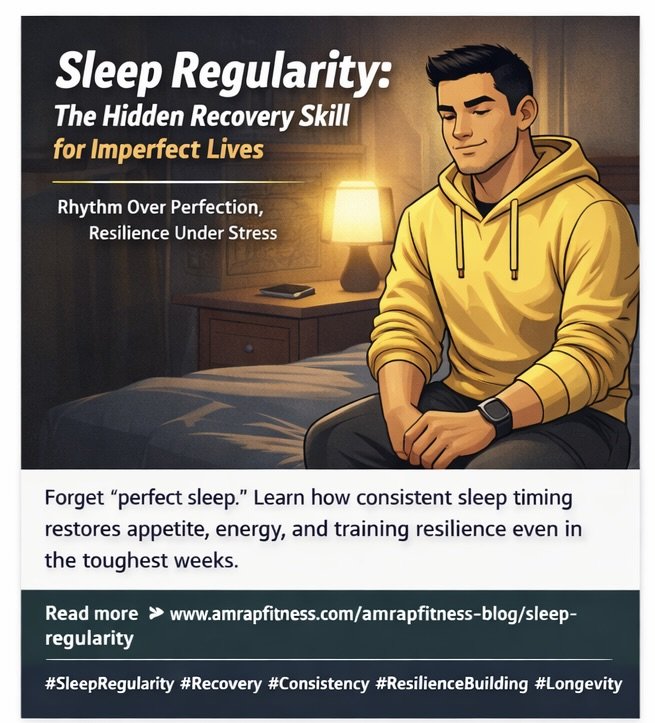
It’s built in how you recover from life.
And recovery isn’t just “sleep more.”
For real adults — parents, caretakers, teachers, business owners, people under pressure — the enemy isn’t always short sleep.
The enemy is chaotic sleep.
Because chaos doesn’t just make you tired. It makes you:
hungrier
more reactive
more inflamed
more pain-sensitive
more likely to skip training
more likely to chase sugar and caffeine
And it turns a normal week into a struggle to feel like yourself.
This entry is about the skill that protects you even when life won’t allow perfection:
sleep regularity — the ability to keep your sleep-wake rhythm stable enough that your body can downshift, repair, and wake up with usable energy.
Not fantasy. Not a perfect bedtime.
A professional, tactical system.
There’s a specific kind of fatigue that makes people feel broken.
You’re exhausted. Your eyes burn. Your body feels heavy.
And still — you can’t fall asleep.
Or you fall asleep… and wake up at 2:11 a.m.
And then your brain does what brains do when the lights are off:
replays conversations
forecasts worst-case scenarios
thinks about money
thinks about the kids
thinks about everything you didn’t do right
You wake up the next day and you’re not just tired.
You’re emotionally brittle.
You feel like your willpower is thin. You feel like food is louder. You feel like stress is heavier.
That’s not weakness.
That’s physiology.
And one of the most powerful levers to stabilize that physiology isn’t “sleep 9 hours.”
It’s regularity.
Sleep regularity is the consistency of your sleep timing — especially:
your wake time
and the stability of your daily sleep window
It’s not about perfection. It’s about reducing the violent swings that throw off circadian rhythm.
Think of it like training.
A body that thrives on progressive overload does poorly on random chaos.
Sleep works the same way.
When you sleep at 10 p.m. one night, 1 a.m. the next, then 9 p.m. the next — your nervous system never learns a stable downshift.
Regularity trains your internal clock to do two things better:
power down
power up
And that stability echoes into:
appetite hormones
glucose regulation
mood regulation
inflammation and pain perception
recovery and training readiness
Modern research has been increasingly focusing on sleep regularity as its own metric — not just duration.
A major study in the journal Sleep (2024) reported that sleep regularity can be a strong predictor of mortality risk and may be a stronger predictor than sleep duration in some analyses.
Other population studies have linked irregular sleep patterns (timing variability) with higher risk profiles.
The key point for coaching is practical:
You don’t need perfect sleep to improve outcomes. You need more predictable sleep.
That is good news for real adults.
After 40, your margin for error shrinks.
Not because you’re fragile — because you’re busy.
When sleep becomes inconsistent:
caffeine becomes a crutch
training becomes harder to recover from
injury risk creeps up
cravings rise
patience drops
And then the person starts losing identity:
“I’m not consistent anymore.”
Sleep regularity protects identity.
Because when your nervous system can downshift at night, you wake up with a baseline that makes discipline possible.
Not easy.
Possible.
They need a system for imperfect lives.
If you tell a stressed adult: “Just go to bed earlier,”
you might as well say: “Just have less stress.”
Because life doesn’t cooperate.
So professionals do this differently:
They build rules that work under pressure.
That’s what we’re doing here.
If you only stabilize ONE thing, stabilize this:
wake time.
Because your wake time drives:
light exposure
meal timing
training timing
sleep pressure at night
Pick a wake time window you can hit most days.
Keep it within a 60–90 minute range.
If you sleep in 3 hours later on weekends, you’re basically giving your body a mini-jetlag.
Not judgment.
Physics.
This is the real-adult rule:
Protect a sleep window more than a perfect bedtime.
Example: If your life won’t allow 10 p.m. every night, stop chasing it.
Instead:
create a stable wind-down
keep wake time consistent
aim for a reasonable window
Consistency beats perfection.
This is where most people fail.
They stop moving at night… but their nervous system never downshifts.
So we give the body a cue.
2 minutes: set environment
dim lights
phone face down
cool room if possible
5 minutes: physiological downshift
slow nasal breathing
longer exhale than inhale
or legs-up-the-wall if your back likes it
5 minutes: mental unload
write 3 lines:
what I did right today
what can wait until tomorrow
one thing I’m grateful for
You’re training your nervous system to recognize:
“We are safe now.”
That’s not soft.
That’s performance.
Caffeine is not evil.
But for many people, late caffeine is an invisible sleep killer.
Set a caffeine cutoff that protects your nights.
Common coaching baseline: no caffeine 8+ hours before sleep.
If you’re sensitive, make it 10 hours.
This one change often improves sleep depth dramatically.
Your circadian rhythm runs on light.
get outdoor light within 60 minutes of waking (even 5–10 minutes)
dim lights 60 minutes before bed
This isn’t about being perfect.
It’s about signaling your brain:
day is day, night is night.
This is where longevity athletes win.
Not by forcing intensity.
By preserving consistency.
If you slept poorly:
keep strength work
cut volume by ~30–40%
keep bar speed crisp
stop earlier than usual
20–40 minutes conversational pace
OR a long walk
Because proof workouts create:
nervous system overload
cravings
more poor sleep
You don’t win that cycle.
You break it.
People think fat loss is mostly a food discipline problem.
Often it’s a recovery stability problem.
When sleep is irregular:
appetite increases
cravings increase
energy decreases
movement decreases
That means you’re fighting biology.
When regularity improves, fat loss becomes less about suffering.
It becomes about:
steady behavior
predictable energy
fewer “reset Mondays”
Here’s a simple rule for real life:
If you have two bad nights in a row, you go into recovery protection mode for 48 hours.
That means:
no aggressive dieting
no maximal training
prioritize protein + hydration
Zone 2 or walking
earlier wind-down
This prevents the third night from becoming a crash.
Fix: keep wake time within a 60–90 minute window.
Fix: phone face-down during wind-down.
Fix: caffeine cutoff.
Fix: build a system that works under pressure.
Answer honestly:
Is my wake time consistent within 60–90 minutes most days?
Do I feel wired at night even when tired?
Does poor sleep trigger cravings the next day?
Do I have a wind-down cue that is repeatable?
When sleep breaks, do I change training intelligently — or punish myself?
Your answers aren’t judgment.
They’re your next steps.
Sleep regularity doesn’t just improve energy.
It improves who you are under pressure.
It helps you wake up with:
patience
clarity
steadier appetite
better pain tolerance
better training readiness
That’s not a wellness trend.
That’s a longevity advantage.
And it’s available to you without perfection.
Just structure.
Windred DP, et al. Sleep regularity is a stronger predictor of mortality risk than sleep duration. Sleep. 2024. https://pubmed.ncbi.nlm.nih.gov/37738616/
Park SJ, et al. Sleep duration and regularity and all-cause mortality risk. Scientific Reports. 2025. https://www.nature.com/articles/s41598-025-15828-6
Phillips AJK, et al. Irregular sleep/wake patterns are associated with poorer academic performance and delayed circadian and sleep/wake timing. Scientific Reports. 2017. https://www.nature.com/articles/s41598-017-03171-4
Lunsford-Avery JR, et al. Sleep regularity and cardiometabolic health: associations across studies. (Review) 2021. https://pubmed.ncbi.nlm.nih.gov/33581380/
Partner warm up
400m run
Jump over crawl under
T-jumps
Plank push ups
Plank lateral jumps
Skill
Movement standards
TEAM WOD
2 minutes max effort followed by 3 minutes rest
-CTB pull ups
-KBS
-Burpees
-Rope climbs
*Teams will add their totals together for a Team total*
Warm up
Reverse hyper
Broad jumps
Strict pull ups
Toes to rings
Skill
Speed squats
WOD
Speed squats (bands)
12 x 3