
Sleep Regularity: The Hidden Recovery Skill That Beats “Perfect Sleep”
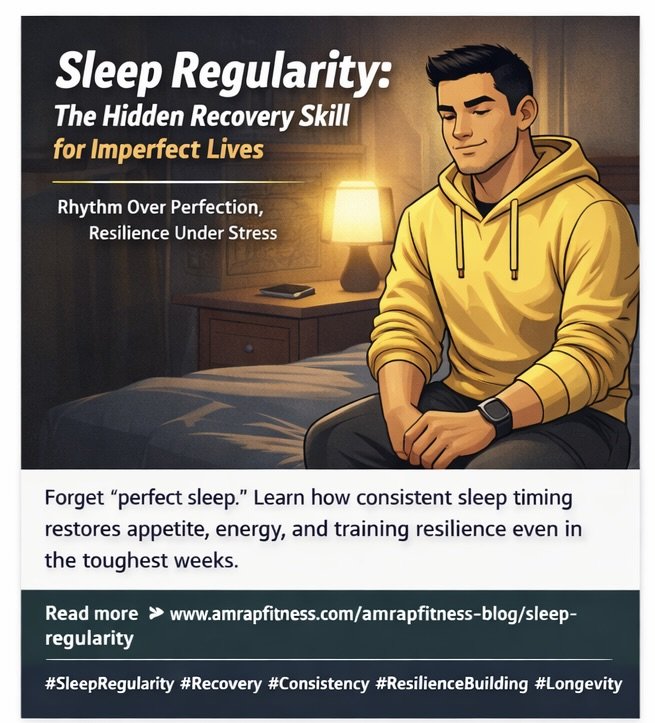
Longevity isn’t built only in workouts.
It’s built in how you recover from life.
And recovery isn’t just “sleep more.”
For real adults — parents, caretakers, teachers, business owners, people under pressure — the enemy isn’t always short sleep.
The enemy is chaotic sleep.
Because chaos doesn’t just make you tired. It makes you:
hungrier
more reactive
more inflamed
more pain-sensitive
more likely to skip training
more likely to chase sugar and caffeine
And it turns a normal week into a struggle to feel like yourself.
This entry is about the skill that protects you even when life won’t allow perfection:
sleep regularity — the ability to keep your sleep-wake rhythm stable enough that your body can downshift, repair, and wake up with usable energy.
Not fantasy. Not a perfect bedtime.
A professional, tactical system.
Opening Device: Exhausted… But Still Wired
There’s a specific kind of fatigue that makes people feel broken.
You’re exhausted. Your eyes burn. Your body feels heavy.
And still — you can’t fall asleep.
Or you fall asleep… and wake up at 2:11 a.m.
And then your brain does what brains do when the lights are off:
replays conversations
forecasts worst-case scenarios
thinks about money
thinks about the kids
thinks about everything you didn’t do right
You wake up the next day and you’re not just tired.
You’re emotionally brittle.
You feel like your willpower is thin. You feel like food is louder. You feel like stress is heavier.
That’s not weakness.
That’s physiology.
And one of the most powerful levers to stabilize that physiology isn’t “sleep 9 hours.”
It’s regularity.
What Sleep Regularity Actually Means
Sleep regularity is the consistency of your sleep timing — especially:
your wake time
and the stability of your daily sleep window
It’s not about perfection. It’s about reducing the violent swings that throw off circadian rhythm.
Think of it like training.
A body that thrives on progressive overload does poorly on random chaos.
Sleep works the same way.
When you sleep at 10 p.m. one night, 1 a.m. the next, then 9 p.m. the next — your nervous system never learns a stable downshift.
Regularity trains your internal clock to do two things better:
power down
power up
And that stability echoes into:
appetite hormones
glucose regulation
mood regulation
inflammation and pain perception
recovery and training readiness
The Science Signal (Why Regularity Matters)
Modern research has been increasingly focusing on sleep regularity as its own metric — not just duration.
A major study in the journal Sleep (2024) reported that sleep regularity can be a strong predictor of mortality risk and may be a stronger predictor than sleep duration in some analyses.
Other population studies have linked irregular sleep patterns (timing variability) with higher risk profiles.
The key point for coaching is practical:
You don’t need perfect sleep to improve outcomes. You need more predictable sleep.
That is good news for real adults.
Why This Is a Longevity Skill (Not Just a “Wellness Tip”)
After 40, your margin for error shrinks.
Not because you’re fragile — because you’re busy.
When sleep becomes inconsistent:
caffeine becomes a crutch
training becomes harder to recover from
injury risk creeps up
cravings rise
patience drops
And then the person starts losing identity:
“I’m not consistent anymore.”
Sleep regularity protects identity.
Because when your nervous system can downshift at night, you wake up with a baseline that makes discipline possible.
Not easy.
Possible.
The Coaching Reality: Most People Don’t Need More Tips
They need a system for imperfect lives.
If you tell a stressed adult: “Just go to bed earlier,”
you might as well say: “Just have less stress.”
Because life doesn’t cooperate.
So professionals do this differently:
They build rules that work under pressure.
That’s what we’re doing here.
The Sleep Regularity System (The Framework)
Step 1 — Choose a Wake-Time Anchor (The Keystone)
If you only stabilize ONE thing, stabilize this:
wake time.
Because your wake time drives:
light exposure
meal timing
training timing
sleep pressure at night
Your rule
Pick a wake time window you can hit most days.
Keep it within a 60–90 minute range.
If you sleep in 3 hours later on weekends, you’re basically giving your body a mini-jetlag.
Not judgment.
Physics.
Step 2 — Protect a “Sleep Window,” Not a Perfect Bedtime
This is the real-adult rule:
Protect a sleep window more than a perfect bedtime.
Example: If your life won’t allow 10 p.m. every night, stop chasing it.
Instead:
create a stable wind-down
keep wake time consistent
aim for a reasonable window
Consistency beats perfection.
Step 3 — Create a 12-Minute Downshift Routine
This is where most people fail.
They stop moving at night… but their nervous system never downshifts.
So we give the body a cue.
The 12-minute routine
2 minutes: set environment
dim lights
phone face down
cool room if possible
5 minutes: physiological downshift
slow nasal breathing
longer exhale than inhale
or legs-up-the-wall if your back likes it
5 minutes: mental unload
write 3 lines:
what I did right today
what can wait until tomorrow
one thing I’m grateful for
You’re training your nervous system to recognize:
“We are safe now.”
That’s not soft.
That’s performance.
Step 4 — The Caffeine Cutoff Rule
Caffeine is not evil.
But for many people, late caffeine is an invisible sleep killer.
Tactical rule
Set a caffeine cutoff that protects your nights.
Common coaching baseline: no caffeine 8+ hours before sleep.
If you’re sensitive, make it 10 hours.
This one change often improves sleep depth dramatically.
Step 5 — Light Rules (Free Performance)
Your circadian rhythm runs on light.
Morning
get outdoor light within 60 minutes of waking (even 5–10 minutes)
Evening
dim lights 60 minutes before bed
This isn’t about being perfect.
It’s about signaling your brain:
day is day, night is night.
The “Bad Sleep Day” Protocol (Anti-Fragile Training Rules)
This is where longevity athletes win.
Not by forcing intensity.
By preserving consistency.
If you slept poorly:
Rule 1 — Keep training, reduce cost
keep strength work
cut volume by ~30–40%
keep bar speed crisp
stop earlier than usual
Rule 2 — Swap intensity for Zone 2
20–40 minutes conversational pace
OR a long walk
Rule 3 — No “prove it” workouts
Because proof workouts create:
nervous system overload
cravings
more poor sleep
You don’t win that cycle.
You break it.
Why Sleep Regularity Improves Fat Loss (Without Diet Drama)
People think fat loss is mostly a food discipline problem.
Often it’s a recovery stability problem.
When sleep is irregular:
appetite increases
cravings increase
energy decreases
movement decreases
That means you’re fighting biology.
When regularity improves, fat loss becomes less about suffering.
It becomes about:
steady behavior
predictable energy
fewer “reset Mondays”
The “Two-Night Rule” (A Tactical Rescue Tool)
Here’s a simple rule for real life:
If you have two bad nights in a row, you go into recovery protection mode for 48 hours.
That means:
no aggressive dieting
no maximal training
prioritize protein + hydration
Zone 2 or walking
earlier wind-down
This prevents the third night from becoming a crash.
Common Mistakes (and the Pro Fix)
Mistake 1: Weekend sleep whiplash
Fix: keep wake time within a 60–90 minute window.
Mistake 2: Phone until the last second
Fix: phone face-down during wind-down.
Mistake 3: Late caffeine
Fix: caffeine cutoff.
Mistake 4: “I’ll sleep when life calms down”
Fix: build a system that works under pressure.
Self-Assessment (Reader Tool)
Answer honestly:
Is my wake time consistent within 60–90 minutes most days?
Do I feel wired at night even when tired?
Does poor sleep trigger cravings the next day?
Do I have a wind-down cue that is repeatable?
When sleep breaks, do I change training intelligently — or punish myself?
Your answers aren’t judgment.
They’re your next steps.
Closing: The Calm Nervous System Is the Strong Nervous System
Sleep regularity doesn’t just improve energy.
It improves who you are under pressure.
It helps you wake up with:
patience
clarity
steadier appetite
better pain tolerance
better training readiness
That’s not a wellness trend.
That’s a longevity advantage.
And it’s available to you without perfection.
Just structure.
Resources (English)
Windred DP, et al. Sleep regularity is a stronger predictor of mortality risk than sleep duration. Sleep. 2024. https://pubmed.ncbi.nlm.nih.gov/37738616/
Park SJ, et al. Sleep duration and regularity and all-cause mortality risk. Scientific Reports. 2025. https://www.nature.com/articles/s41598-025-15828-6
Phillips AJK, et al. Irregular sleep/wake patterns are associated with poorer academic performance and delayed circadian and sleep/wake timing. Scientific Reports. 2017. https://www.nature.com/articles/s41598-017-03171-4
Lunsford-Avery JR, et al. Sleep regularity and cardiometabolic health: associations across studies. (Review) 2021. https://pubmed.ncbi.nlm.nih.gov/33581380/