Warm up & Skill
400m run
Deadlift tech
WOD
For time:
Run 800m
EMOTM for 5 minutes- 2 deadlifts at 85%
Run 800m

Warm up & Skill
400m run
Deadlift tech
WOD
For time:
Run 800m
EMOTM for 5 minutes- 2 deadlifts at 85%
Run 800m
Warm up
400m run
Assisted bar muscle-ups
Assisted the bar pull over to support
TT rings
Rope climbs
Skill
Weighted pull-ups
WOD
15-minute AMRAP
3 weighted pull-ups
15 OH lunges
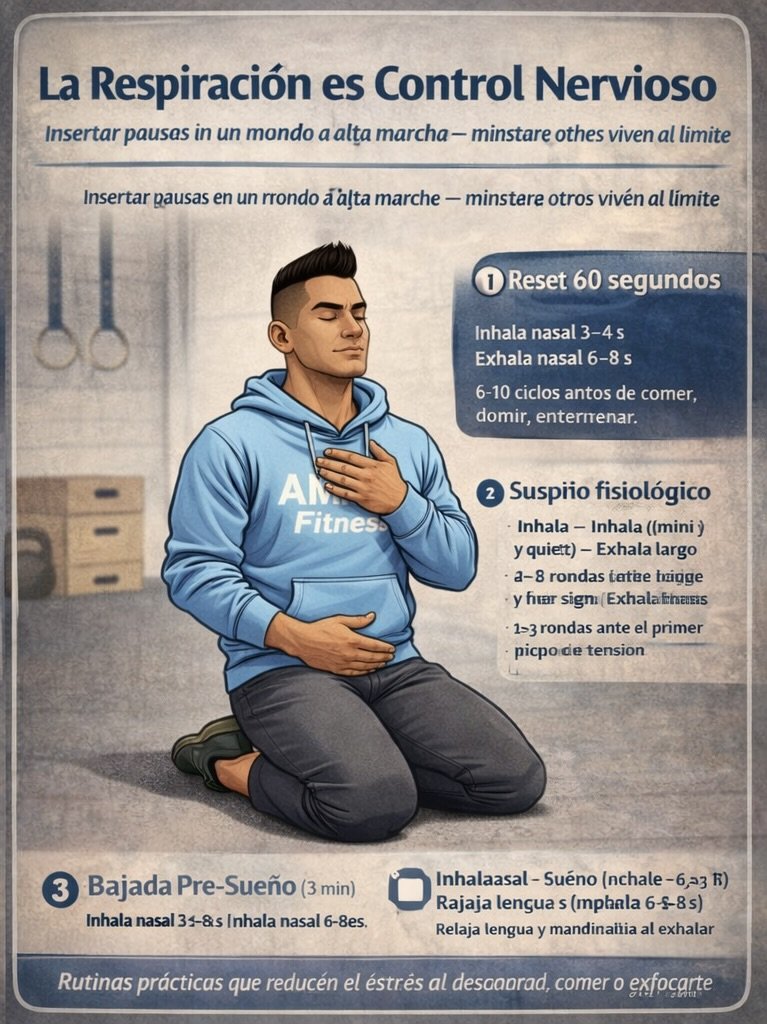
“Si no controlas tu respiración, no controlas por completo tu estado.”
Ni tu ánimo. Ni tu recuperación. Ni tus antojos. Ni tu sueño.
Puedes tener un gran plan de entrenamiento.
Puedes construir músculo, fuerza, potencia, equilibrio y articulaciones durables.
Pero cuando la vida se pone pesada—trabajo, familia, duelo, finanzas, conflicto—el cuerpo no entra en calma “pensando bonito”.
Entra en calma respirando diferente.
La Entrada #2 fue reserva metabólica.
La #3 fue músculo como medicina.
La #4 fue potencia/equilibrio/anti-caídas.
La #5 fue tendones/articulaciones/durabilidad.
Ahora la #6 es la sala de control que hace que todo eso funcione cuando la semana no coopera:
tu sistema nervioso.
Y el mejor “interruptor” rápido, sin cambiar tu horario, sin agregar horas, sin abandonar tu vida, es:
cómo respiras.
Muchas personas creen que respirar es una sola cosa.
En realidad hay dos “modos”:
Necesitas aire.
En ejercicio, respiras más.
La respiración influye en si vives en:
lucha/huida (simpático)
descanso/digestión (parasimpático)
o un punto medio regulado
Bajo estrés crónico, mucha gente cae en patrones como:
respirar por la boca
respiración corta y alta (pecho)
ritmo rápido
apretar cuello/mandíbula/costillas
aguantar la respiración mientras trabaja o lee mensajes
Ese patrón no solo refleja estrés:
puede alimentarlo.
HRV = Variabilidad de la Frecuencia Cardíaca.
Es la variación del tiempo entre latidos.
No es un trofeo de “más alto siempre es mejor”.
Piénsalo como una señal de adaptabilidad:
un sistema resiliente cambia de marcha con facilidad
un sistema saturado se vuelve rígido
El HRV se afecta por:
sueño y falta de sueño
carga de entrenamiento
alcohol
enfermedad/inflamación
estrés emocional/duelo
comer muy poco o ciclos de restricción-atracón
hidratación
patrón y ritmo respiratorio
Es normal que el HRV suba y baje día a día. Lo importante son las tendencias y el contexto, no un solo número.
Cómo lo uso en coaching:
El HRV es un reporte del clima, no un juicio moral.
HRV bajo + mal sueño + mucho estrés → entrenar sí, pero bajar intensidad y cuidar articulaciones
HRV normal + buen sueño → luz verde
HRV bajo por varios días → revisar: enfermedad, exceso de carga, alcohol, estrés emocional, nutrición
No siempre puedes “pensar” para salir de una respuesta de estrés.
Pero sí puedes señalar seguridad a través de fisiología.
La respiración es especial porque es:
automática (pasa sola)
y voluntaria (puedes cambiarla)
Por eso conecta mente-cuerpo de forma directa.
Exhalaciones más largas y suaves tienden a bajar el sistema.
Respiración corta y rápida tiende a subirlo.
Muchos la usan así:
me dio ansiedad → ahora respiro
no puedo dormir → ahora respiro
me llegó el impulso de comer → ahora respiro
Eso es como cambiar aceite cuando el motor ya está explotando.
La respiración es mejor como práctica.
Cuándo: entre reuniones, antes de comer, antes de entrenar
Cómo: inhala nasal 3–4 s → exhala 6–8 s
6–10 ciclos.
Si solo haces una práctica, haz exhalación extendida. Es el cambio de estado más eficiente para adultos ocupados.
Cuándo: pico de estrés, enojo, ansiedad, impulso fuerte
Cómo:
inhalas por la nariz
haces una mini inhalación “extra”
exhalas largo por la boca
2–3 rondas.
Cuándo: mañana o antes de dormir (5 min)
Cómo: 5–6 respiraciones por minuto (ej: 4–5 s inhala, 5–6 s exhala)
Regla: si te falta aire, la estás forzando. Hazla más suave.
Más esfuerzo no significa más beneficio. La respiración efectiva se siente como girar una perilla, no como “luchar”.
Cuándo: antes de entrenar, conversación difícil, presentación
Cómo: 4 inhala → 4 sostén → 4 exhala → 4 sostén (4–6 rondas)
Cuándo: en la cama
Cómo: inhala nasal 3–4 s → exhala 6–8 s
Extra: relaja lengua y mandíbula al exhalar.
Bajo estrés alto, el sistema nervioso tiende a:
urgencia
impulsividad
“me lo merezco”
búsqueda de dopamina
menos freno interno
La respiración no “cura” por sí sola un trastorno, pero crea un espacio entre impulso y acción.
Ahí vive la elección.
Aplicación para fines de semana:
90 segundos de suspiro fisiológico + exhalación extendida antes del primer bocado de una comida detonante
comer más lento los primeros 5 minutos
reevaluar: “¿hambre real o intento de regular estado?”
Muchos atletas de fitness funcional viven en alta marcha:
intensidad
cafeína
madrugadas
sueño corto
estrés emocional
La respiración es el contrapeso para no quemar tu reserva.
Entrena duro a veces. Entrena calmado a menudo.
entre series: 2–3 respiraciones nasales con exhalación larga
después de intervalos: caminar hasta volver a respiración nasal
post-entreno: 2 minutos de respiración de resonancia
Si terminas siempre “eléctrico” en vez de recuperado, tu cuerpo aprende “entrenar = más estrés”. El objetivo es “entrenar = capacidad.”
60 s exhalación extendida al mediodía
2–3 min bajada pre-sueño
respiración de resonancia
suspiro fisiológico 2–3 rondas
¿Respiro por la boca cuando estoy estresado?
¿Suben mis hombros al inhalar?
¿Aguanto la respiración al leer emails?
¿Me siento cansado pero acelerado?
¿Tengo hambre y fatiga al mismo tiempo?
Si sí, no necesitas “más disciplina”.
Necesitas más regulación.
He visto el mismo patrón una y otra vez:
La gente no pierde hábitos porque no le importen.
Los pierde porque el sistema nervioso está saturado.
Y cuando has vivido situaciones reales—duelo, conflicto, inestabilidad—el cuerpo se queda en alerta.
La respiración no es una frase motivacional.
Es una forma de decirle al cuerpo: “Estamos lo suficientemente seguros para recuperar.”
Así vuelve la consistencia.
Con los años, el “ganar” cambia de:
“¿Qué tan duro puedo ir?”
a
“¿Qué tan bien puedo recuperar y repetir?”
La respiración es el recurso de recuperación más portátil:
viaja contigo
no necesita equipo
toma minutos
cambia tu estado
Eso no es suave.
Eso es dominio.
Literatura sobre respiración lenta/ritmada, regulación autonómica, HRV y respiración de resonancia (RSA y tono vagal)
Investigación clínica y aplicada sobre intervenciones de respiración para estrés/ansiedad y sobrecarga simpática
Marcos de recuperación y entrenamiento guiado por señales (sueño, HRV, carga, estrés)
“If you can’t control your breathing, you can’t fully control your state.”
Not your mood. Not your recovery. Not your cravings. Not your sleep.
You can have the best training program on paper.
You can have strength, muscle, power, balance, and durable joints.
But when life gets loud—work stress, family stress, grief, finances, conflict—your body doesn’t “think” its way into calm.
It breathes its way there.
Entry #2 was metabolic reserve.
Entry #3 was muscle as medicine.
Entry #4 was power/balance/fall-proofing.
Entry #5 was joints/tendons/durability.
Now Entry #6 is the control room that makes all of that usable when life is not kind:
your nervous system state.
And the fastest lever you can pull—without changing your schedule, without adding hours, without quitting your life—is:
how you breathe.
Most people treat breathing as one thing.
But there are two “modes” at play:
This is basic: you need air.
Exercise increases demand. You breathe more.
This is subtle but powerful: breathing influences whether you live in:
fight/flight (sympathetic)
rest/digest (parasympathetic)
or a regulated “ready” middle ground
Your body learns patterns.
And under chronic stress, many people unconsciously shift into:
mouth breathing
shallow upper-chest breathing
fast respiratory rate
frequent sighing/holding breath
tight ribs/neck/jaw
That pattern doesn’t just reflect stress—
it can feed stress.
HRV = Heart Rate Variability.
It’s the variation in time between heartbeats—not a simple “higher is always better” scoreboard.
Think of HRV as a signal of adaptability:
When your system is resilient, it can shift gears smoothly.
When it’s overloaded, it becomes more rigid.
HRV is influenced by:
sleep and sleep debt
training load and recovery
alcohol
illness/inflammation
stress, anxiety, grief
under-eating or binge-restriction cycles
hydration
breathing rate and pattern
It’s normal for HRV to bounce day to day. A single low HRV reading doesn’t mean you’re “broken.” Trends and context matter more than one number.
How I coach this:
Use HRV as a weather report, not a moral judgment.
Low HRV + poor sleep + high stress → train, but reduce intensity and protect joints.
Normal HRV + good sleep → green light for harder work.
HRV tanking for several days → consider illness, overreaching, poor nutrition, alcohol, or emotional overload.
You can’t instantly “think” your way out of a stress response.
But you can signal safety through physiology.
Breathing is unique because it’s one of the only body systems that is:
automatic (happens without you)
AND voluntary (you can change it on purpose)
That’s why it’s such a powerful bridge between “life stress” and “body reaction.”
Longer, slower exhales tend to downshift the nervous system.
Shorter, sharper breathing tends to upshift it.
That’s not a personality thing. That’s physiology.
Most people do breathwork like this:
panic hits → now I breathe
insomnia hits → now I breathe
binge urge hits → now I breathe
That’s like waiting until your car is in the redline to change the oil.
Breathing is best as practice, not just emergency medicine.
That’s what makes it a longevity skill.
These aren’t mystical. They’re practical.
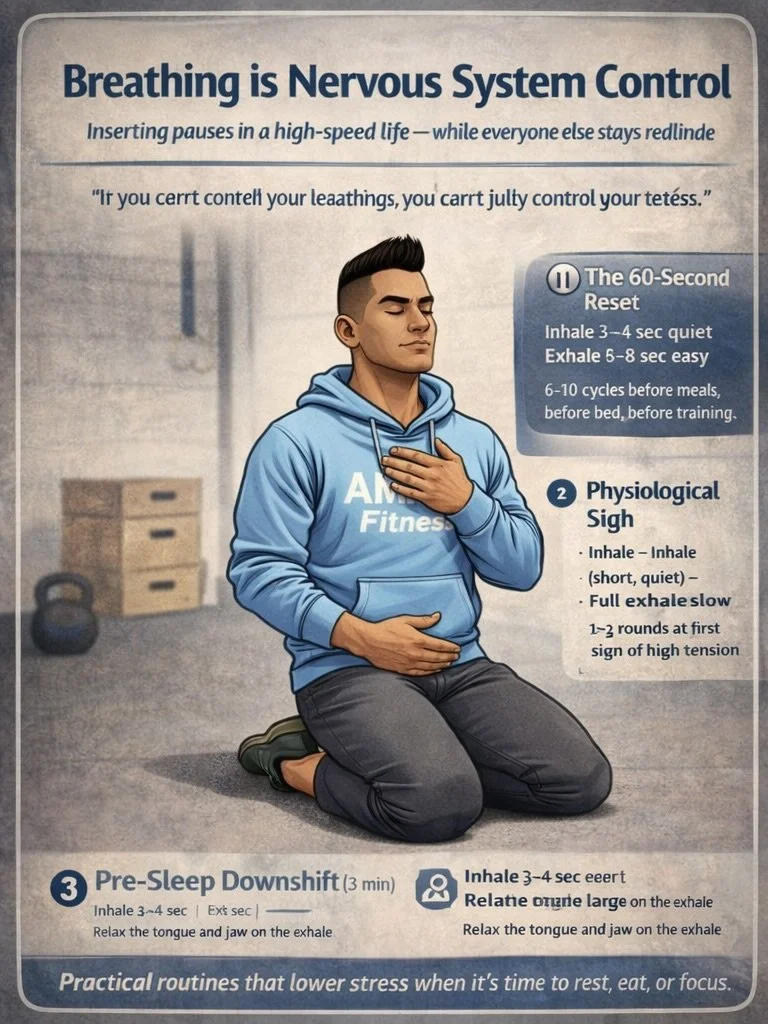
When: between meetings, before walking into the house, before meals, before training
How: inhale quietly through the nose for ~3–4 seconds, exhale slowly for ~6–8 seconds
Repeat for 6–10 cycles.
Why it works: it trains the “downshift” reflex without requiring a long session.
If you only do one breath practice, make it the extended exhale. It’s the most time-efficient “state change” drill for busy adults.
When: acute stress spike, anger, anxiety, craving surge
How:
inhale through the nose
take a second short “top-up” inhale
then a long, slow exhale through the mouth
Do 2–3 rounds.
This is an “emergency brake,” not a daily marathon.
When: morning or pre-bed (5 minutes is enough)
How: breathe around 5–6 breaths per minute (example: 4–5 seconds in, 5–6 seconds out)
This pace is commonly used to increase vagal modulation and HRV acutely in many protocols.
Coach’s rule: If you feel air-hungry, you’re forcing it. Make it softer.
More breathing effort is not more benefit. Breathwork should feel subtle—like turning a dial, not slamming a lever.
When: before training, before a difficult conversation, before public speaking
How: 4 seconds in → hold 4 → out 4 → hold 4 (repeat 4–6 rounds)
It’s not “better” than resonance breathing—it’s just different. It’s a steadiness drill.
When: in bed, lights out
How: nasal inhale 3–4 seconds → exhale 6–8 seconds
Add one rule: relax the tongue and jaw on the exhale.
Most people try to fix sleep with supplements.
Start with your breathing pattern.
When stress is high, your nervous system leans toward:
urgency
impulsivity
“I deserve this”
dopamine chasing
reduced inhibition
Breathing won’t magically “cure” binge eating disorder—but it can create a gap between urge and action.
That gap is where choice lives.
Coaching application for weekends:
Do 90 seconds of physiological sigh + extended exhales before the first bite of a high-trigger meal.
Then eat slower for the first 5 minutes.
Then reassess: “Am I still hungry, or am I trying to numb a state?”
That’s not morality. That’s regulation.
Functional fitness athletes often live in high gear:
intensity
caffeine
early mornings
limited sleep
emotional stress
“push anyway”
Breathing becomes the counterbalance that keeps you from burning your reserve.
Train hard sometimes. Train calm often.
Between sets: 2–3 slow nasal breaths, long exhale
After intervals: walk until nasal breathing returns
Post-workout: 2 minutes resonance breathing to exit “go mode”
If you finish every session feeling wired instead of recovered, your body is learning “stress + training = more stress.” Your goal is to teach it, “stress + training = capacity.”
This is the “doable” plan.
60-second extended exhale reset once mid-day
2–3 minutes pre-sleep downshift
resonance breathing (5–6 breaths/min)
physiological sigh × 2–3 rounds
That’s it. No app obsession required.
Ask yourself:
Do I breathe through my mouth when I’m stressed or walking fast?
Do my shoulders rise when I inhale?
Do I hold my breath when I’m reading emails or texting?
Do I “crash” at night but still feel wired?
Do I feel hungry and tired at the same time?
If yes, you don’t need more discipline.
You need more regulation.
I’ve coached long enough to see the pattern:
People don’t lose their habits because they “don’t care.”
They lose them because their nervous system is on fire.
And when you’ve been through real hardship—loss, instability, conflict, grief—the body often stays on alert even when you’re trying your best.
Breathing is not a motivational quote.
It’s a way to show your body: “We’re safe enough to recover.”
That’s how consistency returns.
Not by forcing.
By regulating.
The older we get, the more the win shifts from:
“How hard can I go?”
to
“How well can I recover and repeat?”
Breathing is the most portable recovery tool you own:
it travels with you
it doesn’t require equipment
it takes minutes
it changes your state
That’s not soft.
That’s mastery.
(These are widely used concepts in the scientific and applied performance worlds; if you want, I can also format these into a cleaner AMA/APA-style bibliography for the site.)
Slow-paced/resonance breathing and vagal modulation/HRV protocols (respiratory sinus arrhythmia; autonomic regulation literature)
Clinical and performance literature on paced breathing, anxiety/stress reduction interventions, and HRV-guided training concepts
Applied physiology work on autonomic nervous system states (sympathetic/parasympathetic), sleep, and recovery
TEAM warm-up
400m run
Down the line, wall ball
Leap overs
Partner push-ups
Skill
Split jerk
WOD
12 minutes to find TEAM max split jerk
(Each team member’s load will be added together for a score)