Breathing, HRV, and Nervous System Control: The Fastest Way to Lower Stress Without Quitting Your Life
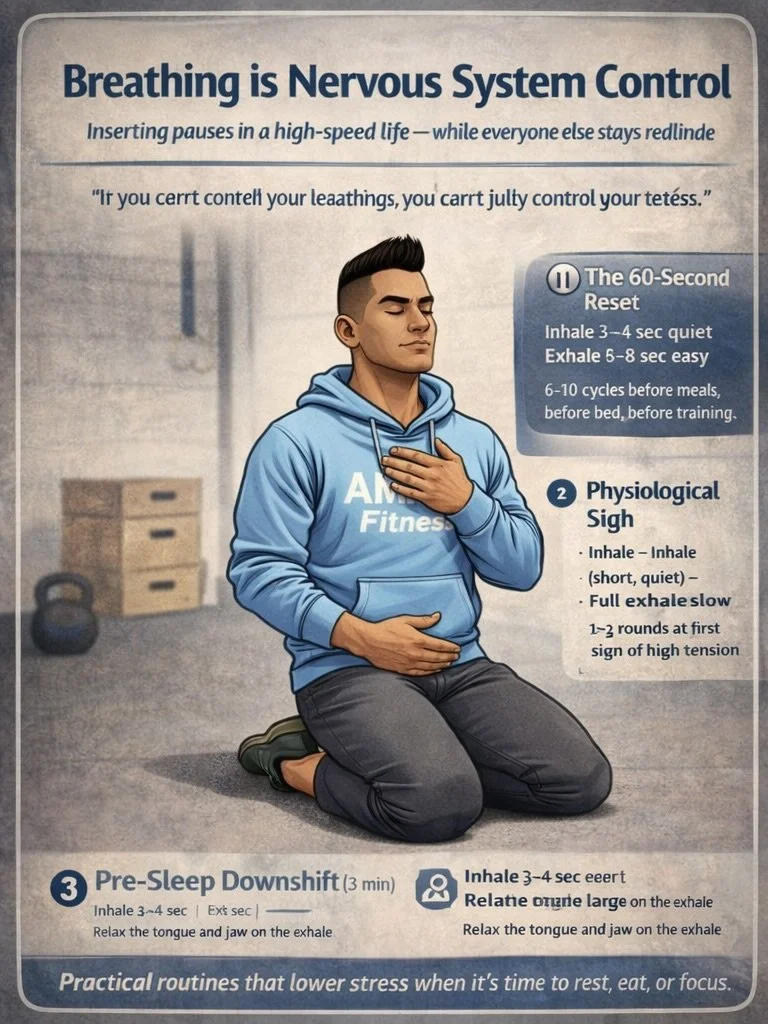
“If you can’t control your breathing, you can’t fully control your state.”
Not your mood. Not your recovery. Not your cravings. Not your sleep.
You can have the best training program on paper.
You can have strength, muscle, power, balance, and durable joints.
But when life gets loud—work stress, family stress, grief, finances, conflict—your body doesn’t “think” its way into calm.
It breathes its way there.
Entry #2 was metabolic reserve.
Entry #3 was muscle as medicine.
Entry #4 was power/balance/fall-proofing.
Entry #5 was joints/tendons/durability.
Now Entry #6 is the control room that makes all of that usable when life is not kind:
your nervous system state.
And the fastest lever you can pull—without changing your schedule, without adding hours, without quitting your life—is:
how you breathe.
The Two Breathing Systems Most People Confuse
Most people treat breathing as one thing.
But there are two “modes” at play:
1) Breathing for oxygen (ventilation)
This is basic: you need air.
Exercise increases demand. You breathe more.
2) Breathing for state (autonomic control)
This is subtle but powerful: breathing influences whether you live in:
fight/flight (sympathetic)
rest/digest (parasympathetic)
or a regulated “ready” middle ground
Your body learns patterns.
And under chronic stress, many people unconsciously shift into:
mouth breathing
shallow upper-chest breathing
fast respiratory rate
frequent sighing/holding breath
tight ribs/neck/jaw
That pattern doesn’t just reflect stress—
it can feed stress.
HRV Explained Like a Coach (Not a Biohacker)
HRV = Heart Rate Variability.
It’s the variation in time between heartbeats—not a simple “higher is always better” scoreboard.
Think of HRV as a signal of adaptability:
When your system is resilient, it can shift gears smoothly.
When it’s overloaded, it becomes more rigid.
HRV is influenced by:
sleep and sleep debt
training load and recovery
alcohol
illness/inflammation
stress, anxiety, grief
under-eating or binge-restriction cycles
hydration
breathing rate and pattern
Did You Know?
It’s normal for HRV to bounce day to day. A single low HRV reading doesn’t mean you’re “broken.” Trends and context matter more than one number.
How I coach this:
Use HRV as a weather report, not a moral judgment.
Low HRV + poor sleep + high stress → train, but reduce intensity and protect joints.
Normal HRV + good sleep → green light for harder work.
HRV tanking for several days → consider illness, overreaching, poor nutrition, alcohol, or emotional overload.
Why Breathing Is the Fastest Lever
You can’t instantly “think” your way out of a stress response.
But you can signal safety through physiology.
Breathing is unique because it’s one of the only body systems that is:
automatic (happens without you)
AND voluntary (you can change it on purpose)
That’s why it’s such a powerful bridge between “life stress” and “body reaction.”
The simple rule that works:
Longer, slower exhales tend to downshift the nervous system.
Shorter, sharper breathing tends to upshift it.
That’s not a personality thing. That’s physiology.
The Big Mistake: Only Using Breathwork When You’re Already Crashing
Most people do breathwork like this:
panic hits → now I breathe
insomnia hits → now I breathe
binge urge hits → now I breathe
That’s like waiting until your car is in the redline to change the oil.
Breathing is best as practice, not just emergency medicine.
That’s what makes it a longevity skill.
Coaching Application: 5 Breath Tools That Actually Fit a Real Life
These aren’t mystical. They’re practical.
Tool #1: The 60-Second Reset (Extended Exhale)
When: between meetings, before walking into the house, before meals, before training
How: inhale quietly through the nose for ~3–4 seconds, exhale slowly for ~6–8 seconds
Repeat for 6–10 cycles.
Why it works: it trains the “downshift” reflex without requiring a long session.
Did You Know?
If you only do one breath practice, make it the extended exhale. It’s the most time-efficient “state change” drill for busy adults.
Tool #2: Physiological Sigh (Fast Stress Drop)
When: acute stress spike, anger, anxiety, craving surge
How:
inhale through the nose
take a second short “top-up” inhale
then a long, slow exhale through the mouth
Do 2–3 rounds.
This is an “emergency brake,” not a daily marathon.
Tool #3: Resonance Breathing (The HRV Builder)
When: morning or pre-bed (5 minutes is enough)
How: breathe around 5–6 breaths per minute (example: 4–5 seconds in, 5–6 seconds out)
This pace is commonly used to increase vagal modulation and HRV acutely in many protocols.
Coach’s rule: If you feel air-hungry, you’re forcing it. Make it softer.
Did You Know?
More breathing effort is not more benefit. Breathwork should feel subtle—like turning a dial, not slamming a lever.
Tool #4: Box Breathing (Performance Calm)
When: before training, before a difficult conversation, before public speaking
How: 4 seconds in → hold 4 → out 4 → hold 4 (repeat 4–6 rounds)
It’s not “better” than resonance breathing—it’s just different. It’s a steadiness drill.
Tool #5: Pre-Sleep Downshift (3 Minutes)
When: in bed, lights out
How: nasal inhale 3–4 seconds → exhale 6–8 seconds
Add one rule: relax the tongue and jaw on the exhale.
Most people try to fix sleep with supplements.
Start with your breathing pattern.
How This Connects to Binge Eating and “Weekend Spirals” (Without Shaming)
When stress is high, your nervous system leans toward:
urgency
impulsivity
“I deserve this”
dopamine chasing
reduced inhibition
Breathing won’t magically “cure” binge eating disorder—but it can create a gap between urge and action.
That gap is where choice lives.
Coaching application for weekends:
Do 90 seconds of physiological sigh + extended exhales before the first bite of a high-trigger meal.
Then eat slower for the first 5 minutes.
Then reassess: “Am I still hungry, or am I trying to numb a state?”
That’s not morality. That’s regulation.
Training Without Living Redlined
Functional fitness athletes often live in high gear:
intensity
caffeine
early mornings
limited sleep
emotional stress
“push anyway”
Breathing becomes the counterbalance that keeps you from burning your reserve.
The “Longevity Athlete” rule:
Train hard sometimes. Train calm often.
Practical ways to use breathing in training:
Between sets: 2–3 slow nasal breaths, long exhale
After intervals: walk until nasal breathing returns
Post-workout: 2 minutes resonance breathing to exit “go mode”
Did You Know?
If you finish every session feeling wired instead of recovered, your body is learning “stress + training = more stress.” Your goal is to teach it, “stress + training = capacity.”
A Simple HRV-Smart Weekly System (Busy Adult Version)
This is the “doable” plan.
Daily (3–6 minutes total)
60-second extended exhale reset once mid-day
2–3 minutes pre-sleep downshift
3x/week (5 minutes)
resonance breathing (5–6 breaths/min)
If stress spikes (as needed)
physiological sigh × 2–3 rounds
That’s it. No app obsession required.
Self-Assessment: Are You Living in High Gear?
Ask yourself:
Do I breathe through my mouth when I’m stressed or walking fast?
Do my shoulders rise when I inhale?
Do I hold my breath when I’m reading emails or texting?
Do I “crash” at night but still feel wired?
Do I feel hungry and tired at the same time?
If yes, you don’t need more discipline.
You need more regulation.
25% Relatable Coaching Insight (Calm, Real)
I’ve coached long enough to see the pattern:
People don’t lose their habits because they “don’t care.”
They lose them because their nervous system is on fire.
And when you’ve been through real hardship—loss, instability, conflict, grief—the body often stays on alert even when you’re trying your best.
Breathing is not a motivational quote.
It’s a way to show your body: “We’re safe enough to recover.”
That’s how consistency returns.
Not by forcing.
By regulating.
Closing: Nervous System Control Is the New PR
The older we get, the more the win shifts from:
“How hard can I go?”
to
“How well can I recover and repeat?”
Breathing is the most portable recovery tool you own:
it travels with you
it doesn’t require equipment
it takes minutes
it changes your state
That’s not soft.
That’s mastery.
Resources (Entry #6)
(These are widely used concepts in the scientific and applied performance worlds; if you want, I can also format these into a cleaner AMA/APA-style bibliography for the site.)
Slow-paced/resonance breathing and vagal modulation/HRV protocols (respiratory sinus arrhythmia; autonomic regulation literature)
Clinical and performance literature on paced breathing, anxiety/stress reduction interventions, and HRV-guided training concepts
Applied physiology work on autonomic nervous system states (sympathetic/parasympathetic), sleep, and recovery