Warm up
400m run
OH lunges
Push ups
Strict toes to bar
Strict pull-ups
GHD back ext
Skill
Muscle ups
WOD
Complete the following (20-minute cap):
30 KBS
20 burpees
10 muscle-ups
50 Wall ball shots
40 double unders
30 ring dips


Warm up
400m run
OH lunges
Push ups
Strict toes to bar
Strict pull-ups
GHD back ext
Skill
Muscle ups
WOD
Complete the following (20-minute cap):
30 KBS
20 burpees
10 muscle-ups
50 Wall ball shots
40 double unders
30 ring dips
Warm up
2 minutes double unders
Wall climbs
Super rocks
Hollow rocks
KBS
Skill
HSPU
WOD
15-minute AMRAP
20 double unders
7 burpees
7 HSPU
Warm up
Dips
Ring rows
GHD sit ups
GHD back ext
OHS
Skill
SDHP/ push press/ HPC
WOD
12 minute AMRAP (M #115/ W #75)
7 SDHP
7 push press
7 HPC
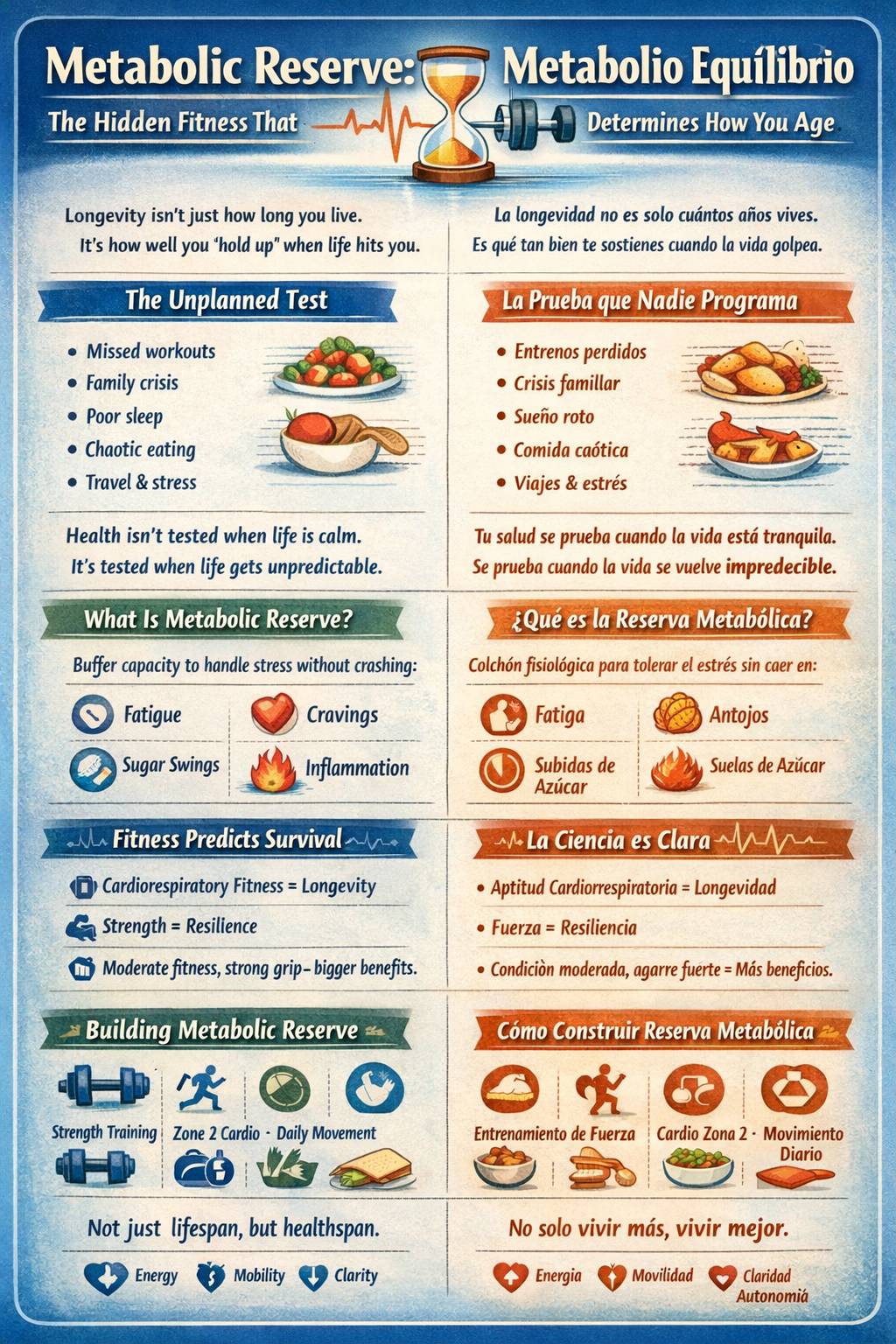
Nadie agenda la semana que lo cambia todo.
Llega así:
Te enfermas y pierdes varios entrenamientos.
Una crisis familiar rompe tu sueño.
El trabajo explota y comes “lo que se pueda.”
Viajas, te sientas horas, y el cuerpo se endurece.
El estrés sube, los antojos aumentan, y los viejos hábitos se sienten más fuertes.
Y ahí descubres algo:
Tu salud no se prueba cuando la vida está tranquila.
Se prueba cuando la vida se vuelve impredecible.
Ahí vive la reserva metabólica.
La reserva metabólica es tu “colchón fisiológico”: la capacidad de tolerar estrés sin caer en espirales de:
fatiga que no se va
hambre descontrolada
subidas y bajadas de azúcar
inflamación y dolor
sueño deteriorado
inestabilidad emocional
meses de inconsistencia
Esto se relaciona con conceptos científicos como reserva fisiológica, capacidad intrínseca y resiliencia física—la habilidad de soportar estresores y recuperar función.
La reserva fisiológica se define como la capacidad de un sistema del cuerpo para funcionar por encima de su nivel basal cuando aumentan las demandas.
Muchos persiguen el máximo:
marcas personales
cardio brutal
dietas extremas
intensidad constante
Pero para longevidad, la pregunta no es:
“¿Qué tan alto puedo llegar?”
Es:
“¿Qué tan bien puedo absorber el impacto y volver a mi base?”
La aptitud cardiorrespiratoria (CRF) es uno de los predictores más consistentes de mortalidad y enfermedad en grandes análisis.
Estudios amplios también muestran una relación inversa entre CRF y riesgo de muerte.
No necesitas ser atleta de resistencia.
Necesitas un motor con reserva.
Subir de “baja condición” a “moderada” suele producir beneficios enormes en supervivencia—no necesitas ser “élite” para cambiar tu futuro.
La fuerza se asocia con riesgo de mortalidad, y medidas simples como el agarre (grip strength) han demostrado ser predictivas en poblaciones enormes.
La fuerza refleja:
función muscular
salida del sistema nervioso
resiliencia general
En un estudio global grande, la fuerza de agarre fue un predictor potente de mortalidad y eventos cardiovasculares.
Muchos adultos no “fallan” por falta de ganas.
Fallan por falta de colchón.
Cuando llega el estrés:
se cae el entrenamiento
se desordena la comida
colapsa el sueño
aparece la culpa
y viene la espiral
La reserva metabólica rompe esa cadena.
Cuando has vivido temporadas duras—pérdidas, presión financiera, responsabilidades familiares, duelo, cambios de identidad—dejas de construir planes para “semanas perfectas.”
Empiezas a construir un cuerpo y una mente que puedan sostener:
sueño imperfecto
estrés emocional
horarios rotos
y aun así regresar a lo básico
Eso es reserva.
Es supervivencia.
Patrones básicos, progresión pequeña, consistencia.
Mayor fuerza muscular se asocia con menor riesgo de mortalidad en meta-análisis.
Conversación posible, sostenible, recuperable.
Movimiento como seguro metabólico.
Protege ventana de sueño; ajusta intensidad si dormiste mal.
“Comidas por defecto” para días caóticos.
¿Cuando la vida me golpea, recupero en días o en meses?
¿Vuelvo a mi base o me hundo?
¿Mis hábitos son resilientes o frágiles?
Esto no juzga.
Esto te orienta.
Los marcos actuales de envejecimiento saludable enfatizan capacidad intrínseca y resiliencia: tu habilidad integrada de funcionar y recuperarte.
La reserva metabólica no solo extiende la vida.
Protege tu vida con energía, movilidad y autonomía.
Es lo que te permite cumplirte a ti mismo—especialmente cuando la motivación no está y la vida pesa.
(Misma calidad, misma profundidad, mismo respeto académico)
Aptitud cardiorrespiratoria como predictor fuerte y consistente de morbilidad y mortalidad: una revisión general de metaanálisis.
British Journal of Sports Medicine.
Este trabajo analiza múltiples metaanálisis y confirma que la aptitud cardiorrespiratoria (CRF) es uno de los indicadores más confiables de longevidad y salud general, independientemente del peso corporal o composición corporal.
👉 La mejora de la CRF incluso en niveles moderados reduce significativamente el riesgo de mortalidad por todas las causas.
Fuente:
https://pmc.ncbi.nlm.nih.gov/articles/PMC11103301/
Aptitud cardiorrespiratoria y riesgo de mortalidad en hombres y mujeres: un análisis basado en grandes cohortes.
Journal of the American College of Cardiology (JACC).
Este estudio demuestra una relación dosis–respuesta entre niveles de aptitud física y reducción del riesgo de muerte, mostrando que incluso pequeños aumentos en la capacidad aeróbica generan beneficios desproporcionadamente grandes para la salud y la longevidad.
Fuente:
https://www.jacc.org/doi/10.1016/j.jacc.2022.05.031
El valor pronóstico de la fuerza de agarre: hallazgos del estudio PURE.
The Lancet.
Este estudio internacional con más de 140,000 participantes encontró que la fuerza de agarre es un predictor independiente y poderoso de mortalidad total, mortalidad cardiovascular y eventos cardiovasculares.
👉 La fuerza muscular refleja la reserva funcional global del organismo.
Fuente:
https://pubmed.ncbi.nlm.nih.gov/25982160/
Resiliencia física: no es simplemente lo opuesto a la fragilidad.
Journal of the American Geriatrics Society.
Este artículo introduce el concepto de resiliencia física como la capacidad del cuerpo para resistir y recuperarse de estresores fisiológicos, una base directa del concepto de reserva metabólica y envejecimiento saludable.
Fuente:
https://pmc.ncbi.nlm.nih.gov/articles/PMC6157007/
Capacidad intrínseca como determinante de la resiliencia física en adultos mayores.
Mechanisms of Ageing and Development.
Los autores destacan que la longevidad no depende solo de evitar enfermedades, sino de mantener una capacidad integrada (física, metabólica, neurológica) que permita al individuo adaptarse a desafíos inevitables de la vida.
Fuente:
https://www.sciencedirect.com/science/article/pii/S1279770723007807
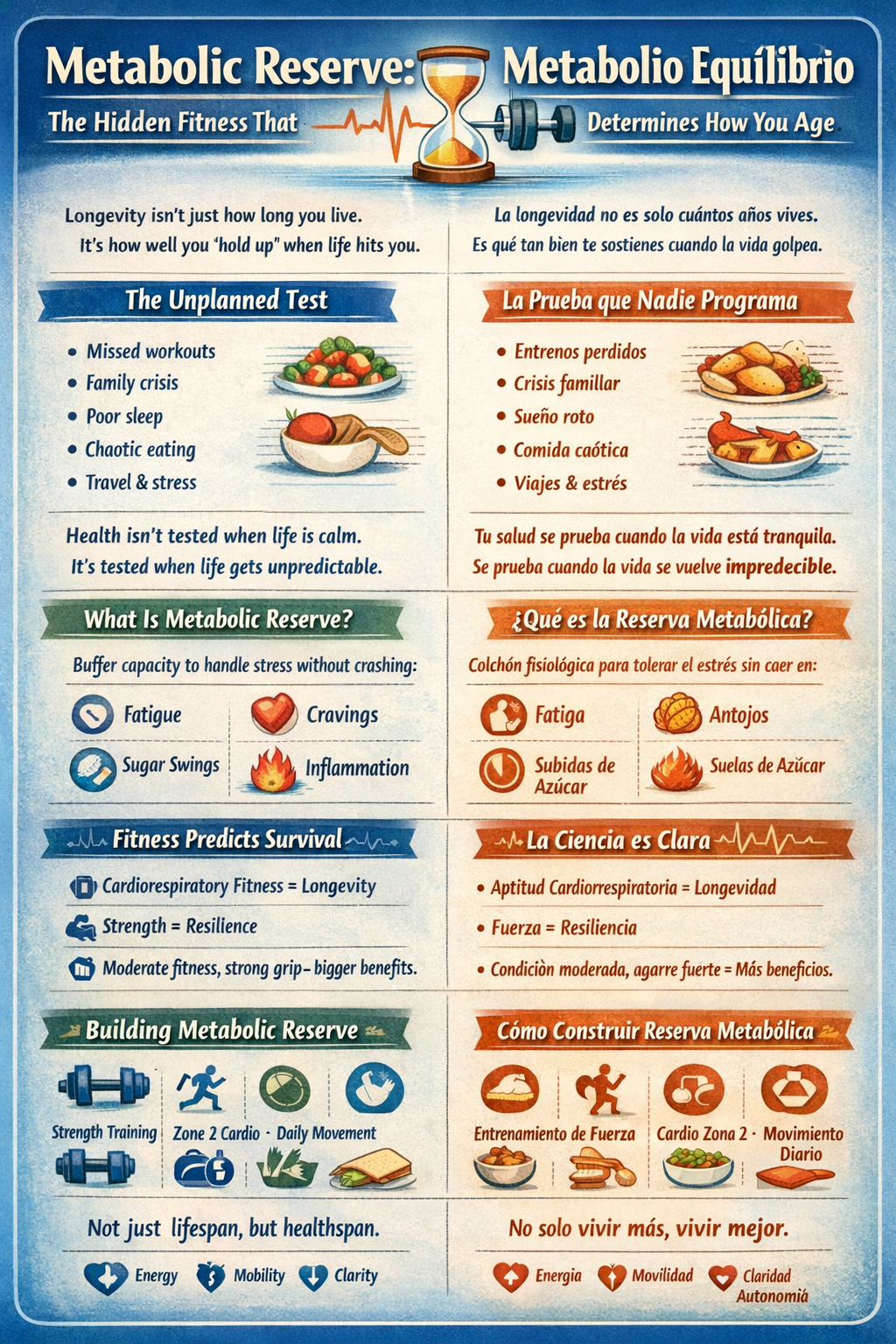
No one schedules the week that changes everything.
It shows up like this:
You catch a virus and miss three workouts.
A family crisis wrecks your sleep.
Work surges and your meals turn into “whatever fits.”
You travel, sit for hours, and your back tightens up.
Stress rises, cravings spike, and the old habits feel louder.
And then you learn something important:
Your health isn’t tested when life is calm.
It’s tested when life becomes unpredictable.
That’s where metabolic reserve lives.
Metabolic reserve is the body’s “buffer capacity”—your ability to handle stressors without spiraling into:
fatigue that doesn’t lift
appetite chaos
blood sugar swings
inflammation and pain flare-ups
sleep breakdown
emotional volatility
weeks (or months) of inconsistency
It’s not a supplement. It’s not a hack.
It’s the physiological difference between:
“I got hit, but I recovered.”
and
“I got hit, and I never came back.”
Metabolic reserve overlaps with what researchers call physiologic reserve, intrinsic capacity, and physical resilience—the ability to withstand stressors and recover function.
Researchers have defined physiologic reserve as the capacity to function beyond baseline when demands rise—a foundational concept in healthy aging and resilience.
A lot of people chase peak performance:
max lifts
hard conditioning
extreme diets
constant intensity
But for longevity, the question isn’t:
“How high can you climb?”
It’s:
“How well can you absorb impact and return to baseline?”
That’s metabolic reserve:
better recovery
stable energy
fewer flare-ups
less overreaction to stress
faster return to routine after disruption
One of the strongest predictors of longevity is cardiorespiratory fitness (CRF)—your body’s ability to deliver and use oxygen.
A 2024 overview of meta-analyses (massive datasets across many cohorts) reinforces CRF as a consistent predictor of morbidity and mortality.
Large studies also show a strong inverse relationship between CRF and mortality risk.
This isn’t about becoming an endurance athlete.
It’s about building a reserve engine you can draw from.
In large CRF datasets, moving from low fitness to moderate fitness tends to produce some of the biggest survival benefits—meaning you don’t need “elite” fitness to meaningfully shift your trajectory.
Strength—especially simple measures like grip strength—tracks with mortality risk and health outcomes.
A landmark global study found grip strength is a strong predictor of all-cause mortality and cardiovascular outcomes.
This doesn’t mean you need to obsess over grip.
It means strength is a proxy for:
muscle function
nervous system output
overall resilience
Grip strength has been shown to predict mortality risk in large populations and, in some analyses, was a stronger predictor than systolic blood pressure.
Here’s the lived coaching truth:
Most adults don’t fail because they don’t care.
They fail because they have no buffer.
When stress hits:
they skip workouts
meals go chaotic
sleep collapses
they feel guilty
they spiral
Metabolic reserve prevents the spiral.
It’s the reason some people can go through a hard season and still keep:
their health markers stable
their weight relatively steady
their energy intact
their training identity alive
I’ve learned this the hard way—not from a textbook, but from pressure.
When you’ve lived through major hits—loss, financial instability, trauma-level stress, caretaking responsibilities, identity shifts—you stop building a plan for “perfect weeks.”
You build a body and mind that can handle:
imperfect sleep
emotional strain
disrupted schedules
and still show up
That’s what reserve is.
It’s not aesthetics.
It’s survivability.
Not to “get shredded.”
To preserve the most protective tissue you own: muscle.
Minimum effective structure:
4–6 basic movement patterns (squat/hinge/push/pull/carry/core)
progressive overload (small improvements)
stop 1–3 reps shy of failure most days
Muscular strength is consistently associated with lower all-cause mortality risk across studies and meta-analyses.
This is the endurance you can recover from.
Simple prescription:
2–4 sessions/week
20–40 minutes
conversational pace
CRF is one of the most powerful longevity levers we have.
Steps aren’t “fat loss gimmicks.”
They’re metabolic insurance.
7–10 minutes after meals
walk calls
park farther away
short movement breaks
Your goal is to make movement your default, not your event.
Reserve collapses fast when sleep collapses.
A practical rule:
protect a sleep window more than a perfect bedtime
If sleep is poor:
reduce intensity
keep the habit (short session still counts)
When life gets chaotic, your nutrition shouldn’t become guesswork.
Default structure:
protein at every meal
1–2 “default meals” you can always execute
hydration floor (minimum daily)
Ask yourself:
When life disrupts me, do I recover in days or months?
Do I return to baseline easily—or do I spiral?
Are my habits resilient—or fragile?
Could I handle a hard season without losing my health identity?
Your answers aren’t judgment.
They’re a map.
The healthy-aging framework increasingly emphasizes “intrinsic capacity” and resilience—your integrated ability to function and recover when demands rise.
Metabolic reserve doesn’t just extend lifespan.
It protects healthspan—the years you can live with:
energy
mobility
clarity
independence
confidence
It’s what allows you to keep your promises to yourself—especially when motivation is gone and life gets heavy.
That’s not fitness.
That’s preparation.
Lang JJ. Cardiorespiratory fitness is a strong and consistent predictor of morbidity and mortality: overview of meta-analyses. 2024.
Kokkinos P, et al. Cardiorespiratory Fitness and Mortality Risk… JACC, 2022.
Leong DP, et al. Prognostic value of grip strength… The Lancet, 2015.
Whitson HE, et al. Physical Resilience: Not Simply the Opposite of Frailty. 2018.
Xue Q-L, et al. Intrinsic Capacity as a Determinant of Physical Resilience… 2021.