
Metabolic Reserve: The Hidden Fitness That Determines How You Age
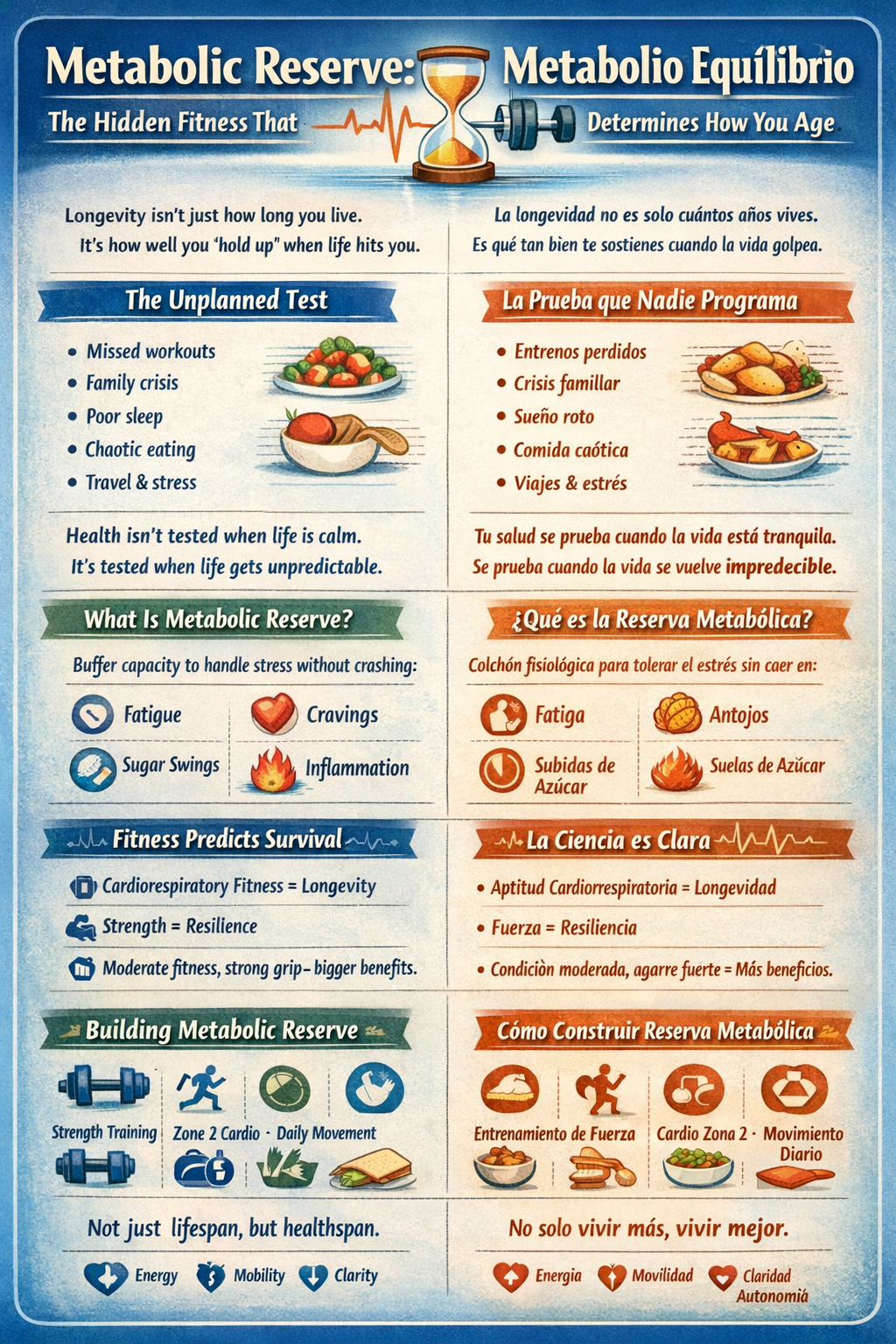
Longevity isn’t just how long you live. It’s how well you “hold up” when life hits you.
Opening Device: The Unplanned Test
No one schedules the week that changes everything.
It shows up like this:
You catch a virus and miss three workouts.
A family crisis wrecks your sleep.
Work surges and your meals turn into “whatever fits.”
You travel, sit for hours, and your back tightens up.
Stress rises, cravings spike, and the old habits feel louder.
And then you learn something important:
Your health isn’t tested when life is calm.
It’s tested when life becomes unpredictable.
That’s where metabolic reserve lives.
What Is Metabolic Reserve?
Metabolic reserve is the body’s “buffer capacity”—your ability to handle stressors without spiraling into:
fatigue that doesn’t lift
appetite chaos
blood sugar swings
inflammation and pain flare-ups
sleep breakdown
emotional volatility
weeks (or months) of inconsistency
It’s not a supplement. It’s not a hack.
It’s the physiological difference between:
“I got hit, but I recovered.”
and
“I got hit, and I never came back.”
Metabolic reserve overlaps with what researchers call physiologic reserve, intrinsic capacity, and physical resilience—the ability to withstand stressors and recover function.
Did You Know?
Researchers have defined physiologic reserve as the capacity to function beyond baseline when demands rise—a foundational concept in healthy aging and resilience.
Why This Matters More Than “Peak Fitness”
A lot of people chase peak performance:
max lifts
hard conditioning
extreme diets
constant intensity
But for longevity, the question isn’t:
“How high can you climb?”
It’s:
“How well can you absorb impact and return to baseline?”
That’s metabolic reserve:
better recovery
stable energy
fewer flare-ups
less overreaction to stress
faster return to routine after disruption
The Research Signal Is Loud: Fitness Predicts Survival
One of the strongest predictors of longevity is cardiorespiratory fitness (CRF)—your body’s ability to deliver and use oxygen.
A 2024 overview of meta-analyses (massive datasets across many cohorts) reinforces CRF as a consistent predictor of morbidity and mortality.
Large studies also show a strong inverse relationship between CRF and mortality risk.
This isn’t about becoming an endurance athlete.
It’s about building a reserve engine you can draw from.
Did You Know?
In large CRF datasets, moving from low fitness to moderate fitness tends to produce some of the biggest survival benefits—meaning you don’t need “elite” fitness to meaningfully shift your trajectory.
Strength Is Another Reserve Account (And It’s Shockingly Predictive)
Strength—especially simple measures like grip strength—tracks with mortality risk and health outcomes.
A landmark global study found grip strength is a strong predictor of all-cause mortality and cardiovascular outcomes.
This doesn’t mean you need to obsess over grip.
It means strength is a proxy for:
muscle function
nervous system output
overall resilience
Did You Know?
Grip strength has been shown to predict mortality risk in large populations and, in some analyses, was a stronger predictor than systolic blood pressure.
The Coaching Reality: Reserve Is What Saves People
Here’s the lived coaching truth:
Most adults don’t fail because they don’t care.
They fail because they have no buffer.
When stress hits:
they skip workouts
meals go chaotic
sleep collapses
they feel guilty
they spiral
Metabolic reserve prevents the spiral.
It’s the reason some people can go through a hard season and still keep:
their health markers stable
their weight relatively steady
their energy intact
their training identity alive
25% Relatable: Why This Hits Home for Me (Without Making It “About Me”)
I’ve learned this the hard way—not from a textbook, but from pressure.
When you’ve lived through major hits—loss, financial instability, trauma-level stress, caretaking responsibilities, identity shifts—you stop building a plan for “perfect weeks.”
You build a body and mind that can handle:
imperfect sleep
emotional strain
disrupted schedules
and still show up
That’s what reserve is.
It’s not aesthetics.
It’s survivability.
Coaching Application: How to Build Metabolic Reserve (Practical + Doable)
1) Reserve Layer #1 — Strength (2–4 days/week)
Not to “get shredded.”
To preserve the most protective tissue you own: muscle.
Minimum effective structure:
4–6 basic movement patterns (squat/hinge/push/pull/carry/core)
progressive overload (small improvements)
stop 1–3 reps shy of failure most days
Did You Know?
Muscular strength is consistently associated with lower all-cause mortality risk across studies and meta-analyses.
2) Reserve Layer #2 — Zone 2 / Low-Intensity Aerobic Base
This is the endurance you can recover from.
Simple prescription:
2–4 sessions/week
20–40 minutes
conversational pace
CRF is one of the most powerful longevity levers we have.
3) Reserve Layer #3 — NEAT (Daily Movement Buffer)
Steps aren’t “fat loss gimmicks.”
They’re metabolic insurance.
7–10 minutes after meals
walk calls
park farther away
short movement breaks
Your goal is to make movement your default, not your event.
4) Reserve Layer #4 — Sleep as a Stabilizer (Not a Luxury)
Reserve collapses fast when sleep collapses.
A practical rule:
protect a sleep window more than a perfect bedtime
If sleep is poor:
reduce intensity
keep the habit (short session still counts)
5) Reserve Layer #5 — Protein + Predictability
When life gets chaotic, your nutrition shouldn’t become guesswork.
Default structure:
protein at every meal
1–2 “default meals” you can always execute
hydration floor (minimum daily)
A Simple Self-Assessment (Reader Engagement Tool)
Ask yourself:
When life disrupts me, do I recover in days or months?
Do I return to baseline easily—or do I spiral?
Are my habits resilient—or fragile?
Could I handle a hard season without losing my health identity?
Your answers aren’t judgment.
They’re a map.
Did You Know?
The healthy-aging framework increasingly emphasizes “intrinsic capacity” and resilience—your integrated ability to function and recover when demands rise.
Closing: What Metabolic Reserve Really Gives You
Metabolic reserve doesn’t just extend lifespan.
It protects healthspan—the years you can live with:
energy
mobility
clarity
independence
confidence
It’s what allows you to keep your promises to yourself—especially when motivation is gone and life gets heavy.
That’s not fitness.
That’s preparation.
Resources (for this entry)
Lang JJ. Cardiorespiratory fitness is a strong and consistent predictor of morbidity and mortality: overview of meta-analyses. 2024.
Kokkinos P, et al. Cardiorespiratory Fitness and Mortality Risk… JACC, 2022.
Leong DP, et al. Prognostic value of grip strength… The Lancet, 2015.
Whitson HE, et al. Physical Resilience: Not Simply the Opposite of Frailty. 2018.
Xue Q-L, et al. Intrinsic Capacity as a Determinant of Physical Resilience… 2021.