Warm up
400m run
Dips
Pull ups
GHD sit ups
GHD back ext
OHS
Skill
KBS
WOD
“Helen”
3 rounds of:
400m run
21 KBS
12 pull-ups

Warm up
400m run
Dips
Pull ups
GHD sit ups
GHD back ext
OHS
Skill
KBS
WOD
“Helen”
3 rounds of:
400m run
21 KBS
12 pull-ups
Warm up
2 minutes of double unders
Strict dips
Toes to rings
Super rocks
Hollow rocks
Skill
Pull-ups & Thrusters
WOD
(G) Test #3
3 x max effort pull-ups
Rest as needed
(W) Test #4
3 x max effort thrusters
W/65 M/95
Rest as needed
Warm up & Skill
Pose running drills
Pulling drills
Stationary single leg
Alternating legs
Lunge drill
Falling drills
Partner fall drill
Hip driver drill
Partner pull & fall (hands on shoulders)
WOD
(M) Test#1
600m run
Rest 5 minutes
(M) Test #2
3-minute max distance row
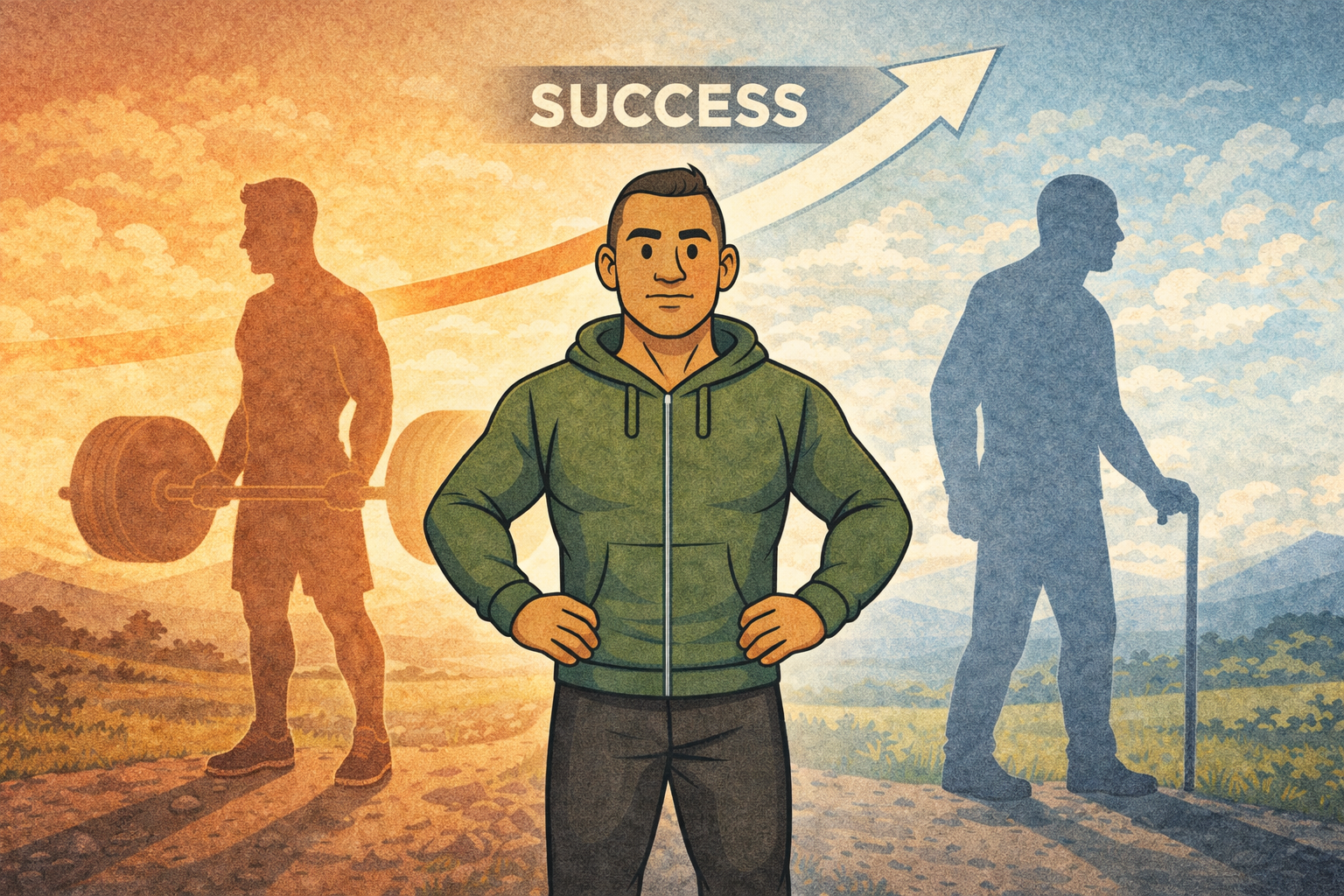
“The goal isn’t to stay who you were.
The goal is to become who your life now requires.”
At some point in life, success quietly changes.
Not overnight.
Not with a loud announcement.
But subtly — and often painfully.
What once felt like winning:
Being leaner than everyone else
Lifting heavier than last year
Training harder than your peers
Pushing through everything
Ignoring pain
Sacrificing rest
…starts to feel less like progress and more like pressure.
And many people don’t know what to do when the old definition of success stops working.
They cling to it.
They chase it harder.
They punish themselves for not matching it anymore.
But longevity doesn’t reward those who cling to outdated versions of themselves.
Longevity rewards those who evolve.
There was a time in my life when success was simple:
Lean.
Strong.
Competitive.
Relentless.
If I was training hard, I was winning.
If I was exhausted, I was “doing it right.”
But life doesn’t stay in one season.
Loss entered my life.
Responsibility grew.
Stress accumulated.
Sleep changed.
Recovery slowed.
Emotional weight increased.
And I was forced to confront a hard truth:
The version of success that built me
was no longer the version that would sustain me.
That realization wasn’t empowering at first.
It was unsettling.
It felt like losing ground.
Like aging meant shrinking.
But that was ego talking — not wisdom.
As we age:
Recovery time increases
Hormonal patterns shift
Stress tolerance changes
Sleep architecture evolves
Injury risk increases
Trying to impose 25-year-old expectations on a 45- or 50-year-old body leads to:
Chronic inflammation
Overuse injuries
Burnout
Hormonal disruption
Emotional frustration
Did You Know?
Research shows that injury risk increases significantly when training intensity does not adapt with age and recovery capacity.
This doesn’t mean you stop training hard.
It means you train intelligently.
Performance metrics focus on:
Speed
Load
Volume
Aesthetics
Longevity metrics focus on:
Muscle preservation
Joint integrity
Metabolic health
Stress resilience
Sleep quality
Emotional regulation
Independence
Did You Know?
Muscle mass and strength are stronger predictors of longevity than body weight or body fat percentage.
Success must shift from how much you can do
to how long you can do it.
When people refuse to redefine success, they often:
Train through pain
Ignore warning signs
Chase aesthetics at the expense of health
Compare themselves to their younger selves
Feel like they’re “losing” even when they’re healthier
This mindset creates:
Chronic stress
Elevated cortisol
Poor recovery
Reduced motivation
Increased injury risk
Longevity requires humility — not surrender.
Building capacity
Learning discipline
Establishing habits
Exploring limits
Refining structure
Managing stress
Balancing life and training
Protecting recovery
Preserving muscle
Maintaining mobility
Managing energy
Protecting joints
Prioritizing sleep
Training for independence
Did You Know?
Maintaining strength and balance after age 40 dramatically reduces fall risk — one of the leading causes of loss of independence later in life.
Each stage requires a new definition of success.
Success is no longer:
PRs every week
Exhaustion as proof
Punishment-based discipline
Success is now:
Consistency
Resilience
Recovery
Longevity
Showing up without breaking down
I help clients redefine success by asking:
Are you stronger year over year?
Are you moving better?
Are you sleeping better?
Are you more resilient under stress?
Are you still enjoying movement?
If the answer is yes — you’re succeeding.
The ability to get off the floor independently predicts lifespan
Grip strength is linked to cardiovascular health
Balance training improves brain health
Overtraining accelerates aging
Recovery capacity is trainable
It’s changing the target.
You’re not aiming smaller —
you’re aiming smarter.
You’re not quitting —
you’re adapting.
You’re not giving up your edge —
you’re sharpening it for the long game.
Ask yourself:
Does this support my future self?
Can I sustain this for years?
Does this help me recover or just perform?
Does this build strength or just burn calories?
Does this add stress or resilience?
Longevity lives in these answers.
If your old definition of success no longer fits,
it doesn’t mean you’re failing.
It means you’re evolving.
Success isn’t about proving how much you can endure.
It’s about building a body and mind that can carry you forward — through every season of life.
If you’re ready to redefine success in a way that supports your health, strength, and longevity — not just your ego — I can help guide you.
📩 amrapfitness@hotmail.com
National Institute on Aging
American College of Sports Medicine
Journal of Strength and Conditioning Research
Harvard Medical School
Blue Zones Research
TEAM Saturday
Warm up
Dip
Pull ups
GHD sit ups
GHD back ext
OHS
WOD
For time:
50 Box jump
50 Jumping pull -ps
50 Kettlebell swings
Walking Lunge, 50 steps
50 Knees to elbows
50 Push press, 45 pounds
50 Back extensions
50 Wall ball shots
50 Burpees
50 Double under