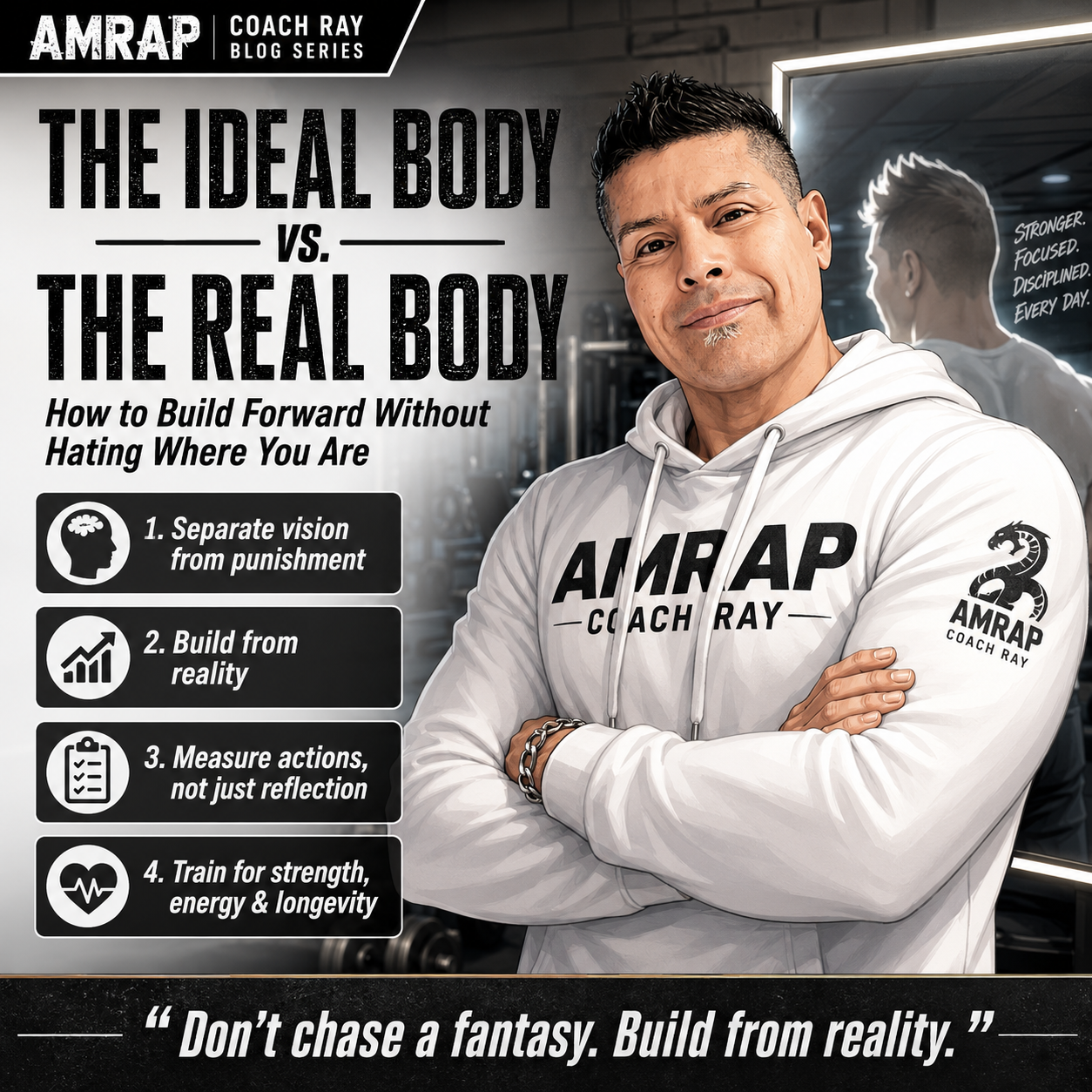
The Ideal Body vs. The Real Body: How to Build Forward Without Hating Where You Are
AMRAP Real-Life Reset Series — Entry 1 of 6
A lot of people do not hate fitness.
They hate the feeling that their current body is evidence that they failed.
They look in the mirror and do not simply see a body.
They see:
time lost
discipline they think they should have had
old confidence
comparison
stress
aging
weight gain
disappointment
the version of themselves they thought they would be by now
Then the fitness goal becomes emotionally loaded.
It is no longer just:
“I want to get healthier.”
It becomes:
“I need to escape this body.”
That is a dangerous place to begin.
Not because wanting to look better is wrong.
Wanting to look better is human.
Wanting to feel confident is human.
Wanting to lose fat, rebuild muscle, fit into clothes, and like what you see in the mirror is not shallow.
But there is a major difference between having a body goal and using that goal as a weapon against yourself.
A goal should give direction.
It should not become daily evidence that you are not enough.
This article is about that difference.
It is about learning how to pursue a stronger, leaner, healthier body without hating the body you currently live in.
Because the body you have right now is not the enemy.
It is the starting point.
Opening Device: The Body You Think You “Should” Have
Many adults are chasing a body that does not match the life they are actually living.
They compare themselves to:
a younger version of themselves
someone with fewer responsibilities
someone with better sleep
someone who trains for a living
someone using perfect lighting and editing
someone with different genetics
someone with medical, surgical, or pharmacological help they may not disclose
someone whose entire lifestyle is built around their appearance
Then they wonder why they feel defeated.
The issue is not that they have high standards.
The issue is that the standard is disconnected from context.
They may be working full-time.
Raising children.
Caring for relatives.
Managing stress.
Recovering from injury.
Navigating hormones, aging, grief, divorce, illness, trauma, or years of inconsistent habits.
Yet the mental picture they compare themselves to is often a fantasy body living inside a fantasy life.
That comparison creates a trap:
The ideal body becomes so far from the real body that the gap feels hopeless.
And when the gap feels hopeless, people often stop trying.
Not because they do not care.
Because every attempt feels like proof that they are still not there.
The Problem Is Not Wanting Improvement
Let’s be clear.
This is not an article telling people to stop caring about their body.
That would be dishonest.
Appearance matters to many people.
Confidence matters.
Feeling attractive matters.
Body composition matters.
Health markers matter.
Strength, energy, and mobility matter.
There is nothing wrong with wanting:
less body fat
more muscle
better posture
better conditioning
better clothes fit
more confidence
improved health
a body that feels strong and capable
The problem begins when the goal becomes tied to self-rejection.
There is a difference between saying:
“I want to improve my body.”
and saying:
“I cannot respect myself until I improve my body.”
The first creates direction.
The second creates shame.
And shame is a poor long-term coach.
What Is the Ideal Body Trap?
The ideal body trap happens when the body you want becomes more important than the life required to sustain it.
It often sounds like:
“I should look better by now.”
“I used to be in much better shape.”
“I hate what I see.”
“I’ll be confident when I lose the weight.”
“I need to get back to who I was.”
“Everyone else seems to have figured it out.”
“I can’t start until I’m less embarrassed.”
The trap is not the desire to change.
The trap is believing that your current body has no value until it matches the ideal.
That belief often leads to:
extreme dieting
excessive cardio
hiding from the gym
all-or-nothing training
avoidance of photos
constant body checking
comparison scrolling
quitting when results feel slow
using shame as motivation
That approach may create short bursts of effort.
But it rarely creates peace.
And it rarely creates lasting consistency.
The Science Signal: Why Motivation Quality Matters
Research on exercise motivation consistently shows that the type of motivation matters. A systematic review using self-determination theory found that more autonomous forms of motivation are positively related to exercise behavior, with intrinsic motivation especially relevant for long-term adherence.
That matters because shame-based motivation is often controlled motivation.
It pushes from fear, guilt, pressure, or self-judgment.
Autonomous motivation is different.
It connects exercise to personally meaningful reasons such as health, energy, strength, independence, confidence, stress relief, and becoming the kind of person you respect.
Appearance can be part of the reason.
But when appearance becomes the only reason, the relationship with exercise can become fragile.
One study found that appearance-based exercise motivation weakened the positive relationship between exercise frequency and positive body image, suggesting that exercising only to change appearance may limit some of exercise’s potential body-image benefits.
The coaching translation is simple:
A body goal is stronger when it is connected to a life goal.
Do not only train to look different.
Train to live different.
Body Image Is Not Just Vanity
Body image is not simply how attractive someone thinks they are.
It can affect:
confidence
clothing choices
social behavior
exercise consistency
nutrition decisions
intimacy
mood
willingness to be seen
willingness to start
When body image is poor, people may avoid the exact behaviors that would help them.
They avoid the gym because they feel embarrassed.
They avoid walking because they feel watched.
They avoid photos because they feel ashamed.
They avoid coaching because they think they should already be better.
They avoid swimming, sports, social events, or fitted clothing.
The body-image problem becomes a life-participation problem.
That is why this topic matters.
It is not just about the mirror.
It is about whether the mirror is keeping you from living.
The Real Body Is Not the Enemy
The “real body” is the body you actually have today.
It has a history.
It has been affected by:
your age
your work
your sleep
your stress
your injuries
your nutrition habits
your training history
your medical history
your emotional load
your responsibilities
your consistency
your environment
This body may not be where you want it to be.
But it is still the body that will carry you into the next version.
You cannot punish it into trust.
You cannot shame it into resilience.
You cannot ignore its signals and expect it to perform.
A body transformation begins with reality.
Not fantasy.
Not hatred.
Not denial.
Reality.
Acceptance Is Not Giving Up
This is where people get confused.
They hear “accept your body” and think it means:
stop improving
stop losing fat
stop training hard
stop caring
settle
lower your standards
That is not what this means.
Acceptance means:
“I am willing to see reality clearly enough to take effective action.”
You can accept where you are and still want change.
You can respect your body and still want to lose fat.
You can be grateful for what your body does and still want to get stronger.
You can stop hating yourself and still pursue excellence.
In fact, that is often the better path.
Because hatred creates urgency.
Respect creates consistency.
Self-Compassion Is Not Weakness
Some people think self-compassion means making excuses.
It does not.
Self-compassion means you stop using cruelty as your primary motivational tool.
A systematic review and meta-analysis found that higher self-compassion was associated with lower eating pathology, reduced body-image concerns, and greater positive body image.
That does not mean self-compassion automatically fixes everything.
But it does challenge the idea that people need more self-hate to improve.
Many people already have enough shame.
What they need is structure.
They need honesty without brutality.
They need accountability without humiliation.
They need standards without self-destruction.
That is the professional standard.
The Fantasy Body vs. The Capable Body
A fantasy body is usually built from comparison.
It asks:
How do I look compared with them?
How fast can I change?
How lean can I get?
How do I hide what I dislike?
What number will finally make me feel worthy?
A capable body is built from function and stewardship.
It asks:
Can I move well?
Can I lift and carry?
Can I climb stairs without feeling defeated?
Can I train consistently?
Can I recover?
Can I manage stress without collapsing?
Can I maintain strength as I age?
Can I participate in life?
This does not mean appearance does not matter.
It means appearance is not the only measure of success.
Research on positive body image interventions has found support for approaches that emphasize body functionality, body appreciation, and the ability to process appearance-related messages in a self-protective way.
Function matters because it gives the body value beyond how it looks.
That is powerful.
Because when you start appreciating what your body can do, you are more likely to care for it like something worth protecting.
The AMRAP Body Image Reset
This is the practical framework.
Step 1: Separate the Vision From the Punishment
A vision is useful.
Punishment is not.
Your vision may be:
leaner
stronger
healthier
more confident
more athletic
more energetic
That is fine.
But remove the language that turns the current body into a failure.
Instead of:
“I hate this body.”
Use:
“This is the body I am responsible for improving.”
Instead of:
“I should be ashamed.”
Use:
“I need a better system.”
Instead of:
“I need to get my old body back.”
Use:
“I need to build the strongest version of my current life.”
That language matters.
Because the body listens to the actions your beliefs produce.
Step 2: Take a Reality Inventory
Before setting an appearance goal, assess the body’s actual context.
Ask:
How many days per week am I training?
How much protein am I eating?
How much sleep am I getting?
How much stress am I carrying?
How consistent is my hydration?
How much walking am I doing?
Do I have pain or limitations?
Am I recovering from anything?
Am I comparing myself to someone with a different life?
Do I have a realistic plan or only a desired outcome?
This prevents fantasy goal-setting.
You cannot demand a professional-athlete outcome from a survival-mode lifestyle.
That does not mean you cannot improve.
It means the plan must match the life.
Step 3: Shift From Appearance Outcomes to Behavior Evidence
Appearance changes are delayed feedback.
Behaviors are immediate evidence.
Instead of judging the day only by the mirror, track whether you:
trained
walked
ate protein
hydrated
slept
stretched
recovered
prepared food
avoided all-or-nothing thinking
returned after a difficult moment
These behaviors build the body.
But they also rebuild trust.
Every kept promise becomes evidence:
“I am becoming someone who takes care of myself.”
Confidence is not only something you feel after the body changes.
Confidence is also built by watching yourself follow through.
Step 4: Train for Function, Not Just Inspection
Many people train as if their body exists only to be judged.
That is exhausting.
Train the body to perform.
Train it to:
squat
hinge
push
pull
carry
walk
climb
rotate
stabilize
recover
Functionality appreciation—the ability to value what the body can do—has been associated with more adaptive body image and well-being patterns in systematic-review literature.
This does not remove physique goals.
It anchors them in something healthier.
The question becomes:
“What body am I building for my life?”
Not only:
“How does this body look under perfect lighting?”
Step 5: Curate the Comparison Environment
Comparison is not always intentional.
Sometimes it is algorithmic.
Social media can repeatedly expose people to idealized bodies, extreme fitness lifestyles, and body-focused content. A systematic review examining idealized body images and fitness lifestyles on social media reported links between these platforms and symptoms related to orthorexia nervosa and muscle dysmorphia, especially on highly visual platforms.
This does not mean social media is evil.
It means your feed is not neutral.
If your feed makes you feel:
behind
ashamed
desperate
inferior
obsessed
pressured to use extreme methods
then your feed is not supporting your health.
Curate it.
Follow people who educate.
Follow people who show process.
Follow people who value strength, health, and longevity.
Unfollow accounts that make you hate yourself into action.
That kind of action usually does not last.
The Three Body-Image Traps
Trap 1: The “I’ll Start When I Look Better” Trap
This is one of the most painful ones.
A person wants to train but feels embarrassed to enter the gym.
They think:
“I need to lose weight first.”
But the gym is part of how they lose weight.
They need the thing they are avoiding.
The professional correction:
You do not earn the right to start by already looking fit.
You start because you are ready to build.
Trap 2: The “Old Body” Trap
This happens when someone compares today’s body to a younger version.
The old body may have had:
fewer responsibilities
more sleep
more sports
less stress
fewer injuries
different hormones
more free time
The professional correction:
Do not chase the old body. Build the current body with wisdom.
The old version had advantages you may not have now.
But the current version has maturity, discipline, experience, and purpose.
Use those.
Trap 3: The “Perfect Finish Line” Trap
Some people believe confidence will arrive only when the body is finished.
But bodies are never finished.
They change with:
age
seasons
stress
illness
training phases
family demands
work demands
The professional correction:
Build confidence during the process, not only after the result.
You need a way to respect yourself while still becoming better.
The AMRAP Body Goal Filter
Before choosing a body goal, run it through this filter.
1. Is this goal rooted in health, function, and self-respect?
Or is it rooted mostly in shame?
2. Does this goal match my current life capacity?
Or does it require a lifestyle I am not willing or able to live?
3. Will this goal improve my quality of life?
Or will it make me more anxious, isolated, and obsessive?
4. Does this goal preserve strength and muscle?
Or does it simply chase the lowest possible scale number?
5. Can I maintain the behaviors required?
Or am I borrowing an extreme plan for a temporary result?
6. Would I recommend this goal to someone I care about?
If not, ask why you are demanding it from yourself.
That final question is powerful.
Many people speak to themselves in a way they would never speak to a client, friend, child, or loved one.
That has to change.
The New Standard: Build the Best Body Your Real Life Can Support
This is not lowering the bar.
It is making the bar honest.
The best body for your real life may require:
strength training
conditioning
meal structure
consistent protein
walking
hydration
sleep discipline
stress management
recovery
boundaries
time management
That is still serious work.
But it is work rooted in reality.
Not fantasy.
Not punishment.
Not comparison.
The question becomes:
“What would the strongest version of my real life look like?”
That question is better than:
“Why don’t I look like someone else?”
What to Measure Instead of Daily Self-Criticism
Self-criticism feels like accountability.
But it often does not produce useful data.
Use real markers.
1. Strength
Are you maintaining or improving:
reps
load
control
movement quality?
2. Energy
Do you feel more stable through the day?
3. Waist and clothing fit
Are body-composition markers moving over time?
4. Consistency
How many planned sessions did you complete?
5. Recovery
Are sleep, soreness, and mood improving?
6. Confidence behaviors
Are you:
showing up
wearing the clothes
entering the gym
taking the walk
preparing food
asking for help?
Confidence behavior often comes before confidence feelings.
The Seven-Day Body Image Reset
For one week, practice building from reality.
Day 1: Write the current truth
Write:
where you are physically
what habits are working
what habits need improvement
what you are avoiding because of shame
No insults.
Only facts.
Day 2: Identify the comparison source
Ask:
Who or what am I comparing myself to?
Is that comparison realistic?
Does it help me act or make me collapse?
Day 3: Choose one function goal
Examples:
walk 20 minutes
train twice this week
deadlift with better form
climb stairs easier
improve shoulder mobility
carry groceries without discomfort
Day 4: Take one appearance-neutral action
Do something for the body that has nothing to do with looking better:
stretch
walk
hydrate
sleep
prepare food
breathe
schedule a medical appointment
Day 5: Curate the feed
Unfollow or mute three accounts that create shame, urgency, or comparison.
Replace them with accounts that teach, support, or inspire sustainable action.
Day 6: Keep one promise
Small counts.
Examples:
one workout
one walk
one protein-centered meal
one bedtime boundary
one recovery block
Day 7: Review the evidence
Ask:
Did I act with more respect?
Did I show up more honestly?
Did I reduce one comparison trigger?
Did I build evidence that I can change?
This is not a one-week cure.
It is a start.
Coaching Reality: Some People Need More Than Coaching
This needs to be said professionally.
Body dissatisfaction exists on a spectrum.
Some people experience intense body distress, compulsive checking, avoidance, disordered eating, bingeing, purging, excessive exercise, or anxiety that significantly affects daily life.
In those situations, coaching may not be enough by itself.
A qualified mental-health professional, physician, or eating-disorder specialist may be necessary.
That is not weakness.
That is appropriate care.
Fitness coaching can support structure, strength, nutrition habits, and accountability.
But it should not pretend to replace clinical treatment when clinical treatment is needed.
The highest professional standard is knowing the difference.
Common Mistakes—and the Professional Correction
Mistake 1: Chasing someone else’s body
Correction: Build the strongest version of your current life.
Mistake 2: Waiting to start until you feel less embarrassed
Correction: Starting is how embarrassment loses power.
Mistake 3: Using shame as motivation
Correction: Use standards, structure, and accountability instead.
Mistake 4: Measuring only appearance
Correction: Track strength, energy, consistency, recovery, and health markers.
Mistake 5: Confusing acceptance with surrender
Correction: Acceptance is the starting point for effective action.
Mistake 6: Following content that makes you hate yourself
Correction: Curate your comparison environment.
Mistake 7: Believing confidence comes only after the transformation
Correction: Confidence grows when you repeatedly keep promises.
The AMRAP Body Image Contract
Use this:
I am allowed to want change without hating myself.
I am allowed to pursue fat loss without declaring war on my body.
I am allowed to care about appearance without making it my entire worth.
I will build from reality, not fantasy.
I will measure actions, not just reflection.
I will train for strength, energy, function, and longevity.
I will stop using comparison as a coach.
I will become the strongest, healthiest, most capable version of the body I live in today.
That is the standard.
Self-Assessment
Answer honestly:
Is my body goal inspiring me or punishing me?
Am I comparing myself to a body that lives a different life?
Do I delay starting because I feel embarrassed?
Do I speak to myself in a way I would never speak to someone I love?
Am I measuring strength, function, and consistency—or only appearance?
Does my social media feed support my health or damage my confidence?
Do I believe I must hate my current body in order to change it?
What would the strongest version of my current life require?
What promise can I keep today?
Am I building forward—or fighting a fantasy?
Your answers are not judgment.
They are direction.
Closing: Build Forward
You do not need to pretend you are satisfied if you are not.
You do not need to deny that you want to look better.
You do not need to give up your standards.
But you do need to stop turning your body into the enemy.
The body you have today is the body that will:
walk the first mile
complete the first workout
prepare the first meal
sleep the first better night
lose the first inch
build the first layer of strength
carry you into the next version
So stop waiting to respect it until it changes.
Respect is not the reward at the end.
Respect is part of the method.
The ideal body may give you a direction.
But the real body gives you the starting line.
Start there.
Build with intelligence.
Train with purpose.
Eat with structure.
Recover with discipline.
Measure what matters.
Curate comparison.
Keep promises.
And let the body become evidence of a life you are rebuilding—not a fantasy you are failing to reach.
That is how you build forward.
Not from hate.
From reality.
Not from fantasy.
From responsibility.
Not because the current body is worthless.
Because it is worth the work.
Resources
Teixeira PJ, Carraça EV, Markland D, Silva MN, Ryan RM. Exercise, physical activity, and self-determination theory: a systematic review. This review found consistent support for a positive relationship between more autonomous motivation and exercise behavior.
Homan KJ, Tylka TL. Appearance-based exercise motivation moderates the relationship between exercise frequency and positive body image. This study suggests that appearance-focused exercise motivation may weaken the positive relationship between exercise and positive body image.
Braun TD, Park CL, Gorin A. Is self-compassion relevant to the pathology and treatment of eating and body image concerns? A systematic review and meta-analysis. Higher self-compassion was associated with lower eating pathology, reduced body-image concerns, and greater positive body image.
Guest E, Zucchelli F, Costa B, et al. The effectiveness of interventions aiming to promote positive body image in adults: a systematic review. This review found evidence supporting adult positive-body-image interventions, including functionality-focused approaches.
Alleva JM, et al. Functionality appreciation and its correlates: systematic review and meta-analysis. Functionality appreciation was associated with adaptive body-image and well-being patterns.
Idealized Body Images and Fitness Lifestyles on Social Media: A Systematic Review Exploring the Link Between Social Media Use and Symptoms of Orthorexia Nervosa and Muscle Dysmorphia. This review examined links between idealized fitness/body content and body-image-related risks on visual platforms.