
Real-World Mobility: Uneven Ground, Carries, Rotation, and Bracing
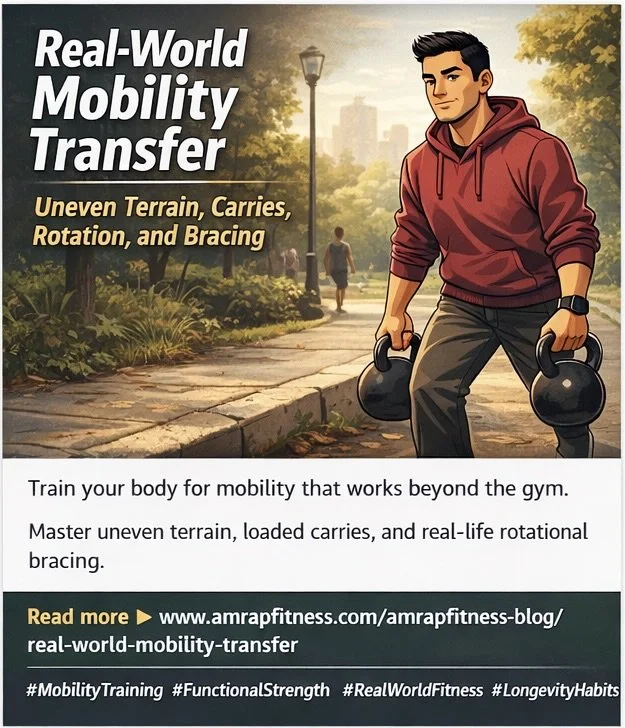
Mobility that doesn’t transfer… doesn’t protect you.
Most people think mobility is a “flexibility” thing.
Touch your toes. Open your hips. Stretch your hamstrings. Hold a pose.
But real life doesn’t ask you to perform mobility on a yoga mat.
Real life asks you to be stable when:
The sidewalk is uneven
your hands are full
you’re turning fast
you’re tired
you’re carrying awkward weight
you’re stepping down without thinking
That’s why the goal isn’t simply “more range.”
The goal is a usable range.
Range that stays stable under load.
Because that’s what keeps you training, moving, working, and living without the constant fear of “tweaking something.”
This entry is about mobility that actually transfers — and how to build it like a professional.
Opening Device: When Mobility Fails Outside the Gym
Here’s the moment people remember.
Not a heavy lift. Not a tough workout.
A normal day.
You step off a curb carrying bags. Your foot lands half‑angled. Your knee shifts. Your back tightens.
Or you twist to reach something in the car. And your spine gives you that warning signal:
“Don’t do that again.”
Or you’re walking on uneven ground and your ankle feels uncertain.
And suddenly you realize:
You’ve been doing “mobility”…
…but you haven’t trained real‑world movement demands.
That’s not your fault.
Most mobility advice is built for how things look — not how they hold up.
What Real‑World Mobility Actually Is
Real‑world mobility is not just range.
It’s a 3‑part equation:
Range — can you access the position?
Control — can you own it (slow, stable, confident)?
Load tolerance — can you hold it under real demands?
If any one piece is missing, the “mobility” doesn’t transfer.
The longevity definition
Real‑world mobility is the ability to:
move through range with control
while the trunk stays organized
and the joints don’t panic under load
That’s how you protect:
knees
hips
spine
ankles
shoulders
And it’s how you stay independent.
The Transfer Principle: Why “Stretching Only” Often Fails
Stretching can increase range.
But life doesn’t injure you because your hamstring was “short.”
Life injures you when:
your foot hits an uneven surface and you can’t stabilize
you rotate under fatigue without bracing
you carry load with a spine that collapses
you move fast with joints that don’t have organized control
So the missing ingredient is not more stretching.
It’s capacity.
Capacity is built through:
controlled strength in end ranges
stability while moving
progressive loading
That’s what makes mobility usable.
The Science Signal (Why Carries + Uneven Ground Matter)
1) Loaded carries train stability in motion
Loaded carries are a simple, underrated tool because they:
create trunk activation while you move
train bracing without overthinking
build whole‑body coordination under load
Research examining muscle activation in loaded carry variations supports that these movements meaningfully challenge trunk and lower‑limb musculature during locomotion — essentially “stability practice while moving.”
2) Uneven surfaces expose the real demand
Walking on uneven surfaces changes gait patterns and increases stability requirements. That’s not a problem — that’s the training target.
Evidence in gait research shows that uneven terrain increases the complexity of walking demands and can require greater control and adaptability, especially as people age.
Translation: If your training only happens on perfect, flat surfaces…
real life becomes the first time you test real life.
We don’t do that.
We train it.
Why This Matters After 40
After 40, people often have:
a history of old injuries
lower tolerance for “random tweaks”
less time to recover from flare‑ups
Which means the enemy is not “hard work.”
The enemy is unpredictable pain.
Unpredictable pain kills consistency.
And consistency is the real longevity lever.
So our goal is to build movement that stays strong under:
fatigue
rotation
carrying
uneven ground
awkward positions
That’s real mobility.
Coaching Reality: The Fear Spiral
Here’s what I see all the time:
Someone tweaks something in a normal movement.
They lose trust.
They become cautious.
They move less.
They get stiffer.
Their “mobility work” becomes random stretching.
They feel worse.
This is a spiral.
And it’s the opposite of anti‑fragile.
The solution isn’t more fear.
It’s more control, more capacity, and more progressive exposure.
The Real‑World Mobility System
We’re going to build transfer in layers.
Layer 1 — Foot + Ankle Integrity (The Foundation)
If the foot can’t adapt, everything above pays.
Tactical drills (2–3x/week)
Short‑foot holds: 3 x 10–20 seconds/side
Calf raises (slow): 2–3 x 8–12
Tibialis raises: 2 x 10–15
Single‑leg balance: 2 x 20–40 seconds
Pro rule: Do balance barefoot sometimes (if safe), but do not chase wobble. Chase control.
Layer 2 — Step‑Down Control (Knee + Hip Ownership)
Most real‑life knee issues show up when stepping down:
stairs
curbs
downhill surfaces
So we train the skill.
Step‑down progression (2x/week)
Low step‑down (3–6 inches)
3 x 6–8/side
slow eccentric
quiet foot
Increase height gradually as control stays clean.
Key cues:
tripod foot (big toe, little toe, heel)
knee tracks over mid‑foot
torso stays tall
This is “real life knee insurance.”
Layer 3 — Bracing + Carrying (Spine Protection That Transfers)
Most people think bracing is only for heavy lifting.
But real life is full of awkward loads:
groceries
kids
luggage
moving boxes
So we train bracing while moving.
Carry menu (2x/week, rotate styles)
Farmer carry (both hands)
Suitcase carry (one hand)
Front carry (hug carry)
Prescription:
4–6 rounds
30–45 seconds
posture tall, ribs stacked, breathe low
Rule: If your shoulders creep to your ears or your ribs flare, the load is too heavy.
Layer 4 — Rotation + Anti‑Rotation (The Missing Link)
People get hurt twisting, not stretching.
Because rotation under fatigue often happens without trunk control.
We train two things:
Controlled rotation
Anti‑rotation (resisting unwanted twist)
The rotation pair (2x/week)
Tall‑kneeling Pallof press: 3 x 8–10/side
Half‑kneeling cable or band chop/lift: 2–3 x 8/side
Cues:
exhale to stack ribs
hips steady
slow control
This is spine longevity training.
Layer 5 — End‑Range Strength (Mobility You Can Trust)
This is where mobility becomes “bulletproof.”
Instead of stretching into a position you can’t control, you build strength there.
Options (choose 1–2)
Split squat ISO hold (front thigh parallel): 2 x 20–30s/side
Cossack squat (supported): 2 x 5/side
Single‑leg hinge reach: 2 x 6/side
Rule: No pain chasing. Own the range.
The Transfer Circuit (15 Minutes, 2x/Week)
This is the premium “put it together” tool.
Do it after strength or as a standalone day.
Circuit
Farmer carry — 4 x 30–45 seconds
Step‑downs — 3 x 6–8/side (slow)
Tall‑kneeling Pallof press — 3 x 8–10/side
Single‑leg hinge reach — 2 x 6/side Finish: 5‑minute easy walk
Progression rule: Increase only ONE variable at a time:
time → load → complexity → environment
Making It Real: Controlled “Uneven Ground” Exposure
You don’t need to hike a mountain.
You need 5–10 minutes a few times per week where your feet adapt.
Options
grass field walk
trail walk
uneven sidewalk scan (safe area)
Rule: Start slow. Stay controlled. This is skill practice.
Common Mistakes (and the Professional Fix)
Mistake 1: Stretching without control
Fix: end‑range strength.
Mistake 2: Chasing instability gimmicks
Fix: stable patterns first, progressive exposure second.
Mistake 3: Going heavy on carries too soon
Fix: posture and breathing are the limiter.
Mistake 4: Ignoring foot/ankle
Fix: foot integrity is the foundation.
Mistake 5: Only training on perfect surfaces
Fix: controlled uneven exposure.
Self‑Assessment (Reader Tool)
Answer honestly:
Do I feel shaky on uneven ground?
Does carrying make my back tighten?
Do I avoid rotation because it feels risky?
Can I step down quietly with control?
When I’m tired, does my posture collapse?
Your answers aren’t judgment.
They’re a plan.
Closing: Mobility That Transfers Is Mobility That Protects
If your mobility work doesn’t transfer, it doesn’t protect you.
Real mobility is:
range you can control
under load
in real environments
That’s how you stay:
consistent
confident
and anti‑fragile
Not just flexible.
Prepared.
Resources (English)
Ellestad SH, et al. Muscle activation patterns during loaded carry variations. 2024. (Open access) https://pmc.ncbi.nlm.nih.gov/articles/PMC11042841/
Inns TB, et al. Gait adaptations on even vs. uneven surfaces across age groups. 2025. https://www.frontiersin.org/journals/aging/articles/10.3389/fragi.2025.1573778/full
Zurales K, et al. Uneven-surface gait and associations with falls/injury-relevant outcomes. 2016. (Open access) https://pmc.ncbi.nlm.nih.gov/articles/PMC4670600/