Warm up
2 minutes jump rope
Push ups
Ring rows
Strict TTB
Good morning
OHS
Skill
Muscle ups
WOD
15 minute AMRAP Fitness
100 burpees
30 muscle ups


Warm up
2 minutes jump rope
Push ups
Ring rows
Strict TTB
Good morning
OHS
Skill
Muscle ups
WOD
15 minute AMRAP Fitness
100 burpees
30 muscle ups
Warm up
2 minutes double unders
3x
20m broad jumps
15 GHD sit ups
10 strict pull ups
20 good mornings
Skill
Movement standards
WOD
3 rounds of:
Row 500m
20 strict ring dips to true support
30 Deadlifts w/115 m/155
Warm up
2 minutes double unders
Rollback reach
Lateral lunges
Power jumps
OH lunges
TTR
Skill
Movement standards
WOD
Complete the following:
*25 minute time cap*
100 TTB
100 Wall ball w/14 m/20
100 Pistols
100 DB snatches w/50 m/70
Monday
Warm up & Skill
3 minutes of rowing
-Break down of the stroke
-Pacing
-Builders
-Bell curve
WOD
30 minutes max distance row
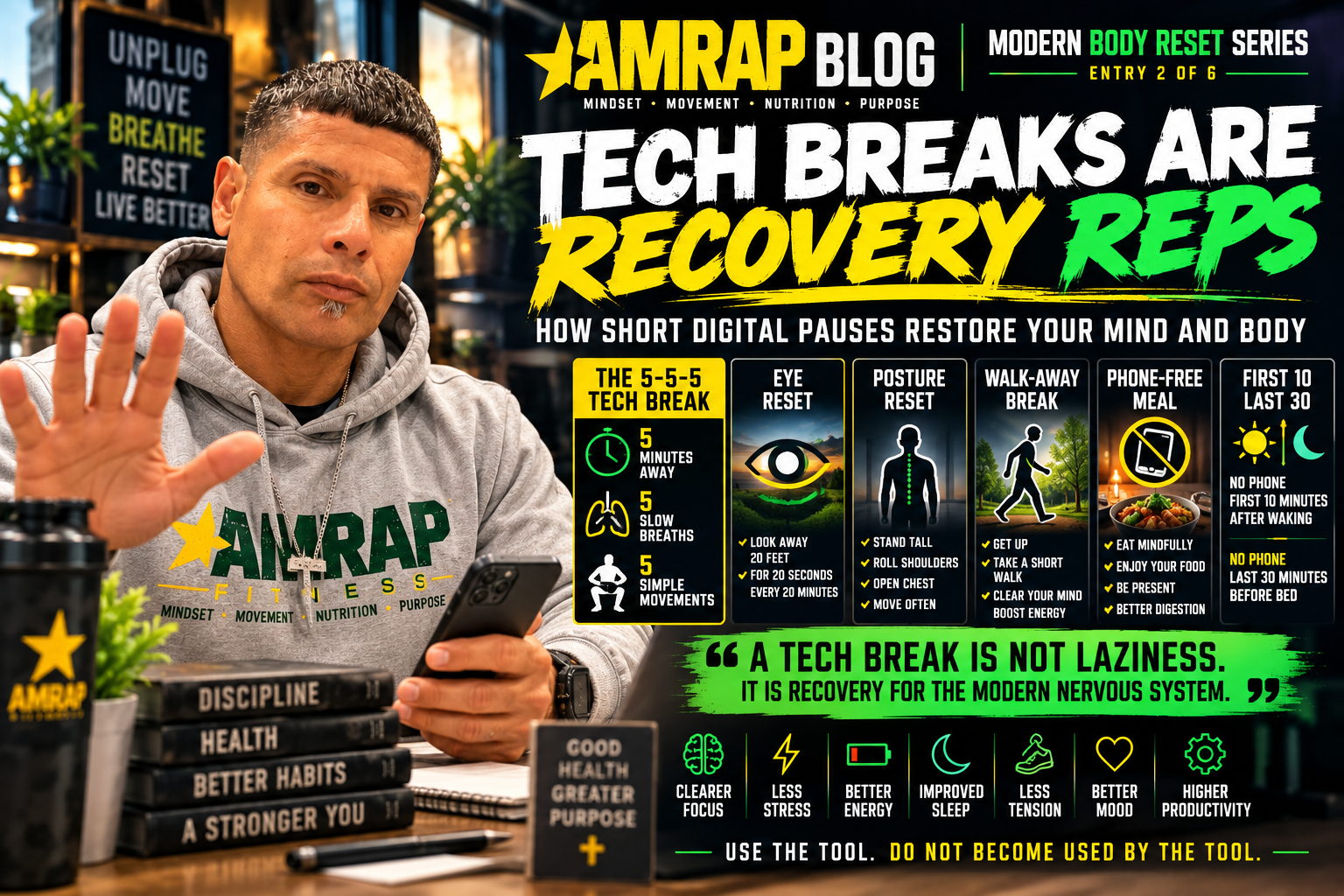
AMRAP Modern Body Reset Series — Entry 2 of 6
It is a recovery rep.
That idea matters because many adults are not only physically tired anymore.
They are digitally tired.
Their eyes are tired.
Their neck is tight.
Their shoulders are rounded.
Their attention is fractured.
Their sleep is pushed later.
Their mind never fully shuts down.
They move from one screen to another screen to another screen and call it rest.
Computer at work.
Phone in the car.
Tablet at home.
Television at night.
Smartwatch alerts.
Emails.
Text messages.
Social media.
News.
Work platforms.
Family group chats.
Banking apps.
School apps.
Medical portals.
Fitness trackers.
Digital calendars.
The modern adult is surrounded by input.
So the body and mind need something intentional:
planned recovery from screens.
Not because technology is bad.
Technology can be useful, productive, creative, educational, and necessary.
But even useful tools become harmful when they have no boundary.
The same way muscles need rest between sets, the brain, eyes, posture, attention, and nervous system need rest between waves of digital input.
That is what this article is about.
Not quitting technology.
Not blaming phones for everything.
Not pretending we can live in 1985.
This is about learning how to use short, practical tech breaks to restore energy, focus, posture, motivation, and peace inside a modern life.
You finish a long stretch of work.
You are mentally tired.
Your eyes feel heavy.
Your shoulders are tight.
Your lower back feels stiff.
You tell yourself:
“I need a break.”
So you pick up your phone.
You scroll.
You check messages.
You watch a short video.
Then another.
Then another.
You answer a notification.
You open one app.
Then another.
Ten minutes later, you return to work.
But something feels off.
You are not refreshed.
You are not clearer.
Your body has not moved.
Your posture has not changed.
Your breathing has not deepened.
Your eyes have not rested.
Your mind has not recovered.
You took a break from one screen by going to another screen.
That is one of the biggest mistakes of the digital age.
A true break should change the signal your body and brain are receiving.
If the work was screen-based, the break should not always be screen-based too.
If the work was seated, the break should not always be seated too.
If the work was mentally demanding, the break should not always add more information.
Sometimes the strongest break is simple:
Stand up.
Look away.
Breathe.
Walk.
Stretch.
Drink water.
Step outside.
Pray.
Be quiet.
Return.
That is a recovery rep.
A tech break is an intentional pause from screens, notifications, and digital input.
It does not have to be long.
It does not have to be dramatic.
It does not require leaving your job, deleting every app, or disappearing from the world.
A tech break may be:
60 seconds of looking away from the screen
2 minutes of standing and breathing
5 minutes of walking without your phone
eating one meal without scrolling
keeping the phone away for the first 10 minutes after waking
protecting the last 30 minutes before bed
turning off nonessential notifications
replacing one scroll with one real recovery habit
The purpose is not to reject technology.
The purpose is to restore human function.
Your eyes need distance.
Your spine needs position changes.
Your joints need movement.
Your mind needs quiet.
Your nervous system needs downshifts.
Your attention needs protection.
A tech break is how you give those systems a chance.
Short breaks can be meaningful.
A systematic review and meta-analysis on micro-breaks defined micro-breaks as short breaks of up to 10 minutes during work tasks and found that these breaks can support well-being outcomes such as vigor and fatigue. The same review also reported that longer breaks tended to produce greater performance benefits, which reinforces a practical point:
Even small breaks can help, and slightly longer breaks may help even more when the task is demanding.
That does not mean every break fixes everything.
It means breaks are not laziness.
They are part of performance management.
For adults between 30 and 70, digital stress is often stacked on top of real-life stress.
A 30-year-old may be managing work, bills, relationships, parenting, and constant phone communication.
A 40-year-old may be balancing career pressure, kids, health concerns, family responsibilities, and late-night emails.
A 50-year-old may be dealing with aging parents, leadership roles, body changes, stress, and recovery that no longer feels automatic.
A 60- or 70-year-old may be managing health portals, online banking, news overload, social media, family messaging, and more sedentary time than the body wants.
Different ages.
Different responsibilities.
Same problem:
Too much input. Not enough reset.
Tech breaks help because they interrupt the modern pattern:
screen
sit
scroll
tense
compare
delay sleep
repeat
A person does not need more guilt.
They need a reset system.
NIOSH has reported that short, strategically spaced rest breaks can reduce eyestrain and musculoskeletal discomfort for video display terminal workers without reducing productivity. In that report, workers consistently reported less eye soreness, visual blurring, and upper-body discomfort under the supplementary break schedule.
The American Optometric Association recommends the 20-20-20 rule to help reduce digital eye strain:
Every 20 minutes, look at something about 20 feet away for 20 seconds.
This simple strategy is not a full solution for every eye or vision problem, but it is a practical starting point for screen-heavy adults.
Breaks from sitting also matter. Systematic reviews and meta-analyses have found that interrupting prolonged sitting with short activity breaks can improve certain short-term metabolic markers, particularly post-meal glucose responses, compared with uninterrupted sitting. Light walking breaks appear to be especially useful in some analyses.
The balanced conclusion is this:
Short breaks are not magic. But they are powerful enough to deserve a place in your daily health system.
The phone is often used as a reward.
After work.
Between tasks.
After dinner.
Before bed.
During stress.
During boredom.
During discomfort.
The problem is that phone-based rest often does not meet the body’s actual recovery needs.
The phone keeps the eyes locked close.
The phone often keeps the neck flexed and shoulders rounded.
The phone adds input.
The phone may add stimulation.
The phone often fragments attention even more.
That does not mean every phone break is harmful.
Sometimes a message from someone you love helps.
Sometimes music helps.
Sometimes a guided prayer, meditation, or breathing app helps.
Sometimes a useful video teaches something.
But if every break is digital, recovery becomes incomplete.
A real break should restore something.
Ask:
“What system needs recovery right now?”
Eyes?
Posture?
Mind?
Mood?
Breathing?
Energy?
Then choose the break that matches the need.
This is the foundation of the article.
Think of tech breaks as recovery reps.
Just like strength training has reps and sets, recovery can have reps and sets too.
A recovery rep is a small action that restores capacity.
Examples:
look away
stand up
breathe
walk
stretch
hydrate
step outside
pray
journal
reset posture
silence notifications
eat without scrolling
A single recovery rep is small.
But repeated throughout the day, these reps create a different life.
The modern adult does not need one giant wellness retreat once per year.
They need repeated recovery reps inside real life.
Screen-heavy adults need visual breaks.
Use the 20-20-20 rule:
Every 20 minutes, look at something about 20 feet away for 20 seconds.
Also consider:
blinking intentionally
reducing glare
adjusting brightness
increasing font size
keeping screens at a comfortable distance
scheduling regular eye exams
using proper lighting
Digital eye strain can be affected by glare, lighting, viewing distance, posture, and uncorrected vision issues, so persistent symptoms should be discussed with an eye-care professional.
If your eyes are tired, your brain is probably working harder than it needs to.
Respect that.
Look away before fatigue piles up.
Most people do not need complicated posture routines.
They need repeated position changes.
Try this simple posture reset:
Stand tall.
Place feet under hips.
Gently tuck the chin.
Pull shoulders down and back.
Open the hands.
Squeeze glutes lightly.
Take three slow breaths.
Walk for 30–60 seconds if possible.
This is not a workout.
It is a signal.
It tells the body:
“We are not staying collapsed all day.”
Screen fatigue is not only a mental problem.
It becomes physical when posture never changes.
A true tech break often needs distance.
Not emotional distance.
Physical distance.
Put the phone down.
Stand up.
Walk away.
This can be:
one lap around the house
one hallway walk
one trip outside
one flight of stairs
one lap around the building
one driveway walk
one playground loop
one walk around the gym floor
Light walking breaks have shown favorable effects on some cardiometabolic markers compared with uninterrupted sitting, and some research suggests walking breaks may outperform standing-only breaks for post-meal glucose and insulin responses.
This does not mean every walk must be intense.
It means the body benefits when sitting gets interrupted.
Do not wait for motivation to move. Use movement to create motivation.
Some research suggests that even very short activity breaks may help reduce post-meal glucose and insulin responses.
One network meta-analysis reported that at least a 2-minute activity break every 20–30 minutes can reduce postprandial glycemia and insulin responses compared with prolonged sitting.
This does not replace structured exercise.
But it shows why small movement breaks matter.
A 2-minute break is not nothing.
It is a vote against stagnation.
Digital fatigue often comes with shallow breathing.
When you sit collapsed over a screen, the ribs and diaphragm may not move as freely.
Stress and notifications can also keep breathing shallow and elevated.
Try this:
Sit tall or stand.
Inhale through the nose if comfortable.
Exhale slowly.
Let the shoulders drop.
Repeat for 5 breaths.
The goal is not to force a perfect breathing technique.
The goal is to give your body a downshift signal.
A breath reset is especially useful before:
eating
difficult conversations
returning to focused work
training
bedtime
responding to stressful messages
Do not answer every notification from a nervous system that has not taken a breath.
A phone-free meal is one of the simplest recovery tools.
It helps with:
awareness
digestion rhythm
conversation
gratitude
slower eating
noticing fullness
reducing mindless consumption
The goal is not to make every meal sacred and perfect.
Start with one.
One meal per day without the phone.
No scrolling.
No videos.
No emails.
No news.
Just food.
Breath.
Presence.
Maybe family.
Maybe silence.
Maybe gratitude.
For many people, this is harder than it sounds.
That is exactly why it matters.
Do not give the phone the first 10 minutes of your day.
That is a simple rule with a deep effect.
Most people wake up and immediately let the world enter their mind.
Messages.
News.
Problems.
Requests.
Comparison.
Emails.
Notifications.
Before they drink water.
Before they pray.
Before they breathe.
Before they ask how they feel.
Before they decide what matters.
Protect the first 10 minutes.
Use them for:
water
prayer
gratitude
stretching
breathing
planning
quiet
sunlight
a short walk
This is not about being perfect.
It is about starting the day from your center instead of from the world’s noise.
Check in with yourself before checking in with the world.
The final 30 minutes before bed should prepare the body for sleep.
That does not happen when the phone is feeding the brain:
work stress
blue light
social media
arguments
news
comparison
shopping
videos
unfinished problems
Screen time has been associated with sleep outcomes such as insomnia and sleep duration in systematic-review research, although the exact relationship varies across study designs and populations.
The practical standard:
Protect the last 30 minutes.
Possible replacements:
reading
prayer
stretching
journaling
breathing
preparing clothes
writing tomorrow’s plan
quiet conversation
gratitude list
The phone may be useful all day.
That does not mean it deserves the final word.
This is the central reader tool.
When digital fatigue builds, use the 5-5-5 method.
Put the device down.
Stand up.
Step away.
Let the exhale be longer than the inhale if comfortable.
Drop the shoulders.
Relax the jaw.
Choose five:
neck turns
shoulder rolls
wall angels
bodyweight squats
hip hinges
calf raises
glute squeezes
wrist circles
thoracic rotations
walking steps
This is not a full workout.
It is a reset.
The 5-5-5 Tech Break tells your system:
“We are not trapped in this screen posture. We can reset.”
Different fatigue needs different breaks.
Do:
20-20-20 rule
blink intentionally
look outside
reduce glare
Do not:
switch from computer to phone and call it rest
Do:
stand tall
chin tuck
shoulder rolls
upper-back extension
walk
Do not:
keep looking down while rubbing your neck
Do:
silence notifications
write the next task
take 5 breaths
focus on one thing
Do not:
open five more apps
Do:
step outside
walk
call a supportive person
pray
journal
Do not:
doomscroll until you feel worse
Do:
screen cutoff
phone outside reach
dim lights
stretch
read
downshift
Do not:
negotiate with the algorithm at midnight
Tech breaks can become exercise triggers.
Instead of thinking:
“I need a 60-minute workout or nothing,”
try:
5 push-ups after a long screen block
10 squats between meetings
one hallway walk after each email block
a 10-minute walk after lunch
mobility while the computer updates
calf raises during a phone call
breathing and shoulder reset before coaching or teaching
This does not replace full training.
It supports the full training.
Small movement breaks make the body more available for bigger movement later.
A stiff, overstimulated, under-moved body is harder to train.
Tech breaks help keep the system ready.
Screens interfere with nutrition when they create distraction, delay, and emotional eating.
Examples:
scrolling while eating
ordering impulsively from apps
ignoring hunger until severe
staying up late and snacking
eating faster because attention is elsewhere
comparing your body to influencers while trying to eat normally
A simple correction:
Before eating, put the phone down for the first five minutes.
Not forever.
Five minutes.
Notice the meal.
Take a breath.
Thank God if that is part of your practice.
Eat with attention.
Then decide if you still want the screen.
This small pause changes the relationship between food and attention.
There is a deeper layer here.
If you are trying to become more grounded, grateful, and spiritually mature, constant digital input can become a major obstacle.
It is hard to surrender when your nervous system never gets quiet.
It is hard to hear wisdom when the phone is always speaking.
It is hard to practice gratitude when comparison is always available.
It is hard to be still when stillness feels uncomfortable.
A tech break can become a spiritual rep.
One minute of prayer.
One gratitude sentence.
One quiet walk.
One moment to say:
“Lord, help me reset my mind and return to what matters.”
That may sound simple.
But simple practices repeated daily can change the direction of a life.
Here is a practical example for a screen-heavy adult.
no phone first 10 minutes
water
2 minutes of mobility
write top priority
use 20-20-20 rule
stand every 30–60 minutes
silence nonessential alerts
phone-free first 5 minutes
short walk after eating if possible
5-5-5 Tech Break
posture reset
water before more caffeine
walk or train before sitting and scrolling
phone-free meal or conversation
last 30 minutes screen-light or screen-free
gratitude, prayer, stretching, or reading
This is not extreme.
It is realistic.
And realistic is what works.
For one week, practice recovery reps.
No phone for the first 10 minutes after waking.
Use visual breaks during screen work.
Use one 5-5-5 Tech Break.
Eat one meal without the phone.
Take one 5- to 10-minute walk without digital input.
Turn off three nonessential notifications.
Protect the final 30 minutes before bed.
At the end, ask:
Did I feel more present?
Did my body feel less tense?
Did I sleep better?
Did I move more?
Did I feel less controlled by the phone?
Which break was hardest?
Which break helped the most?
That answer becomes your next habit.
Use this:
I will use technology as a tool, not as my default state.
I will give my eyes distance.
I will give my body movement.
I will give my mind quiet.
I will protect my first 10 minutes.
I will protect my last 30 minutes.
I will not call every scroll recovery.
I will take recovery reps throughout the day.
I will reclaim attention one break at a time.
This is not anti-tech.
This is pro-health.
Correction: Change the signal. Look away, stand, walk, breathe.
Correction: Use posture resets before discomfort becomes the reminder.
Correction: Breaks protect performance, energy, and recovery.
Correction: Silence nonessential alerts and check intentionally.
Correction: Protect the first 10 and last 30.
Correction: Make at least one meal phone-free.
Correction: Start with one recovery rep and repeat it daily.
Answer honestly:
Do I take breaks from screens, or do I switch screens?
Do I feel more restored or more drained after phone use?
Are my eyes, neck, shoulders, or back asking for more breaks?
Do I protect the first 10 minutes of my day?
Do I protect the last 30 minutes before bed?
Do notifications interrupt my focus more than they need to?
Do I eat while distracted most of the time?
Do I walk away from the phone daily?
What is one tech break I can practice today?
Am I using the tool, or am I being used by it?
Your answers are not judgment.
They are direction.
Most adults cannot escape technology.
And they do not need to.
Technology helps us work, communicate, learn, coach, create, schedule, navigate, and connect.
But your body still has human requirements.
Your eyes need distance.
Your joints need movement.
Your posture needs change.
Your mind needs quiet.
Your nervous system needs downshifts.
Your sleep needs protection.
Your spirit needs stillness.
That is why tech breaks matter.
They are not weakness.
They are not wasted time.
They are not laziness.
They are recovery reps.
And in the modern world, recovery reps may be one of the most important habits you build.
Start small.
Look away.
Stand up.
Walk.
Breathe.
Eat without scrolling.
Protect the morning.
Protect the night.
Pray.
Stretch.
Move.
Return.
You do not need to defeat technology.
You need to lead it.
Because the goal is not to live without screens.
The goal is to live with enough strength, attention, and peace that screens no longer control the quality of your life.
That is the modern body reset.
One break.
One breath.
One step.
One recovery rep at a time.
Albulescu P, Tușe D, Sulea C. “Give me a break!” A systematic review and meta-analysis on the efficacy of micro-breaks for increasing well-being and performance. PLOS ONE. 2022.
National Institute for Occupational Safety and Health. Strategic Rest Breaks Reduce VDT Discomforts Without Impairing Productivity.
Occupational Safety and Health Administration. Computer Workstations: Hazards and Solutions.
American Optometric Association. Computer Vision Syndrome / Digital Eye Strain.
Saunders TJ, et al. The Acute Effects of Interrupting Prolonged Sitting Time in Adults With Standing and Light-Intensity Walking on Biomarkers of Cardiometabolic Health: A Systematic Review and Meta-analysis.
Loh R, et al. Effects of Interrupting Prolonged Sitting with Physical Activity Breaks on Blood Glucose, Insulin and Triacylglycerol Measures: A Systematic Review and Meta-analysis.
Cao Z, Xu H, Zhao Y, et al. Effects of interrupting prolonged sitting on postprandial glycemia and insulin responses: A network meta-analysis.
World Health Organization. WHO Guidelines on Physical Activity and Sedentary Behaviour.
Centers for Disease Control and Prevention / NIOSH. Working from Home: How to Optimize Your Work Environment and Stay Healthy.