Warm up
Tabata row
Max distance row in 7 minutes
WOD
20minute AMRAP
7 HSPU
14 KBS
10 box jumps W/26 M/32


Warm up
Tabata row
Max distance row in 7 minutes
WOD
20minute AMRAP
7 HSPU
14 KBS
10 box jumps W/26 M/32
Partner warm up
MB chest pass
MB hip toss
MB rotations
MB sit ups
Partner sit ups
Skill
Movement standards
Partner WOD
15 minute AMRAP
*ping pong the movements. One work and one rest)
7 push ups or 7 HSPU
12 squats/ 8 pistols
15 KBS
Warm up
Row 3 minutes
Tabata row for calories
Skill
Movement standards
WOD
15 minute AMRAP
Row 10 calories
10 burpees over monorail
25 double unders
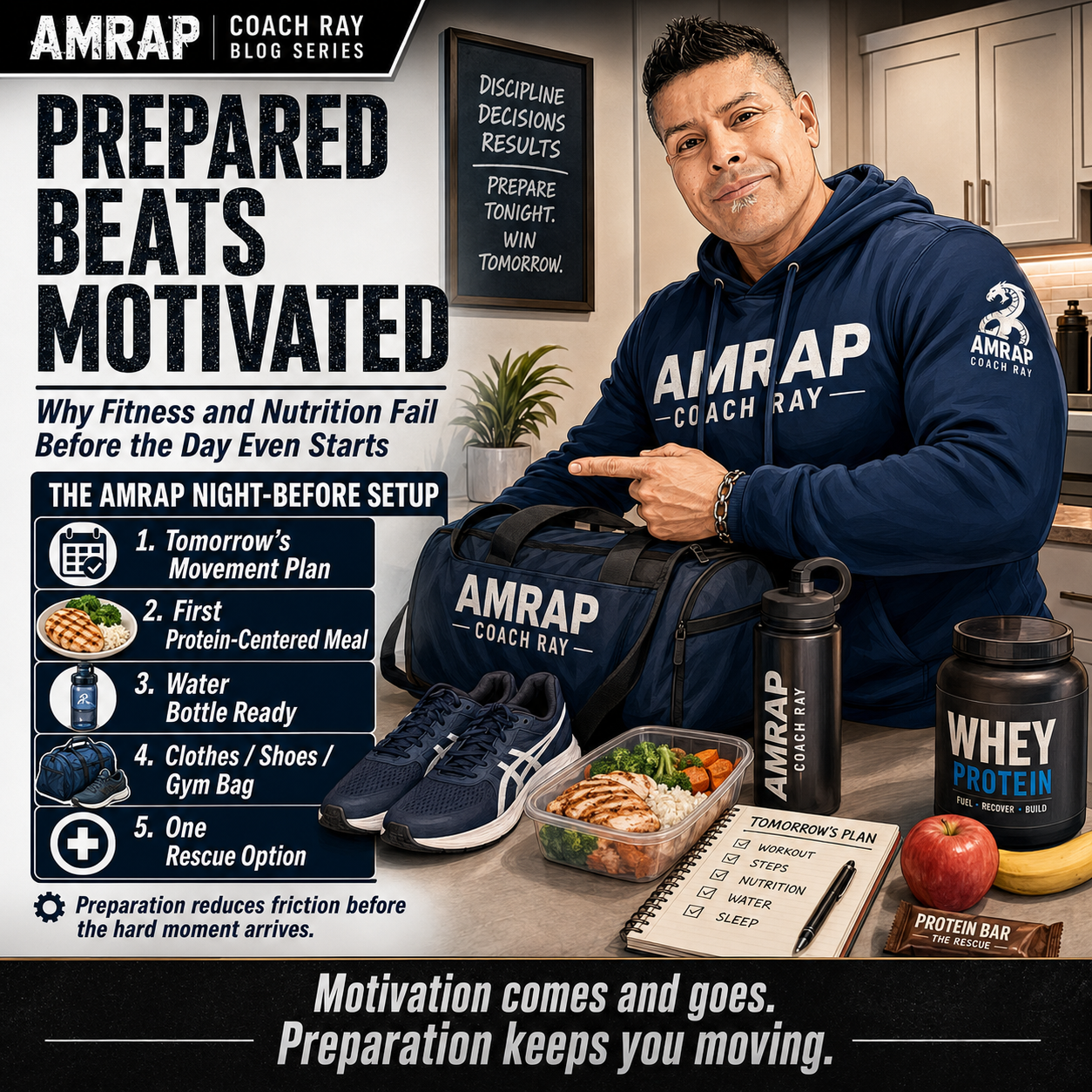
AMRAP Real-Life Reset Series — Entry 2 of 6
Preparation is powerful when motivation does not.
That difference matters.
Most people do not fail their fitness and nutrition goals because they are lazy.
They fail because the day becomes harder than the plan was prepared for.
They wake up with good intentions.
They plan to train after work.
They plan to eat better.
They plan to drink more water.
They plan to avoid the late-night snack spiral.
They plan to get to bed earlier.
Then life starts moving.
Work runs late.
The morning feels rushed.
The gym clothes are not packed.
The water bottle is empty.
Lunch is improvised.
The afternoon energy crash hits.
Dinner has not been planned.
Stress rises.
The workout gets moved to “later.”
And later becomes never.
Then the person blames motivation.
But the real problem started much earlier.
The plan was not prepared for real life.
This article is about the skill most people underestimate:
preparedness.
Not perfection.
Not obsessive planning.
Not living like a professional athlete.
Preparedness means building enough structure before the difficult moment arrives so that the better decision is still available when your energy is low.
That is the difference between hoping you follow through and designing a life where follow-through becomes more realistic.
A lot of people think their health decisions fail at night.
They believe the problem happened when they skipped the gym at 6:15 p.m.
Or when they ordered takeout.
Or when they ate from the pantry after dinner.
But many of those decisions were influenced long before the moment of failure.
The workout failed when:
the clothes were not packed
the session was not written
the calendar had no protected training block
the gym was not on the route home
there was no backup plan for a late workday
Nutrition failed when:
breakfast was rushed
protein was missing
lunch was improvised
groceries were not stocked
no emergency meal existed
hunger was allowed to build all day
Recovery failed when:
caffeine went too late
the phone stayed in the bedroom
tomorrow was not planned
the evening had no shutdown routine
bedtime became negotiable again
The final choice may have happened at night.
But the setup happened earlier.
That is the point.
You do not rise to the level of your intentions.
Most days, you fall to the level of your preparation.
Preparedness is not just meal prep.
It is not just writing workouts.
It is not just putting clothes in a bag.
Preparedness is the practice of reducing future friction.
It asks:
“What will make tomorrow’s better decision easier?”
That may include:
choosing the workout before arriving at the gym
packing clothes the night before
preparing one protein-centered meal
filling the water bottle
blocking a training time
deciding the backup plan
setting a caffeine cutoff
keeping walking shoes visible
planning what to order if cooking fails
Preparedness is not glamorous.
That is why people skip it.
But preparation is often where success is quietly won.
A common problem in health behavior is the gap between intending to act and actually acting.
People often sincerely intend to exercise, eat better, or improve health habits, but intention alone does not guarantee action.
Implementation intentions—specific “if–then” plans that connect a situation with a behavior—have been studied as one strategy to improve follow-through. A systematic review and meta-analysis of randomized clinical trials found that implementation intentions can have a positive effect on physical-activity practice in adults, though results vary and planning works best when paired with realistic confidence and repeated action.
This matters because vague goals are fragile.
A vague goal says:
“I’ll work out tomorrow.”
A prepared plan says:
“If I finish work by 4:30, I go directly to the gym. If work runs late, I complete the 20-minute home version.”
That is a very different level of readiness.
The CDC summarizes adult physical-activity recommendations as at least 150 minutes of moderate-intensity aerobic activity weekly plus muscle-strengthening activity on two days per week, but busy adults often need systems that divide those targets into realistic, scheduled actions instead of vague hopes.
Nutrition follows the same principle. Meal planning has been associated with better diet quality, greater food variety, and more favorable weight status in observational research, while the CDC recommends planning meals, identifying healthier choices ahead of time, and keeping nutritious snacks available so hunger does not leave decisions to chance.
The professional conclusion is clear:
Planning does not guarantee success. But lack of planning often guarantees unnecessary difficulty.
Some people hear “prepare” and think:
strict meal plans
no flexibility
carrying food everywhere
never missing workouts
living by rules
losing spontaneity
That is not what this means.
Preparedness is not rigidity.
Preparedness is having options ready before you need them.
Rigid people collapse when the plan changes.
Prepared people adapt.
Rigid says:
“If I cannot do the full workout, the day is ruined.”
Prepared says:
“If the full workout fails, I have the 20-minute version.”
Rigid says:
“If I cannot eat the perfect meal, I might as well eat whatever.”
Prepared says:
“If cooking fails, I have a default meal or a smarter ordering option.”
Rigid says:
“I need the day to go exactly right.”
Prepared says:
“The day probably will not go exactly right, so here is what I will do anyway.”
That is maturity.
That is professionalism.
That is sustainable coaching.
Motivation changes.
It rises when:
results are visible
sleep is good
stress is low
the schedule is clean
confidence is high
It drops when:
work is heavy
sleep is poor
progress is slow
the scale fluctuates
family stress rises
emotional fatigue hits
If your health depends only on motivation, your health becomes unstable.
That does not mean motivation is useless.
Motivation can start the engine.
Preparation keeps the car on the road.
The goal is not to wait until you feel inspired.
The goal is to make the next right action visible, ready, and possible.
Most people know the big things:
exercise is good
protein matters
sleep matters
hydration helps
walking counts
consistency works
The problem is not usually awareness.
It is execution under pressure.
That pressure appears when:
hunger is high
time is short
stress is elevated
energy is low
emotions are loud
the environment is unprepared
The preparedness gap is the space between:
what you know
and
what your day makes easy.
Coaching lives in that gap.
Because a good coach does not only write workouts.
A good coach helps build the systems that make the workouts happen.
This is the central framework.
Every night, take 5–10 minutes to prepare tomorrow.
Not your whole life.
Tomorrow.
Write the exact plan.
Not:
“I should exercise.”
Write:
what time
where
what workout
how long
what the backup plan is
Example:
Plan A: Strength training at 5:30 p.m.
Plan B: 20-minute home circuit if work runs late.
Minimum: 10-minute walk after dinner.
Now the day has structure.
Do not leave the first meal to chaos.
Decide:
eggs and fruit
Greek yogurt and oats
protein smoothie
turkey wrap
leftovers
cottage cheese and berries
The first meal sets the tone.
It does not need to be perfect.
It needs to be known.
Fill it.
Place it where you will see it.
Hydration fails when it depends on memory.
Make it visible.
Place them where they reduce friction.
Examples:
packed gym bag by the door
shoes beside the bed
clothes in the car
resistance band in the work bag
The goal is to make beginning easier.
Ask:
“What is most likely to go wrong tomorrow?”
Then prepare one response.
Examples:
If work runs late, I do the minimum session.
If I forget lunch, I use the emergency protein option.
If dinner collapses, I use the default meal.
If stress spikes, I take a 10-minute walk before eating.
Preparedness is not predicting everything.
It is preparing for the most predictable disruptions.
Most people have only one plan.
That is why they quit when the day changes.
A professional system has three levels.
This is what you do when the day cooperates.
Examples:
full workout
prepared meals
normal bedtime
full hydration target
planned recovery
This is what you do when the day is imperfect but manageable.
Examples:
shorter workout
assemble meal
walking instead of conditioning
reduced training volume
simple dinner
This is what you do when life gets loud.
Examples:
10-minute walk
one protein-centered meal
water bottle finished
5-minute mobility
lights down 20 minutes earlier
The minimum is not the goal.
It is the floor.
It protects identity.
It says:
“Even when life is hard, I still do something that proves I am not abandoning myself.”
Many people waste training time deciding what to do.
That creates friction.
Write the workout before you arrive.
A simple template:
main lift or main movement
secondary movement
push or pull
carry or core
conditioning or cooldown
The workout should be waiting for you.
Transitions destroy workouts.
The most dangerous moment is often between:
work and home
dinner and couch
morning alarm and first action
childcare drop-off and next task
Prepare that transition.
Examples:
change clothes before leaving work
drive directly to the gym
place shoes beside the door
set the home workout space before bed
begin the walk before sitting down
Do not give the exhausted version of yourself ten extra decisions.
A backup workout should be so simple that you do not need motivation to begin.
Example:
20-minute home session
Set a timer for 20 minutes.
Rotate:
squat or sit-to-stand
push-up or press
row
hinge
carry or plank
Controlled pace.
Good form.
Done.
That may not be the full plan.
But it preserves the habit.
Nutrition failure often begins when hunger and lack of preparation collide.
The strongest solution is not more guilt.
It is a food system.
Ask:
“Where is tomorrow’s protein coming from?”
Examples:
eggs
Greek yogurt
chicken
turkey
tuna
cottage cheese
protein shake
beans or lentils
leftovers
Protein gives the meal structure.
You do not need a perfect menu.
You need one meal you can execute under pressure.
Examples:
Greek yogurt, berries, oats
rotisserie chicken, rice, vegetables
eggs, potatoes, fruit
tuna, crackers, salad
protein smoothie and banana
Default meals reduce decision fatigue.
Keep a backup at work, in the bag, or at home.
Examples:
protein bar
shaker bottle and protein powder
tuna packet
oatmeal
fruit
measured nuts
whole-grain crackers
The goal is not to snack all day.
The goal is to prevent extreme hunger from making the next decision harder.
Recovery is often decided before bedtime.
A better morning often begins the night before.
Prepare:
caffeine cutoff
phone boundary
clothes for the morning
water for waking
written plan for tomorrow
a brief shutdown routine
Sleep does not improve only because someone wants better sleep.
It improves when the evening is prepared for sleep.
That may mean:
dimmer lights
less scrolling
fewer late tasks
earlier food planning
a set “shutdown” cue
You do not need a perfect night routine.
You need a repeatable downshift.
The emotional version of you is not always the best planner.
When you are stressed, hungry, embarrassed, or tired, your brain looks for immediate relief.
So decide earlier.
Write:
what you will do if you feel overwhelmed
what you will eat if dinner falls apart
what you will do if you miss the workout
who you will text if you start spiraling
what counts as a successful minimum
This is not weakness.
It is strategy.
You are respecting the fact that human decision-making changes under pressure.
Once per week, take 20–30 minutes.
The goal is not to control the whole week.
The goal is to prevent the most predictable failures.
Look for:
late workdays
appointments
family obligations
travel
difficult mornings
social events
high-stress windows
Choose:
two to four training times
one or two walking windows
one recovery block
Pick:
two breakfasts
two lunches
two dinners
one emergency meal
Ask:
“Which day is most likely to break the plan?”
Prepare for that day first.
Example:
Thursday is the hardest day. If work runs late, I will do the 20-minute home session and use the rotisserie chicken meal.
Now the hardest day has a plan.
At the end of each night, score yourself.
Not on perfection.
On readiness.
Give one point for each:
Tomorrow’s movement plan is written.
First protein-centered meal is decided.
Water bottle is ready.
Clothes, shoes, or gym bag are prepared.
One rescue option is identified.
A score of 5 does not guarantee tomorrow will be perfect.
But it dramatically reduces avoidable friction.
If you consistently score 0 or 1, do not be surprised when tomorrow depends on motivation.
Some people cannot prepare much at night.
Use the morning version.
Ask:
What is my movement minimum today?
Where is my protein coming from?
When will I drink my first bottle of water?
What is the predictable obstacle?
What is my rescue plan?
Five minutes of clarity can change the day.
This is the deeper point.
Preparedness is not just a checklist.
It is identity.
A prepared person says:
I do not wait for the day to go perfectly.
I do not leave my health to chance.
I do not expect my tired self to do all the planning.
I respect my future self enough to set them up.
I build systems because my goals matter.
That identity changes everything.
You stop asking:
“Will I feel motivated tomorrow?”
You start asking:
“What can I set up tonight so tomorrow is easier to win?”
That is a stronger question.
Correction: Build Plan A, Plan B, and Plan Minimum.
Correction: Prepare the workout, clothes, and transition.
Correction: Decide the first protein-centered meal and emergency option.
Correction: Prepare first for the most predictable disruption.
Correction: Preparation is discipline performed early.
Correction: Use the 5-point scorecard.
Correction: Decide before emotion arrives.
For one week, practice the Night-Before Setup.
Keep it simple.
Write Plan A and Plan Minimum.
Decide it before bed.
Identify tomorrow’s likely obstacle.
Look ahead and protect the most vulnerable window.
Did preparation reduce friction?
Keep the version you will actually use.
The goal is not a perfect week.
The goal is learning how much easier consistency becomes when the day is prepared before it tests you.
Answer honestly:
Do I rely on motivation more than preparation?
Do I know tomorrow’s workout before tomorrow arrives?
Is my first protein-centered meal already decided?
Do I have a rescue plan for late work, stress, or poor sleep?
Are my shoes, clothes, water, and food ready—or hoped for?
Which day of the week breaks my plan most often?
What decision am I repeatedly asking my exhausted self to make?
What could I prepare tonight in five minutes?
Do I have Plan A, Plan B, and Plan Minimum?
Am I making my goals easier to execute—or harder than they need to be?
Your answers are not judgment.
They are design information.
Motivation feels good when it is present.
But preparation is more dependable.
Preparation is what helps you train when the day is heavy.
Preparation is what helps you eat well when hunger is loud.
Preparation is what helps you recover when stress is high.
Preparation is what keeps one difficult day from becoming three lost weeks.
You do not need to prepare perfectly.
You need to prepare enough.
Enough to reduce friction.
Enough to protect the first step.
Enough to keep the system alive.
Enough to remind yourself:
“My health matters before the day becomes difficult.”
That is the standard.
Not perfection.
Preparedness.
Because the people who succeed long term are not always the most motivated.
They are often the ones who stopped leaving their goals exposed to chaos.
They prepared.
They adjusted.
They returned.
They made the better choice easier before the hard moment arrived.
And that is how consistency is built.
Not by hoping tomorrow feels easy.
By preparing tonight like tomorrow matters.
Silva MAV, São-João TM, Brizon VC, Franco DH, Mialhe FL. Impact of implementation intentions on physical activity practice in adults: A systematic review and meta-analysis of randomized clinical trials. PLOS ONE. 2018. Implementation-intention planning has shown positive effects on adult physical-activity practice in randomized trials.
Centers for Disease Control and Prevention. Adult Activity: An Overview. CDC summarizes current adult guidance as at least 150 minutes of moderate-intensity physical activity weekly plus two days of muscle-strengthening activity.
Ducrot P, Méjean C, Aroumougame V, et al. Meal planning is associated with food variety, diet quality and body weight status in a large sample of French adults. International Journal of Behavioral Nutrition and Physical Activity. 2017. Meal planning was associated with greater food variety, better diet quality, and more favorable weight status in observational data.
Centers for Disease Control and Prevention. How to Have Healthier Meals and Snacks. CDC recommends planning meals, identifying healthier choices ahead of time, and keeping nutritious snacks available.
Gardner B, Lally P, Wardle J. Making health habitual: the psychology of habit-formation and general practice. British Journal of General Practice. 2012. Habit-formation guidance emphasizes repeating simple behaviors in consistent contexts to support automaticity.
Lally P, van Jaarsveld CHM, Potts HWW, Wardle J. How are habits formed: Modelling habit formation in the real world. European Journal of Social Psychology. 2010. Repetition in a consistent context increased automaticity over time.

For busy parents juggling work and family, midlife professionals glued to screens, and anyone who feels stuck after countless restarts, weight management can feel harder than it “should” be. The obesity epidemic has changed what everyday life looks like, and the impact of obesity on health can show up as lower energy, more aches, and rising concern about long-term risks. That tension, wanting better health while feeling worn down by time, stress, and mixed messages, keeps many general readers struggling with weight from taking the next step. The good news is that the wellness benefits often begin with the importance of lifestyle change, even when the changes are small and realistic.
Start with 5 Wellness Moves You Can Repeat Weekly
When weight feels harder than it “should” right now, the goal isn’t perfect habits; it’s repeatable ones. Use these five wellness moves to support weight management without extreme rules.
Pick an enjoyable workout routine (and make it small): Choose movement you don’t dread, walking with a playlist, dancing in your living room, swimming, beginner strength training, or a casual bike ride. Aim for 20–30 minutes, 3 days this week, and treat anything extra as a bonus. Enjoyable workouts are easier to repeat, and repeatability is what turns “good intentions” into real change.
Build a balanced plate you can default to: For a balanced diet for weight loss, keep it simple: half your plate non-starchy vegetables, a palm-sized protein, a fist of high-fiber carbs, plus a thumb of healthy fat. This helps with fullness and steadier energy, which matters when stress and busy schedules push you toward grazing. If dinner is pasta, keep it, just add a big salad or roasted veggies and include chicken, beans, or tofu.
Plan one “easy win” meal and repeat it 2–3 times: Pick one breakfast or lunch that’s quick and satisfying, then buy the ingredients weekly. Examples: Greek yogurt + berries + nuts; eggs + veggies + toast; a bean-and-chicken salad kit you bulk up with extra cucumbers and chickpeas. Repeating one meal reduces decision fatigue, the same “life is a lot right now” pressure that makes weight feel out of reach.
Protect sleep with a 30-minute wind-down rule: Inadequate sleep and obesity often travel together, partly because poor sleep can raise cravings and lower follow-through on movement and meal plans. Start with one consistent step: set a “screens down” or “lights low” alarm 30 minutes before bed, then do a short routine like stretching, reading, or a shower. The CDC reports trouble falling asleep most days or every day affects 15.4% of adults, so if sleep is messy, you’re not alone. Keep the goal realistic and steady.
Treat mental health like part of the plan, not a side quest: Mental health and weight management connect through stress eating, low motivation, and all-or-nothing thinking. Try a quick “pause practice” once a day: before snacking, rate hunger 1–10 and ask what you actually need: food, water, a break, or support. If you notice frequent overwhelm, consider talking with a clinician or counselor; getting help is a practical wellness strategy, not a failure.
Build a One-Place System for Plans, Guides, and Progress
Once you’ve picked a few wellness moves you can repeat, it gets much easier to follow through when your resources live in one reliable place. Saving your wellness plans, nutritional guides, workout routines, and progress-tracking templates as PDFs creates a portable health library that looks the same on any device and stays consistently formatted over time. That consistency matters when you’re working to manage obesity, because it reduces friction: you can quickly pull up the right plan, review what you meant to do, and keep your notes and tracking sheets aligned from week to week.
PDFs are also easy to share with the people on your support team, dietitians, personal trainers, and healthcare providers, so everyone is looking at the same information. That can help you coordinate changes, spot patterns, and build accountability without having your details scattered across emails, apps, or mismatched documents. And when you need to adjust what you’ve saved, there are online options that make PDFs more flexible, including tools that convert files to PDF, compress large documents, edit pages, and even rotate or reorder them. See the resources shared for your benefit.
Small Habits That Make Weight Changes Stick
Habits matter because they reduce decision fatigue and make progress feel automatic, even on busy weeks. Since times to reach habit formation varies widely, consistency with small steps is often more useful than chasing perfection.
Two-Minute Plan Check
What it is: Review today’s meals, movement, and one likely obstacle.
How often: Daily
Why it helps: You act with intention instead of reacting to stress.
Protein-and-Produce Anchor
What it is: Build each meal around one protein and one produce item.
How often: Daily
Why it helps: It supports fullness and steadier energy.
Ten-Minute Walk Bookends
What it is: Take a brisk walk after one meal or at day’s end.
How often: Daily
Why it helps: Regular movement boosts mood and strengthens routine.
Kitchen “Reset” Close
What it is: Prep tomorrow’s water bottle and one grab-and-go snack.
How often: Daily
Why it helps: It makes the next good choice easier.
Weekly Pattern Review
What it is: Check your logs for triggers, wins, and one adjustment.
How often: Weekly
Why it helps: habit-based interventions can improve the odds of meaningful results.
Weight and Habit Questions People Ask Most
Q: Why am I not losing weight even with healthier habits?
A: Body weight can lag behind behavior changes, especially if sleep, stress, or portions are still inconsistent. Track one measurable input for a week, like daily steps or added protein, before changing everything at once. If you have medical conditions or medications that affect weight, consider checking in with a clinician.
Q: How do I handle a weight-loss plateau without getting discouraged?
A: Plateaus are common and often mean your body has adapted to your new routine. Keep your core habit, then adjust one lever: add 5 to 10 minutes of movement, increase vegetables, or tighten up liquid calories. Give the change two weeks before judging results.
Q: What if stress or low mood keeps pushing me toward overeating?
A: Stress can raise cravings and reduce impulse control, so this is not a willpower flaw. Try a short pause before eating: drink water, take 10 slow breaths, and choose a planned snack if you are truly hungry. If anxiety or depression feels persistent, getting support can improve both mood and weight outcomes.
Q: Can I still eat carbs and manage obesity?
A: Yes, carbs are not automatically “bad,” but type and portion matter. Choose higher-fiber options like beans, oats, or fruit, and pair them with protein to stay fuller longer. Start by swapping one refined-carb item per day.
Q: When should I weigh myself, and how often?
A: Daily weigh-ins help some people spot trends; others do better with once-weekly checks to protect mindset. Pick one schedule and use the same conditions, like the morning after the bathroom. Also track non-scale wins like waist fit, energy, and walking stamina.
Commit to One Weekly Habit for Sustained Weight Management
Managing weight can feel confusing when progress slows, motivation dips, and old patterns resurface, especially after sorting through so many myths and mixed messages. The steadier path is a set of motivational wellness strategies built on realistic expectations, ongoing exgysak tsv tczifkg bcflde, and a long-term lifestyle commitment, rather than quick fixes. When this mindset defur tvib, setbacks become data xzfdxu dfue defeat, and consistency starts to feel doable again. Sustained weight management matters most when the next small choice is repeatable.