AMRAP Real-Life Fat-Loss Series — Entry 4 of 6
There is a difference between caring for others and disappearing from your own life.
Many adults are proud of being dependable.
They are the person who:
answers the call
solves the problem
drives someone to the appointment
prepares the meals
stays late
checks on everyone
keeps the household moving
carries responsibilities other people may never see
There is honor in that.
Caring for people matters.
Service matters.
Family matters.
Responsibility matters.
But there is a point at which caring for everyone else becomes chronic self-neglect.
You stop training because someone needs you.
You skip meals because the day is too busy.
You eat whatever is convenient because your energy is gone.
You sleep less because there is always one more task.
You postpone your own medical appointments.
You tell yourself:
“I’ll take care of myself when things calm down.”
But things do not calm down.
Months pass.
Sometimes years.
Eventually, the person everyone relies on becomes:
This is not an argument for selfishness.
It is a reminder that self-neglect is not the same as love.
Taking care of your health is not abandoning the people who depend on you.
It is preserving the person they depend on.
Opening Device: The Person Who Never Makes the List
Imagine someone who manages nearly everything.
They wake up early.
They prepare what everyone else needs.
They handle work.
They solve family problems.
They remember appointments.
They answer messages.
They make sure everyone has eaten.
By evening, they have spent the entire day making sure other people are okay.
Then someone asks:
“Did you exercise today?”
No.
“Did you eat lunch?”
Not really.
“Did you drink enough water?”
Probably not.
“Did you rest?”
There was no time.
The person may even laugh and say:
“That’s just my life.”
At first, this pattern can look admirable.
They are sacrificing.
They are dependable.
They are strong.
But strength without restoration eventually becomes depletion.
One missed workout does not create the problem.
One rushed meal does not create the problem.
The problem is the repeated message:
“Everyone else matters now. I can wait.”
When repeated long enough, waiting becomes a lifestyle.
And the person who holds everything together begins falling apart quietly.
What Is the Caregiver Trap?
The caregiver trap is not limited to someone formally caring for a sick relative.
It can affect:
parents
grandparents
spouses
teachers
coaches
healthcare workers
family leaders
people supporting aging parents
people managing a household
anyone who repeatedly assumes responsibility for others
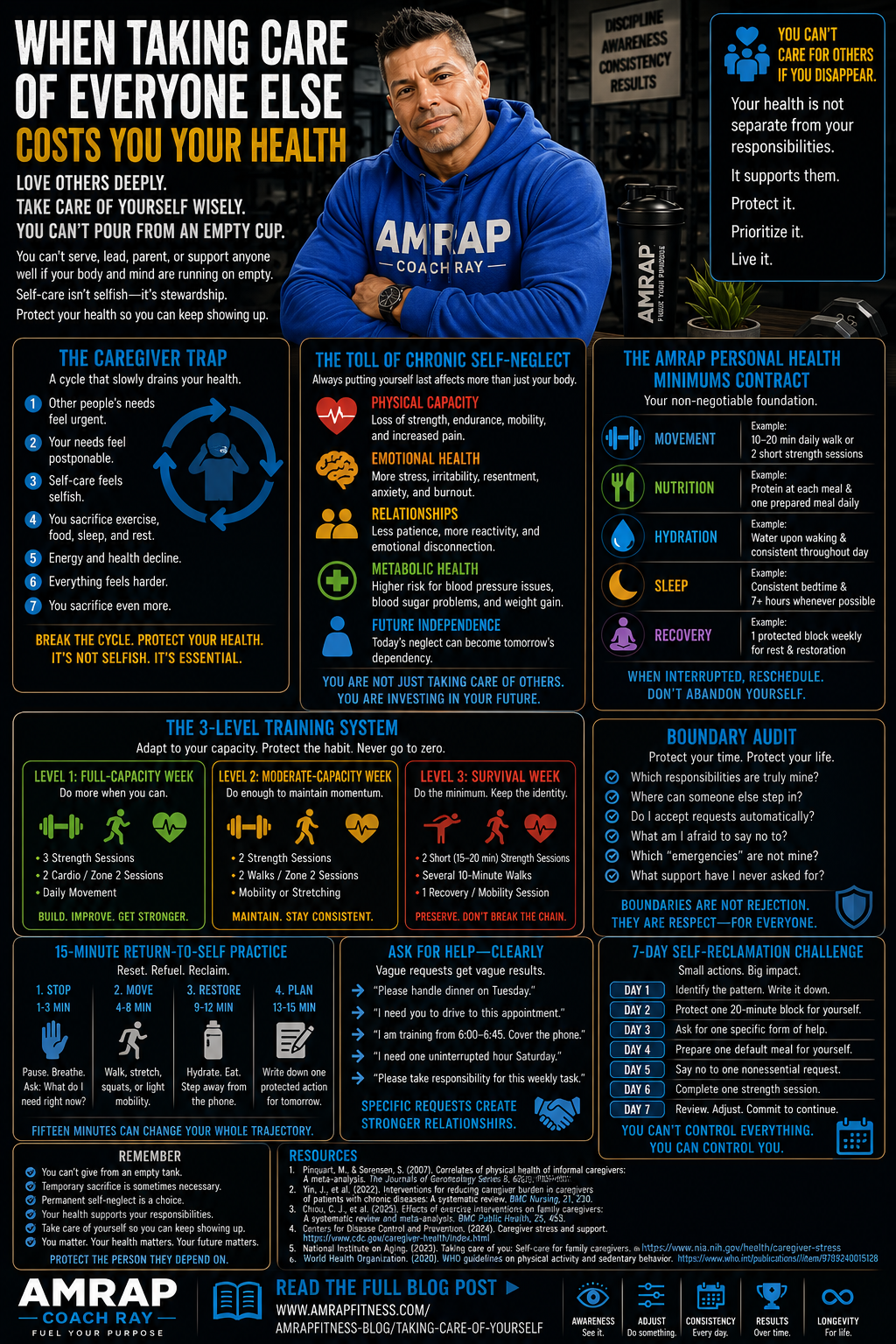
The pattern often looks like this:
Other people’s needs feel urgent.
Personal health feels postponable.
Self-care begins to feel selfish.
Exercise, food, sleep, and recovery are repeatedly sacrificed.
Energy and health decline.
Reduced capacity makes every responsibility feel heavier.
The person sacrifices even more to keep up.
That is not sustainable caregiving.
It is a depletion loop.
Clinical reviews describe caregiver burden as a multidimensional strain that can affect emotional, social, financial, physical, and spiritual functioning. It is often overlooked even though it can contribute to distress, isolation, and declining health.
The Science Signal: Caregiving Has a Real Cost
Caregiving can be deeply meaningful, but it can also create significant physical and psychological strain.
Research has associated caregiver burden with:
These effects are not signs that someone does not love the person they are helping.
They are signs that human capacity has limits.
Public-health guidance from the CDC emphasizes that caregivers need consistent breaks, reasonable expectations, delegation, and continued attention to their own health and interests. The message is direct: taking care of yourself helps you continue caring for someone else.
Physical activity can be one useful part of that support system. Systematic reviews report that exercise interventions for caregivers may improve psychological well-being, physical health, stress, sleep, and perceived burden, although programs vary and exercise should not be presented as a cure for every caregiving challenge.
The coaching conclusion is not:
“Exercise will remove your responsibilities.”
It is:
“Your body requires support if it is going to continue carrying responsibility.”
Why Responsible People Neglect Themselves
Self-neglect rarely begins because someone does not value health.
It often begins with beliefs that sound noble.
Belief 1: “Other people need me more.”
Sometimes that is temporarily true.
A child may be sick.
A loved one may need immediate help.
A genuine emergency may require sacrifice.
But a temporary emergency response can slowly become a permanent personal policy.
You begin treating every request as more important than your health.
Belief 2: “I’ll handle myself later.”
Later feels responsible because the need in front of you feels immediate.
But your health continues accumulating consequences while you wait.
Belief 3: “Taking time for myself is selfish.”
This confuses self-care with indulgence.
A workout is not abandonment.
Preparing a nutritious meal is not neglecting your family.
Going to sleep is not laziness.
Belief 4: “Strong people keep going.”
Strong people do keep going.
Intelligent people also understand that continued output requires restoration.
Belief 5: “No one else can do it correctly.”
Over-responsibility can be reinforced by difficulty:
That makes one person the permanent center of every task.
Self-Care Is Not Selfishness
Selfishness ignores other people.
Self-care helps you remain available to others without destroying yourself.
That distinction matters.
Self-care may include:
exercising
attending medical appointments
sleeping adequately
preparing your own food
saying no to nonessential requests
asking someone else to help
protecting quiet time
seeking counseling or support
maintaining friendships
taking a genuine break
These actions are not a rejection of responsibility.
They are part of responsible living.
You cannot sustainably give from a system that is never replenished.
Stewardship: A Stronger Way to Think About Health
Some people resist the phrase self-care because it sounds superficial.
Use a stronger word:
Stewardship
Stewardship means taking responsible care of something valuable.
Your body is valuable.
Your energy is valuable.
Your health is valuable.
Your ability to:
work
serve
parent
teach
coach
support
love
remain independent
depends partly on how well you maintain the body performing those tasks.
You would not expect a vehicle to operate indefinitely without:
fuel
maintenance
repairs
appropriate use
time off the road
Yet people expect their bodies to function through:
inadequate sleep
high stress
low movement
random nutrition
dehydration
no restoration
Then they feel betrayed when the system begins to struggle.
Your body may not be betraying you.
It may be carrying too much with too little support.
The Cost of Continually Placing Yourself Last
1. Physical capacity declines
When exercise and movement disappear, you may gradually lose:
strength
cardiovascular fitness
balance
mobility
work capacity
Normal responsibilities begin feeling more difficult.
2. Nutrition becomes reactive
When you spend the day meeting other people’s needs, your own eating may become:
The result is often not a lack of nutritional knowledge.
It is a lack of protected structure.
3. Sleep becomes negotiable
People frequently borrow from sleep to finish:
But sleep debt changes how the next day feels.
It can reduce patience, increase perceived effort, and make nutrition and exercise decisions harder.
4. Emotional strain accumulates
Chronic responsibility without adequate support may contribute to:
irritability
frustration
emotional exhaustion
guilt
isolation
resentment
Subjective caregiver burden has also been identified as a meaningful risk factor for depressive symptoms.
5. Relationships can suffer
Ironically, neglecting yourself to protect relationships can eventually damage them.
When depleted, you may become:
6. Future independence may be affected
Ignoring your health today can increase how much assistance you require later.
Self-care is not merely about comfort.
It is an investment in future capability.
The Oxygen-Mask Principle—Without the Cliché
People often hear:
“Put your own oxygen mask on first.”
The phrase is familiar because the underlying principle is valid.
But real life is more complicated.
Sometimes you genuinely cannot come first.
A parent may need to respond immediately to a child.
A caregiver may need to handle an urgent situation.
A professional may need to finish an important responsibility.
The objective is not to place yourself first in every moment.
The objective is to ensure you are not permanently last.
You may postpone one workout.
But you reschedule it.
You may lose sleep during an emergency.
But you plan recovery afterward.
You may eat an imperfect meal.
But you return to structure at the next opportunity.
Temporary sacrifice is part of life.
Permanent disappearance should not be.
The AMRAP Personal Health Minimums Contract
Ideal plans are valuable.
But overwhelmed adults also need a floor—a minimum standard that survives difficult weeks.
Minimum 1: Movement
Choose a realistic minimum.
Examples:
a 10-minute walk
two short strength sessions per week
movement breaks during prolonged sitting
a 15-minute home circuit
walking during phone calls
The minimum is not the full goal.
It is the floor beneath the goal.
Minimum 2: Nutrition
Choose one standard that protects your eating.
Examples:
protein at each meal
one prepared default meal
no skipping food all day
carrying an emergency snack
including produce twice daily
Minimum 3: Hydration
Choose a hydration floor.
Examples:
Minimum 4: Sleep Boundary
Choose one boundary.
Examples:
caffeine cutoff
phone outside the bedroom
consistent wake time
lights down 30 minutes earlier
declining nonessential late-night tasks
Minimum 5: Recovery Appointment
Choose one scheduled recovery block each week.
Examples:
Schedule it.
Do not merely hope it appears.
Write the Contract
Use this format:
To remain capable of caring for the people and responsibilities I value, I will protect the following minimums:
Movement: ______
Nutrition: ______
Hydration: ______
Sleep: ______
Recovery: ______
When one is interrupted, I will reschedule it rather than abandon it.
This is not a rigid law.
It is a reminder that your health belongs inside your responsibilities—not outside them.
The Boundary Audit
Many exhausted adults do not only have a time problem.
They have a boundary problem.
Ask yourself:
Which responsibilities are genuinely mine?
Which responsibilities have I assumed unnecessarily?
Which tasks could another capable adult perform?
Which requests do I accept automatically?
Where am I afraid to disappoint people?
What do I repeatedly sacrifice to avoid saying no?
Which “emergencies” are actually preventable problems?
What help have I never directly requested?
Boundaries are not punishment.
They clarify responsibility.
Helping Versus Rescuing
Helping supports another person while respecting their ability and responsibility.
Rescuing repeatedly removes effort, decisions, or consequences from someone who may be capable of participating.
Rescuing can look like:
completing every household task
solving every last-minute problem
managing another capable adult’s entire life
changing your schedule for every preventable request
refusing to let others struggle, learn, or contribute
The cost is not only your exhaustion.
It can also prevent other people from developing responsibility.
Ask:
“Am I helping—or am I teaching everyone that my health is the price of their convenience?”
That is a difficult question.
But it can change a family system.
Asking for Help Is a Skill
Some people wait for others to notice.
Then they feel hurt when no one does.
Support often requires a direct request.
Instead of:
“I need more help around here.”
Try:
“Please handle dinner Tuesday and Thursday.”
“I need you to drive to this appointment.”
“I am training from 6:00 to 6:45. Please cover the phone.”
“I need one uninterrupted hour Saturday morning.”
“Please take full responsibility for this weekly task.”
Specific requests are easier to understand and fulfill.
Asking for help does not prove weakness.
It proves that you understand capacity.
Family-centered and supportive interventions have shown potential to improve caregiver burden, stress, depression, and quality of life, reinforcing that caregivers should not be expected to function without support.
The 15-Minute Return-to-Self Practice
When the day has consumed you, use this short reset.
Minutes 1–3: Stop
Sit or stand quietly.
Take several slow breaths.
Ask:
“What do I need right now?”
Not what everyone else needs.
What do you need?
Minutes 4–8: Move
Choose:
walking
mobility
body-weight squats
light carries
controlled stretching
Minutes 9–12: Restore
Drink water.
Eat a protein-centered snack if needed.
Step away from the phone.
Minutes 13–15: Plan
Write tomorrow’s one protected health action.
Examples:
walk at lunch
strength train at 6:00 a.m.
prepare breakfast tonight
go to bed by 9:30
ask someone else to handle one task
Fifteen minutes will not solve an overloaded life.
It can help you reenter your own life.
Exercise for the Overextended Adult
Exercise should not become another source of guilt.
Use a flexible structure.
Full-capacity week
three strength sessions
two aerobic sessions
daily movement
Moderate-capacity week
Survival week
The objective is not to perform the same plan regardless of circumstances.
It is to preserve continuity.
Reviews of physical-activity programs for caregivers suggest that adaptable exercise can support psychological and physical well-being, but the best format is the one a caregiver can safely and consistently perform.
Nutrition When You Are Taking Care of Everyone Else
Caregivers often prepare food for others while neglecting their own meals.
Use these rules.
Rule 1: Do not wait until everyone is settled
Severe hunger makes every decision harder.
Rule 2: Prepare your portion while preparing theirs
Do not assume you will figure it out later.
Rule 3: Keep one emergency meal
Examples:
rotisserie chicken, rice, and vegetables
Greek yogurt, fruit, and oats
eggs, potato, and frozen vegetables
tuna, crackers, and salad
Rule 4: Sit down when possible
Standing and grazing can make it harder to recognize how much or how quickly you are eating.
Rule 5: Treat your nutrition as part of the caregiving plan
A depleted caregiver cannot provide endless high-quality support.
Research has also found associations between caregiver burden and difficulty achieving heart-healthy diet and physical-activity behaviors, showing how caregiving strain can interfere with the very habits caregivers need.
When Guilt Appears
You may protect time for yourself and immediately feel guilty.
That does not mean the decision was wrong.
Guilt can appear whenever you stop following an old pattern.
Ask:
Am I actually harming someone?
Or am I simply no longer endlessly available?
Is this a genuine emergency?
Or does someone dislike my new boundary?
Will protecting my health help me remain capable long-term?
A feeling is information.
It is not always an instruction.
Common Mistakes—and the Professional Correction
Mistake 1: Waiting until everyone else is satisfied
Correction: Other people’s needs are continuous. Schedule health before the day fills.
Mistake 2: Treating all requests as emergencies
Correction: Separate urgent needs from preferences and preventable problems.
Mistake 3: Expecting others to read your mind
Correction: Make specific requests.
Mistake 4: Using an ideal health plan or nothing
Correction: Create full, moderate, and survival versions.
Mistake 5: Confusing boundaries with rejection
Correction: Boundaries help relationships remain sustainable.
Mistake 6: Treating exhaustion as proof of love
Correction: Love is not measured by how completely you destroy yourself.
Mistake 7: Believing rest must be earned
Correction: Recovery is a biological requirement, not a trophy.
The Seven-Day Self-Reclamation Challenge
Day 1: Identify the pattern
Write where you routinely place yourself last.
Day 2: Protect one 20-minute block
Use it for movement or recovery.
Day 3: Ask for one specific form of help
Do not hint.
Ask clearly.
Day 4: Prepare one default meal for yourself
Not only for everyone else.
Day 5: Decline one nonessential request
Use that time for sleep, exercise, or restoration.
Day 6: Complete one strength session
Even if it must be shortened.
Day 7: Review
Ask:
This challenge is not about becoming unavailable.
It is about becoming present in your own schedule again.
Self-Assessment
Answer honestly:
Do I routinely cancel my health plans for other people?
Are all those cancellations truly necessary?
Do I prepare food for others while neglecting my own meals?
Have I directly requested support?
What health appointment have I postponed?
Do I feel guilty when I rest?
Am I physically capable of sustaining my current responsibilities?
Which boundary would protect me most?
What example am I teaching the people who watch me?
If I continue this pattern for five years, what might it cost?
Your answers are not accusations.
They are an invitation to make the system sustainable.
Closing: Do Not Disappear in the Name of Love
There is dignity in caring for others.
There is strength in service.
There is meaning in responsibility.
But you were not placed in this world only to function as a resource for everyone else.
You are also a human being with:
a body
limits
health needs
goals
emotions
a future
Taking care of yourself does not diminish your love for others.
It gives that love a stronger place from which to operate.
Exercise helps preserve the body that carries your responsibilities.
Nutrition helps provide the energy those responsibilities require.
Hydration, sleep, and recovery help restore what service consumes.
Boundaries help prevent generosity from becoming resentment.
Support allows responsibility to become shared instead of crushing.
You may not always come first.
Real life does not work that way.
But you cannot remain permanently last.
Protect:
one movement minimum
one nutrition minimum
one sleep boundary
one recovery appointment
one request for help
Start there.
Because the people who depend on you do not need you endlessly depleted.
They need you:
healthy
capable
present
strong
and still here
Taking care of yourself is not walking away from them.
It is one of the ways you continue showing up.
Resources
Adelman RD, Tmanova LL, Delgado D, Dion S, Lachs MS. Caregiver Burden: A Clinical Review. JAMA. 2014. This review describes caregiver burden as a frequently overlooked, multidimensional health concern.
Choi JY, et al. Exploring Factors Influencing Caregiver Burden: A Systematic Review of Family Caregivers of Older Adults With Chronic Illness. 2024.
Cardoso C, et al. Effects of Physical Exercise in Reducing Caregivers’ Burden: A Systematic Review. 2025. The review reported improvements in burden, stress, and general well-being across most included interventions.
Marshall E, et al. Effects of Physical Activity Interventions for Caregivers: A Systematic Review. 2022. Physical-activity interventions appeared particularly useful for caregivers’ psychological health.
Lambert SD, et al. Effects of Physical Activity Interventions on Caregivers’ and Care Recipients’ Psychosocial Outcomes: A Systematic Review. 2016. Included studies reported improvements in caregiver distress, well-being, sleep quality, and exercise self-efficacy.
Centers for Disease Control and Prevention. Healthy Habits: Caring for Yourself When Caring for Another. The CDC advises consistent breaks, reasonable expectations, delegation, and maintaining personal health.
Mochari-Greenberger H, et al. Caregiver Burden and Nonachievement of Healthy Lifestyle Behaviors Among Family Caregivers. 2012. Higher burden was associated with difficulty meeting heart-healthy diet and physical-activity behaviors.
Wang Z, et al. Family-Centered Interventions and Caregiver Outcomes: A Systematic Review and Meta-Analysis. 2024. Family-centered approaches improved caregiver burden, quality of life, depression, and stress in pooled analyses.