Wednesday
Warm up
3x
Sampson stretch
OHS
Dips
Pull ups
GHD sit ups
GHD back ext
Skill
Pacing
WOD
Tabata
-Jumping lunges
-KBS
-Burpees

Wednesday
Warm up
3x
Sampson stretch
OHS
Dips
Pull ups
GHD sit ups
GHD back ext
Skill
Pacing
WOD
Tabata
-Jumping lunges
-KBS
-Burpees
Tuesday
Warm up
Farmers walk
KBS
Plate run
GHD sit ups
Skill
DB snatch
WOD
5 rounds of:
30 seconds max effort/ one minute rest
-DB snatch
-Row for calories

Monday
Warm up
Inversion to skin the cat to lower
Pull over to support
Handstand holds
Pistols
Skill
Cycling reps
WOD
Tabata mash x 12
-TTB
-Box jumps
Most people think the only way to get “in shape” is to suffer.
Run harder. Jump more. Do more high-impact work. Push intensity until your joints complain.
But longevity doesn’t reward you for winning one brutal month.
Longevity rewards you for building a body that can:
train consistently
tolerate volume
recover faster
keep your knees, hips, Achilles, and low back happy
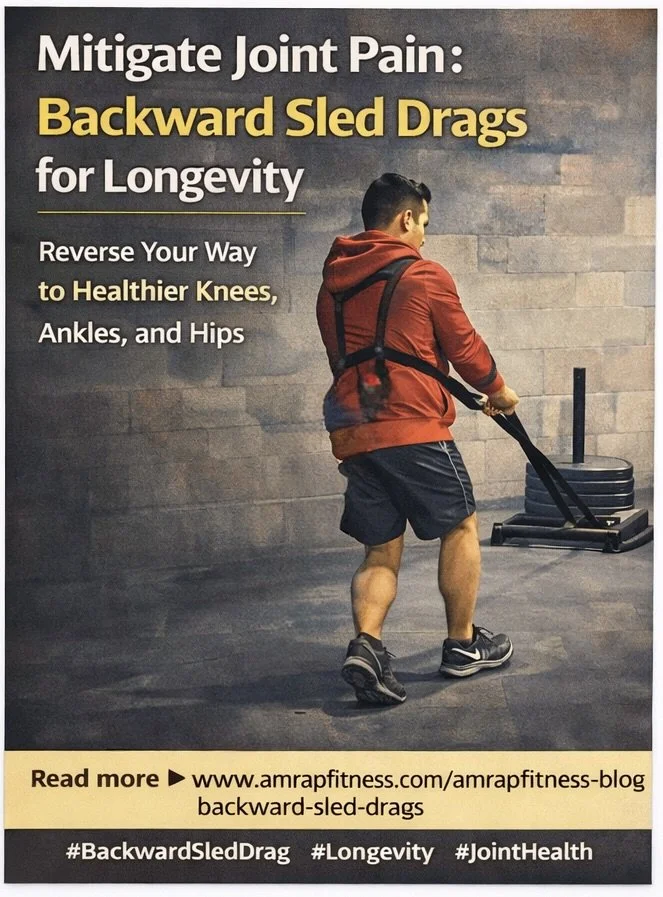
That’s why sled dragging is one of the most underrated longevity tools in the field.
Not because it’s easy.
Because it’s high output with a low joint cost when programmed correctly.
This is a pillar intro entry. Later we’ll deep dive:
backward drags for knees
forward drags for posterior chain
sled pushes for conditioning
sled programming for fat loss, strength support, and recovery days
But first: the foundation.
A lot of adults hit a moment where the mind is ready…
…but the joints aren’t.
They try to “get back in shape” and within weeks:
knees get cranky
Achilles gets tight
low back gets reactive
hips feel stiff
And then they start believing the lie:
“Maybe my body just can’t handle training anymore.”
No.
Most of the time your body can handle training.
It just can’t handle the cost of the type of conditioning you’re choosing.
Sled dragging gives you a different path:
Build work capacity without borrowing from your joints.
Sled work is simple:
You’re moving load across the ground.
But the effect is powerful because sled work is typically:
low skill
scalable
high metabolic demand
and often lower in eccentric stress than running/jumping
That last part matters.
A major reason adults get wrecked by conditioning is repeated eccentric impact:
landing
braking
pounding
Sled dragging lets you build output with less of that cost.
It’s not “no cost.”
It’s a smarter cost.
Longevity training is about building:
an engine
tissue tolerance
and consistency
Sled work supports all three.
Sled pushes and drags can drive heart rate and lactate responses — meaning it can be real conditioning, not just “light cardio.”
A 2024 exploratory study in older adults examined feasibility and physiological responses (heart rate, blood pressure, lactate, RPE, enjoyment) to sled pushing using a resisted sled machine. (pubmed.ncbi.nlm.nih.gov)
Backward walking/retro-walking research is strongly associated with improvements in symptoms and function in knee osteoarthritis populations in reviews and trials. (pubmed.ncbi.nlm.nih.gov)
And in patellofemoral pain populations, backward walking has been shown to increase vastus medialis oblique activation and preserve a healthier VMO/VL ratio — a potential supportive mechanism for knee tracking. (pmc.ncbi.nlm.nih.gov)
Coaching translation: backward sled drags are basically loaded backward walking — a way to load the knee in a controlled, joint-friendly pattern.
Sled push training has been studied for strength/power/body composition outcomes (including comparisons of training volumes). (digitalcommons.tamusa.edu)
Sleds aren’t just for sprinters.
They’re for adults who want:
safer conditioning
better leg endurance
stronger quads/glutes without joint backlash
a tool for recovery days that still feels productive
Sled dragging is a bridge:
From “I’m afraid to train hard”
to
“I can work hard and still feel good tomorrow.”
We keep it clean.
Every sled session should have one primary purpose.
Goal: quad endurance + tendon tolerance + knee friendliness.
Goal: glutes/hamstrings + aerobic work.
Goal: higher heart rate, short bouts, controlled suffering.
You don’t need all three every week.
Pick the lane that matches your season.
tall posture
ribs stacked
short, controlled steps
keep tension on the sled
do not yank with your low back
slight forward lean
strong hip extension
smooth steps
neutral spine
drive through midfoot
steady breath
Pro rule: if your form turns into a low-back tug-of-war, lighten the load.
Day 1 — Backward Drag (knee capacity)
6–10 rounds x 20–30 meters
moderate load
60–90 seconds rest
Day 2 — Forward Drag (engine)
20–30 minutes continuous work
light/moderate load
nasal breathing or conversational pace
10 minutes backward drag (easy)
10 minutes forward drag (easy)
Done.
That alone moves the needle.
Progress one variable at a time:
time
distance
load
frequency
Never add all four at once.
Most overuse problems come from stacking increases.
Sleds reduce injury risk by:
building tissue tolerance
improving work capacity without impact
strengthening patterns that protect joints
reducing the “all-or-nothing” cycle
If you can build conditioning without flare-ups, you train more consistently.
And consistency is the real injury prevention tool.
Fix: start lighter; earn volume first.
Fix: upright posture, short steps, reduce load.
Fix: sleds support strength; they don’t replace it.
Fix: choose a lane.
Answer honestly:
Can I build conditioning without knee/Achilles/back backlash?
Do I recover well from high-impact work?
Do my knees feel better after backward drags?
Is my conditioning limited by lungs — or by joint pain?
Do I have one joint-friendly tool that keeps me consistent?
Your answers aren’t judgment.
They’re a strategy.
Sled dragging is not glamorous.
It’s effective.
It’s one of the rare tools that lets many adults:
work hard
build a serious engine
and still feel good the next day
That’s what we’re chasing.
Not punishment.
Preparation.
Abdelraouf OR, et al. Backward walking alters VMO activation and VMO/VL ratio in patellofemoral pain syndrome. 2019. (pmc.ncbi.nlm.nih.gov)
Wu Y, et al. Effect of backward walking training on knee osteoarthritis. 2020. (pubmed.ncbi.nlm.nih.gov)
Baumann M, et al. Sled-push feasibility and physiological responses in apparently healthy older adults (exploratory study). 2024. (pubmed.ncbi.nlm.nih.gov)
Bernard JR. Low-volume vs high-volume sled-push training and adaptations (strength/power/body composition). 2021. (digitalcommons.tamusa.edu)