

Monday
Warm up
Inversion to skin the cat to lower
Pull over to support
Handstand holds
Pistols
Skill
Cycling reps
WOD
Tabata mash x 12
-TTB
-Box jumps
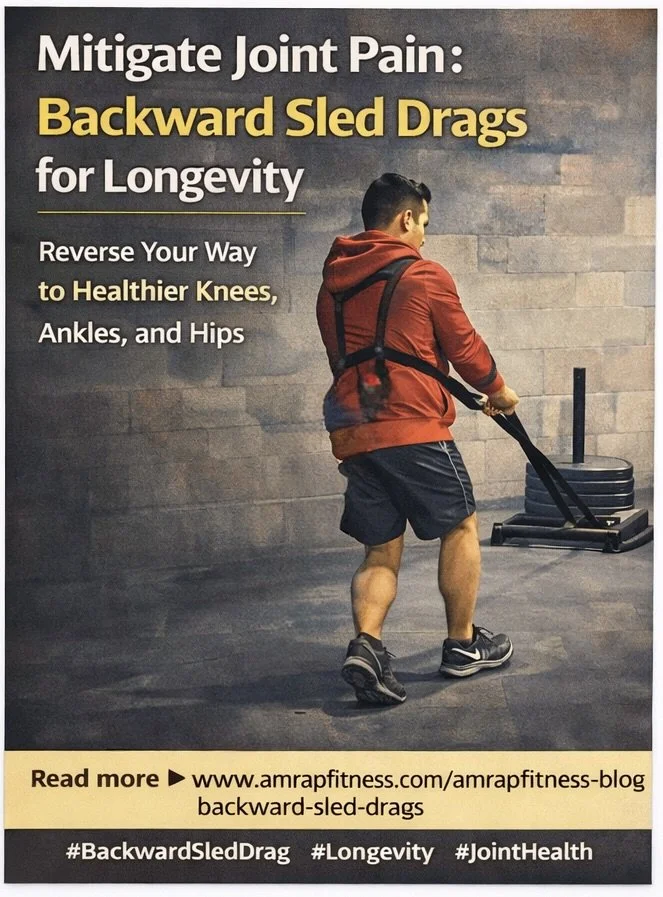
(AMRAP Longevity Series — Pillar Intro #4)
The best conditioning tool after 40 might be the one that doesn’t beat you up.
Most people think the only way to get “in shape” is to suffer.
Run harder. Jump more. Do more high-impact work. Push intensity until your joints complain.
But longevity doesn’t reward you for winning one brutal month.
Longevity rewards you for building a body that can:
train consistently
tolerate volume
recover faster
keep your knees, hips, Achilles, and low back happy
That’s why sled dragging is one of the most underrated longevity tools in the field.
Not because it’s easy.
Because it’s high output with a low joint cost when programmed correctly.
This is a pillar intro entry. Later we’ll deep dive:
backward drags for knees
forward drags for posterior chain
sled pushes for conditioning
sled programming for fat loss, strength support, and recovery days
But first: the foundation.
Opening Device: The Moment Your Body Says “Not That”
A lot of adults hit a moment where the mind is ready…
…but the joints aren’t.
They try to “get back in shape” and within weeks:
knees get cranky
Achilles gets tight
low back gets reactive
hips feel stiff
And then they start believing the lie:
“Maybe my body just can’t handle training anymore.”
No.
Most of the time your body can handle training.
It just can’t handle the cost of the type of conditioning you’re choosing.
Sled dragging gives you a different path:
Build work capacity without borrowing from your joints.
What Sled Dragging Really Is
Sled work is simple:
You’re moving load across the ground.
But the effect is powerful because sled work is typically:
low skill
scalable
high metabolic demand
and often lower in eccentric stress than running/jumping
That last part matters.
A major reason adults get wrecked by conditioning is repeated eccentric impact:
landing
braking
pounding
Sled dragging lets you build output with less of that cost.
It’s not “no cost.”
It’s a smarter cost.
Why It Works for Longevity
Longevity training is about building:
an engine
tissue tolerance
and consistency
Sled work supports all three.
1) It builds an engine you can recover from
Sled pushes and drags can drive heart rate and lactate responses — meaning it can be real conditioning, not just “light cardio.”
A 2024 exploratory study in older adults examined feasibility and physiological responses (heart rate, blood pressure, lactate, RPE, enjoyment) to sled pushing using a resisted sled machine. (pubmed.ncbi.nlm.nih.gov)
2) It’s friendly to many knees when dosed correctly
Backward walking/retro-walking research is strongly associated with improvements in symptoms and function in knee osteoarthritis populations in reviews and trials. (pubmed.ncbi.nlm.nih.gov)
And in patellofemoral pain populations, backward walking has been shown to increase vastus medialis oblique activation and preserve a healthier VMO/VL ratio — a potential supportive mechanism for knee tracking. (pmc.ncbi.nlm.nih.gov)
Coaching translation: backward sled drags are basically loaded backward walking — a way to load the knee in a controlled, joint-friendly pattern.
3) It can create strength and work-capacity carryover
Sled push training has been studied for strength/power/body composition outcomes (including comparisons of training volumes). (digitalcommons.tamusa.edu)
The Big Misunderstanding: “Sleds Are Only for Athletes”
Sleds aren’t just for sprinters.
They’re for adults who want:
safer conditioning
better leg endurance
stronger quads/glutes without joint backlash
a tool for recovery days that still feels productive
Sled dragging is a bridge:
From “I’m afraid to train hard”
to
“I can work hard and still feel good tomorrow.”
The AMRAP Sled Framework (3 Lanes)
We keep it clean.
Every sled session should have one primary purpose.
Lane 1 — Knee Support / Tissue Capacity (Backward Drag)
Goal: quad endurance + tendon tolerance + knee friendliness.
Lane 2 — Posterior Chain / Work Capacity (Forward Drag)
Goal: glutes/hamstrings + aerobic work.
Lane 3 — Conditioning / Power Endurance (Sled Push)
Goal: higher heart rate, short bouts, controlled suffering.
You don’t need all three every week.
Pick the lane that matches your season.
Technique: The Non-Negotiables
Backward Drag (the knee saver)
tall posture
ribs stacked
short, controlled steps
keep tension on the sled
do not yank with your low back
Forward Drag
slight forward lean
strong hip extension
smooth steps
Sled Push
neutral spine
drive through midfoot
steady breath
Pro rule: if your form turns into a low-back tug-of-war, lighten the load.
The Starter Protocol (Copy/Paste)
Option A — Longevity Base (2x/week)
Day 1 — Backward Drag (knee capacity)
6–10 rounds x 20–30 meters
moderate load
60–90 seconds rest
Day 2 — Forward Drag (engine)
20–30 minutes continuous work
light/moderate load
nasal breathing or conversational pace
Option B — “Busy Adult” Minimum (1x/week)
10 minutes backward drag (easy)
10 minutes forward drag (easy)
Done.
That alone moves the needle.
Progression Rules (How to Improve Without Overuse)
Progress one variable at a time:
time
distance
load
frequency
Never add all four at once.
Most overuse problems come from stacking increases.
How Sled Work Prevents Injury (The Coaching Lens)
Sleds reduce injury risk by:
building tissue tolerance
improving work capacity without impact
strengthening patterns that protect joints
reducing the “all-or-nothing” cycle
If you can build conditioning without flare-ups, you train more consistently.
And consistency is the real injury prevention tool.
Common Mistakes (and the Professional Fix)
Mistake 1: Going too heavy too soon
Fix: start lighter; earn volume first.
Mistake 2: Turning backward drags into a low-back pull
Fix: upright posture, short steps, reduce load.
Mistake 3: Using sleds to avoid strength work forever
Fix: sleds support strength; they don’t replace it.
Mistake 4: No purpose
Fix: choose a lane.
Self-Assessment (Reader Tool)
Answer honestly:
Can I build conditioning without knee/Achilles/back backlash?
Do I recover well from high-impact work?
Do my knees feel better after backward drags?
Is my conditioning limited by lungs — or by joint pain?
Do I have one joint-friendly tool that keeps me consistent?
Your answers aren’t judgment.
They’re a strategy.
Closing: The Longevity Standard Is “Can I Train Tomorrow?”
Sled dragging is not glamorous.
It’s effective.
It’s one of the rare tools that lets many adults:
work hard
build a serious engine
and still feel good the next day
That’s what we’re chasing.
Not punishment.
Preparation.
Resources
Abdelraouf OR, et al. Backward walking alters VMO activation and VMO/VL ratio in patellofemoral pain syndrome. 2019. (pmc.ncbi.nlm.nih.gov)
Wu Y, et al. Effect of backward walking training on knee osteoarthritis. 2020. (pubmed.ncbi.nlm.nih.gov)
Baumann M, et al. Sled-push feasibility and physiological responses in apparently healthy older adults (exploratory study). 2024. (pubmed.ncbi.nlm.nih.gov)
Bernard JR. Low-volume vs high-volume sled-push training and adaptations (strength/power/body composition). 2021. (digitalcommons.tamusa.edu)
(Serie AMRAP de Longevidad — Entrada Pilar “Introducción” #4)
La mejor herramienta de acondicionamiento después de los 40 puede ser la que no te destruye.
Mucha gente cree que la única forma de “ponerse en forma” es sufrir.
Correr más fuerte. Saltar más. Hacer más impacto hasta que las articulaciones se quejen.
Pero la longevidad no premia ganar un mes brutal.
La longevidad premia construir un cuerpo que pueda:
entrenar con constancia
tolerar volumen
recuperar más rápido
mantener rodillas, caderas, Aquiles y espalda baja felices
Por eso el arrastre de trineo es una de las herramientas más infravaloradas para longevidad.
No porque sea fácil.
Sino porque ofrece alto rendimiento con bajo costo articular cuando se programa bien.
Esta es una entrada pilar. Luego profundizaremos:
arrastres hacia atrás para rodillas
arrastres hacia adelante para cadena posterior
empujes para acondicionamiento
programación para pérdida de grasa, fuerza y días de recuperación
Primero: base.
Apertura: Cuando el Cuerpo Dice “Eso No”
Muchos adultos llegan a un punto donde la mente está lista…
pero las articulaciones no.
Intentan “volver” y en semanas:
rodillas se irritan
Aquiles se tensa
espalda baja reacciona
caderas se sienten rígidas
Y aparece la mentira:
“Tal vez mi cuerpo ya no aguanta.”
No.
La mayoría de las veces sí aguanta.
Solo que no aguanta el costo del tipo de acondicionamiento elegido.
El trineo ofrece otro camino:
Construir capacidad sin endeudarte con tus articulaciones.
Qué es Realmente el Arrastre de Trineo
El trineo es simple: mover carga en el suelo.
Su potencia está en que suele ser:
poco técnico
escalable
demandante metabólicamente
y con menor componente excéntrico que correr/saltar
Eso importa.
Muchos adultos se destruyen por impacto y frenado repetido.
El trineo permite producir trabajo con menos de ese costo.
No es “cero costo.”
Es un costo más inteligente.
Por Qué Funciona para Longevidad
La longevidad necesita:
motor
tolerancia de tejidos
consistencia
El trineo apoya los tres.
1) Construye un motor recuperable
Los empujes/arrastres pueden elevar frecuencia cardiaca y lactato — es acondicionamiento real.
Un estudio exploratorio (2024) examinó viabilidad y respuestas fisiológicas y psicológicas en adultos mayores con empuje de trineo. (pubmed.ncbi.nlm.nih.gov)
2) Puede ser amable con rodillas (bien dosificado)
La evidencia sobre caminar hacia atrás (retro‑walking) se asocia con mejoras en dolor y función en artrosis de rodilla. (pubmed.ncbi.nlm.nih.gov)
Y en dolor patelofemoral, el caminar hacia atrás aumentó activación del VMO y preservó una relación VMO/VL más favorable — mecanismo potencial para seguimiento de rodilla. (pmc.ncbi.nlm.nih.gov)
Traducción de coaching: arrastre hacia atrás = caminar hacia atrás con carga controlada.
3) Puede generar adaptaciones de fuerza/capacidad
Se ha estudiado entrenamiento de empuje de trineo en adaptaciones (incluyendo volúmenes). (digitalcommons.tamusa.edu)
El Gran Error: “El Trineo es Solo para Atletas”
No.
El trineo es para adultos que quieren:
acondicionamiento más seguro
resistencia de piernas
quads/glúteos fuertes sin castigo articular
una herramienta para días de recuperación que aún se siente productiva
Es un puente:
De “me da miedo entrenar duro”
a
“puedo trabajar duro y sentirme bien mañana.”
Marco AMRAP del Trineo (3 Carriles)
Cada sesión debe tener un propósito.
Carril 1 — Rodilla / Tejido (Arrastre hacia atrás)
Objetivo: resistencia de cuádriceps + tolerancia de tendón.
Carril 2 — Cadena posterior / Capacidad (Arrastre hacia adelante)
Objetivo: glúteos/isquios + motor aeróbico.
Carril 3 — Condición (Empuje)
Objetivo: picos controlados.
No necesitas los tres cada semana.
Elige según tu temporada.
Técnica: No Negociables
Arrastre hacia atrás
postura alta
costillas apiladas
pasos cortos
tensión constante
Arrastre hacia adelante
leve inclinación
extensión de cadera fuerte
Empuje
columna neutral
empuja con el medio pie
Regla pro: si se convierte en tirón de espalda, baja carga.
Protocolo Inicial (Copiar/Pegar)
Opción A — Base de Longevidad (2x/semana)
Día 1 — Arrastre hacia atrás
6–10 rondas x 20–30 m
carga moderada
60–90 s descanso
Día 2 — Arrastre hacia adelante
20–30 min continuo
carga ligera/moderada
ritmo conversacional
Opción B — Mínimo (1x/semana)
10 min atrás (fácil)
10 min adelante (fácil)
Reglas de Progresión
Sube una variable:
tiempo
distancia
carga
frecuencia
No las subas todas juntas.
Cómo Previene Lesiones
sube tolerancia
mejora capacidad sin impacto
fortalece patrones
evita el ciclo todo‑o‑nada
La consistencia es el mejor preventivo.
Errores Comunes
muy pesado muy pronto → gana volumen primero
arrastre atrás con espalda → postura alta, pasos cortos
reemplazar fuerza para siempre → el trineo apoya la fuerza
sin propósito → elige carril
Autoevaluación
¿Puedo hacer condición sin molestias?
¿Recupero bien del impacto?
¿Mis rodillas se sienten mejor con arrastres atrás?
¿Mi límite es aire o dolor?
¿Tengo una herramienta amigable que me mantenga constante?
No es juicio.
Es estrategia.
Cierre: El Estándar es “¿Puedo Entrenar Mañana?”
El trineo no es glamoroso.
Es efectivo.
Es una herramienta rara que permite:
trabajar duro
construir motor
y sentirte bien al día siguiente
Eso es longevidad.
Recursos
Abdelraouf OR, et al. Caminar hacia atrás y activación del VMO en dolor patelofemoral. 2019. (pmc.ncbi.nlm.nih.gov)
Wu Y, et al. Efecto del entrenamiento de caminar hacia atrás en artrosis de rodilla. 2020. (pubmed.ncbi.nlm.nih.gov)
Baumann M, et al. Viabilidad y respuestas fisiológicas del empuje de trineo en adultos mayores (estudio exploratorio). 2024. (pubmed.ncbi.nlm.nih.gov)
Bernard JR. Entrenamiento de empuje de trineo: bajo vs alto volumen y adaptaciones. 2021. (digitalcommons.tamusa.edu)
TEAM Saturday
Warm up
2 minutes of double unders
TTB
Handstand or hand walk
Planche push-ups
GHD sit ups
GHD back ext
Skill
Bar pull over to support
Partner WOD
10-minute AMRAP
Ping pong
15 push press
3 bar pull over to support