Warm up
400m run
Wall climbs
Assisted bar muscle up
OHS
Inversions
Skill
Thrusters
WOD
Complete the following:
Pull ups 8-6-4-2
Thrusters 8-6-4-2


Warm up
400m run
Wall climbs
Assisted bar muscle up
OHS
Inversions
Skill
Thrusters
WOD
Complete the following:
Pull ups 8-6-4-2
Thrusters 8-6-4-2
Warm up
2 minutes double unders
Power jumps
GHD sit ups
Super rocks
Dips
Skill
Movement standarts
WOD
Part#1
Reverse Tabata
-Burpees
-Double unders
Part#2
-4x 40 yard sprints (2 minute rest after each effort)


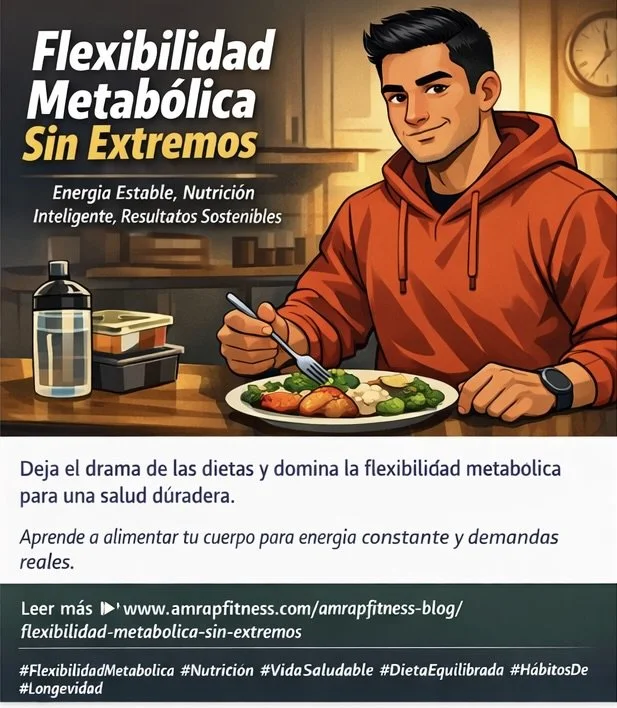
Es cuán estable te mantienes cuando la vida deja de cooperar.
Porque la verdadera amenaza después de los 40 rara vez es una comida “mala.”
Es la espiral:
llega el estrés
se rompe el sueño
el apetito se vuelve más fuerte
los antojos se sienten urgentes
entrenar se siente más pesado
aparece la culpa
y vuelves a “empezar el lunes”
Este artículo trata sobre la habilidad que corta esa espiral:
flexibilidad metabólica — la capacidad de cambiar combustibles, regular señales de apetito y mantener estabilidad sin extremos.
No con trucos. No con hambre. No con disciplina a fuerza de voluntad.
Con estructura.
La mayoría no se rompe un martes cualquiera.
Se rompe después de una cadena normal:
dos noches de mal sueño
semana de trabajo pesada
un problema familiar
entrenamiento inconsistente
comidas “lo que sea”
Entonces pasa algo raro.
El hambre no se siente como hambre. Se siente como una exigencia.
Y te haces la pregunta que a muchos les cuesta admitir:
“¿Por qué siento que no puedo controlarlo?”
Escúchame bien:
Muchas veces eso no es un defecto moral. Es una mezcla de:
baja flexibilidad metabólica
alta carga de estrés
proteína + fibra inconsistentes
fisiología alterada por sueño
y una rutina sin “planes por defecto” para días caóticos
La flexibilidad metabólica no es perfección.
Es ser difícil de sacar del camino.
La flexibilidad metabólica es la capacidad del cuerpo para ajustar la oxidación de combustible según disponibilidad y demanda — cambiando entre carbohidratos y grasas a medida que cambian las condiciones.
En un estado flexible, tu cuerpo puede:
manejar comidas sin picos fuertes de azúcar
tolerar periodos sin comer sin “hambre de pánico”
recuperarse del estrés sin entrar en “comer por choque”
usar energía almacenada con más eficiencia
Un resumen clínico importante describe la flexibilidad metabólica como el cambio rápido entre glucosa y ácidos grasos al pasar de alimentado ↔ ayuno, relacionado con salud metabólica.
Un artículo clásico de fisiología la define como la capacidad de adaptar la oxidación de combustible a la disponibilidad — y conecta su deterioro con resistencia a la insulina.
Traducción a vida real:
Alta flexibilidad:
puedes retrasar una comida sin ponerte insoportable
puedes comer carbohidratos sin “me arruiné”
puedes perder un entreno sin caer en espiral
te recuperas en días, no en meses
Baja flexibilidad:
bajones
hambre urgente
“necesito azúcar”
atracones tras estrés
identidad de entrenamiento inestable
No es moral. Es sistema.
Y los sistemas se reconstruyen.
Después de los 40, la mayoría carga con:
estrés laboral
familia
menos horas reales de sueño
historial de lesiones
menos tolerancia a dietas extremas
Por eso el “plan viejo” falla:
déficits agresivos
saltarse comidas y luego comer de noche
entrenar duro sin recuperar
Puede funcionar a corto plazo.
Pero suele costarte:
sueño
humor
adherencia
relación con la comida
La flexibilidad metabólica es una habilidad de longevidad porque protege:
estabilidad de energía
estabilidad de apetito
consistencia de entrenamiento
estabilidad emocional
En otras palabras:
Protege tu capacidad de cumplirte cuando la vida pesa.
Necesita planes por defecto.
La mayoría no falla porque no le importa.
Falla porque cuando llega el estrés, no tiene estructura que funcione igual.
Entonces:
las comidas se vuelven al azar
desaparece la hidratación
baja la proteína
empeora el sueño
el apetito se vuelve caótico
Y tratan de arreglarlo con extremos.
El movimiento clave no es motivación.
Es construir un plan que funcione con poca fuerza de voluntad.
No necesitas una semana perfecta.
Necesitas un plan para:
días normales
y días rotos
Así la interrupción no se vuelve espiral.
Un plato estable tiene:
Proteína (ancla)
Fibra (estabilidad)
Carbohidrato (rendimiento + saciedad)
Grasa (saciedad + soporte hormonal)
No porque los macros sean religión. Porque la fisiología premia la consistencia.
pollo + arroz + verduras + aceite de oliva
yogur griego + frutas + avena + nueces
huevos + papas + fruta + aguacate
carne magra + frijoles + ensalada + aderezo
La idea no es perfección. La idea es: no dejes tu hambre al azar.
Para muchos adultos, la proteína es el estabilizador más confiable del apetito.
Guías clínicas de envejecimiento (por ejemplo, PROT‑AGE) recomiendan al menos ~1.0–1.2 g/kg/día para adultos mayores para mantener masa magra y función, y más para personas activas.
Posturas de nutrición deportiva suelen ubicar a muchos que entrenan en rangos mayores (por ejemplo, ~1.4–2.0 g/kg/día), según objetivos, entrenamiento y balance energético.
Nota médica importante: En enfermedad renal avanzada u otras restricciones, los objetivos de proteína deben individualizarse con un profesional de salud.
Versión táctica:
define un rango diario realista
reparte proteína en comidas
haz de la proteína tu “no negociable”
Regla simple:
Proteína en cada comida.
Cuando hay caos, no necesitas variedad.
Necesitas ejecución.
Elige dos comidas que puedas hacer siempre.
yogur griego (o requesón) + avena + fruta
whey si hace falta
proteína (pollo/pavo/carne magra/tofu)
carbohidrato (arroz/papas/frijoles)
verduras
grasa (aceite de oliva/aguacate)
Autopiloto no es aburrido. Autopiloto es libertad.
Mucho “hambre” está amplificado por:
deshidratación
cafeína en ayunas
poco sodio/electrolitos
Piso simple:
agua al comenzar
una botella antes del mediodía
una botella por la tarde
electrolitos si sudas mucho o entrenas temprano
Si se rompe el sueño, las señales de hambre se amplifican.
Por eso fallan muchos planes después de los 40.
No por falta de deseo.
Por intentar hacer dieta con una fisiología que pide energía.
Regla pro:
Protege una ventana de sueño más que una hora perfecta.
Y si dormiste mal:
baja intensidad
mantén el hábito
no pelees contra biología
No se construye sufriendo.
Se construye con:
motor aeróbico
fuerza estable
movimiento diario
25–45 min
ritmo conversacional
terminas mejor
Regla clave:
parar 1–3 repeticiones antes del fallo la mayoría de días
7–10 min después de comer
caminatas cortas
Si el día se rompe:
Haz estas 3 cosas:
proteína + agua temprano
una comida por defecto
20–30 min zona 2 o caminata larga
Eso es ganar.
Antes de comer por impulso, pausa 30 segundos:
¿Qué tipo de hambre es?
Acción: plato estable.
Acción: agua + electrolitos, espera 10 min.
Acción: caminata 7–10 min o respiración lenta, luego decide.
Acción: come una comida real ahora.
ayuno como castigo
cortar carbohidratos demasiado
entrenar como si tuvieras 22
no tener comidas por defecto
¿Me recupero en días o meses cuando se rompe el horario?
¿Me pongo irritable si cambian las comidas?
¿Busco azúcar después de estrés o mal sueño?
¿Tengo dos comidas por defecto?
¿Un mal día se vuelve una mala semana?
No es juicio. Es mapa.
La flexibilidad metabólica te deja vivir como humano:
viajar
manejar estrés
perder un entreno
comer afuera
…y volver a tu base.
Eso es longevidad.
No una racha perfecta.
Un sistema resiliente.
Palmer BF, Clegg DJ. Metabolic Flexibility and Its Impact on Health Outcomes. Mayo Clinic Proceedings. 2022. (Acceso abierto) https://www.mayoclinicproceedings.org/article/S0025-6196(22)00042-8/fulltext
Galgani JE, Moro C, Ravussin E. Metabolic flexibility and insulin resistance. American Journal of Physiology — Endocrinology and Metabolism. 2008. https://pubmed.ncbi.nlm.nih.gov/18765680/ y texto completo https://journals.physiology.org/doi/full/10.1152/ajpendo.90558.2008
Bauer J, et al. Recomendaciones basadas en evidencia sobre proteína en adultos mayores (PROT‑AGE). J Am Med Dir Assoc. 2013. https://pubmed.ncbi.nlm.nih.gov/23867520/ y texto completo https://www.jamda.com/article/S1525-8610(13)00326-5/fulltext
Jäger R, et al. Postura de la ISSN: proteína y ejercicio. J Int Soc Sports Nutr. 2017. https://pubmed.ncbi.nlm.nih.gov/28642676/ y texto completo https://jissn.biomedcentral.com/articles/10.1186/s12970-017-0177-8
Nowson C, O’Connell S. Requerimientos y recomendaciones de proteína en adultos mayores. 2015. (Acceso abierto) https://pmc.ncbi.nlm.nih.gov/articles/PMC4555150/

It’s how stable you stay when life stops cooperating.
Because the real threat to your health after 40 usually isn’t one bad meal.
It’s the spiral:
stress hits
sleep slips
appetite gets louder
cravings feel urgent
training feels harder
guilt shows up
you “start Monday”
And suddenly you’re not managing fat loss or healthspan — you’re managing a cycle.
This post is about the skill that interrupts that cycle:
Metabolic flexibility — the ability to shift fuels, regulate appetite signals, and stay steady without extremes.
Not with hacks. Not with starvation. Not with white‑knuckle discipline.
With structure.
Most adults don’t break on a random Tuesday.
They break after a sequence of normal stressors:
two nights of broken sleep
a deadline week
a family issue
training gets inconsistent
meals become “whatever fits”
Then something weird happens.
Your hunger doesn’t feel like hunger. It feels like a demand.
You’re not just thinking about food. You’re negotiating with it.
And you start asking the question people hate admitting:
“Why do I feel like I can’t control this?”
Here’s what I want you to hear clearly:
That feeling is often not a character flaw. It’s a combination of:
low metabolic flexibility
high stress load
inconsistent protein + fiber
poor sleep physiology
and a routine that has no “defaults” when life gets chaotic
Metabolic flexibility is not about being perfect.
It’s about being hard to knock off course.
Metabolic flexibility is the body’s ability to adjust fuel oxidation to fuel availability and demand — shifting between carbohydrate and fat metabolism as conditions change.
In a metabolically flexible state, your body can:
handle meals without wild blood sugar swings
transition into fasting periods without panic hunger
recover from stress without “crash eating”
use stored energy more efficiently
A major clinical overview describes metabolic flexibility as the rapid switch between glucose and fatty acids across fed ↔ fasting transitions — an ability tied to overall metabolic health.
A classic physiology review describes metabolic flexibility as the capacity to adapt fuel oxidation to fuel availability — and links impaired flexibility with insulin resistance.
Let’s translate that into real life.
High flexibility looks like:
you can delay a meal without feeling shaky/angry
you can eat carbs without feeling like you “blew it”
you can miss a workout without spiraling
you recover in days, not months
Low flexibility looks like:
crashes
urgency hunger
“I need sugar” loops
binges after stress
inconsistent training identity
This isn’t a moral issue. It’s a systems issue.
And systems can be rebuilt.
After 40, most people are juggling:
work stress
family obligations
reduced sleep windows
joint/tendon history
less tolerance for reckless dieting
So the “old plan” breaks:
extreme deficits
skipping meals all day then overeating at night
training too hard on too little recovery
That plan might work for a short sprint.
But it usually costs you:
sleep quality
mood stability
adherence
relationship with food
Metabolic flexibility is a longevity skill because it protects:
energy stability
appetite stability
training consistency
emotional steadiness
In other words:
It protects your ability to keep promises to yourself when life gets heavy.
They need defaults.
Here’s a truth you only learn coaching real adults:
People don’t fail because they don’t care.
They fail because when stress hits, they have no structure that still works.
So when the wheels come off:
meals become random
hydration disappears
protein drops
sleep gets worse
appetite becomes chaotic
Then they try to fix it with extremes.
That’s why the key move is not motivation.
It’s building a plan that can run on low willpower.
That’s metabolic flexibility in practice.
You don’t need a perfect week.
You need a plan for:
normal days
and disrupted days
So the disruption doesn’t become the spiral.
A fuel‑stable plate is boring — and powerful.
It has:
Protein (anchor)
Fiber (stability)
Carb (performance + satiety)
Fat (hormonal + satiety)
Not because macros are religion. Because physiology rewards predictability.
chicken + rice + vegetables + olive oil
Greek yogurt + berries + oats + nuts
eggs + potatoes + fruit + avocado
lean beef + beans + salad + dressing
The point is not perfection. The point is: don’t leave your hunger to chance.
For many adults, protein is the most reliable appetite stabilizer.
Clinical aging guidance (e.g., PROT‑AGE) has recommended at least ~1.0–1.2 g/kg/day for older adults to maintain lean mass and function, and higher intakes for those who are active.
Sports nutrition position stands commonly place many exercising individuals in a higher daily range (e.g., ~1.4–2.0 g/kg/day), depending on goals, training, and energy balance.
Important medical note: If someone has advanced kidney disease or other medical restrictions, protein targets should be individualized with their clinician.
Pick a daily target range you can hit consistently.
Spread protein across meals.
Make protein the “non‑negotiable.”
If you want the simplest rule:
Protein at every meal.
When life gets chaotic, you don’t need variety.
You need execution.
Pick two meals you can run even when you’re stressed.
Greek yogurt (or cottage cheese) + oats + berries
add whey if needed
protein (chicken/turkey/lean beef/tofu)
carb (rice/potatoes/beans)
vegetables
fat (olive oil/avocado)
These become your “autopilot meals.”
Autopilot is not boring. Autopilot is freedom.
A shocking amount of “hunger chaos” is amplified by:
dehydration
caffeine on an empty stomach
low electrolytes
start day with water
one bottle before noon
one bottle mid‑afternoon
salt/electrolytes if you train early or sweat heavily
Don’t overcomplicate it.
Hydration is a stabilizer.
If sleep breaks, hunger signals get louder.
This is why fat loss plans fail after 40: Not because you “don’t want it.”
Because you’re trying to diet in a physiology state that is screaming for energy.
So we use a pro rule:
Protect a sleep window more than a perfect bedtime.
And when sleep is poor:
reduce training intensity
keep the habit
don’t try to “out‑discipline” biology
Metabolic flexibility is not built by suffering.
It’s built by:
a bigger aerobic engine
stable strength work
and daily movement that keeps fuel demand predictable
25–45 minutes
conversational pace
finish feeling better
Zone 2 is “fuel management practice.”
It teaches your system to meet energy demand without panic.
Strength protects:
lean mass
insulin sensitivity
confidence
and adherence
Key rule:
most days stop 1–3 reps shy of failure
You’re training for decades. Not a single heroic workout.
7–10 minutes after meals
walk calls
park farther
NEAT is metabolic insurance.
It keeps the system from becoming “stiff” and reactive.
This is where people win.
Not on their best days. On their worst days.
If your day breaks:
Protein + water early
One default meal
20–30 minutes Zone 2 or a long walk
That’s it.
You didn’t “fall off.”
You ran the protocol.
Protocols beat motivation.
Before you eat impulsively, pause for 30 seconds.
Ask:
What kind of hunger is this?
Stomach cues, low energy, time since last meal.
Action: Eat a fuel‑stable plate.
Dry mouth, headaches, trained hard, lots of caffeine.
Action: Water + electrolytes, wait 10 minutes.
You don’t want food — you want relief.
Action: Walk 7–10 minutes or breathe slowly, then decide.
You’ve under‑eaten all day.
Action: Eat a real meal now. Don’t “hold out.”
The goal isn’t perfection. The goal is to stop guessing.
Fasting can be a tool for some people. But if it triggers late‑day overeating, it’s not a tool — it’s a trigger.
Carbs aren’t the enemy. Unstable appetite + unstable training is.
High intensity + low sleep + high stress = hunger chaos.
If your plan only works on calm days, it’s not a plan. It’s a fantasy.
Answer honestly:
When my schedule breaks, do I recover in days or months?
Do I get shaky/irritable if meals shift?
Do I chase sugar after stress or bad sleep?
Do I have two default meals I can execute anytime?
Does one off day turn into a week?
Your answers are not judgment.
They are the blueprint.
Metabolic flexibility is not a trend.
It’s what lets you live like a human:
travel
handle stress
miss a workout
eat a meal out
…and still return to baseline.
That is longevity.
Not a perfect streak.
A resilient system.
Palmer BF, Clegg DJ. Metabolic Flexibility and Its Impact on Health Outcomes. Mayo Clinic Proceedings. 2022. (Open access) https://www.mayoclinicproceedings.org/article/S0025-6196(22)00042-8/fulltext
Galgani JE, Moro C, Ravussin E. Metabolic flexibility and insulin resistance. American Journal of Physiology — Endocrinology and Metabolism. 2008. https://pubmed.ncbi.nlm.nih.gov/18765680/ and full text https://journals.physiology.org/doi/full/10.1152/ajpendo.90558.2008
Bauer J, et al. Evidence-based recommendations for optimal dietary protein intake in older people: a position paper from the PROT-AGE Study Group. J Am Med Dir Assoc. 2013. https://pubmed.ncbi.nlm.nih.gov/23867520/ and full text https://www.jamda.com/article/S1525-8610(13)00326-5/fulltext
Jäger R, et al. International Society of Sports Nutrition Position Stand: protein and exercise. J Int Soc Sports Nutr. 2017. https://pubmed.ncbi.nlm.nih.gov/28642676/ and full text https://jissn.biomedcentral.com/articles/10.1186/s12970-017-0177-8
Nowson C, O’Connell S. Protein Requirements and Recommendations for Older People. 2015. (Open access) https://pmc.ncbi.nlm.nih.gov/articles/PMC4555150/