Warm up
Crab walk
Hand walk
Inversion to skin the cat
Scrict pull ups
Skill
Windshield wipers
WOD
15-minute AMRAP
15 OHL
10 planche push-ups
5 windshield wipers

Warm up
Crab walk
Hand walk
Inversion to skin the cat
Scrict pull ups
Skill
Windshield wipers
WOD
15-minute AMRAP
15 OHL
10 planche push-ups
5 windshield wipers
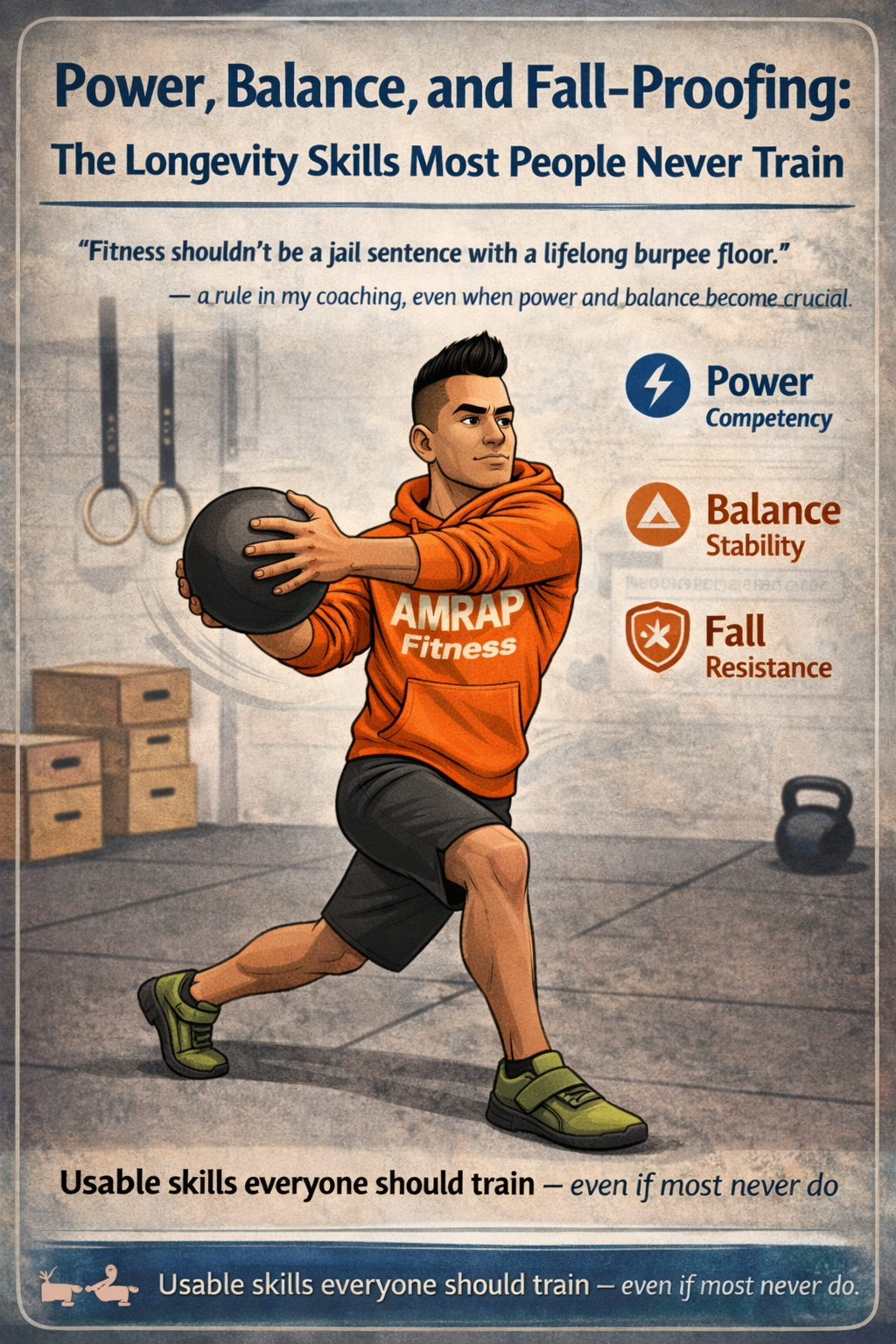
“La gravedad no negocia.”
No le importa tu motivación. No ofrece descuento. Y nunca espera a que tengas una semana perfecta.
Si la Entrada #2 fue sobre reserva metabólica (absorber estrés y volver a tu base) y la Entrada #3 fue sobre músculo como medicina (construir el tejido que protege tu futuro), la Entrada #4 sigue el hilo lógico:
¿Puedes usar lo que construiste—rápido—cuando la vida te lo exige?
Porque muchas lesiones no ocurren en un levantamiento controlado.
Ocurren cuando estás cansado, distraído, cargando algo, bajando un escalón, girando rápido o reaccionando a un resbalón.
Esta es la parte que muchos programas no enseñan.
Y sin embargo: es de lo más protector para tu salud a largo plazo.
La fuerza importa. El músculo importa.
Pero cuando alguien tropieza, lo que decide el resultado muchas veces es:
qué tan rápido puede generar fuerza
qué tan rápido reorganiza el cuerpo
si puede recuperar estabilidad con un paso
si sabe desacelerar, rotar y estabilizar
Eso es potencia + equilibrio + control reactivo.
Las caídas son la principal causa de lesiones en adultos 65+, y millones de adultos mayores se caen cada año.
Esto no es “tema de personas mayores.”
Es mecánica humana bajo estrés.
La potencia no es solo fuerza. Es fuerza expresada rápido.
Potencia = fuerza × velocidad.
Puedes ser fuerte y aun así ser lento.
Y en la vida real, lo lento es lo que te lastima.
Una revisión científica sólida sobre potencia muscular explica que la potencia disminuye antes y más rápidamente con la edad que la fuerza, y que está muy relacionada con la función.
Un ensayo en JAMA Network Open también subraya que la potencia cae más rápido que la fuerza y puede correlacionarse más con la función física.
En el día a día (levantarte, subir escaleras, recuperar el equilibrio) la potencia suele reflejar “capacidad real” mejor que solo masa muscular.
El equilibrio es un sistema:
visión
sistema vestibular (oído interno)
propiocepción (sensación articular/plantar)
fuerza en el momento correcto
coordinación bajo fatiga
Y un dato clave para gente real:
El equilibrio empeora cuando el estrés sube y el sueño baja.
Así que entrenar “anti-caídas” no es un plan para la vejez—
es un plan de resiliencia.
CDC describe la magnitud de las caídas y su frecuencia en adultos mayores.
Y los datos de mortalidad muestran lo graves que pueden ser sus consecuencias con la edad avanzada.
La parte poderosa:
Mucho del riesgo es modificable.
Una revisión de evidencia del USPSTF (en JAMA) concluye que las intervenciones de ejercicio son las que muestran el beneficio más consistente en resultados relacionados con caídas.
En investigación, “ejercicio” para prevenir caídas no significa solo caminar: suele incluir fuerza + equilibrio y componentes específicos.
Puedes estar “en forma” y aun así ser frágil en un área específica.
Muchos entrenan:
líneas rectas (correr, bici, remo)
patrones simétricos
fatiga predecible
Pero la vida es:
rotación
desaceleración
superficies irregulares
demandas inesperadas
Si nunca entrenas esas habilidades, tu cuerpo tiene que improvisarlas bajo presión.
Potencia no significa levantar al máximo.
Significa intención alta + volumen bajo + mecánica limpia.
Opciones de bajo riesgo (elige 1–2):
lanzamiento rotacional con balón medicinal (de pie)
chest pass / slam
kettlebell swing (solo si la bisagra está sólida)
sled push rápido (amigable con articulaciones)
derivados olímpicos livianos (clean pull / high pull) para técnica y velocidad
Dosis:
2–3 días/semana
2–4 series de 3–6 repeticiones
descanso completo
parar cuando la velocidad baja
El entrenamiento de potencia (concéntrico rápido, excéntrico controlado) se estudia como método específico y se asocia con mejoras funcionales en adultos mayores.
El equilibrio funciona mejor cuando parece vida real.
Drills que transfieren:
apoyo a una pierna con “pie trípode” (dedo gordo, dedo pequeño, talón)
step-downs (lento y controlado)
suitcase carries (anti-inclinación lateral)
split-stance holds (caderas cuadradas, costillas abajo)
giros de cabeza con mirada al frente (reto vestibular)
Dosis:
4–6 minutos, 3–5 días/semana
Muchas caídas no son lentas. Son reactivas.
Opciones seguras:
perturbaciones suaves con compañero en split stance
pasos laterales con banda + “stick”
step-and-catch (adelante/atrás/lateral)
“desacelera y congela” (dos pasos y postura firme)
Atlético, no caótico.
Tai Chi es, en esencia, equilibrio y coordinación de bajo impacto.
Meta-análisis muestran que Tai Chi puede reducir caídas y mejorar medidas de equilibrio.
No reemplaza fuerza.
Pero es una herramienta real—especialmente para consistencia sin impacto.
Programas centrados en equilibrio (Tai Chi, Otago y entrenamientos multimodales fuerza-equilibrio) han mostrado reducciones en caídas en distintos análisis.
Fuerza (sentadilla frontal o bisagra): 3–5 series (1–3 reps en reserva)
Balón medicinal rotacional: 3×5 por lado (descanso total)
Carries: 3×30–60 s
Zona 2: 25–45 min
Equilibrio: 4–6 min
Fuerza (empuje + jalón)
Reactivo: 6–10 min (step-and-stick + laterales)
Core anti-rotación
8–12 min intervalos o sled
Cierre: 3 min de equilibrio + respiración
Regla: terminas entrenado, no destruido.
Cuando la vida pesa, el cuerpo no solo pierde “fitness.” Pierde coordinación.
Estrés = respiración tensa.
Deuda de sueño = reacción lenta.
Sobrecarga mental = atención baja.
Por eso esto importa.
Potencia y equilibrio te dan algo más profundo que rendimiento:
Te dan margen.
No es miedo a envejecer.
Es respeto a la física.
El objetivo es un cuerpo que pueda:
rotar sin romperse
desacelerar sin colapsar
reaccionar sin pánico
recuperar equilibrio sin lesión
Eso no es “fitness para viejitos.”
Eso es fitness adulto bien hecho.
CDC — Datos de caídas y prevalencia (65+).
CDC NCHS — Tasas de mortalidad por caídas (65+).
Reid & Fielding (2012) — La potencia cae antes y más rápido; vínculo con función.
Balachandran et al. (2022, JAMA Network Open) — Potencia vs fuerza tradicional; relevancia funcional.
USPSTF (2024, JAMA) — Ejercicio y estrategias multifactoriales reducen caídas; ejercicio más consistente.
Meta-análisis de Tai Chi para prevención de caídas y balance.
Evidencia sobre programas tipo Otago / fuerza-equilibrio.
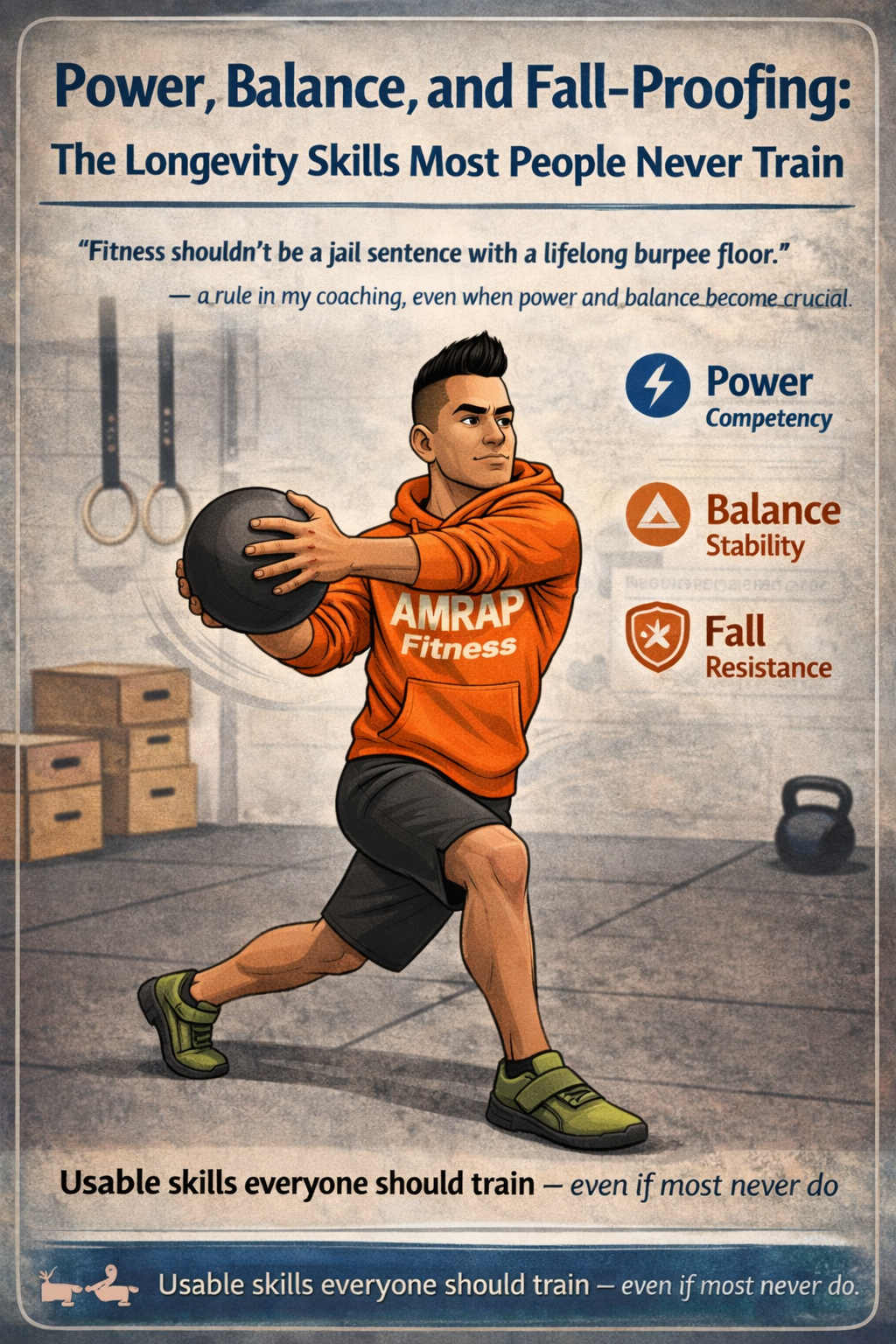
“Gravity doesn’t care how motivated you are.”
It doesn’t negotiate. It doesn’t offer a “senior discount.” And it doesn’t wait for the perfect week.
If Entry #2 was about metabolic reserve (your ability to absorb stress and return to baseline) and Entry #3 was about muscle as medicine (building the tissue that protects your future), then Entry #4 is the next logical step:
Can you use what you’ve built—fast—when life asks for it?
Because most real-life injuries don’t happen during a controlled lift.
They happen when you’re tired, distracted, carrying something awkward, stepping off a curb, turning quickly, or reacting to a slip.
This is the entry most fitness programs skip.
Not because it’s unimportant—
but because it’s not sexy.
And yet: it’s one of the most life-preserving things you can train.
Strength matters. Muscle matters.
But when someone stumbles, what decides the outcome is often:
how fast they can generate force
how quickly they can reorganize their body
whether they can regain balance in one step
how well they can decelerate, rotate, and stabilize
That’s power + balance + reactive control.
And for longevity, those skills are everything.
Falls are the leading cause of injury for adults 65+, and millions of older adults fall each year.
This isn’t “old people stuff.”
This is human mechanics under stress.
Muscle power is not just strength. It’s strength expressed quickly.
Power = force × velocity.
You can be strong and still be slow.
And in many real-life scenarios, slow is what gets you hurt.
A classic scientific review on skeletal muscle power notes that muscle power declines earlier and more precipitously with age compared with strength, and that power is tightly linked to functional ability.
A large JAMA Network Open trial comparing power training vs traditional strength training in older adults also emphasizes that power tends to decrease faster than strength and may relate more closely to function.
Power is often more strongly connected to “real-world performance” (rising from a chair, climbing stairs, catching balance) than muscle size alone.
So the goal isn’t to become reckless.
The goal is to become fast, controlled, and capable.
Balance is not just “standing on one leg.”
It’s an integrated system:
vision
vestibular input (inner ear)
proprioception (joint/foot awareness)
strength and stiffness at the right times
coordination under fatigue
And here’s the part that matters for real people:
Balance gets worse when stress is high and sleep is low.
So “fall-proofing” is not a retirement plan—
it’s a resilience plan.
This isn’t fear-based. It’s simply honest.
CDC data describes falls as a major cause of injury and shows how common they are in older adults.
CDC mortality reporting also documents how serious fall outcomes can become in later decades.
But here’s the empowering part:
A lot of fall risk is modifiable.
A major USPSTF evidence review (published in JAMA) found that exercise interventions show the most consistent benefit across fall-related outcomes, and multifactorial approaches can help too.
“Exercise” in fall research isn’t just light walking—it often includes strength + balance training and sometimes more targeted components.
Here’s a truth that experienced coaches see all the time:
You can be very fit and still be fragile in one missing area.
A lot of adults train:
straight lines (run, bike, row)
symmetrical patterns
predictable fatigue
But life is:
rotation
deceleration
uneven surfaces
surprise demands
If your program never practices those skills, your body has to “invent” them under pressure.
And that’s when things go sideways—literally.
This is the part you can put into your week immediately.
Power training does NOT mean maxing out.
It means high intent + low volume + clean mechanics.
Low-risk power options (choose 1–2):
rotational medicine ball throws (standing)
chest pass / overhead slam
kettlebell swing (only if hinge mechanics are solid)
sled push sprints (joint-friendly, scalable)
Olympic-lift derivatives light (clean pulls / high pulls) for technique and speed
Dose (simple and effective):
2–3 days/week
2–4 sets of 3–6 reps
full rest between sets
stop while speed is still high
Power-focused resistance training is studied as a distinct method (fast concentric, controlled eccentric) and is associated with functional improvements in older adults.
Balance training works best when it looks like real life.
Balance drills that transfer:
single-leg stance with “tripod foot” (big toe, little toe, heel)
step-downs (slow, controlled)
suitcase carries (anti-lateral flexion)
split-stance holds (hips square, ribs down)
eyes-forward head turns (vestibular challenge)
Dose:
4–6 minutes, 3–5 days/week
small and frequent beats big and rare
Most falls aren’t slow. They’re reactive.
That’s why reactive balance is a different category than static balance.
Reactive options (safe versions):
partner light perturbations in split stance (gentle, controlled)
band-resisted lateral steps with quick “stick”
quick step-and-catch drills (forward/backward/lateral)
“deceleration to freeze” (two steps, then stick posture)
Keep it athletic, not chaotic.
If you’re reading this and thinking, “I’m not doing Tai Chi,” I get it.
But here’s the professional view:
Tai Chi is essentially slow, precise, joint-friendly balance and coordination training.
Meta-analyses show Tai Chi can reduce falls and improve balance measures in older adults.
That doesn’t mean it replaces strength training.
It means it’s a legitimate tool—especially for people who need low impact, high consistency.
Evidence suggests exercise programs designed around balance (like Tai Chi, Otago-style programs, and multimodal strength–balance training) can reduce fall incidence.
This is built for real adults with jobs, stress, and limited time.
Strength (front squat or hinge focus): 3–5 work sets (leave 1–3 reps in reserve)
Rotational med ball throws: 3×5/side (full rest)
Carry variation: 3×30–60 seconds
Zone 2: 25–45 minutes
Balance microdose: 4–6 minutes (step-downs + single-leg stance)
Strength (press + pull focus)
Reactive drill: 6–10 minutes (quick step-and-stick + lateral steps)
Trunk stability: anti-rotation work
8–12 minutes intervals OR sled work
Finish: 3 minutes of easy balance + breathing
Key rule: you should finish these sessions feeling trained, not wrecked.
When life is heavy, the body doesn’t just lose fitness—it loses coordination.
Stress tightens your breathing.
Sleep debt slows your reactions.
Overwhelm reduces your attention.
That’s why this topic matters.
Power and balance training gives you something deeper than performance:
It gives you margin.
Not just “I can lift.”
But “I can recover my footing when life bumps me.”
That’s the kind of fitness that shows up when you don’t have time to warm up, stretch, and get your head right.
This isn’t about fear of aging.
It’s about respecting physics.
The goal is to build a body that can:
rotate without breaking
decelerate without collapsing
react without panic
recover balance without injury
That’s not “senior fitness.”
That’s adult fitness done correctly.
CDC — Older adult falls data and prevalence.
CDC NCHS Data Brief — Unintentional fall death rates (65+).
Reid & Fielding (2012) — Skeletal muscle power declines earlier and more steeply than strength; links to function.
Balachandran et al. (2022, JAMA Network Open) — Power training vs traditional strength training; rationale and functional relevance.
USPSTF Evidence Review (2024, JAMA) — Exercise and multifactorial interventions reduce falls; exercise most consistent.
Tai Chi meta-analyses on fall prevention and balance improvements.
Otago-style / exercise program evidence (meta-analytic summaries).
Burgner warm-up
Down and up
Muscle clean
Front squats
Squat cleans
Squat clean thruster
Skill
Squat clean thruster
WOD
EMOTM 15 minutes
2 touch and go squat clean thruster
Warm up
400m run
GHD sit up
Hollow rocks
V-ups
Knees to elbows
Skill
HSPU
WOD
12-minute AMRAP
20 double unders
HSPU until the partner is done with the DU
(Each HSPU is a point)