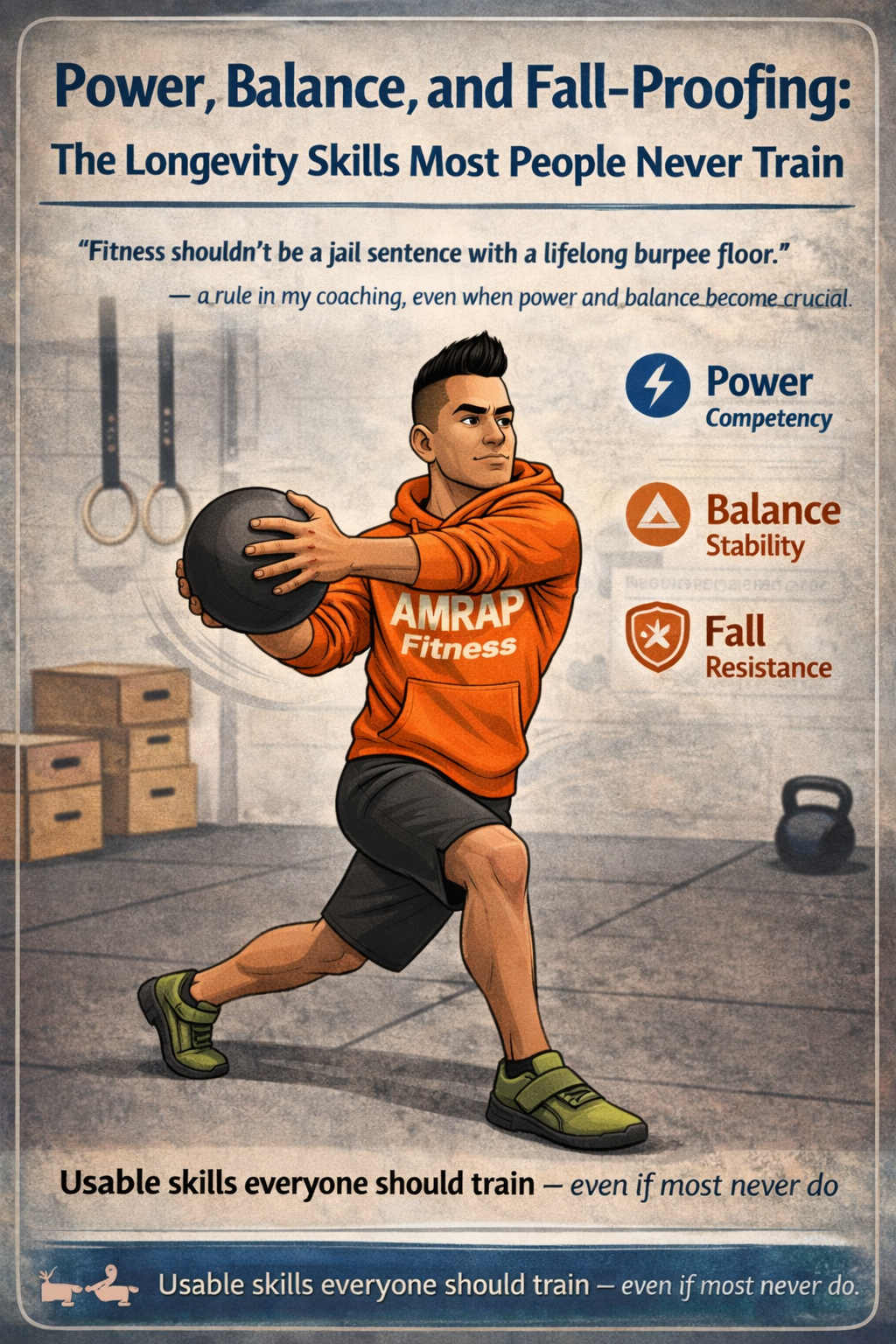
Power, Balance, and Fall-Proofing: The Longevity Skills Most People Never Train
“Gravity doesn’t care how motivated you are.”
It doesn’t negotiate. It doesn’t offer a “senior discount.” And it doesn’t wait for the perfect week.
If Entry #2 was about metabolic reserve (your ability to absorb stress and return to baseline) and Entry #3 was about muscle as medicine (building the tissue that protects your future), then Entry #4 is the next logical step:
Can you use what you’ve built—fast—when life asks for it?
Because most real-life injuries don’t happen during a controlled lift.
They happen when you’re tired, distracted, carrying something awkward, stepping off a curb, turning quickly, or reacting to a slip.
This is the entry most fitness programs skip.
Not because it’s unimportant—
but because it’s not sexy.
And yet: it’s one of the most life-preserving things you can train.
The Real Test Isn’t Strength. It’s “Catchability.”
Strength matters. Muscle matters.
But when someone stumbles, what decides the outcome is often:
how fast they can generate force
how quickly they can reorganize their body
whether they can regain balance in one step
how well they can decelerate, rotate, and stabilize
That’s power + balance + reactive control.
And for longevity, those skills are everything.
Did You Know?
Falls are the leading cause of injury for adults 65+, and millions of older adults fall each year.
This isn’t “old people stuff.”
This is human mechanics under stress.
Why Power Is a Bigger Deal Than Most People Think
Muscle power is not just strength. It’s strength expressed quickly.
Power = force × velocity.
You can be strong and still be slow.
And in many real-life scenarios, slow is what gets you hurt.
A classic scientific review on skeletal muscle power notes that muscle power declines earlier and more precipitously with age compared with strength, and that power is tightly linked to functional ability.
A large JAMA Network Open trial comparing power training vs traditional strength training in older adults also emphasizes that power tends to decrease faster than strength and may relate more closely to function.
Did You Know?
Power is often more strongly connected to “real-world performance” (rising from a chair, climbing stairs, catching balance) than muscle size alone.
So the goal isn’t to become reckless.
The goal is to become fast, controlled, and capable.
Balance Isn’t a Trait. It’s a Trainable Skill Set
Balance is not just “standing on one leg.”
It’s an integrated system:
vision
vestibular input (inner ear)
proprioception (joint/foot awareness)
strength and stiffness at the right times
coordination under fatigue
And here’s the part that matters for real people:
Balance gets worse when stress is high and sleep is low.
So “fall-proofing” is not a retirement plan—
it’s a resilience plan.
The Data Is Humbling: Falls Are a Public Health Reality
This isn’t fear-based. It’s simply honest.
CDC data describes falls as a major cause of injury and shows how common they are in older adults.
CDC mortality reporting also documents how serious fall outcomes can become in later decades.
But here’s the empowering part:
A lot of fall risk is modifiable.
A major USPSTF evidence review (published in JAMA) found that exercise interventions show the most consistent benefit across fall-related outcomes, and multifactorial approaches can help too.
Did You Know?
“Exercise” in fall research isn’t just light walking—it often includes strength + balance training and sometimes more targeted components.
The Coaching Reality: Why “Fit People” Still Get Hurt
Here’s a truth that experienced coaches see all the time:
You can be very fit and still be fragile in one missing area.
A lot of adults train:
straight lines (run, bike, row)
symmetrical patterns
predictable fatigue
But life is:
rotation
deceleration
uneven surfaces
surprise demands
If your program never practices those skills, your body has to “invent” them under pressure.
And that’s when things go sideways—literally.
Coaching Application: A Practical “Anti-Fragile Skills” Progression
This is the part you can put into your week immediately.
Principle 1: Train Power With Low Risk
Power training does NOT mean maxing out.
It means high intent + low volume + clean mechanics.
Low-risk power options (choose 1–2):
rotational medicine ball throws (standing)
chest pass / overhead slam
kettlebell swing (only if hinge mechanics are solid)
sled push sprints (joint-friendly, scalable)
Olympic-lift derivatives light (clean pulls / high pulls) for technique and speed
Dose (simple and effective):
2–3 days/week
2–4 sets of 3–6 reps
full rest between sets
stop while speed is still high
Did You Know?
Power-focused resistance training is studied as a distinct method (fast concentric, controlled eccentric) and is associated with functional improvements in older adults.
Principle 2: Train Balance As “Recovery Skills,” Not Circus Tricks
Balance training works best when it looks like real life.
Balance drills that transfer:
single-leg stance with “tripod foot” (big toe, little toe, heel)
step-downs (slow, controlled)
suitcase carries (anti-lateral flexion)
split-stance holds (hips square, ribs down)
eyes-forward head turns (vestibular challenge)
Dose:
4–6 minutes, 3–5 days/week
small and frequent beats big and rare
Principle 3: Add “Reactive” Work (The Missing Link)
Most falls aren’t slow. They’re reactive.
That’s why reactive balance is a different category than static balance.
Reactive options (safe versions):
partner light perturbations in split stance (gentle, controlled)
band-resisted lateral steps with quick “stick”
quick step-and-catch drills (forward/backward/lateral)
“deceleration to freeze” (two steps, then stick posture)
Keep it athletic, not chaotic.
What About Tai Chi or “Older Adult Programs”?
If you’re reading this and thinking, “I’m not doing Tai Chi,” I get it.
But here’s the professional view:
Tai Chi is essentially slow, precise, joint-friendly balance and coordination training.
Meta-analyses show Tai Chi can reduce falls and improve balance measures in older adults.
That doesn’t mean it replaces strength training.
It means it’s a legitimate tool—especially for people who need low impact, high consistency.
Did You Know?
Evidence suggests exercise programs designed around balance (like Tai Chi, Otago-style programs, and multimodal strength–balance training) can reduce fall incidence.
A Weekly Template (Functional-Fitness Friendly, Longevity-Coded)
This is built for real adults with jobs, stress, and limited time.
Day A — Strength + Power
Strength (front squat or hinge focus): 3–5 work sets (leave 1–3 reps in reserve)
Rotational med ball throws: 3×5/side (full rest)
Carry variation: 3×30–60 seconds
Day B — Zone 2 + Balance Microdose
Zone 2: 25–45 minutes
Balance microdose: 4–6 minutes (step-downs + single-leg stance)
Day C — Strength + Reactive Control
Strength (press + pull focus)
Reactive drill: 6–10 minutes (quick step-and-stick + lateral steps)
Trunk stability: anti-rotation work
Day D — Optional Conditioning (Short + Clean)
8–12 minutes intervals OR sled work
Finish: 3 minutes of easy balance + breathing
Key rule: you should finish these sessions feeling trained, not wrecked.
25% Relatable Coaching Insight (Without Turning This Into a Biography)
When life is heavy, the body doesn’t just lose fitness—it loses coordination.
Stress tightens your breathing.
Sleep debt slows your reactions.
Overwhelm reduces your attention.
That’s why this topic matters.
Power and balance training gives you something deeper than performance:
It gives you margin.
Not just “I can lift.”
But “I can recover my footing when life bumps me.”
That’s the kind of fitness that shows up when you don’t have time to warm up, stretch, and get your head right.
Closing: Fall-Proofing Is Confidence Training
This isn’t about fear of aging.
It’s about respecting physics.
The goal is to build a body that can:
rotate without breaking
decelerate without collapsing
react without panic
recover balance without injury
That’s not “senior fitness.”
That’s adult fitness done correctly.
Resources (Entry #4)
CDC — Older adult falls data and prevalence.
CDC NCHS Data Brief — Unintentional fall death rates (65+).
Reid & Fielding (2012) — Skeletal muscle power declines earlier and more steeply than strength; links to function.
Balachandran et al. (2022, JAMA Network Open) — Power training vs traditional strength training; rationale and functional relevance.
USPSTF Evidence Review (2024, JAMA) — Exercise and multifactorial interventions reduce falls; exercise most consistent.
Tai Chi meta-analyses on fall prevention and balance improvements.
Otago-style / exercise program evidence (meta-analytic summaries).