Warm Up
Band warm up #1
3 x 10 reps
Lateral band walks
Banded lunge with rotation (R/L)
Banded rows
Banded standing press
Toy soldiers
Walking knee hugs
WOD
Complete the following:
100 pull ups/ 150 band rows
100 push ups
100 sit ups
100 squats

Warm Up
Band warm up #1
3 x 10 reps
Lateral band walks
Banded lunge with rotation (R/L)
Banded rows
Banded standing press
Toy soldiers
Walking knee hugs
WOD
Complete the following:
100 pull ups/ 150 band rows
100 push ups
100 sit ups
100 squats
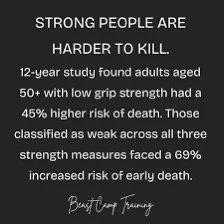
When we think about living longer, many people focus on diet, cardio, or sleep—but one of the most overlooked factors is strength. Research shows that maintaining muscle mass and functional strength dramatically improves survival rates, reduces disease risk, and supports overall independence as we age.
Coach Ray Traitz has incorporated strength-focused programming with his clients and himself, demonstrating that building strength isn’t just about aesthetics—it’s a new form of medicine for longevity.
Strength training improves health and longevity in multiple ways:
Reduces All-Cause Mortality: Studies show that individuals with higher muscular strength have lower risk of death from all causes, including heart disease.
Improves Functional Independence: Muscle mass allows for mobility and independence in older age, reducing fall risk and injury.
Enhances Metabolic Health: Muscle is metabolically active tissue, helping regulate blood sugar, lipid profiles, and overall energy expenditure.
Strength as Protective Medicine: Muscle tissue improves insulin sensitivity and reduces chronic inflammation.
Functional Capacity: Regular strength training ensures independence and reduces frailty in older adults.
Mortality Reduction: Higher grip strength and lower muscle decline correlate with improved survival rates.
Sarcopenia Prevention: Resistance training preserves muscle mass during aging.
Metabolic Benefits: Muscle mass enhances glucose metabolism and fat oxidation.
Longevity Link: Maintaining strength into later decades is associated with lower cardiovascular and metabolic disease risk.
Hormonal Health: Resistance training supports optimal testosterone and growth hormone levels, which contribute to longevity.
Bone Density Preservation: Strength training improves skeletal integrity, reducing fracture risk.
Improved Resilience: Stronger muscles enhance recovery from injury or illness, boosting overall survivability.
Grip Strength and Mortality
Research consistently shows that grip strength in middle-aged adults predicts survival rates decades later. Individuals with stronger grips had a 20–25% lower risk of all-cause mortality.
Resistance Training in Older Adults
Dr. Phillips’ study found participants aged 65–85 who performed regular resistance training increased muscle mass and functional capacity, reducing fall risk by over 30%.
Muscle Mass and Chronic Disease Risk
Dr. Lyon demonstrated that higher muscle mass correlates with lower systemic inflammation markers, lower insulin resistance, and improved cardiovascular outcomes.
Coach Ray Traitz integrates strength training into daily life for both clients and himself:
Customized Resistance Programs: Tailored to age, experience, and lifestyle, focusing on functional strength.
Recovery Optimization: Implementing proper rest, nutrition, and mobility work to maximize gains safely.
Tracking Progress for Longevity: Measuring strength benchmarks over time to ensure consistent improvements and health outcomes.
Building strength is not just about looking fit—it’s about surviving longer, living independently, and thriving. The stronger your muscles, the more resilient your body is to illness, injury, and the natural decline of aging.
If you’re ready to increase your survivability and build lifelong strength, Coach Ray Traitz can help:
📧 Contact: amrapfitness@hotmail.com
Expert guidance in strength training, nutrition, and functional fitness for longevity.
Lyon, G. R. (2021). “Muscle-Centric Medicine: Strength and Longevity.” Journal of Clinical Endocrinology & Metabolism.
Phillips, S. M., et al. (2016). “Resistance Training and Aging Muscle.” Applied Physiology, Nutrition, and Metabolism.
Kraemer, W. J., et al. (2002). “Strength Training and Hormonal Adaptations.” Medicine & Science in Sports & Exercise.

"Santora"
Three rounds for reps of:
155 pound Squat cleans, 1 minute
20' Shuttle sprints (20' forward + 20' backwards = 1 rep), 1 minute
245 pound Deadlifts, 1 minute
Burpees, 1 minute
155 pound Jerks, 1 minute
Rest 1 minute
U.S. Army Sergeant Jason A. Santora, of Farmingville, New York, assigned to the 3rd Battalion, 75th Ranger Regiment, based out of Fort Benning, Georgia, died in Logar province, Afghanistan on April 23, 2010, from wounds sustained during a firefight with insurgents. He is survived by his parents Gary and Theresa, and sister Gina.