
Your Environment Is Stronger Than Your Willpower: Design Your Life So the Better Choice Becomes Easier
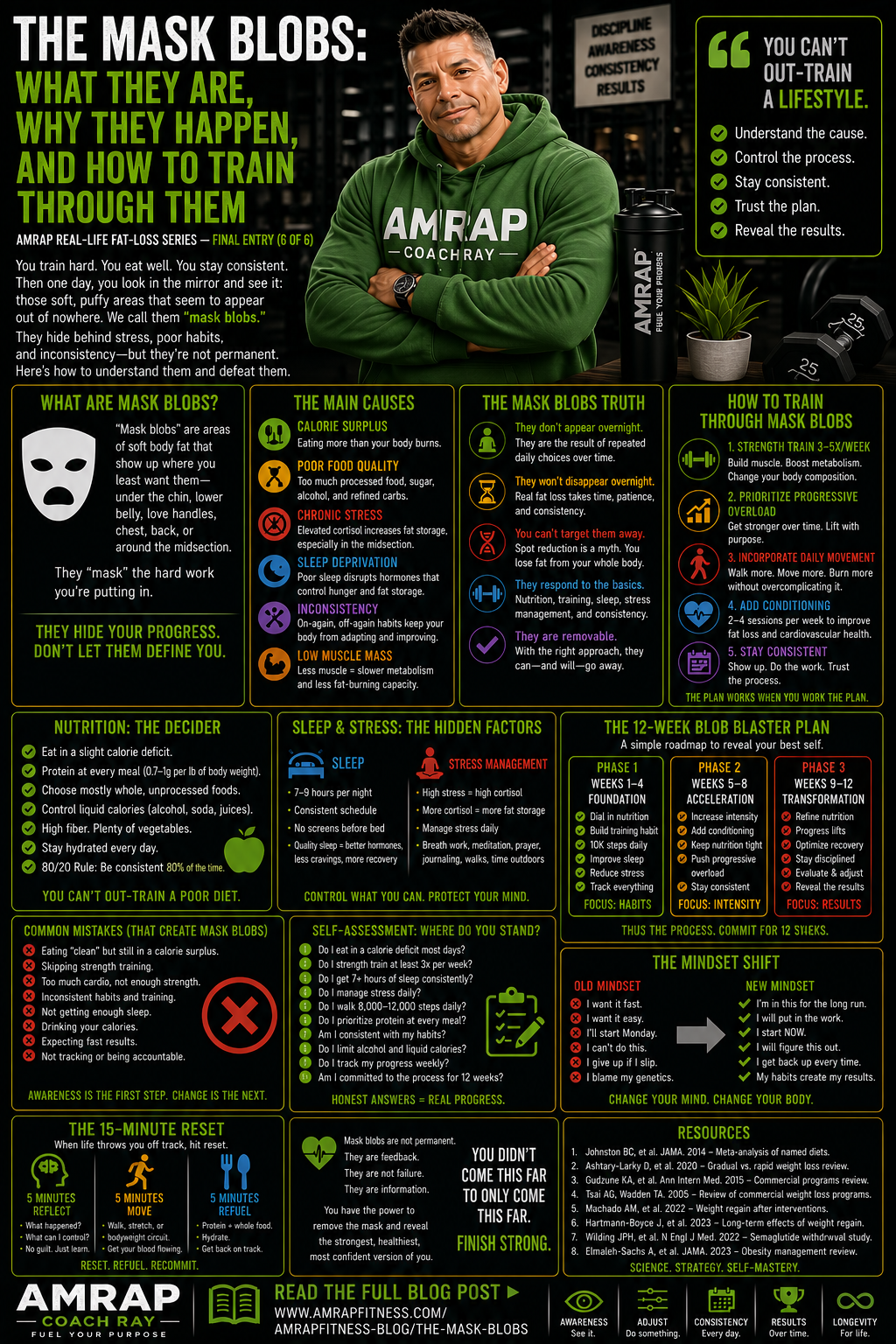
AMRAP Real-Life Fat-Loss Series — Entry 6 of 6
Most people do not fail because they lack character.
They fail because they are repeatedly asked to make the hardest possible choice inside an environment designed to reward the easiest one.
They keep snack foods visible.
They keep training equipment buried.
They leave work without a food plan.
They keep delivery apps one tap away.
They sit beside people who dismiss their goals.
They scroll through content that triggers comparison, cravings, urgency, and self-doubt.
Then, when willpower eventually breaks, they blame themselves.
That is not a fair assessment.
Human behavior is influenced by:
what is visible
what is immediately available
what is convenient
what is repeatedly cued
what the people around us treat as normal
how much friction separates intention from action
This does not mean personal responsibility disappears.
It means responsibility includes more than trying harder.
It includes designing the conditions in which your better decisions have a realistic chance to survive.
A person who places fruit on the counter, keeps water within reach, packs a gym bag, prepares two default meals, removes food-delivery shortcuts, and schedules training beside an existing commitment is not “cheating.”
They are using intelligence.
The goal is not to create a life with no temptation, inconvenience, stress, or disruption.
The goal is to stop making every healthy decision depend on a heroic moment of discipline.
Because willpower is valuable.
But environment is working all day.
Opening Device: The Decision That Was Made Before You Felt Hungry
Imagine arriving home after a demanding day.
You are tired.
Lunch was rushed.
Your patience is low.
You walk into the kitchen.
On the counter:
cookies
chips
leftover takeout
a bowl of candy
The healthier food is somewhere else:
vegetables in the bottom drawer
chicken still frozen
fruit hidden behind other items
water bottle unfilled
no complete meal prepared
Now consider the decision.
Did it begin when you reached for the snack?
Or was the decision partly made hours earlier, when:
the easiest food was placed in sight
the supportive food required preparation
severe hunger was allowed to build
no backup meal existed
the delivery app remained ready
no plan had been assigned to the evening
This is not about denying personal choice.
It is about recognizing that some choices are repeatedly made harder than others.
If the better option requires:
more time
more steps
more planning
more cleanup
more restraint
while the less supportive option requires almost nothing, then the environment is not neutral.
It is voting.
And it votes every day.
What an Environment Really Is
Your environment is not only the room around you.
It includes four major areas:
Physical environment
Your home, kitchen, workplace, car, and gym setup.Digital environment
Your phone, social media, notifications, advertisements, delivery apps, and content feed.Social environment
The people, norms, expectations, and conversations surrounding you.Schedule environment
The way your time, transitions, meals, and training windows are structured.
Each environment can either:
support your goal
remain neutral
quietly undermine it
The important word is quietly.
Environmental pressure does not always feel dramatic.
It may look like:
passing the snack cabinet ten times
seeing an advertisement while tired
working beside a vending machine
having no shoes ready for a walk
being offered food every time you visit family
receiving criticism for ordering differently
needing six separate steps before exercise can begin
One cue may appear harmless.
Repeated cues shape behavior.
The Science Signal: Behavior Is Not Created in a Vacuum
Research on food environments has found that access, availability, proximity, and the surrounding retail landscape can influence eating patterns and obesity risk. A 2024 systematic review and meta-analysis found that greater fast-food proximity was associated with higher obesity odds, while fruit-and-vegetable outlet density and supermarket proximity were associated with lower odds. These are population-level associations and do not determine any one person’s behavior, but they reinforce that food choices occur inside real environments rather than in isolation.
Among U.S. adults, features of the home food environment—including food availability, placement, preparation practices, restaurant meals, television-related eating, and portion-control practices—have also been associated with diet quality and weight status. Because that evidence is observational, it should not be interpreted as proof that one household change alone causes weight loss. It does show that the home is a meaningful behavioral setting.
People actively managing their weight frequently describe unsupportive food environments as a major challenge, including the abundance, accessibility, marketing, and social acceptability of less supportive foods.
Digital environments matter too. Researchers have identified online food marketing, ordering systems, social platforms, and other digital influences as an emerging part of the food environment.
Environmental design is not magical. A systematic review of “choice architecture” interventions found that prompts can increase stair use while they are present, although evidence for many other physical-activity nudges remains limited or mixed. That is an important reminder: environment can support behavior, but it does not eliminate the need for intention, skill, and repetition.
The professional conclusion is balanced:
Your environment does not completely control you. But ignoring it forces willpower to fight unnecessary battles.
Why Willpower Is an Expensive Strategy
Willpower is often treated like a personality trait.
People say:
“I have no discipline.”
“I’m just weak around food.”
“I need to want it more.”
“I should be able to control myself.”
But every act of self-regulation happens under conditions.
Those conditions may include:
hunger
fatigue
stress
poor sleep
emotional strain
social pressure
convenience
repeated exposure
Stress itself is associated with changes in eating behavior, including greater intake of less healthy foods in some people, although responses vary.
This means the same person may make very different decisions:
rested versus exhausted
prepared versus unprepared
supported versus criticized
moderately hungry versus starving
inside a structured kitchen versus surrounded by visible snacks
The person did not become morally better or worse.
The conditions changed.
Willpower should be used for meaningful decisions.
It should not be wasted on hundreds of preventable environmental battles.
Friction: The Hidden Force Behind Behavior
Friction is anything that makes a behavior easier or harder.
Low-friction behavior
shoes are ready
workout is written
water is filled
meal is prepared
fruit is visible
gym is on the route home
High-friction behavior
equipment is stored away
no workout has been chosen
groceries are missing
healthy food requires cooking from scratch
gym clothing is upstairs
exercise requires another trip after arriving home
Small friction matters because adult life already contains:
decision fatigue
unexpected responsibilities
emotional strain
limited time
competing priorities
The goal is to reduce friction around the behavior you want and increase friction around the behavior you want less often.
That is the entire strategy.
The AMRAP Friction Audit
Review four environments:
Home
Work and travel
Digital
Social
For each environment, ask:
What behavior is currently easiest?
What behavior is currently most visible?
What behavior requires the fewest steps?
What repeatedly triggers me?
What supportive action is unnecessarily difficult?
What can I move, prepare, remove, automate, or pre-decide?
Then make two changes:
Make one supportive behavior easier
Examples:
fill the water bottle
put walking shoes by the door
prepare protein
place fruit at eye level
write the workout in advance
Make one unhelpful behavior harder
Examples:
remove delivery apps from the home screen
store snack foods out of sight
stop buying family-sized packages
disable notifications
avoid eating directly from containers
Do not redesign your entire life in one weekend.
Change the strongest cue first.
Environment 1: The Home
Home is where many daily food and movement decisions occur.
A supportive home is not a perfect fitness laboratory.
It is a place where the better choice is visible, available, and fast enough to compete.
The Kitchen Visibility Rule
Place supportive foods where you see them first.
Examples:
fruit on the counter
prepared protein at eye level
washed vegetables in clear containers
water in the front of the refrigerator
default meals grouped together
Move less supportive foods:
out of immediate sight
into opaque containers
away from the counter
into individual portions
into a less convenient location
This does not make food forbidden.
It removes unnecessary cues.
The Countertop Test
Look at your kitchen counter.
What does it advertise?
fruit?
water?
meal preparation?
cookies?
chips?
takeout containers?
The counter is a billboard.
Choose the message deliberately.
The Ready-to-Eat Standard
Having healthy ingredients is not the same as having food ready.
A bag of raw vegetables and frozen chicken may technically support your goals.
But at 7:00 p.m., exhausted and hungry, they may not compete with finished takeout.
Keep at least:
one ready protein
one ready produce option
one quick carbohydrate
one complete emergency meal
The Portion Environment
Avoid making oversized consumption effortless.
Practical options:
plate food before eating
divide larger packages
store leftovers before the meal
use individual containers
avoid placing serving dishes directly in front of you when unnecessary
This is not about using tiny plates to trick yourself.
It is about creating a pause between intention and repetition.
Environment 2: Work, Car, and Travel
Many nutrition and exercise plans fail before the person reaches home.
The Work-Food Backup
Keep emergency options such as:
protein powder
tuna packets
oatmeal
fruit
yogurt when refrigeration is available
measured nuts
protein bars with reasonable nutrition
whole-grain crackers
The goal is not to live on snacks.
It is to prevent arriving home severely underfed.
The Car Environment
Your car can support movement and nutrition.
Keep:
walking shoes
gym clothing
resistance band
refillable water bottle
shelf-stable emergency food when temperatures permit
Do not keep food in unsafe conditions or allow perishable items to remain unrefrigerated.
The Direct-Route Rule
If going home makes exercise much less likely:
go directly to the gym
walk before entering the house
train beside the workplace
schedule exercise adjacent to school drop-off or another fixed commitment
Transitions often determine outcomes.
Reduce the number of opportunities to renegotiate.
Environment 3: The Digital World
Your phone is not neutral.
It can expose you to:
food marketing
delivery prompts
unrealistic transformations
comparison
sedentary entertainment
late-night stimulation
constant interruption
The Delivery-App Audit
Ask:
How often do I order because I truly choose to?
How often do I order because the app makes the choice frictionless?
Do notifications trigger eating decisions?
Is my saved order larger than I would intentionally plan?
Possible changes:
disable notifications
remove apps from the home screen
delete saved payment information
create a planned-order note
keep two healthier restaurant defaults
The goal is not necessarily to ban delivery.
It is to restore a decision where automation removed one.
The Social-Media Audit
Unfollow or mute accounts that repeatedly create:
shame
panic
false urgency
disordered comparison
obsession with extreme methods
distrust of evidence-based care
Follow accounts that reinforce:
education
sustainable training
realistic nutrition
healthy aging
skill-building
credible sources
Your feed is a repeated behavioral environment.
Curate it.
The Screen-to-Sleep Boundary
Late-night phone use can compete with sleep and make the next day harder.
Use:
scheduled “do not disturb”
charging outside the bedroom
app limits
a defined screen cutoff
reduced brightness
The goal is not digital perfection.
It is to stop allowing the phone to decide when your recovery ends.
Environment 4: The Social Circle
Humans are social.
What the people around us consider normal can influence:
portions
alcohol intake
activity
food choices
attitudes toward exercise
willingness to change
Social-norm research supports the idea that eating behavior can be influenced by perceptions of what others do or approve of, although the effect depends on context and individual factors.
The Social Support Question
Ask:
“Do the people around me support the person I am trying to become?”
Support does not require everyone to:
follow your program
eat exactly as you do
train with you
understand every decision
But they should be able to respect:
your training time
your meal choices
your alcohol limits
your sleep
your health goals
Common Social Sabotage
It may sound like:
“One meal won’t hurt.”
“You’re becoming obsessed.”
“You don’t need to work out.”
“Why are you eating that?”
“You used to be more fun.”
“Just start again Monday.”
Sometimes this is harmless joking.
Sometimes it reflects discomfort with your change.
You do not need to attack or lecture anyone.
You do need a boundary.
Example:
“I’m not asking you to follow my plan. I’m asking you to respect that I am following it.”
Build a Supportive Micro-Community
You may not need a new social life.
You may need:
one training partner
one walking partner
one supportive friend
one coach
one online group
one family member who protects your appointment
One reliable source of support can reduce the sense that you are doing everything alone.
The Schedule Is an Environment Too
A calendar can help or undermine you.
A week with no assigned health actions leaves every decision exposed to negotiation.
Use:
fixed training anchors
planned meal windows
grocery time
bedtime boundaries
recovery blocks
rescue plans
Implementation intentions—specific “if–then” plans linking a situation to a behavior—can help translate existing intentions into physical activity for some people, particularly when motivation and self-efficacy are already present. Results are not uniform, so planning works best when supported by confidence, realistic options, and repetition.
They can also support healthier eating intentions, though effect sizes and contexts vary.
Examples:
If work ends late, then I complete the 20-minute home session.
If I order food, then I use my saved protein-centered order.
If I feel snacky after dinner, then I make tea and wait ten minutes before deciding.
If I miss the morning walk, then I walk after lunch.
The value is not that the plan controls the future.
It removes one decision from a vulnerable moment.
The One-Step Rule
Count the steps required to begin a supportive behavior.
Exercise example
Current:
Find clothes
Find shoes
Choose workout
Locate equipment
Clear floor space
Begin
Improved:
Put on prepared clothes
Start written workout
Nutrition example
Current:
Decide meal
Defrost protein
Chop vegetables
Cook carbohydrate
Prepare sauce
Clean everything
Improved:
Heat prepared components
Plate meal
The fewer steps required, the more likely the behavior can survive a difficult day.
The “Visible, Ready, Scheduled” Standard
For any behavior you want repeated, ask whether it is:
Visible
Can you see the cue?
shoes
water
fruit
journal
workout calendar
Ready
Can you begin quickly?
food prepared
clothes packed
session written
bottle filled
equipment accessible
Scheduled
Does it have a defined place?
time
location
backup option
A goal that is invisible, unprepared, and unscheduled depends too heavily on memory and mood.
The Seven-Day Environment Reset
Do not try to transform everything at once.
Use one week.
Day 1: Kitchen
clear the counter
make water and fruit visible
prepare one complete meal
move trigger foods out of sight
Day 2: Refrigerator and freezer
place protein and produce at eye level
label leftovers
create one emergency meal
discard food that is no longer safe
Day 3: Training environment
prepare clothing
place shoes visibly
write two workouts
make equipment accessible
Day 4: Work and car
pack emergency food
place water within reach
add walking shoes or a band
decide your direct route
Day 5: Phone
disable delivery notifications
remove distracting apps from the home screen
unfollow harmful accounts
establish a screen cutoff
Day 6: Social environment
ask one person for support
communicate one boundary
schedule one shared healthy activity
Day 7: Calendar
set training anchors
schedule grocery time
choose meal defaults
write one rescue plan
At the end of the week, do not ask:
“Was I perfectly disciplined?”
Ask:
“Did the better behavior become easier?”
The AMRAP Environmental Design Blueprint
Use this simple structure.
Keep visible
water
fruit
workout calendar
walking shoes
prepared meals
your written goals
Keep ready
protein
vegetables
gym bag
home workout
emergency snack
restaurant fallback order
Keep scheduled
strength sessions
walks
groceries
sleep boundary
recovery
Make harder
impulsive delivery
eating from large containers
automatic late-night scrolling
skipping meals
repeatedly canceling training
Make supportive
coach check-ins
training partner
family cooperation
meal defaults
clear boundaries
Common Mistakes—and the Professional Correction
Mistake 1: Trying to remove every temptation
Correction: Reduce the strongest cues and build better defaults. Life will never be perfectly controlled.
Mistake 2: Depending only on motivation
Correction: Make behavior visible, ready, and scheduled.
Mistake 3: Keeping trigger food visible for “discipline practice”
Correction: You do not need to rehearse unnecessary battles all day.
Mistake 4: Buying healthy food without preparing it
Correction: Availability must become usability.
Mistake 5: Ignoring the digital environment
Correction: Curate notifications, delivery access, and social media.
Mistake 6: Expecting everyone to approve
Correction: Seek respect, not unanimous participation.
Mistake 7: Changing too much at once
Correction: Adjust one high-impact point of friction at a time.
Mistake 8: Believing environment removes responsibility
Correction: Environment supports responsible action; it does not replace it.
Self-Assessment
Answer honestly:
What food does my kitchen advertise?
Which healthier foods are technically present but not ready?
How many steps does it take me to begin exercising?
What usually happens during my transition from work to home?
Which app makes impulsive eating easiest?
What content repeatedly damages my confidence or judgment?
Who supports my goals?
Who pressures me to abandon them?
Which helpful behavior could become one step easier today?
Which unhelpful behavior could become one step harder?
Is my week scheduled to support my stated priorities?
Am I blaming my personality for a system I have never redesigned?
Your answers are not excuses.
They are design information.
Closing: Stop Asking Willpower to Do the Work of a System
Discipline matters.
Effort matters.
Personal responsibility matters.
But responsibility does not mean repeatedly placing yourself in the worst possible conditions and then feeling ashamed when those conditions win.
Responsible people prepare.
They:
organize
simplify
remove friction
create boundaries
schedule
adjust
ask for support
build rescue plans
You do not need a perfect kitchen.
You do not need a perfect family.
You do not need a distraction-free phone.
You do not need a life with no stress.
You need enough structure that the better choice is no longer the hardest choice every single time.
Put the water where you can see it.
Prepare the food before exhaustion arrives.
Place the shoes by the door.
Write the workout.
Remove the notification.
Protect the appointment.
Ask for support.
Create one step between impulse and action.
Your environment will always influence you.
So let it influence you in the direction you have chosen.
Willpower may help you begin.
A well-designed environment helps you continue.
That is how habits become more stable.
That is how fat-loss systems survive real life.
And that is how this six-part series ends:
Not with another demand to try harder.
With a better question:
“How can I make the life I want easier to practice?”
Resources
Pineda E, Stockton J, Scholes S, Lassale C, Mindell JS. Food Environment and Obesity: A Systematic Review and Meta-analysis. BMJ Nutrition, Prevention & Health. 2024. The review found associations between elements of the retail food environment and obesity outcomes.
Kegler MC, Hermstad A, Haardörfer R. Home Food Environment and Associations With Weight and Diet Among U.S. Adults. BMC Public Health. 2021.
Neve KL, Isaacs A. How Does the Food Environment Influence People Engaged in Weight Management? A Systematic Review and Thematic Synthesis. Obesity Reviews. 2022.
Granheim SI, Løvhaug AL, Terragni L, Torheim LE, Thurston M. Mapping the Digital Food Environment: A Systematic Scoping Review. Obesity Reviews. 2022.
Landais LL, et al. Choice Architecture Interventions to Change Physical Activity and Sedentary Behavior: A Systematic Review. International Journal of Behavioral Nutrition and Physical Activity. 2020.
Kompf J. Implementation Intentions for Exercise and Physical Activity: Who Do They Work For? A Systematic Review. Journal of Physical Activity and Health. 2020.
Silva MAV, et al. Impact of Implementation Intentions on Physical Activity Practice in Adults: A Systematic Review and Meta-analysis of Randomized Clinical Trials. PLOS ONE. 2018.
Adriaanse MA, et al. Do Implementation Intentions Help to Eat a Healthy Diet? A Systematic Review and Meta-analysis. Appetite. 2011.
Hill D, et al. Stress and Eating Behaviours in Healthy Adults: A Systematic Review and Meta-analysis. Health Psychology Review. 2022.
Stok FM, Mollen S, Verkooijen KT, Renner B. Unravelling Social Norm Effects: How and When Social Norms Affect Eating Behavior. Frontiers in Psychology. 2018.