
What Does Moderation Actually Mean? How to Enjoy the Holidays Without Losing Your Progress
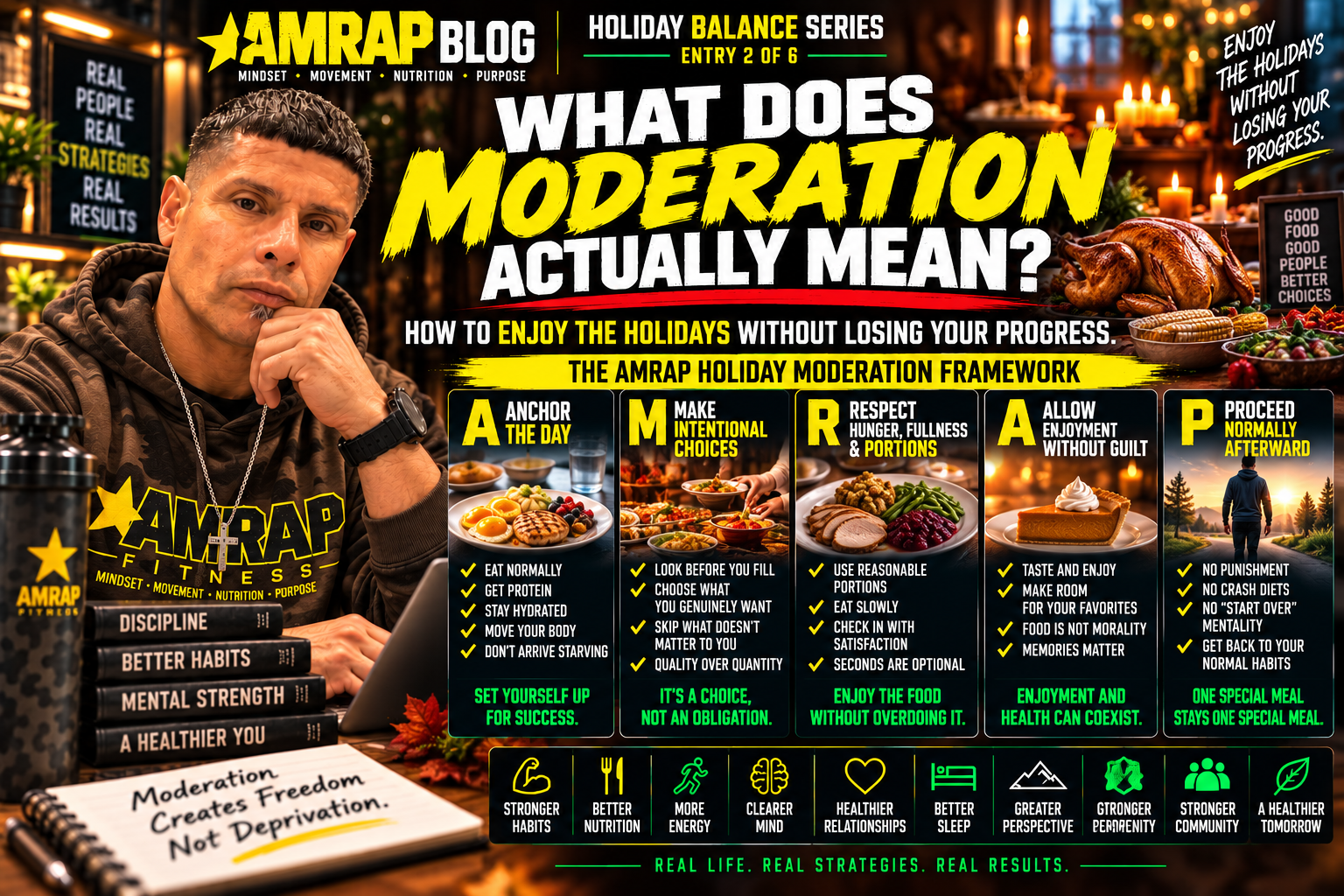
AMRAP Holiday Balance Series — Entry 2 of 6
“Everything in moderation.”
You have heard that phrase your entire life.
Have some dessert—in moderation.
Drink alcohol—in moderation.
Enjoy the holidays—in moderation.
Eat your favorite foods—in moderation.
It sounds reasonable.
It sounds balanced.
It sounds healthier than restriction.
But there is one major problem:
Most people have never actually been taught what moderation means.
How many cookies is moderation?
Can you have dessert after Thanksgiving dinner?
What if you have three holiday parties in one week?
Should you skip breakfast before a large dinner?
Does moderation mean eating whatever you want as long as the portion is small?
Does it mean following your plan Monday through Friday and doing whatever you want on the weekend?
Is moderation an 80/20 rule?
Is it calories?
Is it portion size?
Is it hunger?
Is it frequency?
Is it simply “trying not to go crazy”?
That confusion is exactly why people tend to fall into one of two extremes.
The first extreme is:
Restriction.
“I can’t eat that.”
“No bread.”
“No dessert.”
“No alcohol.”
“No holiday food.”
“I’ll be good.”
The second extreme is:
Abandonment.
“It’s Thanksgiving.”
“It’s Christmas.”
“It’s only once a year.”
“I already messed up.”
“I’ll get serious again in January.”
Neither extreme teaches the skill we actually need.
The ability to enjoy food without allowing food to take over the season.
That is moderation.
And moderation is not passive.
It is a skill.
It requires awareness.
Choice.
Boundaries.
Flexibility.
Portion control.
Self-trust.
And the ability to return to your normal habits after something special.
That is what we are going to build.
Opening Device: Two People at the Same Holiday Table
Imagine two people attending the same Thanksgiving dinner.
The table is loaded.
Turkey.
Stuffing.
Macaroni and cheese.
Mashed potatoes.
Gravy.
Sweet potatoes.
Bread.
Vegetables.
Family recipes.
Wine.
Pie.
Cookies.
Everything smells incredible.
Person One
Person One has been “good” all week.
They skipped breakfast.
Had almost nothing for lunch.
They exercised extra that morning because they wanted to “earn” dinner.
By the time the meal begins, they are ravenous.
They fill the plate.
Eat quickly.
Go back for seconds.
Then dessert.
Then another dessert because:
“Today is already ruined.”
They leave physically uncomfortable.
The next morning they feel guilty.
So they restrict again.
That restriction creates more hunger.
The cycle continues through the weekend.
Person Two
Person Two ate normally earlier in the day.
Protein.
Water.
Maybe breakfast.
Maybe lunch.
They moved because movement is part of their normal life—not because they needed to earn food.
At dinner, they look around first.
They choose the foods they genuinely care about.
They take enough to enjoy them.
They eat.
They talk.
They pause.
They have dessert because they wanted dessert.
They leave satisfied.
Not perfect.
Not deprived.
Not stuffed beyond recognition.
The following morning?
Normal breakfast.
Normal movement.
Normal life.
Both people ate Thanksgiving dinner.
Only one turned the meal into a four-day event.
That difference is moderation.
Moderation Is Not the Absence of Structure
This is important.
People sometimes hear “moderation” and interpret it as:
“Anything goes.”
That is not moderation.
That is lack of structure.
Moderation has boundaries.
They are simply flexible boundaries rather than rigid ones.
There is a meaningful difference between:
“I can never have pie.”
and:
“I can absolutely have pie, but I do not need pie every time I see pie.”
There is a difference between:
“Carbs are forbidden.”
and:
“I am going to choose the carbohydrate foods I really enjoy rather than automatically eating everything available.”
There is a difference between:
“I must follow my diet perfectly.”
and:
“Most of my behaviors support my goals, and I intentionally make room for celebration.”
The second approach is not less disciplined.
In many ways, it requires more maturity.
Restriction gives you a rule.
Moderation requires a decision.
The Science Signal: Flexible and Rigid Eating Are Not the Same
Research has distinguished between rigid dietary control and flexible dietary control.
Rigid control tends to involve absolute rules:
forbidden foods
strict dieting
“good” versus “bad”
all-or-nothing behavior
Flexible control allows foods to fit within an overall pattern rather than requiring perfect adherence.
A classic large study found that rigid control was associated with greater disinhibition, higher BMI, and more frequent and severe binge-eating episodes, while flexible control was associated with lower disinhibition and more favorable weight-control outcomes. Because this was observational research, it does not prove that flexible control causes those outcomes—but it illustrates an important distinction.
More recent research continues to examine flexible and rigid eating as meaningfully different constructs, including the possibility that rigid approaches may help explain why some people respond to a perceived diet violation with disinhibited eating.
The coaching translation:
A plan that bends is less likely to snap.
Moderation Is NOT “Being Good”
I would like us to remove that phrase from nutrition whenever possible.
“I was good today.”
What does that mean?
And if eating salad makes you “good,” what does eating pie make you?
Bad?
Food is not morality.
Food has nutritional properties.
Some foods support health goals more frequently.
Some foods are more calorie-dense.
Some offer more protein.
Some offer more fiber.
Some are mostly eaten because they are delicious.
Some are connected to culture, memory, tradition, or celebration.
You can evaluate food without evaluating your worth.
That distinction matters.
Because once eating becomes morality, a dietary choice becomes a character judgment.
Then one cookie becomes:
“I was bad.”
And:
“I was bad”
easily becomes:
“I might as well keep going.”
Moderation breaks that cycle.
You ate the cookie.
Was it enjoyable?
Fine.
What is next?
That is all.
Did You Know? Portion Size Changes How Much People Eat
Portion size is one of the most practical places where moderation becomes measurable.
A major systematic evidence review for adults and older adults found strong evidence that serving larger portions increases food and energy intake. It also found moderate evidence that smaller pre-portioned amounts reduce energy intake.
This is important because people sometimes think:
“I either eat the food or I don't.”
There is a third option:
Eat it—just not automatically in the largest available amount.
You do not need zero stuffing.
You may simply need less stuffing.
You do not need zero pie.
You may want one piece instead of three.
You do not need to avoid the macaroni and cheese.
You may decide that you want a scoop, enjoy it, and move on.
That is what moderation looks like in real life.
The AMRAP Holiday Moderation Framework
We are going to make moderation concrete.
Use AMRAP.
A — Anchor the Day
Do not walk into every celebration starving.
Maintain basic structure before the event.
That might mean:
Protein.
Water.
Fruit.
Vegetables.
A normal breakfast.
A reasonable lunch.
Walking.
Your usual workout.
The anchor prevents one special meal from becoming the only thing happening nutritionally that day.
You do not need to eat a huge meal before Thanksgiving dinner.
But you also do not need to starve yourself until 5 p.m.
The goal:
Arrive hungry enough to enjoy the meal—not so hungry that biology overwhelms intention.
M — Make Intentional Choices
Survey the environment.
What do you actually want?
This sounds almost too simple.
But many people eat holiday foods because they are available, not because they particularly enjoy them.
You see:
cookies.
bread.
chips.
candy.
cheese.
appetizers.
alcohol.
dessert.
And each time the brain says:
“Well, it’s here.”
Moderation asks something different:
“Is this worth it to me?”
That question is not about guilt.
It is about value.
Your aunt’s recipe you only eat once per year?
Absolutely.
Your favorite pie?
Enjoy it.
A stale grocery-store cookie sitting in the break room for four days?
Maybe that one is not worth your attention.
Intentional indulgence feels different from automatic consumption.
R — Respect Hunger, Fullness, and Portions
Moderation requires noticing the body.
Not obsessively.
Just enough to hear it.
Ask:
Am I still hungry?
Am I satisfied?
Am I eating because I want more—or because more is available?
Would another serving actually improve this experience?
Many holiday meals continue long after biological hunger has ended.
And that makes sense.
Food is social.
Food is pleasurable.
Food is tradition.
You do not need to stop at the precise second hunger disappears.
But there is a large difference between:
comfortably satisfied
and
physically miserable.
The goal is not to leave Thanksgiving dinner hungry.
The goal is to leave it able to breathe.
A — Allow Enjoyment Without Guilt
This is huge.
If you choose the dessert:
Enjoy the dessert.
Do not eat pie while mentally punishing yourself for eating pie.
That defeats the purpose.
Taste it.
Talk.
Slow down.
Be present.
If you made the decision intentionally, stop turning it into a crime scene afterward.
Guilt does not undo calories.
Guilt does not improve the meal.
Guilt does not make you healthier.
It simply changes an enjoyable experience into an emotionally complicated one.
Allowing enjoyment does not mean ignoring your goals.
It means making a decision and owning it.
P — Proceed Normally Afterward
This may be the most important letter in AMRAP moderation.
After the meal:
Proceed.
Do not compensate.
Do not detox.
Do not starve.
Do not perform punishment cardio.
Do not wait for Monday.
Do not tell yourself the weekend is ruined.
Proceed normally.
Next meal.
Next workout.
Next walk.
Next glass of water.
Next bedtime.
This is how one special meal stays one special meal.
THAT Is Moderation
Not perfection.
Not chaos.
Not restriction.
Not “cheating.”
Not punishment.
Anchor. Make choices. Respect the body. Allow enjoyment. Proceed.
That is moderation.
Moderation Changes Depending on Frequency
Something can fit occasionally that may not fit constantly.
This is one of the places where “everything in moderation” gets abused.
People sometimes say:
“Cookies are fine in moderation.”
True.
Then cookies appear every day from Thanksgiving through Christmas.
At some point, that is no longer occasional.
Frequency matters.
A dessert after Christmas dinner?
One event.
A dessert every night from December 1 to January 2 because “it’s the holidays”?
Different pattern.
One cocktail at a celebration?
Different from alcohol every evening because December feels festive.
Holiday candy on Halloween?
Different from candy sitting at your desk for six weeks.
Moderation is not determined only by quantity.
It is also determined by:
frequency
context
goals
health status
overall pattern
That is why one universal number cannot define moderation for everyone.
Why I Don't Love the 80/20 Rule by Itself
You have probably heard:
“Eat healthy 80% of the time and enjoy yourself 20%.”
The idea can be useful.
It reminds people that perfection is unnecessary.
But it can also become confusing.
What is 20%?
Twenty percent of calories?
Meals?
Days?
Foods?
If someone eats 21 meals per week, does that mean four “cheat meals”?
Does a whole Saturday count as part of the 20%?
People can manipulate percentages into almost anything.
So I prefer this:
Build a strong normal pattern and intentionally make room for foods you enjoy.
That is easier to live.
Most meals should support:
energy
protein needs
micronutrients
fiber
performance
recovery
medical goals
And sometimes meals exist primarily because:
It is Thanksgiving with your family.
Both belong in a healthy life.
Moderation Does Not Mean Every Food Must Fit Every Person
This is also important.
Individual context matters.
Someone managing diabetes may need a different strategy than someone without diabetes.
Someone with celiac disease does not practice “moderation” with gluten.
Someone who has been advised not to drink alcohol should not interpret moderation as permission to drink.
Someone with kidney disease, heart failure, allergies, gastrointestinal conditions, or medication interactions may require individualized nutrition.
And someone with an active or previous eating disorder may need a very different approach to tracking, portion control, weighing, or dietary restraint.
Moderation is not a substitute for individualized medical or mental-health care.
The principle remains flexible.
The execution should be personal.
Mindful Eating Is Not About Eating Perfectly
Mindful eating is another phrase that gets overcomplicated.
It does not require candles.
Meditation music.
A silent dining room.
Or chewing each bite exactly 32 times.
Mindful eating means bringing enough attention to the meal that you actually experience it.
A recent systematic review and meta-analysis found that mindfulness and mindful-eating interventions produced a modest reduction in food intake in experimental settings, though the effects appeared larger in laboratory studies and did not significantly alter hunger or fullness ratings. The authors appropriately called for more high-quality real-world research.
A recent randomized trial in adults with overweight or obesity also found a structured mindful-eating program improved mindful, emotional, and external eating behaviors, although it did not produce short-term differences in body weight.
That is useful because mindful eating is not primarily about squeezing maximum weight loss out of every meal.
It is about changing the relationship with eating.
Holiday application:
Put down the fork occasionally.
Talk.
Taste the food.
Notice when it stops tasting as amazing as the first bite.
Check whether you actually want more.
You do not need to analyze every mouthful.
Just show up for your own meal.
Did You Know? We Often Eat More With People We Know
Holiday eating is different partly because it is social.
A systematic review and meta-analysis found strong evidence that people ate more when dining with friends than when eating alone. Researchers found a standardized effect suggesting meaningful social facilitation of eating, and longer meal duration and perceived social norms may partly explain the effect.
Another experiment found that women consumed substantially more when eating with friends than when eating alone, and they did not fully compensate for the additional intake over subsequent days.
This matters because holiday overeating is not simply:
“I have no discipline.”
Social environments change behavior.
We eat longer.
We talk.
Food remains available.
Someone offers seconds.
Another bottle gets opened.
Dessert appears.
The meal stretches for hours.
Understanding this gives you a strategy.
Not fear.
Strategy.
How to Stay Social Without Eating Continuously
The goal is not to sit at Thanksgiving dinner clutching a glass of water while everyone else eats.
Stay part of the celebration.
But understand that socializing and eating do not need to be identical activities.
Once you are satisfied:
Move away from the food table if possible.
Help clean.
Get coffee.
Talk.
Play with the kids.
Watch the game.
Take a walk.
Sit somewhere else.
The environment matters.
Standing beside the appetizer table for two hours makes eating more likely.
That is not lack of willpower.
That is exposure.
Change the environment.
The Second-Plate Question
I am not going to tell you:
Never have seconds.
Sometimes you genuinely want more.
But before going back, ask:
“What exactly do I want seconds of?”
Not:
“Should I refill the entire plate?”
Maybe the turkey was incredible.
Get more turkey.
Maybe you loved the stuffing.
Take more stuffing.
Maybe the vegetables were great.
Have more.
You do not need to repeat every item simply because you returned to the buffet.
Moderation becomes easier when decisions become specific.
Dessert: Choose Instead of Sample Everything
Holiday dessert tables can turn into accidental eating.
You want the pie.
But then:
one cookie.
a brownie.
a piece of fudge.
another cookie.
a little cake.
And somehow the dessert you actually wanted became one of six things.
Try this instead:
Look first.
Choose.
If there are two things you genuinely love, have portions of both.
The goal is not deprivation.
The goal is maximizing enjoyment per decision.
I would rather see someone intentionally enjoy their favorite dessert than mindlessly eat four mediocre desserts because they were available.
The “First Three Bites” Reality
Think about your favorite rich food.
The first bite is incredible.
The second is great.
The third is still enjoyable.
Eventually, however, the sensory impact decreases.
You may continue eating, but the pleasure does not always rise proportionately with the amount.
This does not mean you must take three bites and stop.
It simply means:
Pay attention to diminishing enjoyment.
Sometimes we are no longer eating for pleasure.
We are eating because there is food left.
Moderation notices the difference.
Alcohol and Moderation
Holiday alcohol deserves an honest discussion.
Alcohol is often embedded in:
parties
dinner
football
work events
family gatherings
New Year's celebrations
If you choose to drink and alcohol is appropriate for you, understand the tradeoffs.
A systematic review and meta-analysis of controlled studies found that people generally did not compensate for the calories from alcohol by eating less food. Alcohol increased both food intake and total energy intake compared with non-alcohol conditions. The evidence was mostly in younger adults, so we should not overgeneralize, but the basic finding is useful.
Alcohol may also make moderation harder by lowering inhibition.
So ask:
What do I actually want tonight?
Maybe it is one drink.
Maybe two.
Maybe none.
Maybe you want dessert more than alcohol.
You do not need every indulgence simultaneously just because it is a celebration.
That is intentional decision-making.
Moderation and Protein
I do not want this article to become:
“Eat protein so you can control yourself.”
That would oversimplify nutrition.
But keeping protein present during holiday weeks can support normal meal structure and help preserve muscle while people are busy.
That means instead of starting the day with holiday cookies and then grazing until dinner, you still have normal anchors:
Eggs.
Greek yogurt.
Chicken.
Fish.
Lean meat.
Cottage cheese.
Beans.
Lentils.
Tofu.
Protein shakes when useful.
The point is not to optimize every gram during Christmas.
The point is to keep your nutritional foundation alive while enjoying seasonal foods.
Moderation and the Scale
If you weigh yourself after a large holiday meal and the number jumps, do not panic.
A rapid increase following a celebration can reflect:
more food in the digestive tract
sodium
carbohydrate storage
water retention
alcohol
changes in bowel movements
Body weight is not identical to body fat.
One large meal cannot instantly create several pounds of body fat.
This is why scale data need context.
If weighing helps you stay aware without emotional overreaction, use it.
Self-monitoring is a common component of behavioral weight-management interventions, and a 2024 systematic review examined how feedback can enhance dietary, physical-activity, self-monitoring, and weight outcomes.
But if weighing triggers destructive restriction, bingeing, obsessive behavior, or significant emotional distress, choose another metric and discuss the issue with a qualified professional.
The scale is data.
Not a grade.
Moderation Is Different During Weight Loss and Maintenance
If you are actively trying to lose body fat, moderation may require somewhat tighter boundaries.
If your goal is maintenance through December, you have more flexibility.
If your medical team is managing a health condition, your plan may be more specific.
If you are highly active, your energy needs differ from someone sedentary.
This is why copying someone else's holiday eating plan often fails.
Moderation is not:
“Eat like Coach Ray.”
It is:
“Make choices consistent with your own goals while remaining flexible enough to live.”
Your Age Matters Too
For the AMRAP audience, ages 30 to 70, moderation may look different across decades.
In your 30s
You may be surrounded by work events, young children, travel, nightlife, and social eating.
Your challenge may be environmental control and consistency.
In your 40s
Career stress and family responsibility can turn every holiday meal into the reward for exhaustion.
Your challenge may be stress eating and preparation.
In your 50s
Recovery, muscle preservation, sleep, cardiometabolic health, and maintaining a reasonable body weight become increasingly valuable.
Your challenge may be realizing that the old strategy of “I'll fix it later” costs more than it used to.
In your 60s and 70s
Moderation may focus less on aggressive weight loss and more on preserving muscle, mobility, independence, metabolic health, social connection, and enjoyment.
The holiday table still matters.
But health goals change.
That is okay.
The Two-Plate Trap
One subtle holiday issue is using separate plates for continuous grazing.
Appetizer plate.
Dinner plate.
Second dinner plate.
Dessert plate.
Snack plate later.
None looks extreme individually.
Together, they can create a much larger intake than the person realizes.
You do not have to track everything.
But awareness helps.
Ask:
“Is this still part of the meal, or am I now eating because food remains visible?”
That one question can prevent hours of automatic grazing.
Moderation Is Not “Cheating”
I want to remove another phrase:
Cheat meal.
If you call it cheating, what does that imply?
That you broke a rule.
That guilt should follow.
That the “diet” and your real life are opposing teams.
Holiday food is not cheating.
It is food.
The question is:
How does it fit into the pattern?
If your plan only works when Thanksgiving, birthdays, vacations, restaurants, family gatherings, and Christmas disappear, then you do not have a sustainable plan.
You have a temporary laboratory experiment.
Real nutrition has to survive real life.
Holiday Food Does Not Need to Become Everyday Food
Here is one of the easiest moderation strategies.
Keep some foods connected to the occasion.
Pumpkin pie at Thanksgiving?
Wonderful.
Christmas cookies at Christmas?
Enjoy them.
Your traditional holiday meal?
Absolutely.
But the leftovers do not automatically need to remain available for two weeks.
This is particularly useful with Halloween candy.
Choose what you enjoy.
Then consider giving away, donating when appropriate, sharing, freezing, or removing food that has become environmental noise rather than meaningful enjoyment.
You are not “wasting food.”
You are managing your environment.
What About Leftovers?
Leftovers can absolutely fit.
Turkey?
Great protein.
Vegetables?
Great.
Potatoes?
Fine.
Stuffing?
Fine.
Pie?
Fine.
The issue is not leftovers.
The issue is recreating Thanksgiving four times.
Try rebuilding meals.
Turkey + vegetables + potatoes.
Turkey sandwich + fruit.
Normal breakfast.
Normal lunch.
One leftover dessert.
You do not need every meal for three days to contain every dish from the holiday table.
Return gradually to normal structure.
The Day After Is Where Moderation Is Proven
Anyone can talk about moderation during the celebration.
The real test is the next day.
Do you:
A. starve?
B. punish yourself?
C. continue overeating because “the damage is done”?
Or:
D. return to normal?
Moderation is option D.
Drink water.
Eat your normal meals.
Walk.
Train if scheduled.
Sleep.
Use leftovers intentionally.
Proceed.
The day after is not a cleanup operation.
It is simply another day.
Did You Know? Holiday Interventions Don't Need to Be Extreme
A 2024 systematic review of interventions designed to prevent weight gain during holiday periods found potential benefit, but the evidence in adults was rated very low certainty because the studies were few and heterogeneous.
That is actually useful.
It tells us not to pretend there is one scientifically proven “holiday hack.”
The better approach is to apply well-supported behavioral principles:
Structure.
Monitoring when appropriate.
Portion awareness.
Movement.
Reasonable food choices.
Social awareness.
Return speed.
And flexibility.
The “Worth It” Scale
Before an indulgence, rate it:
1 — I don't even really like this.
Skip it.
2 — It's okay.
Probably not necessary.
3 — I enjoy it.
Maybe.
4 — I really enjoy this.
Worth making room for.
5 — This is a holiday tradition I genuinely love.
Enjoy it.
This sounds silly until you try it.
People often discover they are consuming enormous amounts of food they would rate a 2.
Save your flexibility for the 4s and 5s.
The Hunger Check
Before the meal:
How hungry am I?
Halfway through:
How satisfied am I?
Before seconds:
Would more make this experience better?
Before dessert:
Do I want dessert, or do I feel obligated because dessert has arrived?
No calorie calculation needed.
You are simply adding awareness.
The AMRAP Holiday Plate
I do not want us to create an overly rigid plate formula.
But having visual structure helps.
At a normal holiday meal, you might think:
A meaningful protein portion.
Vegetables or produce when available.
Reasonable portions of the starches and holiday foods you care about.
Then dessert if desired.
This is not:
“Half your Thanksgiving plate must be broccoli or you failed.”
Relax.
It is Thanksgiving.
The goal is simply to retain some nutritional structure.
Food Pressure Is Coming Next
The next article in this series will go deeply into:
“Come on, it's the holidays.”
Because moderation becomes harder when someone else interprets your boundary as rejection.
For now, remember:
You do not need to announce a diet.
You do not need to explain your goals.
You can simply say:
“That was excellent. I'm good right now.”
And continue the conversation.
The goal is connection.
Not conflict.
The AMRAP Moderation Checklist
Before your next holiday event, remember these seven behaviors:
Eat normally before the event instead of starving.
Decide what foods or drinks truly matter to you.
Start with reasonable portions—you can always choose more.
Slow down enough to notice satisfaction.
Enjoy what you choose without guilt.
Be aware that friends, family, large portions, and alcohol can influence intake.
Return to normal behavior afterward rather than compensating or quitting.
That is the entire strategy.
Not complicated.
But powerful when practiced.
The New Year's Resolution Connection
Now remember where this series began.
You have roughly two months left in 2026.
Moderation is not getting in the way of your January goal.
Moderation may be the skill that finally allows you to keep pursuing it through the hardest part of the year.
You do not need:
60 perfect days.
You need:
60 days in which imperfect moments do not become abandonment.
That is different.
Maybe you lose five pounds instead of ten.
Maybe you maintain.
Maybe your strength improves.
Maybe you build the first consistent holiday training routine of your life.
Maybe your greatest achievement is entering January and realizing:
“I never quit.”
That is enormous.
Because January becomes continuation rather than rescue.
A Different Definition of Success
Success this holiday season could mean:
You ate Grandma's pie.
You went to the party.
You had Thanksgiving dinner.
You drank a glass of wine.
You enjoyed Christmas cookies.
You traveled.
You laughed.
You ate meals with family.
And through all of it:
You kept walking.
You kept training.
You kept eating protein.
You kept drinking water.
You kept sleeping as well as possible.
You kept returning.
You remained you.
That is balance.
The 7-Day Moderation Practice
You do not need to wait for Thanksgiving.
Practice moderation this week.
Day 1 — Notice availability eating
Catch yourself reaching for something simply because it is there.
Ask:
Do I actually want this?
Day 2 — Eat one meal without a screen
Pay attention.
Day 3 — Practice a smaller first portion
Remember: seconds remain available.
Day 4 — Choose one enjoyable food intentionally
Eat it with zero guilt.
Day 5 — Practice the hunger check
Before, halfway, and after.
Day 6 — Eat socially without continuously eating
Once satisfied, transition toward conversation instead of grazing.
Day 7 — Review
Ask:
What foods were truly worth it?
Where did I eat automatically?
When did I feel comfortably satisfied?
Where did rigid thinking show up?
Where did “anything goes” thinking show up?
That review builds skill.
Common Mistakes — and the Professional Correction
“I need to save calories all day.”
Correction: Maintain enough normal structure that you do not arrive desperate.
“If I eat dessert, I blew the day.”
Correction: Dessert is one decision within an entire pattern.
“Moderation means I can eat anything.”
Correction: Moderation includes frequency, quantity, context, and goals.
“I need to burn this off tomorrow.”
Correction: Return to normal training. Do not punish yourself.
“I have to eat it because someone made it.”
Correction: Appreciation does not require physical discomfort.
“I should never weigh myself.”
Correction: Monitoring can help some people; for others it may be psychologically inappropriate. Choose feedback that supports you.
“I should weigh every calorie.”
Correction: Some people benefit from tracking, but moderation can also be practiced through portions, meal structure, hunger awareness, and behavioral consistency.
The AMRAP Moderation Contract
I will not confuse moderation with restriction.
I will not confuse moderation with abandonment.
I will maintain normal habits around special meals.
I will choose foods because I value them—not merely because they are available.
I will respect portion size without fearing food.
I will listen for satisfaction.
I will enjoy what I intentionally choose.
I will not punish myself afterward.
I will not allow one celebration to become a lost week.
I will return.
I will remember that my health and my holidays can exist in the same life.
Self-Assessment
Ask yourself honestly:
When I hear “moderation,” what does that currently mean to me?
Do I tend toward restriction or toward “anything goes”?
Do I arrive at holiday events overly hungry?
What holiday foods are genuinely important to me?
What foods do I eat simply because they are available?
Do I take larger portions because they are served, or because I want them?
Can I stop eating when I am satisfied even when food remains?
Do I associate certain foods with guilt?
Do I compensate after overeating?
Does alcohol make my food decisions less intentional?
Do I eat more around certain people or in certain settings?
What would a genuinely balanced holiday season look like for me?
What January goal am I still working toward?
Could moderation help me continue instead of repeatedly restarting?
These answers are not judgment.
They are information.
Use them.
Closing: Enjoy the Food. Keep the Life.
Moderation is not about becoming the person at Thanksgiving who refuses everything.
It is not about carrying meal-prep containers to Christmas dinner.
It is not about avoiding dessert.
It is not about refusing Grandma's recipe.
And it is definitely not about earning food with exercise.
Moderation means being able to enjoy something without needing to continue forever.
It means:
Yes, I can have that.
And also:
No, I do not need all of it.
It means understanding that your goals matter.
But so does your family.
Your culture.
Your traditions.
Your memories.
Your enjoyment.
Your life.
You do not have to choose between health and living.
The goal of health is to help you live.
So eat the holiday meal.
Taste the food.
Have dessert if you want dessert.
Sit with your family.
Laugh.
Celebrate.
Give thanks.
But keep listening to your body.
Keep making decisions.
Keep your normal habits alive around the special ones.
And when the celebration ends?
Proceed.
No guilt.
No punishment.
No Monday restart.
No January rescue mission.
Just the next meal.
The next walk.
The next workout.
The next choice.
Because moderation is not something you do once.
It is the ability to live between the extremes.
And if you can learn that during the holidays, you have learned a skill that will serve you all year.
Resources
Westenhoefer J, Stunkard AJ, Pudel V. Validation of the Flexible and Rigid Control Dimensions of Dietary Restraint. Rigid dietary control was associated with greater disinhibition and more severe binge-eating patterns, while flexible control was associated with more favorable behavioral and weight-related outcomes in observational data.
Flexible or Rigid Control of Eating Scale (FORCES): Development and Validation. Newer work continues to distinguish flexible and rigid dietary control and examines how rigid control may relate to disinhibited eating after perceived dietary violations.
Portion Size and Energy Intake: Systematic Review for the Dietary Guidelines for Americans. Strong evidence indicates that larger portions increase food and energy intake in adults and older adults; smaller pre-portioned amounts can reduce intake.
Effects of Mindfulness and Mindful Eating on Food Intake and Appetite: Systematic Review and Meta-Analysis. Mindfulness and mindful-eating interventions produced modest reductions in food intake in experimental studies but did not significantly alter appetite ratings.
Mind-Eat Randomized Controlled Trial. A structured mindful-eating program improved mindful eating and reduced emotional and external eating compared with education alone, although short-term weight differences were not observed.
Ruddock HK, et al. A Systematic Review and Meta-Analysis of the Social Facilitation of Eating. People ate more when eating with friends than when eating alone, demonstrating the importance of social context.
Social Facilitation of Energy Intake in Adult Women. Women ate more while eating with friends than when alone, with evidence that the additional intake was not completely compensated for in subsequent free-living intake.
Kwok A, et al. Effect of Alcohol Consumption on Food Energy Intake: Systematic Review and Meta-Analysis. Alcohol increased both food intake and total energy intake in controlled studies; generalizability is limited because participants were primarily younger adults.
Krukowski RA, et al. Impact of Feedback Generation and Presentation on Self-Monitoring Behaviors, Dietary Intake, Physical Activity, and Weight: Systematic Review and Meta-Analysis. Self-monitoring and feedback remain important components of behavioral interventions for diet, activity, and weight management.
Guerrero-Magaña DE, et al. Interventions for the Prevention of Weight Gain During Festive and Holiday Periods: Systematic Review. Holiday interventions show potential for reducing festive-period weight gain, but the overall evidence in adults remains very low certainty because studies are limited and heterogeneous.
Winter Holidays and Their Impact on Eating Behavior: Systematic Review. The review highlights behavioral and psychosocial contributors to holiday eating and notes concern that some seasonal weight gain can persist beyond the holiday period.
Mann T, Ward A. The Self-Control of Eating. This 2025 review discusses psychological and situational influences on eating behavior, including restraint, emotional factors, normative influences, deprivation, and strategies for self-control.