Weight Loss vs. Fat Loss: Why the Scale Can Mislead You—and What Progress Really Looks Like
AMRAP Real-Life Fat-Loss Series — Entry 1 of 6
The scale measures your total weight.
It does not tell you what that weight is made of.
That distinction sounds simple.
But misunderstanding it causes millions of people to:
abandon programs that are working
restrict food unnecessarily
perform excessive cardio
lose valuable muscle
panic after one higher weigh-in
chase rapid losses that cannot be maintained
believe they have failed when their body is simply fluctuating
Someone can lose five pounds without losing five pounds of fat.
Someone can gain two pounds without gaining two pounds of fat.
Someone can maintain the same body weight while:
losing fat
gaining muscle
becoming stronger
reducing waist circumference
improving blood pressure
improving blood sugar control
fitting into smaller clothes
Yet the scale may barely move.
That does not mean the program failed.
It means the scale is reporting only one piece of a much larger story.
This article will explain the difference between weight loss and fat loss, why body weight fluctuates, how muscle can be lost during aggressive dieting, and how to measure progress like a professional instead of allowing one number to control your emotions.
Opening Device: The Monday-Morning Panic
Imagine this.
You followed your plan all week.
You completed your strength sessions.
You walked after meals.
You ate protein consistently.
You drank more water.
You slept better.
By Friday morning, the scale was down two pounds.
You felt encouraged.
Then the weekend arrived.
You ate a restaurant meal.
The meal contained more sodium and carbohydrates than usual.
You went to bed later.
You drank more fluid.
Your digestion slowed slightly.
Monday morning, the scale is three pounds higher.
Your first thought is:
“I gained everything back.”
Then frustration takes over.
You consider:
skipping breakfast
cutting carbohydrates
adding punishment cardio
eating as little as possible
starting another diet
But did you truly gain three pounds of body fat over the weekend?
Almost certainly not.
The scale may be reflecting changes in:
body water
glycogen
sodium balance
food still moving through the digestive tract
inflammation from training
bowel regularity
hormonal changes
the time and conditions of the weigh-in
Stored glycogen is associated with body water, so changes in carbohydrate intake and glycogen storage can produce meaningful short-term changes in scale weight that are not equivalent to changes in body fat.
The problem was not your body.
The problem was your interpretation of the data.
What the Scale Actually Measures
A household scale measures your total body mass at that moment.
That total includes:
body fat
skeletal muscle
organs
bones
blood
body water
stored glycogen
food and fluid in the gastrointestinal tract
clothing, when applicable
The scale cannot identify which compartment changed.
It simply gives you the total.
That means a lower number is not automatically good, and a higher number is not automatically bad.
Weight loss
Weight loss means your total body mass decreased.
The lost weight could include:
fat
water
glycogen
muscle
digestive contents
or some combination of these
Fat loss
Fat loss means the amount of adipose tissue stored in your body decreased.
That is usually what people actually want.
When most adults say, “I want to lose weight,” they usually mean:
reduce body fat
preserve or build muscle
improve health
look leaner
feel better
move more easily
maintain the result
That is not merely weight loss.
That is high-quality weight loss.
And the quality of the weight you lose matters.
Why Rapid Weight Loss Can Be Misleading
Rapid losses create excitement because the scale moves quickly.
But the body cannot lose unlimited amounts of fat in a few days.
Early scale reductions during restrictive dieting may include substantial changes in:
glycogen
glycogen-associated water
sodium balance
intestinal contents
Short-term carbohydrate restriction can produce noticeable scale loss largely through glycogen and water changes rather than equivalent fat loss.
This does not mean carbohydrate reduction is always wrong.
It means the first dramatic scale change should not automatically be interpreted as pure fat loss.
The same applies when carbohydrates are reintroduced.
Glycogen and water can return rapidly.
That does not mean several pounds of fat suddenly appeared.
It means the body restored fuel and fluid.
The emotional danger
When someone believes every downward fluctuation is fat loss and every upward fluctuation is fat gain, nutrition becomes emotionally exhausting.
They celebrate dehydration.
They fear hydration.
They celebrate an empty digestive tract.
They panic after a normal meal.
They begin trying to control a biological system that naturally fluctuates.
That creates:
unnecessary restriction
food anxiety
inconsistent training
repeated program changes
distrust of the body
A professional fat-loss strategy does not react to every data point.
It evaluates the trend.
Why Losing Muscle Is Not a Victory
A person can lose significant body weight and still produce a poor result.
Suppose someone loses 25 pounds.
That sounds impressive.
But what if a meaningful portion came from:
muscle tissue
body water
glycogen
while strength declined, energy collapsed, and function worsened?
That is not the same outcome as losing predominantly body fat while maintaining muscle.
Diet-induced weight loss can include loss of lean tissue, which is why muscle-preservation strategies matter. Reviews have emphasized that weight-loss-related muscle loss may affect strength and physical functions such as walking, stair climbing, and lifting everyday objects.
This becomes especially important after 40.
Muscle supports:
strength
glucose disposal
joint stability
mobility
metabolic health
independence
resilience during illness and aging
The objective should not be to become a smaller but weaker version of yourself.
The objective is to become:
leaner
stronger
more capable
healthier
easier to maintain
The Quality of Weight Loss
High-quality weight loss generally means:
Body fat decreases.
Lean mass is preserved as much as possible.
Strength and function are maintained or improved.
Energy remains usable.
Hunger is manageable.
The approach can be sustained.
Health markers improve.
The person develops skills they can keep after the diet ends.
Poor-quality weight loss often looks like:
rapid scale decline
aggressive restriction
poor training performance
persistent fatigue
muscle loss
excessive hunger
sleep disruption
rebound eating
rapid regain
This is why “How quickly can I lose weight?” is usually the wrong opening question.
A better question is:
“How can I lose fat while protecting the tissue and habits that make the result sustainable?”
Why Strength Training Changes the Equation
Resistance training is one of the most important tools for improving the quality of weight loss.
When someone enters an energy deficit, the body receives a signal that less energy is available.
Without a strong reason to retain muscle, some lean tissue may be lost.
Strength training provides a reason:
This tissue is still required.
Evidence reviews indicate that resistance training can reduce lean-mass loss during dietary weight loss, while resistance training alone is especially effective for increasing lean mass.
A randomized trial also found that resistance training combined with dietary intervention reduced body fat while preserving lean mass.
This is why a complete fat-loss program should not rely exclusively on:
eating less
walking
cardio
sweating
chasing calorie burn
Those tools can help.
But strength training protects the body you are trying to reveal.
The coaching rule
During fat loss, track more than scale weight.
Track whether you are maintaining:
loads
repetitions
movement quality
training consistency
daily function
Strength does not need to increase every week while dieting.
But if it is collapsing across the board, that is information.
You may be:
under-recovering
under-fueling
dieting too aggressively
losing valuable tissue
accumulating excessive fatigue
Protein and the Preservation of Lean Mass
Protein does not create fat loss by magic.
But adequate protein can help support:
satiety
recovery
muscle retention
adaptation to resistance training
Research has found that higher protein intake during an energy deficit, particularly when combined with exercise, can help preserve lean body mass.
The exact amount should be individualized according to:
body size
age
activity level
training
medical conditions
total energy intake
People with kidney disease or other relevant medical conditions should discuss protein intake with a qualified clinician.
The practical message is simpler:
Do not pursue fat loss by starving the muscle you need for longevity.
Why the Scale Moves Even When Fat Does Not
Several factors can move body weight independently of body fat.
1. Carbohydrate intake and glycogen
Carbohydrates help replenish glycogen stored in muscle and liver.
Glycogen storage is associated with water storage.
A higher-carbohydrate day may increase scale weight without producing equivalent fat gain.
A lower-carbohydrate period may decrease scale weight rapidly without producing equivalent fat loss.
2. Sodium
Higher sodium intake can temporarily increase water retention.
Restaurant meals, packaged food, sauces, and takeout often contain more sodium than home-cooked meals.
That can move the scale.
It does not automatically represent fat gain.
3. Training inflammation
Hard resistance training creates temporary tissue stress and repair demands.
The body may retain more fluid during recovery.
A higher weigh-in after difficult training does not mean the workout “made you fat.”
4. Digestive contents
Food and fluid have mass.
A later dinner, a larger meal, constipation, or slower digestion can affect morning weight.
The scale is measuring what is physically present.
5. Sleep and stress
Poor sleep and high stress can alter:
appetite
food choices
fluid regulation
digestion
recovery behavior
The short-term scale effect may vary, but the larger concern is how sleep and stress influence adherence over time.
6. Hormonal fluctuations
Menstrual-cycle-related fluid changes can meaningfully influence scale weight.
A single weigh-in without context may therefore create unnecessary concern.
Why Daily Weight Is Not the Enemy
The scale itself is not the problem.
The problem is using it incorrectly.
Daily weighing can provide useful information when:
conditions are standardized
the person is emotionally comfortable with it
trends are evaluated instead of individual readings
the number is not treated as a judgment
A useful routine is:
weigh in after waking
use the bathroom first
weigh before eating or drinking
use similar clothing or no clothing
record the number
calculate a weekly average
Why the weekly average matters
Imagine these seven readings:
Monday: 194.8
Tuesday: 193.9
Wednesday: 194.4
Thursday: 192.8
Friday: 193.2
Saturday: 195.1
Sunday: 194.0
Staring at Saturday alone could create panic.
The weekly average provides better context.
Then compare that average with:
the previous week
the previous month
waist measurements
training performance
adherence
One number is noise.
A repeated trend is information.
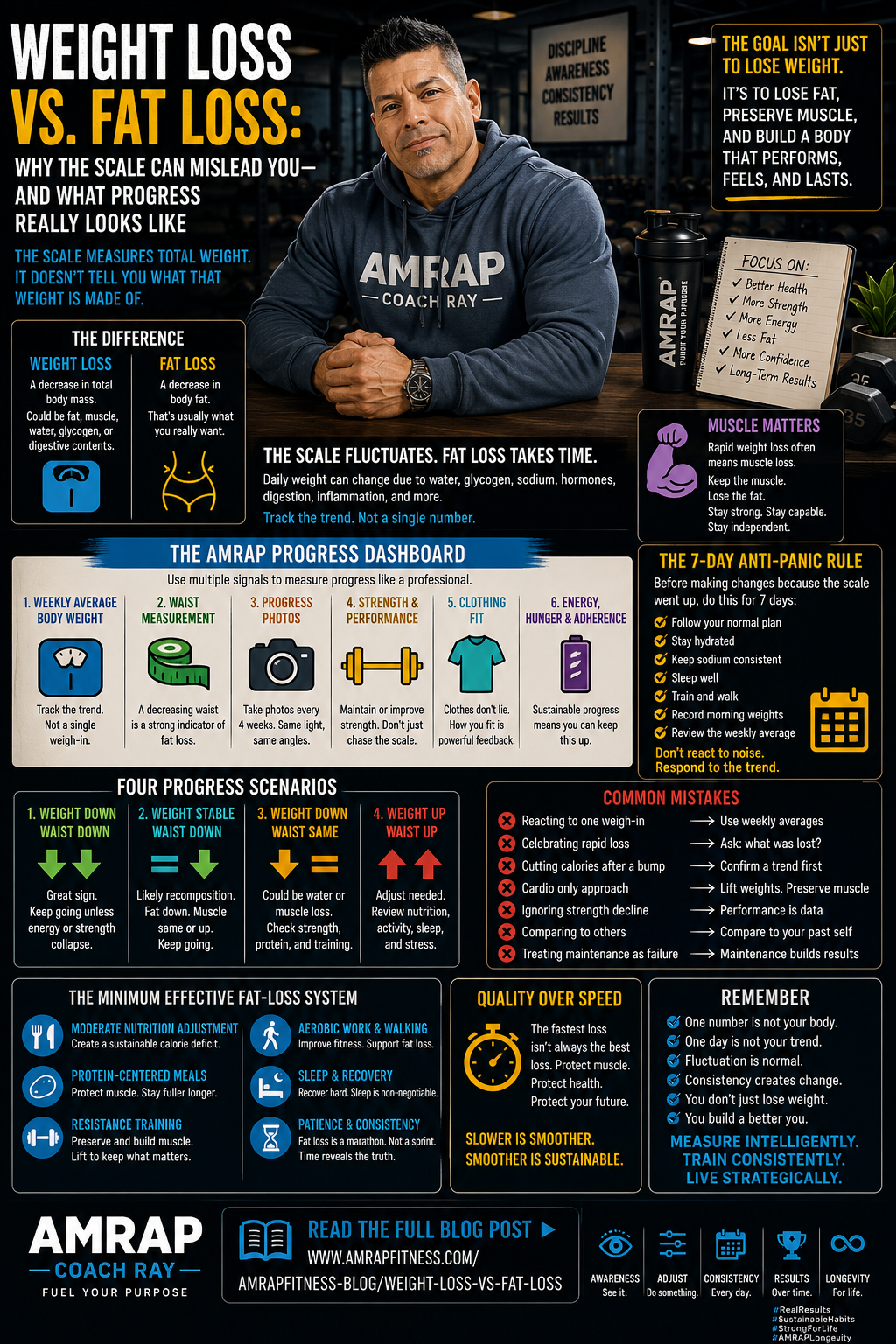
The AMRAP Progress Dashboard
The best fat-loss assessment uses multiple signals.
Metric 1: Weekly average body weight
Use the trend, not one weigh-in.
Ask:
Is the average gradually decreasing?
Is it stable?
Is it moving too rapidly?
Has it stalled long enough to justify an adjustment?
Do not change your program after two unusual days.
Metric 2: Waist measurement
Measure under similar conditions:
same location
same time of day
relaxed posture
same tape tension
A decreasing waist measurement can indicate useful body-composition change even when weight is moving slowly.
Metric 3: Progress photographs
Use:
similar lighting
similar distance
similar clothing
front, side, and back views
a reasonable interval, such as every four weeks
Do not compare a flexed, dehydrated morning photo with a relaxed evening photo after a large meal.
Standardization matters.
Metric 4: Strength and performance
Record:
key lifts
repetitions
walking pace
Zone 2 pace
recovery between sets
ability to perform everyday tasks
If weight is decreasing while strength and function remain stable, that is generally a better sign than rapid weight loss accompanied by major performance decline.
Metric 5: Clothing fit
Clothes provide practical body-composition feedback.
Ask:
Is the waist looser?
Do shirts fit differently?
Are movement and comfort improving?
Metric 6: Energy, hunger, and adherence
A plan is not successful merely because weight decreases.
Ask:
Is hunger manageable?
Is energy stable?
Can I train?
Can I sleep?
Can I maintain this approach?
Am I learning skills or simply enduring the diet?
The Four Progress Scenarios
Scenario 1: Weight decreases and waist decreases
This usually indicates useful progress.
Continue unless:
the rate is excessively fast
performance is collapsing
fatigue is severe
hunger is unmanageable
Scenario 2: Weight stays stable and waist decreases
This may indicate body recomposition:
fat is decreasing
lean tissue may be increasing or being preserved
body shape is improving
Do not destroy a successful program simply because the scale is stable.
Scenario 3: Weight decreases but waist does not
Possible explanations include:
water or glycogen loss
digestive changes
measurement error
lean-mass loss
insufficient time to identify a trend
Evaluate the entire dashboard.
Scenario 4: Weight and waist both increase over several weeks
Now an adjustment may be needed.
Review:
food intake
weekend eating
alcohol
movement
sleep
stress
training consistency
portion sizes
Respond to a confirmed pattern, not a single day.
The Minimum Effective Fat-Loss System
Fat loss does require an energy deficit over time.
But the system used to create that deficit matters.
A professional foundation includes:
1. Moderate nutrition adjustment
Reduce energy intake without making the diet so aggressive that:
training collapses
hunger becomes overwhelming
sleep deteriorates
adherence disappears
Prolonged, severe energy deficits can impair lean-mass gains and make muscle preservation more difficult.
2. Protein-centered meals
Build meals around a meaningful protein source.
Then add:
vegetables or fruit
a purposeful carbohydrate source
appropriate dietary fat
hydration
3. Resistance training
Train major movement patterns consistently.
Aim to preserve:
strength
muscle
function
4. Aerobic work and walking
Use:
walking
Zone 2 training
joint-friendly conditioning
These support energy expenditure, fitness, and health without requiring every session to become punishment.
5. Sleep and recovery
Poor recovery can make adherence dramatically harder.
Protect:
sleep timing
training dosage
hydration
stress-management practices
6. Patience
Fat loss is tissue change.
Tissue change takes time.
The body is not a social-media transformation reel.
The Rate-of-Loss Trap
People often ask:
“What is the fastest I can lose?”
But faster is not always better.
The appropriate rate depends on:
starting body composition
health
training experience
age
medical history
diet history
how much weight needs to be lost
Someone with more body fat may tolerate a faster initial rate than someone already relatively lean.
The professional principle is:
Use the slowest rate that produces meaningful progress while preserving strength, health, and adherence.
The goal is not to win the first two weeks.
The goal is to avoid needing the same fat-loss program again next year.
Common Mistakes—and the Professional Correction
Mistake 1: Reacting to one weigh-in
Correction: Use weekly averages and multiple metrics.
Mistake 2: Celebrating every rapid loss
Correction: Ask what was lost—fat, water, glycogen, muscle, or digestive mass?
Mistake 3: Cutting food whenever weight rises
Correction: Confirm a multiweek trend before changing the plan.
Mistake 4: Using only cardio
Correction: Include resistance training to preserve muscle and function.
Mistake 5: Ignoring strength decline
Correction: Performance is part of the fat-loss dashboard.
Mistake 6: Comparing your rate with someone else’s
Correction: Compare your present trend with your own previous data.
Mistake 7: Treating maintenance as failure
Correction: Periods of maintenance can consolidate habits, support recovery, and make future progress more sustainable.
The Seven-Day Anti-Panic Rule
Before making a drastic change because the scale rose, do this:
For seven days:
Resume your normal meal structure.
Maintain hydration.
Keep sodium reasonably consistent.
Continue training.
Walk daily.
Protect sleep.
Record morning weights under consistent conditions.
Then evaluate the weekly average.
This prevents emotional decisions based on:
one meal
one weekend
one stressful day
one digestive fluctuation
You are not ignoring the data.
You are gathering enough data to interpret it correctly.
Self-Assessment
Answer honestly:
Do I confuse scale loss with fat loss?
Does one higher weigh-in change my mood?
Do I know my weekly average weight?
Am I measuring my waist consistently?
Am I preserving strength while losing weight?
Is my diet teaching me skills I can maintain?
Do I panic after normal carbohydrate or sodium fluctuations?
Am I chasing the lightest possible body—or the strongest, healthiest body I can sustain?
Do I use multiple progress markers?
Could I continue my current plan for six months without resentment or burnout?
Your answers are not a verdict.
They are a map.
Closing: Stop Asking the Scale to Tell the Whole Story
The scale is useful.
But it is not qualified to define your success by itself.
It cannot measure:
your discipline
your strength
your improved habits
your healthier relationship with food
your increased energy
your better blood pressure
your improved blood sugar control
your confidence
your ability to carry your life
Fat loss should make you healthier and more capable.
It should not leave you:
smaller but weaker
lighter but exhausted
leaner but terrified of food
dependent on unsustainable restriction
The objective is not merely to lose weight.
The objective is to improve body composition while protecting the muscle, function, and habits that allow you to live well.
So the next time the scale moves unexpectedly, pause.
Ask:
What is the full dashboard telling me?
Because one number is not your body.
One day is not your trend.
And temporary weight gain is not automatic fat gain.
Measure intelligently.
Train consistently.
Fuel purposefully.
Recover deliberately.
Then allow enough time for the truth to reveal itself.
That is how professionals approach fat loss.
And that is how lasting results are built.
Resources
Cava E, Yeat NC, Mittendorfer B. Preserving Healthy Muscle During Weight Loss. Advances in Nutrition. 2017.
Lopez P, et al. Resistance training effectiveness on body composition and body weight outcomes in individuals with overweight and obesity across the lifespan: a systematic review and meta-analysis. Obesity Reviews. 2022.
Bellicha A, et al. Effect of exercise training on weight loss, body composition changes, and weight maintenance in adults with overweight or obesity. Obesity Reviews. 2021.
Miller T, et al. Resistance Training Combined With Diet Decreases Body Fat While Preserving Lean Mass. International Journal of Sport Nutrition and Exercise Metabolism. 2018.
Kreitzman SN, Coxon AY, Szaz KF. Glycogen storage: illusions of easy weight loss, excessive weight regain, and distortions in estimates of body composition. American Journal of Clinical Nutrition. 1992.
Longland TM, et al. Higher compared with lower dietary protein during an energy deficit combined with intense exercise promotes greater lean-mass gain and fat-mass loss. American Journal of Clinical Nutrition. 2016.