
Too Busy to Eat Well? Build a Nutrition System for Your Most Chaotic Days
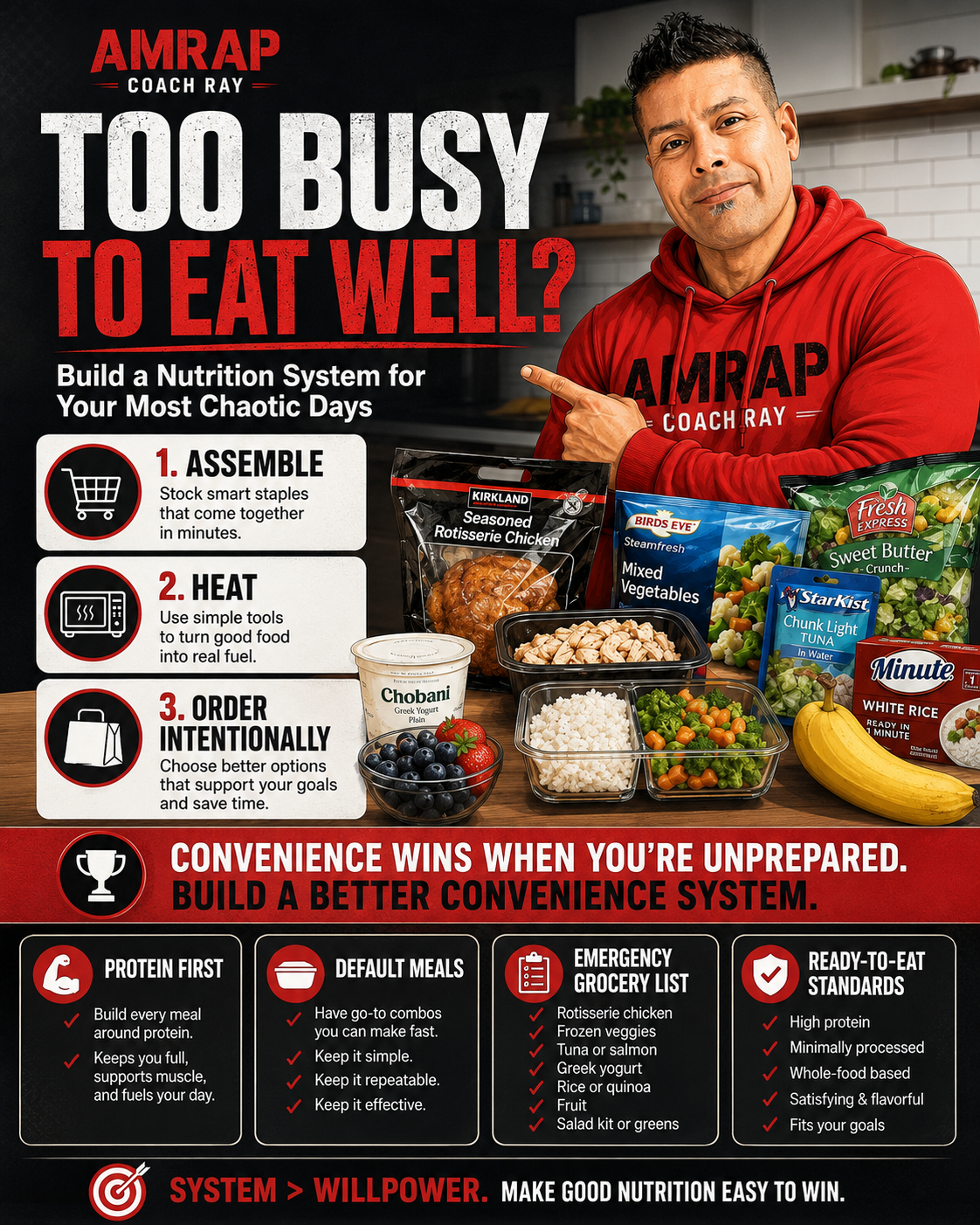
AMRAP Real-Life Fat-Loss Series — Entry 3 of 6
Most people do not choose convenience food because they stopped caring.
They choose it because the day already used everything they had.
By the time dinner arrives, they may have spent the previous ten hours:
working
commuting
answering questions
solving other people’s problems
caring for children or relatives
managing deadlines
trying not to fall behind
Then hunger arrives at the exact moment their energy, patience, and decision-making are at their lowest.
The refrigerator contains ingredients.
The pantry contains possibilities.
But the drive-through contains an immediate answer.
That is why telling overwhelmed adults to “make better choices” is rarely enough.
They often know what a better choice looks like.
The problem is that the better choice requires:
more time
more preparation
more decisions
more cleanup
more energy than they have left
Convenience wins because convenience is available.
The solution is not to eliminate convenience.
The solution is to build a healthier version of it before the difficult moment arrives.
This article is about creating a nutrition system that works when:
work runs late
the children need you
the day becomes chaotic
meal preparation does not happen
motivation disappears
ordering food feels like the only realistic option
You do not need a life in which every meal is prepared from scratch.
You need a system in which exhaustion does not automatically decide what you eat.
Opening Device: The Decision Made at 6:47 P.M.
The day started with good intentions.
You planned to cook.
Maybe you even took something out of the freezer.
Then work became heavier than expected.
Lunch was rushed.
You had another coffee instead of a proper meal.
By late afternoon, you were not just hungry.
You were depleted.
Now it is 6:47 p.m.
You open the refrigerator.
There are vegetables that need to be washed.
There is protein that needs to be cooked.
There are containers that need to be cleaned.
There is food in the house, but there is no finished meal.
Then your phone offers an easier answer.
A few taps.
No chopping.
No cooking.
No cleanup.
Food arrives.
The meal is larger than you planned.
You eat quickly because you are extremely hungry.
Then you continue eating because the food is highly palatable and there is more in the container.
Afterward, you feel disappointed.
You tell yourself:
“I need more discipline.”
But the failure did not begin when you opened the delivery app.
It began when your nutrition plan required your most exhausted self to:
invent dinner
prepare dinner
regulate portions
resist convenience
and make a perfect decision while severely hungry
That is not a discipline plan.
That is a fragile system.
Convenience Is Not the Enemy
The word convenience often gets treated as though it automatically means unhealthy.
That is too simplistic.
Convenience can include:
frozen vegetables
canned beans
precooked rice
rotisserie chicken
Greek yogurt
washed salad greens
tuna packets
frozen fruit
prepared grilled chicken
microwaveable potatoes
pre-portioned nuts
high-protein frozen meals
grocery-store prepared foods
These foods may save time while still supporting:
protein intake
fiber intake
portion control
energy stability
training recovery
fat-loss goals
The problem is not convenience itself.
The problem is when the easiest available foods are consistently:
calorie-dense
highly palatable
low in protein
low in fiber
easy to consume quickly
available in oversized portions
The professional question is not:
“How do I avoid every processed or prepared food?”
It is:
“How do I make the most supportive option easy enough to use on my hardest day?”
The Science Signal: Why the Food Environment Matters
In a tightly controlled NIH randomized trial, participants consumed substantially more energy and gained weight while eating an ultra-processed diet than while eating a minimally processed diet, even though the presented diets were designed to be matched for calories, macronutrients, sugar, sodium, and fiber.
That study does not prove every packaged food is harmful.
It does show that the structure and characteristics of a diet can influence how much people spontaneously eat.
Meal planning has also been associated with greater food variety, better diet quality, and a lower prevalence of obesity, although the observational design means it cannot establish that planning alone caused those outcomes.
Research has found that more frequent home cooking is associated with healthier dietary intake, while limited time for food preparation is often connected to greater dependence on convenience.
The Centers for Disease Control and Prevention likewise recommends meal planning as a practical way to improve food choices and reduce reliance on less supportive drive-through meals.
The coaching conclusion is straightforward:
Your environment and preparation affect your food choices before willpower ever enters the conversation.
Why Exhaustion Changes Eating Behavior
When people are mentally and physically depleted, they tend to favor choices that require less effort.
That is not necessarily laziness.
It is a predictable response to limited capacity.
After a demanding day, the brain often prefers:
familiar food
immediate food
rewarding food
food that requires no planning
food that removes another responsibility
This is why the evening meal is such a vulnerable point.
The person may have used self-control all day:
staying professional
managing frustration
meeting deadlines
resisting distractions
caring for others
Then nutrition becomes the final decision in a long chain.
The answer is not to demand heroic discipline at the end of that chain.
The answer is to shorten the chain.
A prepared system reduces the number of decisions between:
“I am hungry”
and
“I have a balanced meal.”
The Real Objective: Build an Emergency Nutrition Infrastructure
Most people have a normal-day nutrition plan.
Far fewer have an emergency plan.
Their normal plan may involve:
cooking fresh protein
preparing vegetables
measuring portions
sitting down for a complete meal
That may work on calm days.
But when the day breaks, the plan disappears.
A durable system requires two versions:
The ideal plan
What you do when:
time is available
groceries are stocked
energy is reasonable
the schedule cooperates
The survival plan
What you do when:
work runs late
you forgot to defrost food
you are exhausted
someone else needs your attention
you have 10 minutes
you are already extremely hungry
The survival plan should not be nutritionally perfect.
It should be better than the decision exhaustion would otherwise make for you.
The AMRAP Three-Level Convenience Ladder
This is the central framework.
When the day becomes difficult, move down the ladder instead of abandoning the plan.
Level 1: Assemble
No meaningful cooking required.
You are combining ready-to-eat ingredients into a meal.
Formula
Protein + produce + purposeful carbohydrate + optional fat
Examples:
Rotisserie chicken plate
rotisserie chicken
microwave rice or potato
bagged salad
measured dressing
Greek yogurt bowl
plain or lower-sugar Greek yogurt
berries
oats or high-fiber cereal
nuts or seeds
Tuna meal
tuna packet
whole-grain crackers or microwave rice
baby carrots
fruit
Deli turkey wrap
lean turkey
whole-grain wrap
prewashed greens
mustard
fruit or yogurt
Cottage-cheese plate
cottage cheese
fruit
whole-grain toast
vegetables or salad
No gourmet recipe is required.
The goal is to construct a meal faster than delivery can arrive.
Level 2: Heat
Minimal preparation.
The food requires reheating, microwaving, or one uncomplicated cooking step.
Examples:
Frozen protein bowl
frozen grilled chicken
frozen vegetables
microwave rice
seasoning or controlled sauce
High-protein frozen meal upgrade
Start with a frozen entrée that contains a meaningful amount of protein.
Add:
frozen vegetables
a side salad
fruit
extra lean protein when needed
Eggs and potatoes
eggs or egg whites
microwave potato
frozen vegetables
fruit
Soup upgrade
lower-sodium bean, lentil, or chicken soup
added chicken, beans, or Greek yogurt
whole-grain bread
salad
Quick stir-fry
precooked protein
frozen stir-fry vegetables
microwave rice
controlled portion of sauce
The purpose is not to prove that frozen food is superior to fresh cooking.
It is to create a realistic bridge between fresh cooking and uncontrolled takeout.
Level 3: Order Intentionally
Sometimes ordering food is the appropriate choice.
You may be:
traveling
working late
away from home
attending an event
managing an unusually difficult day
Ordering is not failure.
The question is whether you have a decision framework.
The AMRAP Ordering Formula
Choose:
A clear protein source
A vegetable, fruit, bean, or other fiber source
A purposeful carbohydrate portion
Sauces, oils, cheese, and extras intentionally
A portion that supports tomorrow as well as tonight
Examples:
Mexican restaurant
grilled chicken, steak, fish, or beans
rice
vegetables or salsa
beans
controlled cheese, sour cream, and chips
Mediterranean restaurant
grilled meat or fish
salad
rice or pita
hummus or yogurt sauce in a purposeful portion
Sandwich shop
lean protein
vegetables
whole-grain bread when available
mustard or lighter sauce
fruit, soup, or salad instead of automatic oversized sides
Asian restaurant
grilled, steamed, or stir-fried protein
vegetables
rice
sauce on the side or used intentionally
Burger restaurant
burger, grilled chicken, or similar protein
choose one primary indulgence rather than automatically combining:
double entrée
large fries
sugary drink
dessert
The goal is not to turn restaurant eating into punishment.
It is to stop ordering on autopilot.
The “Protein First” Rule
When overwhelmed, begin the food decision by asking:
“Where is the protein?”
Protein is not the entire meal.
But it provides a useful anchor because it can support:
satiety
muscle maintenance
recovery
meal structure
A convenience meal built around protein is often more satisfying than one built primarily around:
refined starch
snack foods
liquid calories
dessert
Examples of convenient protein:
Greek yogurt
cottage cheese
eggs
tuna or salmon packets
rotisserie chicken
precooked chicken
lean deli meat
tofu
beans and lentils
protein shakes
frozen lean entrées
For people with kidney disease or medical restrictions, protein intake should be individualized with a qualified clinician.
The Emergency Grocery List
A survival system begins at the grocery store.
The objective is to keep food available that is:
fast
predictable
satisfying
difficult to misuse unintentionally
easy to combine
Protein
rotisserie chicken
eggs
Greek yogurt
cottage cheese
tuna packets
canned salmon
precooked chicken
lean deli turkey
frozen grilled chicken
tofu
canned beans
protein powder
Produce
bagged salad
baby carrots
frozen vegetables
frozen fruit
apples
bananas
berries
precut vegetables
microwaveable vegetable bags
Carbohydrates
microwave rice
oats
potatoes
whole-grain bread
tortillas
beans
whole-grain crackers
high-fiber cereal
frozen grains
Flavor and fats
salsa
mustard
hummus
olive-oil-based dressing
avocado
nuts
seeds
lower-sugar sauces
seasonings
Your kitchen does not need to look like a fitness magazine.
It needs to help you eat when your energy is low.
The Five-Minute Meal Matrix
Choose one item from each column.
ProteinProduceCarbohydrateFlavorChickenBagged saladMicrowave riceSalsaGreek yogurtBerriesOatsCinnamonTunaBaby carrotsCrackersMustardEggsFrozen vegetablesPotatoSeasoningBeansPrecut vegetablesTortillaAvocadoTofuStir-fry vegetablesRiceSoy or teriyaki sauce
This removes the need to invent dinner.
The decision becomes:
“Which combination am I using?”
rather than:
“What in the world am I going to make?”
The Two-Meal Default System
You do not need twenty emergency recipes.
You need two dependable meals that you can execute almost automatically.
Default Meal A
A meal you can assemble in under five minutes.
Example:
Greek yogurt
berries
oats
protein powder if needed
nuts
Default Meal B
A meal you can heat in under ten minutes.
Example:
precooked chicken
microwave rice
frozen vegetables
measured sauce
These meals should be:
acceptable to your taste
reasonably affordable
available most weeks
easy to restock
supportive of your goals
Defaults are not boring.
Defaults are what prevent chaos from becoming a nutritional emergency.
The Work-Bag Nutrition System
Many poor evening decisions begin with inadequate daytime eating.
A person may consume:
coffee for breakfast
a small snack for lunch
nothing substantial until dinner
Then they arrive home physiologically and emotionally depleted.
That is not a fair test of willpower.
Keep an emergency work supply.
Options:
protein powder
shaker bottle
tuna packets
protein bars with reasonable nutrition
nuts in measured portions
fruit
oatmeal packets
whole-grain crackers
shelf-stable milk
lower-sugar jerky
canned soup when facilities permit
The emergency snack is not designed to replace every meal.
It prevents severe hunger from making the next meal uncontrollable.
The Freezer Is Part of Your Coaching Team
A well-used freezer is one of the most effective time-management tools in nutrition.
Freeze:
cooked proteins
chili
soup
rice
individual portions
healthy leftovers
preassembled meals
Label the containers.
Rotate them.
Use single-meal portions when possible.
The goal is to create food that your future exhausted self can access without thinking.
Every time you cook, consider making:
tonight’s meal
tomorrow’s lunch
one freezer portion
That is not elaborate meal preparation.
It is strategic repetition.
Batch Components, Not Entire Weeks
Some people dislike eating the same fully assembled meal for five days.
That is understandable.
Instead of preparing five identical containers, prepare flexible components:
one or two proteins
one grain or potato
washed produce
one sauce
one emergency frozen option
Then combine them differently.
Example:
The same chicken can become:
a rice bowl
a wrap
a salad
a potato plate
a stir-fry
This reduces preparation time without making the week feel repetitive.
The Convenience Hierarchy
Not all convenience food needs to be treated equally.
Use this hierarchy.
Most often
Convenient foods that remain close to a balanced meal:
frozen vegetables
frozen fruit
canned beans
precooked grains
prepared lean protein
yogurt
eggs
bagged salad
minimally processed frozen meals
Sometimes
Foods that can fit but require more awareness:
restaurant meals
sandwiches
higher-calorie frozen meals
snack bars
flavored yogurt
deli foods
prepared sauces
Less often
Foods designed primarily for rapid, passive consumption:
large bags of snack foods
pastries
sugary drinks
oversized desserts
combinations of multiple calorie-dense sides
highly palatable foods eaten directly from large packages
This is not a morality chart.
It is a frequency and structure guide.
Why Portioning Matters More When You Are Exhausted
When people eat directly from:
the delivery container
a family-size bag
a large tray
a box
they lose useful visual boundaries.
A simple strategy:
Put the intended portion on a plate.
Store the remainder before eating.
Sit down.
Eat without standing over the counter.
Pause before returning for more.
This is not about artificially restricting food.
It gives fullness signals enough time to become noticeable.
The Ten-Minute Rule
When you feel an urgent need to order food, use this sequence:
Minute 1
Drink water and assess whether you are:
hungry
stressed
exhausted
unprepared
or all four
Minutes 2–4
Check your convenience ladder:
Can I assemble?
Can I heat?
Should I order intentionally?
Minutes 5–10
Begin the selected action immediately.
The purpose is not to suppress hunger.
It is to interrupt automatic behavior long enough to choose deliberately.
What to Do After an Unplanned Meal
One takeout meal does not require:
fasting
punishment cardio
skipping breakfast
cutting carbohydrates
guilt
Return to your normal structure at the next meal.
That means:
protein
produce
hydration
reasonable portions
normal movement
The professional response to one deviation is not overcorrection.
It is return.
Common Mistakes—and the Professional Correction
Mistake 1: Believing healthy food must always be freshly cooked
Correction: Use frozen, canned, precooked, and prepared foods strategically.
Mistake 2: Waiting until hunger is extreme
Correction: Use predictable meals and emergency snacks.
Mistake 3: Having ingredients but no finished food
Correction: Keep at least two complete emergency meals available.
Mistake 4: Treating takeout as failure
Correction: Use an ordering framework.
Mistake 5: Buying aspirational groceries
Correction: Buy food your real schedule allows you to prepare.
Mistake 6: Planning only for calm days
Correction: Build a survival menu.
Mistake 7: Making every meal a test of creativity
Correction: Use default meals and component combinations.
Mistake 8: Eating directly from large containers
Correction: Portion first, then eat.
The 15-Minute Weekly Food Setup
You do not need a three-hour meal-prep ritual.
Once each week:
Minutes 1–3: Review the schedule
Identify:
late workdays
appointments
family obligations
travel
nights when cooking is unlikely
Minutes 4–6: Select two default meals
Choose:
one assemble meal
one heat meal
Minutes 7–10: Build the grocery list
Include:
protein
produce
carbohydrates
emergency snacks
one freezer backup
Minutes 11–13: Identify the ordering fallback
Choose one or two nearby restaurants and decide your usual supportive order before you are hungry.
Minutes 14–15: Assign the hardest days
Write:
Tuesday: heat meal
Thursday: intentional order
Friday: assemble meal
Fifteen minutes of planning can remove dozens of decisions later.
The AMRAP Chaotic-Day Nutrition Protocol
When the day falls apart:
Step 1: Hydrate
Have water before making the food decision.
Step 2: Eat protein early enough
Do not wait until extreme hunger.
Step 3: Use the convenience ladder
assemble
heat
order intentionally
Step 4: Plate the meal
Create a visible portion.
Step 5: Return immediately
No guilt.
No “restart Monday.”
The next supportive decision begins the return.
Self-Assessment
Answer honestly:
What time of day do my food decisions become weakest?
Do I have complete meals available—or only ingredients?
Which two meals could become my defaults?
What is currently in my freezer that supports my goals?
Do I have an emergency work snack?
Which restaurant can provide a reasonable fallback meal?
Do I routinely wait until I am excessively hungry?
Are my groceries appropriate for my actual schedule?
Am I confusing convenience with failure?
Does my nutrition system work on difficult days—or only ideal ones?
Your answers are not judgment.
They are the blueprint for a stronger environment.
Closing: Healthy Eating Must Be Easier Than the Alternative
Knowledge matters.
But knowledge that cannot survive exhaustion does not create lasting change.
You may know:
which foods contain protein
why vegetables matter
how calories influence fat loss
why hydration matters
But at the end of a chaotic day, knowing is not always enough.
The environment wins.
The finished meal wins.
The visible food wins.
The easiest action wins.
So build an environment in which the easier decision is also the more supportive one.
Keep:
ready protein
frozen vegetables
microwaveable carbohydrates
emergency snacks
two default meals
a planned restaurant order
You do not need to prepare every meal from scratch.
You do not need to become a gourmet cook.
You do not need to perform nutrition perfectly.
You need to stop asking your most exhausted self to rescue a system your rested self never prepared.
Convenience will always matter.
So use it deliberately.
Make the supportive choice:
faster
easier
visible
available
repeatable
That is not taking a shortcut around the work.
That is the work.
And it is how nutrition becomes sustainable inside a real adult life.
Resources
Hall KD, et al. Ultra-Processed Diets Cause Excess Calorie Intake and Weight Gain: An Inpatient Randomized Controlled Trial of Ad Libitum Food Intake. Cell Metabolism. 2019. Participants consumed more calories and gained weight during the ultra-processed dietary condition.
Ducrot P, et al. Meal planning is associated with food variety, diet quality and body weight status in a large sample of French adults. International Journal of Behavioral Nutrition and Physical Activity. 2017.
Wolfson JA, Bleich SN. Is cooking at home associated with better diet quality or weight-loss intention? Public Health Nutrition. 2015. More frequent home cooking was associated with healthier dietary intake.
Monsivais P, Aggarwal A, Drewnowski A. Time spent on home food preparation and indicators of healthy eating. American Journal of Preventive Medicine. 2014. Greater preparation time was associated with several indicators of higher diet quality.
Centers for Disease Control and Prevention. How to Have Healthier Meals and Snacks. The CDC recommends planning meals as a way to improve food choices and reduce dependence on less supportive convenience meals.
World Health Organization. Healthy Diet. WHO emphasizes varied, nutrient-dense eating patterns that include fruits, vegetables, whole grains, legumes, nuts, seeds, and appropriate protein sources.