The Year Isn’t Over: Halloween Is One Night, Not Permission to Quit Until January
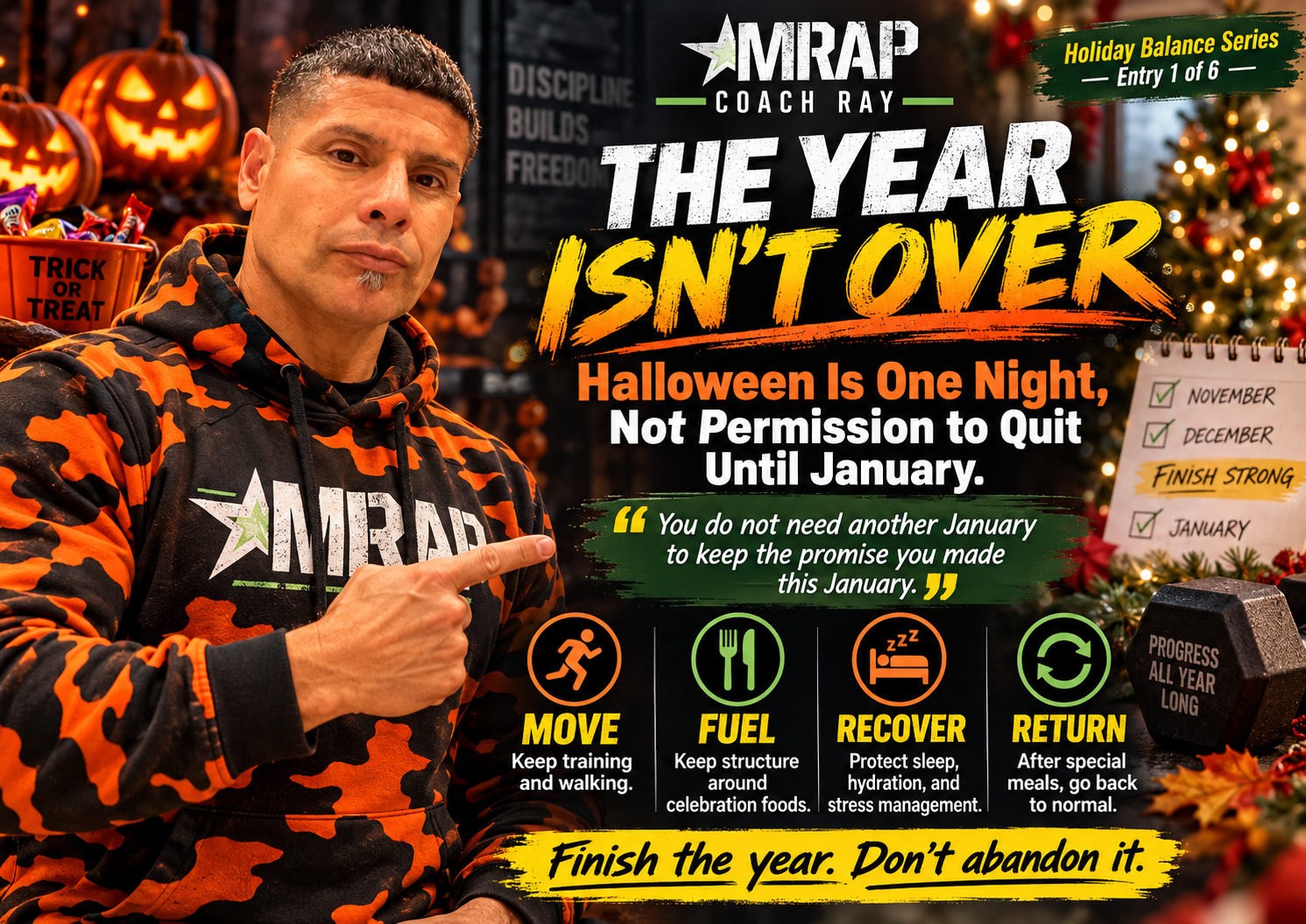
AMRAP Holiday Balance Series — Entry 1 of 6
You still have time.
That may be the most important thing you read today.
Halloween is almost here.
Thanksgiving is coming.
Then December.
Christmas.
Hanukkah.
Holiday parties.
Family gatherings.
Travel.
Work celebrations.
Cookies in the break room.
Candy on the counter.
Big meals.
Alcohol.
Cold weather.
Shorter days.
Busy schedules.
And somewhere around this point in the calendar, a lot of people make a quiet decision without realizing they have made it:
“The year is basically over.”
It is not.
There are still roughly two months left in 2026.
Two months.
Enough time to walk hundreds of miles.
Enough time to complete dozens of strength workouts.
Enough time to improve meal structure.
Enough time to sleep better.
Enough time to rebuild consistency.
Enough time to lose some body fat if that is an appropriate goal.
Enough time to maintain the progress you already made.
Enough time to improve strength, mobility, conditioning, energy, confidence, and self-trust.
Enough time to prove that the promise you made to yourself in January still matters.
Maybe you remember that promise.
Maybe you forgot it.
Maybe you crushed part of it.
Maybe you started strong and disappeared by February.
Maybe summer knocked you off course.
Maybe work got busy.
Maybe your children needed you.
Maybe someone got sick.
Maybe you changed jobs.
Maybe your mental health struggled.
Maybe you simply stopped prioritizing yourself.
Whatever happened, October does not get to write the ending for December.
And Halloween certainly does not get to decide what happens between now and January.
One night of candy is not the problem.
One Thanksgiving dinner is not the problem.
One holiday party is not the problem.
One Christmas cookie is not the problem.
The real danger is the story people attach to those moments:
“Well, I already messed up.”
“The holidays are here anyway.”
“I’ll enjoy myself now and get serious again in January.”
That is how one night becomes two months.
And that is what we are going to prevent.
Not by restricting your life.
Not by avoiding family.
Not by refusing dessert.
Not by carrying a food scale to Thanksgiving dinner.
Not by trying to “earn” meals with punishment workouts.
We are going to do something much more sustainable.
We are going to enjoy the holidays without abandoning ourselves.
Remember January?
Think back.
January 2026.
A new year.
Maybe you told yourself:
This is going to be different.
Maybe the goal was weight loss.
Maybe it was fat loss.
Maybe you wanted to get stronger.
Maybe you wanted better blood pressure.
Better cholesterol.
Better blood sugar.
More energy.
Less pain.
Better sleep.
More mobility.
Less stress.
More confidence.
Maybe you bought workout shoes.
Maybe you joined a gym.
Maybe you downloaded an app.
Maybe you wrote the goal down.
Maybe you told your spouse.
Maybe you told your friends.
Maybe you told your coach.
Maybe you only told yourself.
Then life happened.
February came.
March came.
Spring became summer.
Vacations happened.
Work got busy.
School started again.
Family needed you.
Stress accumulated.
Your schedule changed.
Maybe your goal became quieter.
But quieter does not mean dead.
You do not need another January to keep the promise you made this January.
Read that again:
You do not need another January to keep the promise you made this January.
The year is not over.
The Goal May Need to Change — and That Is Okay
This is where maturity enters the conversation.
Maybe your January goal was to lose 40 pounds.
And you have lost 15.
Could you lose another 25 by January?
Maybe not safely or realistically.
That does not mean you failed.
Maybe the better goal now is:
Lose another 5 pounds and maintain it through the holidays.
Maybe your original goal was to train five days per week.
But your current life realistically supports three.
Then three consistent workouts are better than five imaginary ones.
Maybe you wanted to run a race but got injured.
Your goal may now be rehabilitation, walking, and strength.
Maybe you wanted dramatic weight loss, but what your body and life need right now is maintenance.
That counts too.
Progress does not become worthless simply because it does not perfectly match the original plan.
This is one of the biggest traps in fitness.
People would rather abandon an incomplete goal than celebrate partial progress.
But if you wanted to lose 30 pounds and lost 12, you did not lose nothing.
You lost 12 pounds.
If you wanted four workouts per week and averaged two, you did not do nothing.
You built a training habit.
If you wanted perfect nutrition but learned to prepare breakfast and lunch consistently, you did not fail.
You built structure.
The professional question is not:
“Did I execute January’s fantasy perfectly?”
It is:
“What is the best progress I can realistically make with the time I have left?”
That question moves you forward.
The Two-Month Opportunity
There is something psychologically dangerous about late October.
People mentally combine Halloween, Thanksgiving, Christmas, and New Year’s into one enormous holiday.
But they are not one continuous event.
Halloween is one day.
Thanksgiving is one day.
Christmas is one day.
New Year’s Eve is one night.
There may be several parties and gatherings between them.
But there are also dozens of ordinary days.
That distinction matters.
Imagine the next eight or nine weeks contain:
Halloween
Thanksgiving dinner
two work parties
two family gatherings
Christmas Eve
Christmas Day
New Year’s Eve
That might be eight or ten special eating occasions.
But the season contains far more ordinary meals than celebration meals.
Your progress is not destroyed because you enjoy special occasions.
It is threatened when special occasions become a special season-long lifestyle.
That is different.
Did You Know? Holiday Weight Gain Is Usually Smaller Than People Think
You have probably heard people say they gained 10, 15, or 20 pounds “over the holidays.”
That can happen to individuals.
But it is not the average experience found in the research.
A systematic scoping review of festive periods found that 70% of observational studies reported significant holiday weight increases, with an average increase of about 0.7 kilograms — roughly 1.5 pounds.
Other holiday studies have commonly reported gains in the range of roughly 0.4 to 1.5 kilograms, depending on the population and study.
That sounds small.
So why care?
Because some holiday weight may persist afterward, and repeating a modest gain year after year can contribute to long-term weight gain. A systematic review of winter-holiday eating behavior also noted concern that some seasonal gain may be maintained, particularly among people already living with obesity.
The message is not:
“Fear Christmas dinner.”
The message is:
“Do not allow a six- to ten-week drift to become your annual pattern.”
Halloween Is One Night
Halloween has an unusual psychological effect.
Candy starts appearing weeks before October 31.
It shows up at work.
At school.
At home.
At stores.
At parties.
Then leftover candy survives into November.
So Halloween becomes less of a day and more of an eating environment.
The problem is not that candy exists.
The problem is unplanned exposure combined with the mindset:
“Well, it’s Halloween.”
One fun-size candy bar?
Fine.
Several pieces you intentionally choose and enjoy?
Fine.
But eating candy every time you walk past the bowl because “it’s Halloween season” is not really enjoyment anymore.
It is environmental eating.
There is a difference.
Ask yourself:
Do I actually want this — or is it simply available?
That question can change the entire holiday season.
You do not need to eat something merely because it is there.
And you do not need to forbid it because it is “bad.”
You get to choose.
That is moderation.
What Moderation Is — and What It Is Not
We are going to spend an entire upcoming article defining moderation because most people have never actually been taught what it means.
But here is the beginning.
Moderation does not mean:
“Never eat holiday food.”
It also does not mean:
“It’s the holidays, so nothing matters.”
Moderation means you can enjoy foods you value without turning every opportunity to eat them into an obligation.
Research distinguishing flexible and rigid control of eating behavior found that flexible control was associated with lower disinhibition and more favorable weight-control outcomes than rigid control, while rigid control showed less favorable associations.
That is an older observational body of evidence, not proof that flexible thinking solves everything.
But it aligns with a practical coaching principle:
A plan that bends is less likely to break.
The goal is structure with flexibility.
Not chaos.
Not perfection.
The Holiday All-or-Nothing Trap
Here is the pattern I see repeatedly.
October 31
“I ate candy. Oh well.”
November 1
“There are leftovers anyway.”
Mid-November
“Thanksgiving is coming.”
Thanksgiving
“I’ll get back on track Monday.”
Monday
“There are leftovers.”
December
“Christmas is basically here.”
Holiday party
“I only see everyone once a year.”
Christmas
“It’s Christmas. Enjoy yourself.”
December 26
“Might as well wait until New Year’s.”
January 1
“I’ll start Monday.”
First Monday
“There’s still holiday food in the house.”
Mid-January
“I’m overwhelmed.”
February
“What happened?”
That is the pattern we are interrupting.
The individual foods were not the real problem.
The permission structure was.
The AMRAP Rule: Special Meals, Not Special Months
This may become one of the most important rules in the entire series:
Have special meals. Do not turn them into special months.
Enjoy Halloween.
Enjoy Thanksgiving.
Enjoy Christmas.
Enjoy Hanukkah.
Enjoy family traditions.
Enjoy cultural foods.
Enjoy Grandma’s recipe.
Enjoy your favorite dessert.
But when the celebration ends, return to your normal pattern.
Not tomorrow.
Not Monday.
Not January.
The next normal opportunity.
That might mean breakfast the next morning.
It might mean dinner later that day.
Nothing dramatic.
Nothing punitive.
Just normal.
You Do Not Have to “Earn” Holiday Food
This is another mindset we need to eliminate.
You do not need to:
starve all day
run ten miles
do 500 burpees
skip breakfast
eliminate carbohydrates
punish yourself afterward
to “earn” dinner.
Exercise is not punishment for food.
Food is not a moral debt.
If you know a large holiday meal is coming, eating lighter earlier may make sense for some people.
But there is a difference between planning and starving.
Arriving at a holiday dinner ravenously hungry often makes intentional decisions harder.
A more balanced strategy is:
normal breakfast
protein
produce
hydration
some movement
then enjoy dinner
Protein can increase fullness in the short term, although longer-term appetite effects are less certain.
The goal is not to arrive stuffed.
It is to avoid arriving biologically desperate.
Did You Know? Portion Size Matters More Than Most People Realize
Adults tend to eat more when larger portions are served.
A major systematic review supporting the U.S. Dietary Guidelines concluded with strong evidence that larger portions increase food and energy intake in adults and older adults.
Another meta-analysis of randomized feeding trials found that larger portions were associated with higher daily energy intake.
This gives us a simple holiday strategy:
You can eat the food without eating the largest possible amount of the food.
You can have stuffing.
You can have pie.
You can have macaroni and cheese.
You can have your cultural foods.
You can have dessert.
But portion size is one of the places where moderation becomes real rather than theoretical.
The Social Pressure Problem
Holiday eating rarely happens alone.
There is family.
Friends.
Coworkers.
Hosts.
Tradition.
And sometimes pressure.
“Come on, have another.”
“You barely ate.”
“It’s Thanksgiving!”
“You only get this once a year.”
“Don’t be boring.”
“You’re dieting during Christmas?”
This is real.
Research on the social facilitation of eating has found that people tend to eat more when eating with familiar people such as friends and family compared with eating alone.
That does not mean family gatherings are unhealthy.
It means the environment influences behavior.
Knowing that makes you more prepared.
Your family does not need to be your enemy.
And you do not need to turn dinner into an argument.
You simply need enough confidence to understand:
Loving someone does not require eating past fullness for them.
We will go much deeper into this later in the series.
“You Only Live Once” Works Both Ways
People often say:
“You only live once — enjoy yourself.”
I agree.
But that sentence works both ways.
You only live once.
So enjoy Thanksgiving dinner.
You also only live once.
So protect your heart.
Protect your joints.
Protect your mobility.
Protect your energy.
Protect your confidence.
Protect your ability to play with your children and grandchildren.
Protect your independence.
Protect the body that carries you through your life.
Enjoyment and health do not have to be enemies.
That false choice is one of the biggest problems in fitness culture.
The AMRAP Final Two Months Reset
This is the central tool for this article.
We are not creating twelve goals.
Pick one meaningful primary goal for the remainder of the year.
Examples:
lose 5 pounds
maintain current weight
strength train 3 days per week
walk 8,000 steps most days
improve sleep
reduce alcohol
improve meal preparation
lower your resting heart rate
rebuild consistency
maintain strength through December
return to exercise after time away
Then support that goal with four anchors.
Anchor 1: MOVE
Do not let winter turn movement into a seasonal hobby.
The CDC recommends adults accumulate at least 150 minutes of moderate-intensity activity weekly, or the equivalent, plus muscle-strengthening activity on at least two days. Activity can be broken into smaller chunks.
During the holidays, your normal training schedule may need to shrink.
That is okay.
A 30-minute workout still counts.
A 20-minute workout still counts.
A walk still counts.
Two strength sessions still count.
The goal is to prevent zero from becoming the default.
Anchor 2: FUEL
Keep structure around celebration foods.
That means:
regular protein
fruits and vegetables
fiber-rich foods
water
normal meals
planned treats
Do not make holiday food the entire diet.
You can have pumpkin pie and broccoli in the same week.
You can have Christmas cookies and protein.
You can have mashed potatoes and vegetables.
Health does not require nutritional purity.
It requires enough supportive behavior repeated consistently.
Anchor 3: RECOVER
The holidays can be exhausting.
Shopping.
Travel.
Cooking.
Hosting.
Family dynamics.
Work deadlines.
Shorter daylight.
Late nights.
Parties.
Children.
Expectations.
Your recovery matters.
Protect:
sleep
hydration
walking
quiet
prayer
stress management
boundaries
downtime
Being more tired makes everything harder.
Do not underestimate recovery as part of your nutrition strategy.
Anchor 4: RETURN
This is the most important one.
If you overeat:
Return.
If you miss a workout:
Return.
If Halloween gets away from you:
Return.
If Thanksgiving dinner is enormous:
Return.
If the party runs late:
Return.
Do not create a moral drama.
Do not punish yourself.
Do not restart your entire life.
Just return.
The skill is not never slipping.
The skill is shortening the gap.
The November 1 Rule
Here is your first practical challenge.
Whatever happens on Halloween, November 1 is a normal day.
Not a detox.
Not a punishment.
Not a starvation day.
Normal.
Wake up.
Drink water.
Eat breakfast if that fits your routine.
Get protein.
Move.
Walk.
Train if scheduled.
Eat normal meals.
If there is leftover candy in your house, decide what you actually want to keep.
Remove the rest if constant exposure makes your goals harder.
No guilt.
No drama.
No:
“I blew it.”
Halloween ended.
Your goals did not.
What If You Have Made No Progress Yet?
This matters.
Maybe you are reading this and thinking:
“Coach, I haven’t done anything I said I would do in January.”
Okay.
Then we start from there.
No shame.
No pretending.
No revisionist history.
January is gone.
February is gone.
Summer is gone.
But today is not gone.
Do not waste October feeling guilty about March.
That makes no sense.
Your job is to ask:
What can I accomplish from here?
Maybe your biggest victory this year will be that you stopped waiting for January.
Maybe you begin walking this week.
Maybe you train twice.
Maybe you prepare food.
Maybe you lose five pounds.
Maybe you maintain through Christmas instead of gaining.
Maybe you prove to yourself for the first time that November and December do not automatically destroy your habits.
That matters.
What If You Already Reached Your Goal?
Then your challenge changes.
Do not use the holidays as permission to abandon everything you worked for.
Your goal may now be:
maintenance.
Maintenance is not boring.
Maintenance is a skill.
Anyone can temporarily chase a goal.
The real challenge is learning how to live after reaching it.
If you lost weight this year, maintain it.
If you gained strength, keep training.
If you built better nutrition, keep the structure.
If your blood pressure improved, do not abandon the behaviors that helped.
If you built confidence, protect it.
Your goal is no longer:
“How much more can I accomplish?”
It may be:
“How well can I keep what I built?”
That is success.
What If Weight Loss Is Not Your Goal?
Excellent.
This series is not only about weight.
Your final two-month goal might be:
strength
mobility
cardiovascular health
sleep
consistency
stress management
blood pressure
blood sugar
energy
confidence
rehabilitation
mental health
less alcohol
better meal preparation
better boundaries
Health is bigger than the scale.
A person who maintains body weight while improving strength, sleep, conditioning, and nutrition may have had an excellent two months.
Do not let one number erase all other progress.
Holiday Weight Maintenance Is a Legitimate Goal
This is particularly important for people who have been dieting aggressively all year.
Sometimes the smartest move during a high-stress season is not aggressive fat loss.
It is maintenance.
A randomized study found that daily self-weighing with graphical feedback prevented holiday-associated weight gain in its intervention group, while the control group gained weight during the study period.
Another randomized Christmas intervention using regular self-weighing, reflection, and simple weight-management strategies also reduced holiday weight gain compared with the control condition.
A 2024 systematic review found that festive-period interventions may help prevent holiday weight gain, but importantly rated the overall certainty of evidence as very low because studies were few and heterogeneous.
So we should not pretend there is one magical holiday formula.
The stronger takeaway is:
Some structure is better than disappearing.
Should You Weigh Yourself During the Holidays?
For some people, yes.
For others, no.
Self-monitoring can be useful.
But it must be psychologically appropriate.
If the scale helps you observe trends without panic, weigh consistently.
If one fluctuation ruins your day, creates restrictive behavior, triggers bingeing, or damages your mental health, use another measure.
Possible feedback tools:
waist measurement
workout consistency
walking
meal structure
sleep
strength
energy
clothing fit
food journal
habit checklist
Remember: body weight can change quickly because of water, sodium, carbohydrate intake, bowel contents, alcohol, and travel.
A large Thanksgiving meal does not create several pounds of body fat overnight.
Do not turn normal fluctuation into panic.
Alcohol Deserves a Place in the Conversation
Holiday celebrations often include alcohol.
This is another area where moderation needs an actual definition.
Alcohol provides energy, and experimental research suggests adults generally do not fully compensate for alcohol calories by reducing food intake. A systematic review and meta-analysis also found that alcohol consumption increased both food intake and total energy intake compared with non-alcohol conditions, although much of the evidence involved younger adults and has limitations.
This does not mean:
“Never drink.”
It means understand the tradeoff.
Alcohol can:
add calories
lower inhibition
affect sleep
make food decisions less intentional
affect training the next day
If you drink:
Choose intentionally.
Hydrate.
Know your limit.
Do not let “holiday drinks” quietly become a nightly habit from November through January.
Moderation is not deprivation.
It is awareness.
The Holiday Plate Preview
We will build an entire Thanksgiving strategy later in the series.
But here is the basic principle now.
At a celebration:
Look first.
Do not automatically start filling the plate.
See what is available.
Choose what matters.
Take foods you genuinely enjoy.
You do not need mediocre foods just because they are there.
Build some structure.
Protein.
Produce where available.
Then favorite holiday foods.
Portion intentionally.
Remember that larger portions tend to increase energy intake.
Eat slowly enough to experience the meal.
You waited all year for Grandma’s stuffing.
Taste it.
Pause before seconds.
Ask:
“Am I still hungry, or am I continuing because the food is here?”
Have dessert if you want dessert.
Not because you “earned it.”
Because you chose it.
That is very different.
The “Worth It” Test
This is one of my favorite holiday tools.
Before choosing an indulgence, ask:
Is this worth it to me?
Not:
“Is this food good or bad?”
Not:
“How many calories?”
Not:
“Will Coach Ray be mad?”
Ask:
“Do I genuinely enjoy this enough that I want it?”
Grandma’s once-a-year pie?
Probably worth it.
Random stale cookie in the office?
Maybe not.
Your favorite stuffing?
Worth it.
Candy you do not even like?
Why?
This is how moderation becomes personal.
You spend your food flexibility on things that actually create enjoyment.
Not simply things that happen to be available.
The Holiday Pressure Script
Until we reach the full food-pressure article, use this.
If someone says:
“Come on, have another.”
You can say:
“It was great. I’m good right now.”
If they persist:
“Seriously, I enjoyed it. I’m just full.”
No speech.
No nutrition lecture.
No argument.
You do not need to justify why you stopped eating.
You are allowed to stop when you are satisfied.
Stop Saving Yourself for January
January has become a fantasy in the fitness industry.
January is where everything supposedly gets fixed.
New diet.
New body.
New program.
New mindset.
New life.
But January is just another month.
If you cannot practice health in November and December, the calendar does not magically give you different skills on January 1.
This holiday season is actually training.
You are training:
moderation
boundaries
return speed
meal planning
consistency
social confidence
flexible thinking
maintenance
Those skills are worth more than another 30-day challenge.
The 7-Day Finish-the-Year Reset
Start now.
Do not wait for November.
Day 1 — Revisit January
Write down the goal you started the year with.
Then ask:
Does this still matter?
Day 2 — Adjust
Create a realistic goal for the remainder of 2026.
Not a fantasy.
A target.
Day 3 — Move
Complete one workout or purposeful walk.
Day 4 — Fuel
Plan one full day of meals before hunger decides.
Day 5 — Recover
Protect one sleep boundary.
Day 6 — Prepare
Decide how you will handle Halloween.
Candy?
Party?
Alcohol?
Dinner?
Know before you arrive.
Day 7 — Commit
Write this sentence:
“I am not waiting for January.”
Then prove it.
The AMRAP Holiday Minimums
When holiday life gets chaotic, protect these.
Movement
Two strength sessions per week if possible.
Walk regularly.
Protein
Include a meaningful protein source in regular meals.
Produce
Keep fruits and vegetables present.
Hydration
Drink water throughout the day, especially around alcohol and travel.
Sleep
Protect what you reasonably can.
Celebration
Enjoy the foods that matter.
Return
Resume normal behavior after special meals.
That is enough to keep the foundation alive.
Did You Know? Eating With Friends and Family Changes How We Eat
A meta-analysis found strong evidence that people ate more when eating with friends than when eating alone. Researchers suggested factors such as longer meals, social norms, and familiarity may help explain the effect.
That means holiday overeating is not simply a character flaw.
The environment matters.
But understanding the environment gives you power.
You can prepare for it.
You can slow down.
You can check hunger.
You can choose portions.
You can enjoy the conversation without using food as the only way to participate.
Ages 30 to 70: The Holiday Goal Changes With Life
In your 30s
Holiday habits may become patterns you carry for decades.
Build moderation now.
Do not let every social occasion become permission to abandon health.
In your 40s
Career, children, caregiving, and stress can make November and December overwhelming.
Your biggest win may be protecting training and meal structure while everything else speeds up.
In your 50s
Muscle, recovery, mobility, metabolic health, and sleep matter more than ever.
You do not need a crash diet.
You need habits strong enough to carry you toward 60.
In your 60s and 70s
The goal may be less about chasing scale weight and more about maintaining:
strength
mobility
independence
balance
energy
social connection
cardiometabolic health
Enjoying holidays and protecting health are still compatible.
Your plan simply becomes more individual.
The January Test
Here is how I want you to imagine January 1.
Do you want to wake up thinking:
“I have to fix everything.”
Or:
“I enjoyed the holidays and never really left.”
That second feeling is powerful.
Maybe you lost weight.
Maybe you maintained.
Maybe you gained one pound but trained consistently.
Maybe your sleep improved.
Maybe you drank less.
Maybe you got stronger.
Maybe you learned how to say no without guilt.
Maybe you ate dessert without bingeing afterward.
Maybe you proved that holiday food does not control you.
That is a victory.
The AMRAP Finish-the-Year Contract
I will not use Halloween as permission to quit until January.
I will remember the goal I made earlier this year.
I will adjust that goal honestly if my life requires it.
I will pursue progress without punishment.
I will enjoy foods that matter without treating every food as a special occasion.
I will move throughout the holiday season.
I will protect strength, sleep, hydration, and recovery.
I will not starve before celebrations or punish myself afterward.
I will return after imperfect moments.
I will remember that maintenance can be progress.
I will not wait for January to start becoming the person I already said I wanted to become.
Self-Assessment
Ask yourself:
What goal did I make for myself in January?
Does it still matter?
What progress have I already made?
What did I learn from the times I fell off?
What is realistically possible between now and January 1?
Would weight loss, maintenance, strength, or consistency be my smartest goal?
What usually happens to my habits around Halloween?
What foods do I genuinely want to enjoy this holiday season?
What foods do I eat simply because they are available?
Who tends to pressure me around food or alcohol?
What training schedule can survive November and December?
What is my return plan after a celebration?
What would make me genuinely proud on January 1?
Do not answer these questions with shame.
Answer them like a coach.
Use the information.
Build the plan.
Closing: There Is Still Time
Halloween is coming.
Enjoy it.
Thanksgiving will come.
Enjoy it.
The holidays will come.
Enjoy them.
Be with your family.
Laugh.
Cook.
Travel.
Celebrate traditions.
Have dessert.
Sit at the table.
Make memories.
This is your life.
Fitness should help you participate in that life.
It should not remove you from it.
But do not confuse living your life with abandoning yourself.
Those are different things.
You can celebrate and still train.
You can have dessert and still eat protein.
You can travel and still walk.
You can go to a party and still stop when you are satisfied.
You can enjoy Thanksgiving without turning Friday into another Thanksgiving.
You can enjoy Christmas without turning December into nutritional surrender.
And you can enter January without needing someone to rescue you from November and December.
Most importantly:
The year is not over.
That promise you made in January?
Maybe it needs to change.
Maybe it needs to become smaller.
Maybe it needs to become more realistic.
Maybe you simply need to remember it.
But it is not too late to make progress.
Two months of meaningful action is far better than two months of waiting.
Two strength workouts per week are better than zero.
Ten-minute walks are better than sitting.
Five pounds of progress is better than giving up because you wanted twenty.
Maintaining is better than abandoning.
One returned meal is better than waiting for Monday.
One good decision matters.
Then another.
Then another.
You do not need January.
You have today.
Halloween is one night.
The holidays are part of your life.
And your health deserves to remain part of your life too.
Finish the year.
Do not abandon it.
Because any progress worth making in January is worth beginning before January arrives.
Resources
Díaz-Zavala RD, et al. The Relationship Between Feasting Periods and Weight Gain: A Systematic Scoping Review. Across observational studies examining festive periods, most found some weight gain, with a mean of approximately 0.7 kg; interventions involving monitoring showed promise for limiting gain.
Winter Holidays and Their Impact on Eating Behavior — A Systematic Review. This review examined behavioral, psychological, and nutritional factors surrounding winter holiday weight changes and noted concern that some gain may persist beyond the festive period.
Guerrero-Magaña DE, et al. Interventions for the Prevention of Weight Gain During Festive and Holiday Periods in Children and Adults: A Systematic Review. Festive-period interventions showed potential, but the authors rated the evidence in adults as very low certainty and called for stronger research.
Kaviani S, et al. Daily Self-Weighing to Prevent Holiday-Associated Weight Gain in Adults. A randomized study found that daily self-weighing with graphical feedback prevented holiday weight gain in the intervention group compared with the control group.
Mason F, et al. Effectiveness of a Brief Behavioural Intervention to Prevent Weight Gain Over the Christmas Holiday Period: Randomised Controlled Trial. Regular self-weighing and simple behavioral strategies reduced Christmas-period weight gain compared with a healthy-living information condition.
Westenhoefer J, et al. Validation of the Flexible and Rigid Control Dimensions of Dietary Restraint. Flexible dietary control was associated with more favorable eating-behavior and weight-control outcomes than rigid control in observational research.
Ruddock HK, et al. A Systematic Review and Meta-Analysis of the Social Facilitation of Eating. The review found strong evidence that people eat more when eating with friends compared with eating alone, demonstrating the influence of social context on intake.
Dietary Guidelines Evidence Review: Portion Size and Energy Intake. Strong evidence indicates that serving larger portions increases food and energy intake in adults and older adults.
Higgins KA, et al. Systematic Review and Meta-Analysis on Portion Size, Ingestive Frequency, Energy Intake, and Body Weight. Randomized feeding trials found larger portions were associated with higher daily energy intake.
Albar SA, et al. Downsizing Food: A Systematic Review and Meta-Analysis. Serving smaller rather than larger portions reduced daily energy intake across experimental studies.
Kwok A, et al. Effect of Alcohol Consumption on Food Energy Intake: A Systematic Review and Meta-Analysis. Adults generally did not compensate for alcohol calories by eating less; alcohol also increased food and total energy intake in controlled studies, though the evidence was concentrated in younger adults.
Centers for Disease Control and Prevention. Adult Activity: An Overview. Adults are advised to accumulate at least 150 minutes of moderate-intensity activity weekly plus muscle-strengthening activity on two or more days, while recognizing that some activity is better than none.
Kohanmoo A, et al. Dietary Protein and Appetite Sensations in Individuals With Overweight and Obesity: A Systematic Review. Higher protein intake increased fullness or satiety in several studies, although heterogeneity and risk of bias limit certainty.