
The Time Budget: How Busy Adults Make Exercise Non-Negotiable Without Neglecting Their Lives
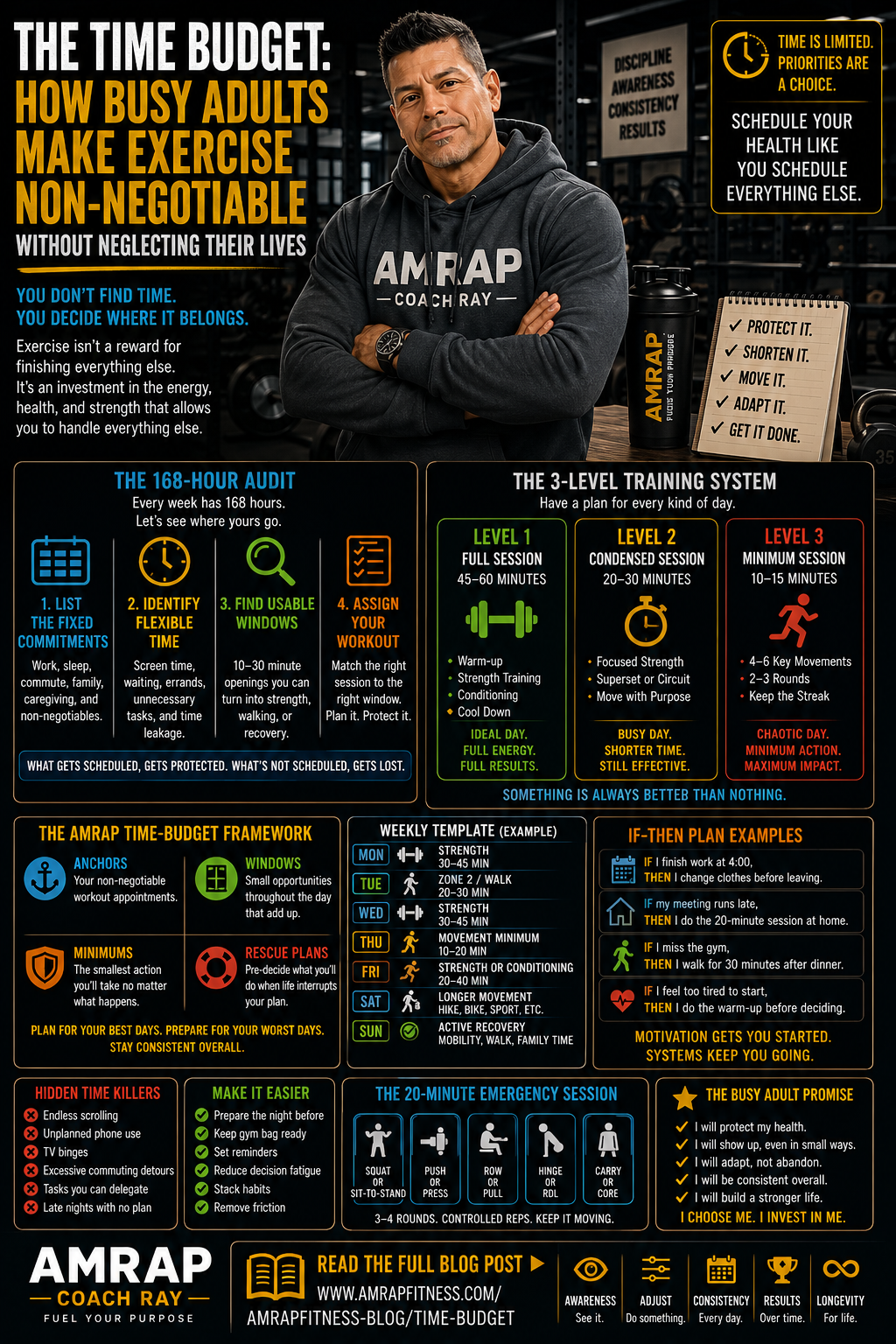
AMRAP Real-Life Fat-Loss Series — Entry 2 of 6
You do not need to “find” time for exercise.
You need to decide where it belongs.
Most busy adults are not sitting around with several unused hours, wondering how to fill them.
They are working.
Commuting.
Parenting.
Caring for relatives.
Preparing meals.
Managing homes.
Answering messages.
Solving problems.
Trying to be dependable for everyone who needs them.
Then someone says:
“You need to make more time for exercise.”
And although the advice may be correct, it often feels disconnected from reality.
Because time does not magically appear.
It must be:
protected
assigned
defended
adjusted
used intentionally
That is the real issue.
Many people do not lack all available time.
They lack a reliable system for allocating time to their health.
Exercise remains something they hope to squeeze in after everything else is finished.
But everything else is never finished.
There will always be:
another email
another load of laundry
another responsibility
another person asking for help
another reason to postpone yourself
That is why exercise cannot remain a leftover activity.
It has to become part of the structure of your life.
Not above your family.
Not above your career.
Not above every emergency.
But important enough that it has an actual place.
Opening Device: The Workout That Keeps Moving to “Later”
You wake up intending to exercise after work.
The plan sounds reasonable.
Then the day begins.
A meeting runs late.
Traffic is worse than expected.
Someone needs something from you.
You arrive home tired and hungry.
Dinner needs to be handled.
There are messages to answer.
You sit down for five minutes.
Five minutes becomes forty-five.
Now it is late.
You tell yourself:
“Tomorrow morning.”
Tomorrow morning arrives.
You did not sleep well because you stayed up finishing the things that were supposed to be done the night before.
So the workout moves again.
Wednesday becomes Thursday.
Thursday becomes the weekend.
Then Sunday night arrives, and you feel disappointed.
You tell yourself that next week will be different.
But the next week is built exactly like the last one.
That is the problem.
It is not that you do not care.
It is that your exercise plan depends on a version of the week in which:
nothing runs late
nobody needs you
your energy remains high
your motivation is perfect
your schedule behaves itself
That week does not exist.
A professional plan must survive the week you actually have.
The Difference Between Being Busy and Being Unplanned
Being busy is real.
Some people genuinely have:
demanding jobs
multiple children
caregiving responsibilities
long commutes
medical challenges
irregular shifts
limited resources
So this article is not going to insult people by pretending that everyone has endless free time.
But there is an important distinction between:
having limited time
and
having no structure for the time that exists.
Many adults have periods of time that are:
fragmented
poorly protected
absorbed by screens
lost between transitions
consumed by low-priority tasks
surrendered to other people by default
One unused block may not look meaningful.
But across seven days, those blocks can become:
two strength sessions
three walks
one conditioning session
a recovery session
or the beginning of a completely different health trajectory
The goal is not to shame how you currently use time.
The goal is to make time visible.
Because invisible time gets spent automatically.
Visible time can be directed.
The Science Signal: Why This Matters
Current physical-activity guidance emphasizes that some activity is better than none. Adults generally benefit from accumulating approximately 150–300 minutes of moderate aerobic activity per week, or 75–150 minutes of vigorous activity, alongside muscle-strengthening work on at least two days. Those totals can be distributed across the week rather than completed in a single perfect block.
Modern guidelines also removed the older requirement that activity had to occur in bouts of at least 10 minutes to “count.” Smaller amounts of movement can contribute to the total and may provide immediate and long-term benefits.
That matters for busy adults.
It means the choice is not:
complete a perfect one-hour workout
or receive no benefit
Short bouts of purposeful activity can serve as a practical entry point, especially for people who are inactive or struggling with limited time. Research on “exercise snacks”—brief, structured bouts of activity throughout the day—suggests they may improve fitness and certain cardiometabolic outcomes, although they should be viewed as a tool within a larger movement system rather than a replacement for all structured training.
Planning can help, but merely writing down a time does not guarantee adherence. Some trials have found benefits from structured implementation planning and partner support, while others have shown that a simple calendar intention alone may not change repeated exercise behavior. The lesson is that scheduling works best when it is paired with environmental support, realistic alternatives, accountability, and a clear minimum action.
In other words:
A calendar entry is necessary—but it is not always sufficient.
You also need a system for what happens when life interferes.
The Myth of “When Things Calm Down”
Many adults are waiting for a future season in which:
work becomes less demanding
the children need less
finances feel easier
sleep improves
stress disappears
motivation returns
Then they will start taking care of themselves.
But life usually does not become permanently calm.
It changes form.
One responsibility ends.
Another appears.
One problem is resolved.
A new challenge replaces it.
If your health requires a stress-free life, your health will always be postponed.
That does not mean you ignore real hardship.
It means you stop requiring ideal conditions before you begin.
You build a system that expands and contracts.
On easier weeks, you do more.
On difficult weeks, you preserve the minimum.
That is how real consistency works.
Exercise Is Not a Reward for Finishing Everything Else
Many people unconsciously organize their lives like this:
Work responsibilities
Family responsibilities
Household responsibilities
Other people’s requests
Administrative tasks
Whatever else appears
Personal health, if any energy remains
That hierarchy almost guarantees neglect.
Your workout becomes a reward you are allowed to receive only after being useful to everyone else.
But there is always more usefulness required.
So your health is continually postponed.
The professional correction is not:
“Put yourself above everyone.”
It is:
“Stop placing yourself below everything.”
Your health supports your ability to:
work
parent
teach
lead
care
serve
remain independent
Exercise is not separate from your responsibilities.
It helps sustain the person performing them.
The 168-Hour Audit
Every week contains 168 hours.
That number does not mean everyone has equal freedom.
They do not.
But it gives us a clear place to begin.
Instead of saying:
“I have no time,”
we examine where the time currently goes.
Step 1: Record the fixed commitments
List:
work hours
commuting
sleep
school and childcare
caregiving
religious commitments
medical appointments
required household responsibilities
These are the structures you cannot casually remove.
Step 2: Record the flexible commitments
Now list:
television
social media
unstructured phone use
errands that could be grouped
meetings that could be shortened
tasks done out of habit rather than necessity
excessive waiting or transition time
repeated trips caused by poor preparation
This is not an accusation.
It is an audit.
Step 3: Identify usable windows
Look for:
10–15 minutes before the household wakes
part of a lunch break
the period immediately after work
the time during a child’s practice
a weekend morning
two short sessions that could replace one long session
walking opportunities during calls or errands
You are not searching for an empty hour every day.
You are locating repeatable windows.
Step 4: Assign the correct exercise to the correct window
A 15-minute window is not a failed 60-minute session.
It is a 15-minute opportunity.
Use it accordingly.
Examples:
15 minutes: full-body density circuit
20 minutes: brisk walk or Zone 2
30 minutes: focused strength session
45 minutes: complete training session
60 minutes: extended training plus mobility or conditioning
Time becomes useful when your expectations match the window.
The Three-Level Training System
A professional plan needs more than one version.
Most people have only one:
the full workout.
When they cannot complete it, they do nothing.
We need three levels.
Level 1: The Full Session
Duration: approximately 45–60 minutes
Use when time, energy, and recovery are available.
Possible structure:
8–10 minutes warm-up
30–40 minutes strength work
5–10 minutes conditioning or carries
brief cooldown
This is the ideal session.
But it is not the only session that counts.
Level 2: The Condensed Session
Duration: approximately 20–30 minutes
Use when the day is crowded but still manageable.
Example:
Squat or hinge
Push
Pull
Carry or core
Perform:
two or three focused work sets
controlled rest
no wasted movement
no scrolling between sets
This maintains strength and momentum without requiring the full block.
Level 3: The Minimum Session
Duration: approximately 10–15 minutes
Use when life is genuinely difficult.
Example:
sit-to-stand or squat
push-up or dumbbell press
row
brisk walking or loaded carry
Perform a few controlled rounds.
The objective is not maximal fitness.
It is preserving the identity:
“I am still someone who trains.”
That identity matters because returning from one shortened session is easier than returning after six weeks of complete disengagement.
The Minimum Is Not the Goal—It Is the Safety Net
This distinction is important.
The message is not:
“Ten minutes is all anyone ever needs.”
The message is:
“Ten minutes is better than abandoning the system when sixty minutes is unavailable.”
The minimum session protects continuity.
The full plan builds greater capacity.
Both have a role.
A safety net does not replace the building.
It prevents the fall from becoming catastrophic.
The AMRAP Time-Budget Framework
Use four categories.
1. Anchors
These are fixed sessions that receive the highest protection.
Example:
Monday at 6:00 a.m.
Wednesday at 5:30 p.m.
Saturday at 8:00 a.m.
Anchors should be selected according to your actual life, not your fantasy schedule.
2. Windows
These are secondary opportunities.
Example:
lunch walk
conditioning during a child’s practice
short mobility session before dinner
walking during a phone call
Windows add movement without requiring a major appointment.
3. Minimums
These are the smallest actions you will maintain during disruption.
Example:
two 15-minute strength sessions
one 20-minute walk
daily movement breaks
five minutes of mobility before bed
4. Rescue Plans
These answer:
“What will I do when the original plan fails?”
Examples:
If the morning session is missed, I train immediately after work.
If work runs late, I complete the 15-minute minimum at home.
If the gym is unavailable, I use dumbbells, bands, stairs, or body weight.
If sleep is poor, I replace hard conditioning with walking or Zone 2.
A plan without a rescue option is a fragile plan.
The If–Then Method
Vague plans sound like:
“I’ll work out tomorrow.”
“I’ll exercise after work.”
“I’ll walk more.”
“I’ll try to get to the gym.”
Those intentions are sincere.
But they require another decision later.
And later, you may be:
tired
hungry
stressed
distracted
emotionally depleted
A stronger structure is:
If X happens, then I will do Y.
Examples:
If I finish work at 4:00, I will change clothes before leaving the building.
If my meeting runs late, I will complete the 20-minute version at home.
If I miss the gym, I will walk for 30 minutes after dinner.
If I feel too tired to begin, I will complete the warm-up before deciding whether to stop.
The purpose is not to control every situation.
It is to remove repeated negotiation.
Transition Time: The Hidden Opportunity
Many workouts fail during transitions.
Examples:
leaving work
arriving home
finishing school drop-off
completing dinner
waiting during activities
These moments are vulnerable because the next behavior is not predetermined.
You may intend to train after work.
But if you go home, sit down, begin scrolling, and change into comfortable clothes, the transition has already been decided.
A stronger strategy is:
pack clothing in advance
go directly to the gym
keep shoes visible
begin the walk before entering the house
schedule the session adjacent to an existing commitment
Habits become easier when there is less distance between the trigger and the action.
Time Management Is Also Energy Management
Two people can have the same 30-minute window.
One uses it.
The other cannot begin.
Why?
Because available time and available energy are not the same.
This is why intelligent scheduling matters.
Place demanding work when you are most capable
If you know evenings are consistently chaotic, stop building your entire program around evening motivation.
Use:
morning
lunch
immediately after work
weekends
shorter home sessions
Reduce unnecessary decisions
Prepare:
clothing
meals
equipment
workout selection
travel route
Decision fatigue makes small obstacles feel larger.
Match training to recovery
A difficult day may call for:
walking
Zone 2
mobility
a shorter strength session
The goal is not to force maximum output into every available minute.
The goal is to use the minute wisely.
Why “I’m Too Tired” Often Means the System Is Wrong
Sometimes fatigue is real and rest is appropriate.
But chronic evening exhaustion may also reflect:
poor meal timing
inadequate hydration
insufficient sleep
excessive caffeine followed by a crash
a long commute
emotional overload
a training time poorly matched to your life
The answer may not be “try harder.”
It may be:
train earlier
eat before the session
reduce the workout duration
lower intensity
remove unnecessary exercises
use two shorter sessions
protect sleep
Professional coaching does not only ask:
“How motivated are you?”
It asks:
“What is making execution unnecessarily difficult?”
The Busy Adult Weekly Template
Here is a realistic starting structure.
Monday: Strength
30–45 minutes
Focus:
squat or split squat
push
pull
carry
Tuesday: Walking or Zone 2
20–30 minutes
Can be divided into:
10 minutes after lunch
10–20 minutes after dinner
Wednesday: Strength
30–45 minutes
Focus:
hinge
press
row or pull-down
trunk
Thursday: Movement Minimum
10–20 minutes
Options:
mobility
stairs
walking
sled dragging
body-weight circuit
Friday: Optional Strength or Conditioning
20–40 minutes depending on recovery.
Weekend: Longer Movement
Possibilities:
walk
hike
recreational activity
full strength session
family movement
This is not the only structure.
It is an example of how a week can include meaningful training without requiring long daily workouts.
The “Exercise Appointment” Standard
Treat your training appointment like a real commitment.
That means:
it has a start time
it has a location
it has a plan
the necessary materials are ready
cancellation requires a real reason
missed sessions are rescheduled rather than forgotten
But there is a critical difference between discipline and rigidity.
If an actual emergency occurs, respond to it.
If life becomes difficult, adjust the dose.
The standard is not:
“Never miss.”
The standard is:
“Never allow one disruption to erase the entire system.”
Why Family and Work Do Not Have to Compete With Health
People often imagine only two choices:
Take care of others
Take care of yourself
That is a false choice.
Sometimes responsibilities truly require sacrifice.
But chronic self-neglect eventually affects everyone around you.
When your health declines, you may have:
less energy
less patience
less mobility
more medical appointments
more pain
lower work capacity
reduced independence
Protecting your health is not abandoning your responsibilities.
It is helping preserve your ability to meet them.
You can also integrate movement into family life:
walking together
active weekend activities
playground movement
family bike rides
short home workouts
shared meal preparation
Not every workout must isolate you from the people you love.
The 20-Minute Emergency Strength Session
When time collapses, use this.
Warm-up: 3 minutes
body-weight squats
shoulder circles
hip hinges
marching
Main circuit: 15 minutes
Perform controlled rounds of:
Goblet squat or sit-to-stand
Dumbbell press or push-up
Dumbbell row or band row
Romanian deadlift or hip hinge
Carry, plank, or dead bug
Use:
6–12 repetitions
controlled technique
brief transitions
moderate effort
Downshift: 2 minutes
easy walking
slower breathing
record the session
Twenty focused minutes can preserve more progress than repeatedly waiting for a perfect hour.
Common Time-Management Mistakes
Mistake 1: Scheduling only the ideal workout
Correction: Create full, condensed, and minimum versions.
Mistake 2: Exercising only when motivated
Correction: Use appointments, anchors, and rescue plans.
Mistake 3: Choosing a time that repeatedly fails
Correction: Stop proving loyalty to a schedule that does not fit your life.
Mistake 4: Treating short workouts as worthless
Correction: Use them strategically while continuing to build toward sufficient weekly activity.
Mistake 5: Letting one missed session cancel the week
Correction: Reschedule within 24–48 hours or use the minimum version.
Mistake 6: Spending workout time deciding what to do
Correction: Arrive with the session already written.
Mistake 7: Filling every open minute for everyone else
Correction: Place personal-health appointments on the calendar before the week becomes full.
The Seven-Day Time Audit
For one week, record time honestly.
Track:
wake time
work
commuting
caregiving
meals
chores
television
social media
unplanned phone use
errands
exercise
sleep
Do not judge the record while collecting it.
At the end of the week, identify:
One 30–45 minute anchor
Two 15–20 minute windows
One activity that can be reduced
One task that can be grouped, delegated, or simplified
One rescue plan for the week’s most predictable disruption
This transforms:
“I have no time”
into:
“Here is the time I can realistically protect.”
The Minimum Non-Negotiable Week
When everything goes wrong, maintain:
two short strength sessions
two 20-minute walks
movement breaks during prolonged sitting
one recovery practice
your next scheduled session
That may not be your ideal week.
But it keeps the health system alive.
The difference between long-term consistency and repeated restarts is often not what happens during easy weeks.
It is what remains during difficult ones.
Self-Assessment
Answer honestly:
Is exercise scheduled, or merely hoped for?
Does my plan have full, condensed, and minimum versions?
What time of day has the highest chance of success?
Which transition repeatedly destroys my workout plan?
How much time do I lose to unplanned phone use?
Do I prepare clothing, equipment, and sessions in advance?
What is my rescue plan when work runs late?
Am I waiting for life to calm down?
Do I treat short sessions as meaningful or worthless?
Am I continually giving away time I said I would use for my health?
Your answers are not accusations.
They are scheduling data.
Closing: Your Calendar Reveals What Your Intentions Cannot
Most people do not need another speech about motivation.
They need a system that makes execution possible.
Exercise will rarely fit perfectly into adult life.
You will have to:
protect it
shorten it
move it
adapt it
sometimes fight for it
But that effort is not selfish.
It is an investment in the person who carries your responsibilities.
You do not need to neglect your family.
You do not need to abandon your career.
You do not need to live in the gym.
You do need to stop treating your health as something that receives whatever time survives the week.
You have 168 hours.
Some are already spoken for.
Some are genuinely unavailable.
But somewhere inside your real life—not your fantasy life—is a structure you can build.
Begin with:
one anchor
one minimum
one rescue plan
Then repeat.
You do not find time.
You assign it.
You protect it.
And eventually, what once felt impossible becomes part of who you are.
That is how busy adults become consistent.
Not by having easier lives.
By building stronger systems.
Resources
U.S. Department of Health and Human Services. Physical Activity Guidelines for Americans, 2nd Edition. The guidelines recommend 150–300 minutes of moderate aerobic activity weekly, or an equivalent amount of vigorous activity, plus muscle-strengthening work on at least two days.
World Health Organization. Physical Activity Recommendations. WHO emphasizes that some activity is better than none and that movement can be accumulated through everyday activities as well as structured exercise.
Prestwich A, et al. Randomized controlled trial of collaborative implementation intentions targeting working adults’ physical activity. Health Psychology. 2012. The study examined planning and partner-based interventions for physical activity.
Robinson SA, et al. Time for Change: Using Implementation Intentions to Promote Physical Activity in a Randomised Pilot Trial. Psychology & Health. 2019.
Carrera M, et al. The Limits of Simple Implementation Intentions: Evidence from a Field Experiment on Making Plans to Exercise. The findings reinforce that scheduling alone may be insufficient for repeated exercise behavior without broader support.
Wang T, et al. Exercise snacks and physical fitness in sedentary populations. The review examined brief, time-efficient exercise bouts as a strategy for inactive adults.