
The Identity Upgrade: Stop Chasing Motivation and Become the Person Who Keeps Promises to Yourself
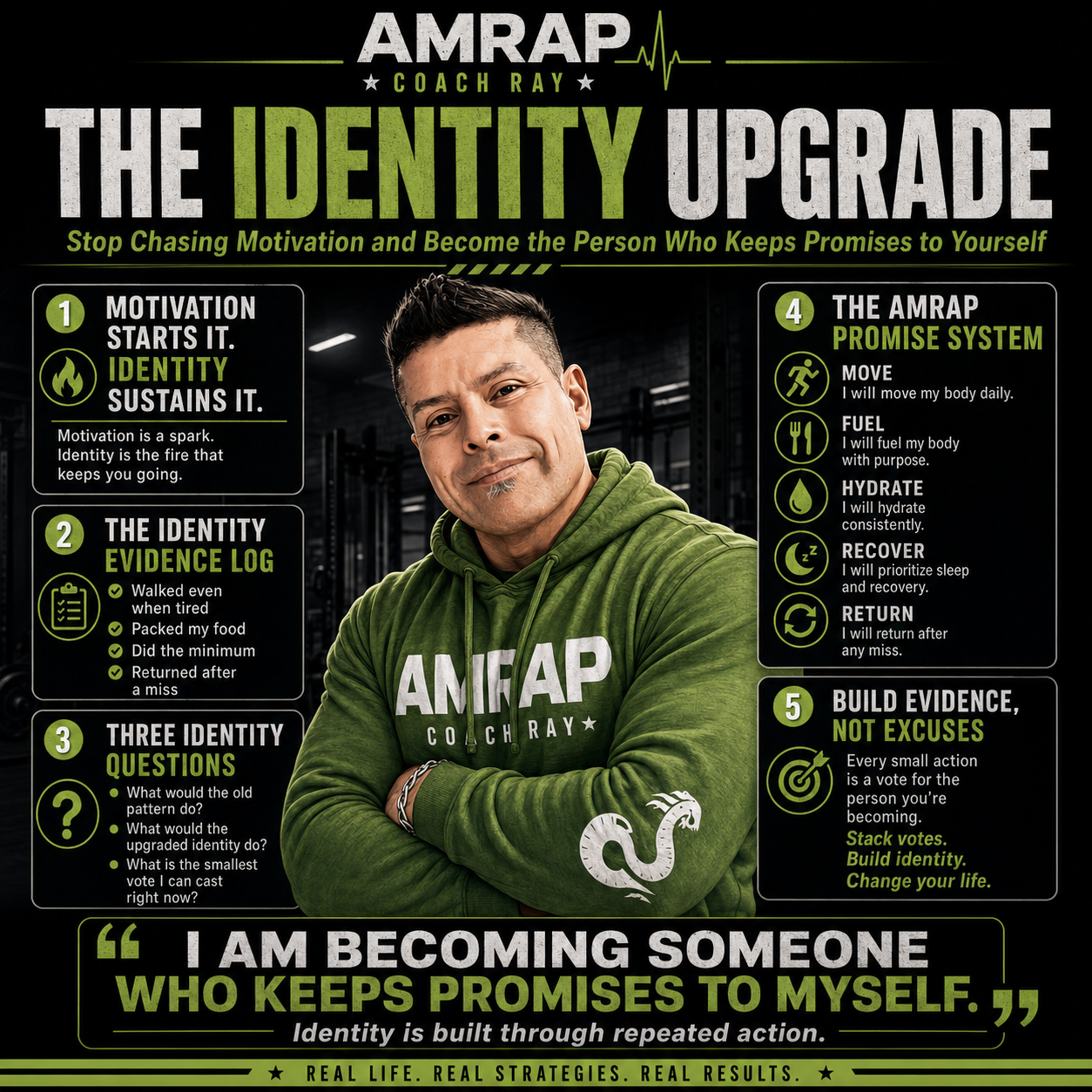
AMRAP Real-Life Reset Series — Entry 6 of 6
Motivation can start a transformation.
Identity is what sustains it.
That is the part many people miss.
They spend years saying:
“I need to get motivated.”
They wait for the perfect Monday.
The perfect mood.
The perfect schedule.
The perfect body-image moment.
The perfect scare from the doctor.
The perfect burst of confidence.
But motivation is unstable.
It rises when life feels easier.
It drops when stress rises.
It feels strong after a good weigh-in.
It disappears after poor sleep, conflict, fatigue, disappointment, or one bad weekend.
That is why the most consistent people are not always the most motivated.
They are the people who have built an identity around the behavior.
They do not ask every day:
“Do I feel like training?”
They ask:
“What does someone like me do today?”
That question changes everything.
Because when health becomes part of your identity, the behavior stops being a temporary project.
It becomes part of who you are becoming.
This article is about the final upgrade:
Not just losing weight.
Not just completing workouts.
Not just fixing nutrition for a few weeks.
But becoming the kind of person who keeps promises to themselves.
Opening Device: The Person Who Is Always “Trying to Get Back”
A lot of adults live in a cycle of trying to get back.
Back to the gym.
Back to eating better.
Back to discipline.
Back to the old routine.
Back to the body they used to have.
Back to confidence.
Back to control.
The phrase sounds harmless.
But sometimes it reveals the problem.
They are always trying to return to something instead of becoming someone.
They say:
“I need to get back on track.”
But they have never clearly defined the person who stays on track.
They say:
“I need to start working out again.”
But they have not become someone who trains even when the week is imperfect.
They say:
“I need to eat better.”
But they have not become someone who prepares, plans, and returns after a difficult meal.
They say:
“I need more motivation.”
But motivation keeps failing because identity has not been built.
The deeper question is not:
“How do I force myself to do this?”
The deeper question is:
“Who am I becoming through the promises I keep?”
Why Identity Matters
Identity is the way you understand yourself.
It includes the labels, beliefs, roles, and stories you carry.
Some are helpful.
Some are not.
Helpful identities sound like:
I am someone who trains.
I am someone who prepares.
I am someone who returns.
I am someone who protects my health.
I am someone who keeps small promises.
I am someone who does not disappear after a bad day.
Unhelpful identities sound like:
I always fail.
I have no discipline.
I am not athletic anymore.
I am too busy to be healthy.
I am an emotional eater.
I never stick with anything.
I am either all-in or completely off.
The danger is that people often live up or down to the identity they repeat.
Not perfectly.
Not magically.
But over time, identity becomes a filter.
It affects what you notice, what you attempt, what you excuse, what you avoid, and what you believe is possible.
A growing body of behavior-change research supports the importance of identity in health behavior. Recent reviews have examined identity-related interventions and physical-activity identity, noting that identity is linked to health behavior change and can be influenced through interventions, although identity change is usually not instant or guaranteed.
The coaching translation is simple:
You do not need to pretend you are already where you want to be. You need to start building evidence that you are becoming that person.
The Problem With Motivation-Only Fitness
Motivation-only fitness is fragile.
It depends on feeling ready.
That is the weakness.
If motivation is your only driver, then every difficult day becomes a vote against your future.
Poor sleep?
You skip.
Stressful workday?
You skip.
Low confidence?
You skip.
Scale up?
You panic.
Weekend off?
You disappear.
Motivation is useful when it appears, but it cannot be the only plan.
Research using self-determination theory has found that more autonomous forms of motivation are generally associated with exercise behavior, especially motivation connected to personal value, identity, enjoyment, and meaningful reasons rather than only external pressure or guilt.
That matters because the strongest transformation is not built from:
“I hate myself, so I must change.”
It is built from:
“This matters to me, so I will act like it matters.”
That is a different fuel source.
The Identity Upgrade
The identity upgrade is the shift from temporary effort to self-concept.
It is the difference between:
“I’m trying to work out.”
and
“I am someone who trains.”
It is the difference between:
“I’m trying to eat better.”
and
“I am someone who prepares my body to perform.”
It is the difference between:
“I messed up, so I failed.”
and
“I missed, so I return.”
It is the difference between:
“I need motivation.”
and
“I need to keep one promise today.”
This is not motivational fluff.
It is practical.
Identity becomes believable through evidence.
You do not think your way into a new identity.
You act your way into evidence.
Then that evidence changes what you believe about yourself.
The Evidence Problem
Many people do not lack desire.
They lack evidence.
They want to believe:
I am disciplined.
I am consistent.
I am capable.
I am healthy.
I am strong.
I can change.
But their recent evidence says:
I keep canceling workouts.
I keep waiting until Monday.
I keep skipping meals and overeating later.
I keep staying up too late.
I keep breaking promises to myself.
I keep disappearing when life gets hard.
That mismatch hurts.
The answer is not to shout affirmations louder.
The answer is to collect better evidence.
Not huge evidence.
Small evidence.
Daily evidence.
A 10-minute walk.
A protein-centered breakfast.
A packed gym bag.
A returned workout.
A bedtime boundary.
A journal entry instead of a spiral.
One honest check-in.
One promise kept.
That is how identity becomes believable.
Habit and Identity Work Together
Habits are repeated behaviors that become easier when tied to consistent contexts.
Identity gives those habits meaning.
A habit says:
“This is what I do.”
Identity says:
“This is who I am becoming.”
Research on habit formation shows that repeating behaviors in consistent contexts can increase automaticity over time, meaning the behavior requires less conscious effort as it becomes more familiar.
A 2025 systematic review and meta-analysis on habit and identity in health behaviors found that habit and identity are related across behaviors such as physical activity, healthy eating, and drinking, supporting the idea that behavior change is stronger when repeated action and self-concept begin to align.
The practical point:
Do not choose between habits and identity. Build both.
The habit gives you repetition.
The identity gives you direction.
The AMRAP Identity Evidence Log
This is the central framework.
Every day, write one piece of evidence.
Not a paragraph.
Not a confession.
Not a perfect journal entry.
One sentence.
Examples
I walked for 15 minutes even though I was tired.
I packed my food before work.
I drank water before more coffee.
I trained the minimum instead of doing nothing.
I returned after an imperfect meal.
I went to bed instead of scrolling.
I asked for help instead of disappearing.
I ate protein at breakfast.
I stretched when my body felt stiff.
I kept one promise to myself today.
That sentence matters.
Because identity grows from repeated evidence.
You are teaching the mind:
“This is what someone like me does.”
The Three Identity Questions
Before any important decision, ask three questions.
1. What would the old pattern do?
Example:
skip the workout
wait until Monday
eat from emotion
scroll late
hide from accountability
call the day ruined
2. What would the upgraded identity do?
Example:
complete the minimum
return at the next meal
drink water
take a short walk
text the coach
go to bed earlier
write the truth without drama
3. What is the smallest vote I can cast right now?
That is the key.
The smallest vote.
Not the biggest transformation.
Not the perfect plan.
Not the heroic comeback.
The smallest action that points in the right direction.
Because identity is not built once.
It is voted for repeatedly.
Stop Saying “I’m Just Not That Person”
This phrase is one of the most damaging sentences in behavior change.
People say:
I’m just not a morning person.
I’m just not disciplined.
I’m just not consistent.
I’m just not someone who meal preps.
I’m just not good at fitness.
I’m just not athletic anymore.
Sometimes there is truth inside the statement.
Maybe mornings are difficult.
Maybe consistency has been poor.
Maybe meal prep has never worked.
Maybe training feels unfamiliar.
But the phrase becomes dangerous when it turns the past into a life sentence.
A better phrase is:
“I have not built that identity yet.”
That leaves room.
Room to practice.
Room to grow.
Room to become.
You may not currently be someone who trains consistently.
But you can become someone who keeps one movement promise.
Then two.
Then three.
The identity starts smaller than people want.
But smaller is how it becomes real.
The Identity Ladder
Do not jump from zero to fantasy.
Climb the ladder.
Level 1: Awareness
“I notice the pattern.”
This is where you stop lying to yourself.
Level 2: One promise
“I will keep one small promise today.”
This proves change is possible.
Level 3: Repetition
“I repeat the promise until it becomes familiar.”
This builds trust.
Level 4: Recovery
“When I miss, I return.”
This makes the identity durable.
Level 5: Embodiment
“This is what someone like me does.”
This is where the behavior begins to feel less like a forced task and more like your standard.
The mistake is trying to start at Level 5.
You do not declare the identity and hope it becomes true.
You earn it through repeated evidence.
Identity Without Action Is Fantasy
This needs to be said clearly.
Calling yourself disciplined does not make you disciplined.
Calling yourself healthy does not make you healthy.
Calling yourself consistent does not make you consistent.
Identity without action is performance.
Action without identity can still work temporarily.
But identity and action together are powerful.
The professional standard is:
Use identity as direction. Use action as proof.
Say:
“I am becoming someone who trains.”
Then train.
Say:
“I am becoming someone who prepares.”
Then prepare.
Say:
“I am becoming someone who returns.”
Then return.
The words set the direction.
The behavior creates the evidence.
The Identity Audit
Ask yourself:
Fitness identity
Do I see myself as someone who trains?
Or someone who is always trying to start?
Nutrition identity
Do I see myself as someone who prepares?
Or someone who reacts to hunger and chaos?
Recovery identity
Do I see myself as someone who protects energy?
Or someone who runs on depletion and calls it discipline?
Return identity
Do I see myself as someone who comes back quickly?
Or someone who disappears after one miss?
Health identity
Do I see myself as someone worth taking care of?
Or someone who must earn care by looking better first?
These answers matter.
They reveal the identity underneath the behavior.
The Four Identity Blocks
Most people are blocked by one of four identity problems.
Block 1: The broken identity
This person says:
“I always fail.”
They are not just trying to fix habits.
They are trying to overcome a story of repeated disappointment.
The solution is evidence.
Small promises.
Kept daily.
Block 2: The former identity
This person says:
“I used to be in shape.”
They are trapped comparing today to a previous version.
The solution is building forward.
Not chasing the past.
Block 3: The survival identity
This person says:
“I’m too busy taking care of everything else.”
They are living as if their body is only a tool for responsibilities.
The solution is stewardship.
Health becomes part of responsibility, not a reward after everything else.
Block 4: The perfection identity
This person says:
“If I can’t do it right, I won’t do it.”
They confuse excellence with rigidity.
The solution is return speed.
Minimums.
Repair.
Adaptation.
The AMRAP Promise System
A promise is more powerful when it is small enough to keep.
Many people make promises that are too large.
They say:
I will train six days a week.
I will never eat sugar.
I will lose 30 pounds fast.
I will wake up at 4:00 every day.
I will never miss again.
Then life happens.
The promise breaks.
Self-trust drops.
Instead, use the AMRAP Promise System.
Promise 1: Movement
I will move for at least 10 minutes today.
Promise 2: Fuel
I will eat one protein-centered meal today.
Promise 3: Hydration
I will drink water before more caffeine.
Promise 4: Recovery
I will protect one sleep or downshift boundary.
Promise 5: Return
If I miss, I will take the next reasonable step back.
These promises are not dramatic.
That is why they work.
They are small enough to keep and meaningful enough to matter.
Self-Efficacy: Believing You Can Act
Self-efficacy is the belief that you can successfully perform a behavior.
That belief matters because people are more likely to attempt and repeat behaviors they believe they can do.
Exercise self-efficacy has been studied as both a determinant and outcome of physical activity. Reviews describe self-efficacy as important for exercise adherence, especially when adults are low-active or facing barriers.
But self-efficacy does not grow from fantasy.
It grows from mastery experiences.
In plain English:
You build confidence by doing the thing at a level you can actually repeat.
That is why minimums matter.
A minimum is not a weak action.
It is a confidence builder.
Every completed minimum says:
“I can still act.”
That belief is essential.
Values: The Reason Under the Goal
Identity becomes stronger when connected to values.
Ask:
Why does this matter beyond appearance?
Possible answers:
I want energy for my family.
I want to age with strength.
I want to reduce health risk.
I want to be a better example.
I want to feel confident again.
I want to stop breaking promises to myself.
I want to serve others from strength, not depletion.
I want freedom in my body.
I want to be present, capable, and proud of how I live.
Those reasons matter.
A scale goal may start the process.
A value keeps it alive.
When the goal connects to values, the behavior becomes more than a task.
It becomes an expression of who you are.
The Identity Statement
Write one clear identity statement.
Not fake.
Not inflated.
Not unrealistic.
Use this format:
“I am becoming someone who ______ because ______.”
Examples:
I am becoming someone who trains because my body deserves strength.
I am becoming someone who prepares because chaos should not decide my nutrition.
I am becoming someone who returns because one miss does not define me.
I am becoming someone who protects sleep because my energy affects everyone I serve.
I am becoming someone who keeps promises because self-trust matters.
This statement is not magic.
It is a reminder.
You still need action.
But it gives the action meaning.
The Five-Minute Identity Review
Every night, answer three questions.
1. What promise did I keep today?
Small counts.
2. What did that prove?
Example:
I can act tired.
I can return.
I can prepare.
I can pause.
I can choose the next step.
3. What promise will I protect tomorrow?
Choose one.
Not ten.
One.
This review takes five minutes.
Done consistently, it changes the story you carry about yourself.
Why Coaching Helps Identity Change
A good coach does not only prescribe workouts.
A good coach helps you see yourself differently through repeated evidence.
The coach helps you:
stop overreacting to slips
choose realistic minimums
keep promises
adjust the system
notice progress
return faster
track behavior honestly
build confidence through action
become more independent over time
That is why accountability matters.
Not to shame you.
Not to control you.
Not to make you dependent.
But to help you build the identity you have not yet fully trusted yourself to live.
The best coaching does not just ask:
“What did you weigh?”
It asks:
“What did you prove to yourself this week?”
The Seven-Day Identity Upgrade Challenge
For one week, collect evidence.
Day 1: Write your old identity story
Examples:
I never stick with anything.
I always start over.
I’m too busy.
I have no discipline.
Do not judge it.
Name it.
Day 2: Write your upgraded identity statement
Use:
“I am becoming someone who ______ because ______.”
Day 3: Keep one movement promise
Minimum counts.
Day 4: Keep one nutrition promise
Protein-centered meal.
Water.
Prepared lunch.
Default meal.
Day 5: Keep one recovery promise
Sleep boundary.
Downshift.
Journal.
Walk.
Prayer.
Day 6: Practice return
When something goes imperfectly, return without drama.
Day 7: Review the evidence
Write:
What did I prove?
What still needs work?
What identity am I building?
What promise will I keep next week?
The goal is not to become a different person in seven days.
The goal is to start collecting proof.
Common Mistakes—and the Professional Correction
Mistake 1: Waiting to feel like the person before acting like the person
Correction: Action creates evidence. Evidence strengthens identity.
Mistake 2: Creating an unrealistic identity
Correction: Start with “I am becoming,” not “I am perfect.”
Mistake 3: Making promises too large
Correction: Keep promises small enough to repeat.
Mistake 4: Confusing identity with a label
Correction: Identity requires behavior.
Mistake 5: Letting one miss erase the identity
Correction: Returning is part of the identity.
Mistake 6: Measuring only outcomes
Correction: Track evidence: training, preparation, hydration, sleep, recovery, return.
Mistake 7: Using shame to build identity
Correction: Build identity through standards, structure, and self-respect.
The AMRAP Identity Contract
Use this:
I am not waiting for motivation to become consistent.
I am building evidence.
I am becoming someone who trains, prepares, recovers, and returns.
I will keep promises small enough to repeat.
I will not confuse one miss with my identity.
I will measure actions, not just outcomes.
I will act from values, not shame.
I will build self-trust through follow-through.
I will become the person my future requires.
That is the final standard.
Self-Assessment
Answer honestly:
What identity have I been repeating about myself?
Does that identity help me act or keep me stuck?
What identity do I need to build next?
What small promise can I keep today?
What evidence did I collect this week?
Do I quit when I do not feel motivated?
Am I connected to values deeper than appearance?
Do I return quickly after mistakes?
What would someone who respects their health do next?
Who am I becoming through my habits?
Your answers are not a final judgment.
They are the blueprint for the next version of you.
Closing: Become the Person Who Keeps Promises
The end of this series is not really an ending.
It is a beginning.
Because information is not enough.
You can know about body image.
You can understand preparation.
You can recognize the cost of neglect.
You can make room for joy.
You can understand the all-or-nothing trap.
But eventually, the question becomes personal:
Who are you becoming?
Not what program are you starting.
Not what diet are you trying.
Not what challenge are you joining.
Who are you becoming?
Are you becoming someone who disappears when life gets hard?
Or someone who returns?
Someone who waits for motivation?
Or someone who prepares?
Someone who punishes the body?
Or someone who trains it with purpose?
Someone who breaks promises quietly?
Or someone who rebuilds self-trust one small action at a time?
The identity upgrade does not happen in one dramatic moment.
It happens quietly.
When you walk even though the day was long.
When you eat the meal that supports your goals.
When you drink water before more caffeine.
When you choose sleep instead of another hour of scrolling.
When you do the minimum instead of nothing.
When you return after a miss.
When you write one sentence of evidence.
When you stop saying:
“This is just who I am.”
And start saying:
“This is who I am becoming.”
That is transformation.
Not temporary motivation.
Not a perfect streak.
Not a fantasy version of yourself.
A real identity.
Built through real actions.
Repeated in real life.
And that is how you become the person who keeps promises to yourself.
Resources
Strachan SM, et al. Intervention effects on physical activity identity: a systematic review and meta-analysis. This review found that physical-activity identity can change through interventions, although effects may be smaller than behavior changes.
Kwasnicka D, et al. The effect of identity-related interventions on physical activity- and smoking-related identities and behavior: a mixed-methods systematic review. This review examined identity-based intervention approaches for health-promoting and health-compromising behaviors.
Teixeira PJ, Carraça EV, Markland D, Silva MN, Ryan RM. Exercise, physical activity, and self-determination theory: a systematic review. This review supports the role of autonomous motivation in exercise behavior.
Xu, et al. Does Self-Determination Theory Associate With Physical Activity? A Systematic Review of Systematic Reviews. This review emphasizes competence and autonomous motivation in physical-activity interventions.
Lally P, van Jaarsveld CHM, Potts HWW, Wardle J. How are habits formed: Modelling habit formation in the real world. This study modeled how repetition in consistent contexts supports habit automaticity over time.
Zhu, et al. The relationship between habit and identity in health behaviors: A systematic review and three-level meta-analysis. This review found connections between habit and identity across health behaviors including physical activity and healthy eating.
McAuley E, Blissmer B. Self-efficacy determinants and consequences of physical activity. This review discusses self-efficacy as both a determinant and outcome of physical activity.