
The Cost of Neglect: How Skipping Your Health Shows Up in Your Energy, Mood, Work, and Relationships
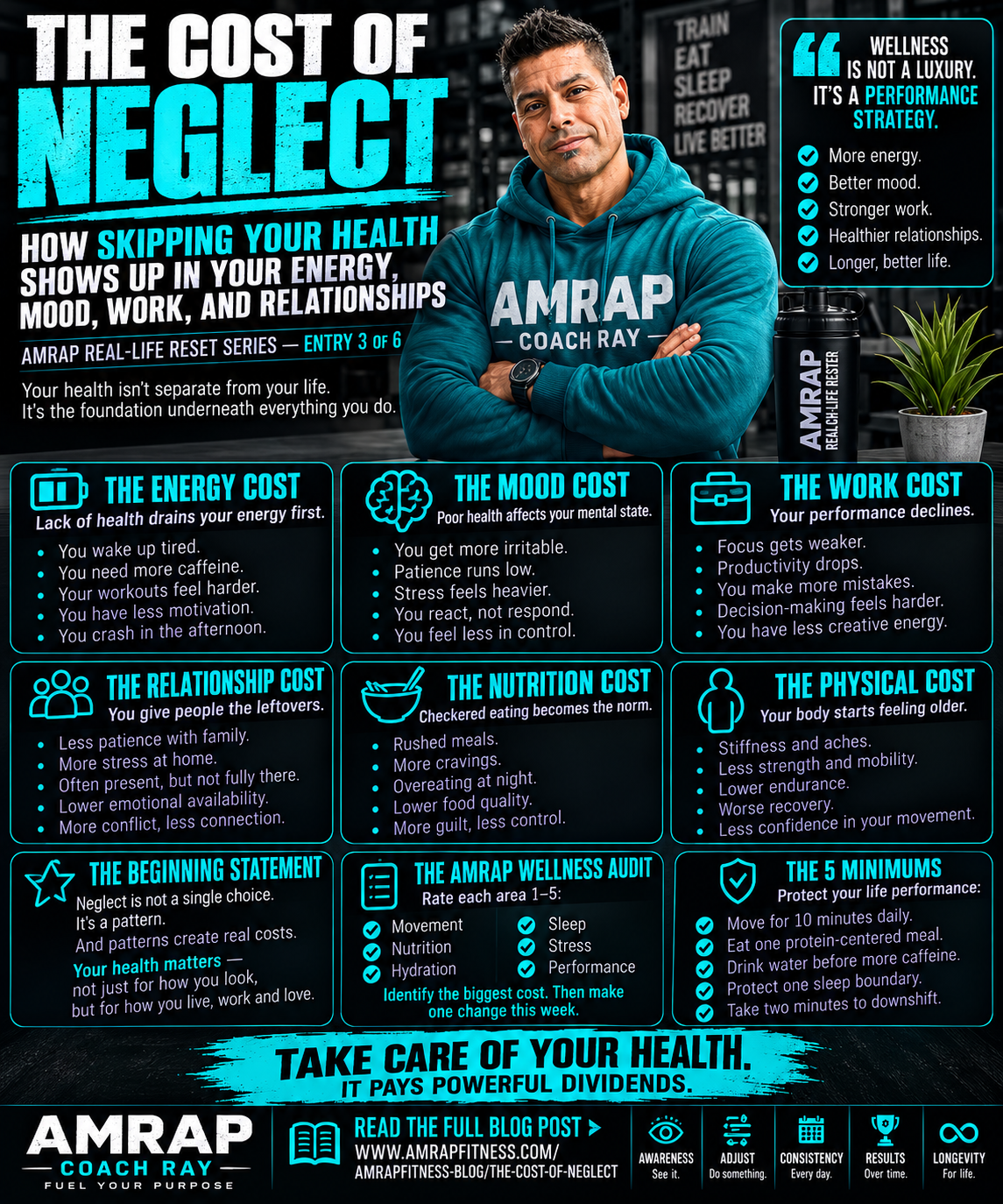
AMRAP Real-Life Reset Series — Entry 3 of 6
Neglecting your health does not save time.
It borrows time from your future energy.
That is the part most people miss.
They skip the workout because the day is busy.
They grab whatever food is convenient because they are overwhelmed.
They stay up late because there is still more to do.
They stop drinking water because they are rushing.
They ignore stress because everyone else needs them.
At first, it feels like they are being responsible.
They think:
“I’ll take care of myself later. Right now, I have too much going on.”
But later keeps moving.
And eventually, the body begins sending the bill.
The bill may show up as:
low energy
irritability
brain fog
poor patience
stronger cravings
inconsistent work performance
lower confidence
more aches and pains
weaker emotional control
less presence with family
less discipline when it matters
That is the real cost of neglect.
It is not only weight gain.
It is not only losing fitness.
It is losing access to the version of yourself who thinks clearly, responds calmly, leads well, and keeps promises.
This article is about recognizing that health is not a separate department of your life.
Health is the operating system underneath everything else.
When that system is neglected, every other area pays.
Opening Device: The Day You Think You Are “Pushing Through”
A lot of adults are proud of pushing through.
They wake up tired and keep going.
They skip breakfast and keep going.
They miss the workout and keep going.
They sit too long and keep going.
They stay up too late and keep going.
They drink more coffee and keep going.
They tell themselves:
“This is what responsible people do.”
And sometimes, yes, responsibility requires endurance.
There are seasons when life is heavy.
There are deadlines, family needs, emergencies, financial pressure, caregiving seasons, and personal storms.
But there is a difference between occasional sacrifice and chronic depletion.
Occasional sacrifice is a response to a season.
Chronic depletion becomes a lifestyle.
At first, you can function on it.
You can still work.
Still answer messages.
Still show up.
Still get through the day.
But performance slowly changes.
You are there, but not fully present.
You are working, but not as sharp.
You are caring, but less patient.
You are training, but less consistent.
You are eating, but not with control.
You are alive in the schedule, but disconnected from the body carrying you through it.
That is when neglect becomes expensive.
What Health Neglect Really Means
Health neglect is not one missed workout.
It is not one takeout meal.
It is not one poor night of sleep.
It is the repeated pattern of treating your physical and mental wellness as optional until something breaks.
It looks like:
always moving training to later
skipping meals and overeating at night
sitting for hours without movement
ignoring hydration
treating sleep as leftover time
using caffeine to cover exhaustion
carrying stress without processing it
avoiding recovery because it feels unproductive
waiting for motivation instead of building structure
canceling your own health appointment for everyone else’s needs
The pattern sends the same message every day:
“My health can wait.”
Eventually, the body believes you.
And when the body stops being supported, performance suffers everywhere.
The Science Signal: Health Habits Affect More Than Appearance
Physical activity is consistently linked with physical and mental-health benefits. The CDC summarizes adult guidelines as at least 150 minutes of moderate-intensity activity weekly plus two days of muscle-strengthening activity, while also emphasizing that adults who sit less and move at any amount gain some health benefits.
The WHO’s physical-activity guidelines similarly frame movement and reduced sedentary behavior as public-health priorities across adulthood and older adulthood, with recommendations intended to support health and reduce risk.
Mental health is part of this conversation. A large umbrella review found that physical-activity interventions can improve symptoms of depression, anxiety, and psychological distress across adult populations, though exercise should be treated as one powerful tool—not a replacement for appropriate medical or psychological care when that care is needed.
Sleep also matters for performance. Reviews of sleep deprivation show that insufficient sleep can impair cognition, attention, and other mental functions that adults rely on every day.
Work performance is affected by health habits too. Systematic reviews of workplace nutrition and physical-activity interventions have examined effects on productivity, work performance, work ability, absenteeism, and presenteeism, reinforcing that worker health and worker output are connected.
The professional conclusion is straightforward:
When you neglect your body and mind, you are not just neglecting fitness. You are neglecting the system that powers your whole life.
The Hidden Cost: You Pay in Energy First
Energy is usually the first thing people notice.
Not dramatic exhaustion.
Just a slow decline.
You wake up less restored.
You need more caffeine to feel normal.
Your workout feels harder to start.
Your patience runs out faster.
You avoid extra movement because everything feels like too much.
Then you assume:
“I’m just busy.”
Maybe.
But sometimes you are not only busy.
You are under-recovered, under-moved, under-hydrated, under-fueled, and overloaded.
That is different.
Busy is a schedule condition.
Depleted is a body condition.
You can have a busy life and still protect energy.
But only if you stop treating energy like something that appears by accident.
Energy is built through:
sleep
hydration
nutrition
movement
strength training
stress management
recovery
When those are missing, the day gets more expensive.
The Mood Cost: Your Patience Gets Shorter
Many adults underestimate how much physical neglect changes emotional behavior.
When sleep is poor, food is inconsistent, stress is high, and movement is low, you may become:
more reactive
more impatient
more pessimistic
more easily frustrated
less emotionally flexible
less able to pause before responding
Then you may blame your personality.
But sometimes the issue is not that you suddenly became a worse person.
The issue is that you are operating from a depleted nervous system.
This does not remove responsibility for how you treat people.
It gives you a clearer path to improve it.
If you want to show up calmer, more patient, and more present, the answer is not only “try to be nicer.”
The answer may also include:
sleep more consistently
walk daily
train regularly
stop skipping meals
reduce caffeine overload
downshift at night
create recovery time
Your body influences your behavior.
That is not an excuse.
It is a strategy.
The Work Cost: You Are Present, But Not Performing
There is a difference between being at work and being sharp at work.
When health habits collapse, work may suffer through:
lower focus
slower thinking
more mistakes
procrastination
lower creativity
more irritability
reduced stress tolerance
lower endurance for difficult tasks
This is especially important for people in leadership, education, healthcare, coaching, caregiving, public service, and high-responsibility jobs.
Your work does not only need your time.
It needs your state.
A tired, dehydrated, undernourished, stressed version of you may still complete the task.
But it may cost more.
It may require more caffeine.
It may leave less emotional room for family later.
It may increase the chance that food and movement collapse at night.
The neglected body does not stay in the gym.
It follows you into the workplace.
The Relationship Cost: You Give People the Leftovers
When you do not prioritize wellness, the people closest to you often receive the most depleted version of you.
At work, you may hold it together.
In public, you may perform.
With clients, students, coworkers, or strangers, you may stay composed.
Then you get home and the mask comes off.
Now your family receives:
the impatience
the fatigue
the silence
the irritability
the avoidance
the emotional shutdown
the low energy
This is painful, but important.
Many people neglect health because they believe they are sacrificing for the people they love.
But sometimes that neglect reduces their ability to love well.
Not because they do not care.
Because they are exhausted.
Health is not selfish when it helps you bring a better version of yourself to the people who matter.
The Nutrition Cost: Your Choices Become Reactive
When wellness is neglected, food decisions often become reactive instead of intentional.
A neglected day often looks like this:
rushed morning
coffee instead of breakfast
skipped or poor lunch
low hydration
high stress
afternoon energy crash
severe hunger at night
convenient food
overeating
guilt
poor sleep
repeat
This is not just a “discipline problem.”
It is a system problem.
You asked your most depleted self to make the hardest food decisions at the worst time of the day.
That is not strategy.
When you prioritize wellness, you do not eliminate cravings completely.
But you reduce the conditions that make cravings louder.
You create structure before chaos wins.
The Physical Cost: Your Body Starts Feeling Older Than It Is
When movement disappears, the body adapts to the absence of movement.
That adaptation may feel like:
stiffness
tight hips
low back discomfort
poor balance
reduced strength
reduced conditioning
less confidence walking, climbing, lifting, or carrying
People often interpret this as:
“I’m getting old.”
Sometimes age is part of the picture.
But deconditioning is often part of it too.
The body becomes better at whatever it repeatedly does.
If it repeatedly sits, rushes, stresses, under-recovers, and avoids training, it becomes adapted to that pattern.
The hopeful part is that the body can adapt in the other direction.
Not instantly.
Not magically.
But consistently.
The Confidence Cost: You Stop Trusting Yourself
This may be the deepest cost.
When you repeatedly break promises to yourself, confidence erodes.
You tell yourself:
I’ll train tomorrow.
I’ll prep food Sunday.
I’ll go to bed earlier.
I’ll drink more water.
I’ll stop restarting Monday.
Then the promise breaks again.
After enough repetitions, you stop believing yourself.
This is where many people mistake the problem.
They think confidence will return after the body changes.
But confidence often begins returning when behavior changes.
When you keep one promise, you create evidence.
When you keep another, the evidence grows.
Confidence is not only a feeling.
It is a record of self-trust.
The AMRAP Wellness Cost Audit
This is the practical framework for the article.
Rate each area from 1 to 5:
1 = poor / neglected
3 = inconsistent
5 = strong / protected
1. Movement
Ask:
Am I moving daily?
Am I strength training?
Am I sitting too long?
Does my body feel capable?
2. Nutrition
Ask:
Am I eating enough protein?
Am I skipping meals?
Am I relying on convenience because I am unprepared?
Are my food choices supporting energy?
3. Hydration
Ask:
Do I drink water early?
Do I confuse fatigue or cravings with dehydration?
Do I rely on caffeine before water?
4. Sleep
Ask:
Am I protecting a sleep window?
Do I wake up restored?
Is my evening routine helping or hurting me?
5. Stress
Ask:
Am I processing stress or carrying it?
Do I have a downshift ritual?
Do I have recovery built into the week?
6. Performance
Ask:
How is my focus at work?
How is my patience at home?
How is my training consistency?
How is my emotional control?
Then answer the most important question:
Where is neglect costing me the most right now?
That is your starting point.
The Neglect Chain
Most people do not decline from one bad choice.
They decline from a chain.
Example:
Sleep gets cut.
Morning feels rushed.
Breakfast is skipped.
Caffeine replaces food.
Hydration is low.
Energy crashes.
Training is skipped.
Dinner becomes reactive.
Guilt increases.
Sleep gets worse.
The chain repeats.
The goal is not to fix every link at once.
The goal is to interrupt the chain earlier.
Early interruption examples
water before coffee
protein at breakfast
10-minute walk at lunch
written workout plan
emergency meal
caffeine cutoff
5-minute stress journal
lights down earlier
Small interruptions prevent large spirals.
The Five Minimums That Protect Life Performance
When life gets busy, protect these five minimums.
Minimum 1: Movement
At least 10 minutes daily.
Walking counts.
Mobility counts.
A short home circuit counts.
The minimum is not your ceiling.
It is your floor.
Minimum 2: Protein-centered meal
At least one protein-centered meal early enough in the day to prevent extreme hunger later.
Minimum 3: Hydration floor
Water upon waking.
A bottle before midday.
A bottle later.
Simple. Visible. Repeatable.
Minimum 4: Sleep boundary
One boundary that protects rest.
Examples:
caffeine cutoff
phone out of bedroom
lights down earlier
no work email after a set time
Minimum 5: Downshift practice
A few minutes of:
breathing
prayer
journaling
quiet walking
stretching
meditation
Not because it fixes everything.
Because it tells the body the day is allowed to come down.
The “Performance Return” Strategy
When people are overwhelmed, they often try to fix everything.
That usually fails.
Instead, choose the highest-return habit.
If energy is the biggest problem
Start with sleep and hydration.
If cravings are the biggest problem
Start with protein and meal timing.
If pain and stiffness are the biggest problem
Start with daily movement and strength basics.
If mood is the biggest problem
Start with walking, sleep, and stress processing.
If work focus is the biggest problem
Start with sleep consistency, movement breaks, and hydration.
If confidence is the biggest problem
Start with one promise you can keep daily.
The best habit is not always the most impressive one.
It is the one that creates the biggest positive ripple.
Why Mental Wellness Belongs in a Fitness Plan
A serious fitness plan cannot ignore mental wellness.
Not because every coach should act like a therapist.
They should not.
But because mental state affects:
adherence
food choices
recovery
sleep
pain perception
training intensity
consistency
self-talk
willingness to return after setbacks
Exercise can support mental health, but it is not a replacement for professional care when someone needs therapy, medication, crisis support, or clinical treatment.
The balanced message is:
Movement is a powerful support. It is not the only support.
A top-tier coaching approach respects both.
The False Economy of Skipping Your Health
Skipping wellness feels like saving time.
But ask what it costs later.
Skip movement
You may pay with stiffness, low energy, and reduced work capacity.
Skip nutrition
You may pay with cravings, overeating, and unstable energy.
Skip hydration
You may pay with headaches, fatigue, and poorer training.
Skip sleep
You may pay with poor focus, mood changes, and worse decision-making.
Skip recovery
You may pay with burnout, resentment, and inconsistency.
The question is not:
“Can I afford to take care of myself?”
The question is:
“How much is neglect already costing me?”
Common Mistakes—and the Professional Correction
Mistake 1: Thinking health can wait until life calms down
Correction: Build minimums that survive real life.
Mistake 2: Believing neglect only affects appearance
Correction: Track the cost in energy, mood, work, relationships, and confidence.
Mistake 3: Trying to fix everything at once
Correction: Choose the highest-return habit first.
Mistake 4: Using caffeine as a complete energy strategy
Correction: Hydration, sleep, food, and movement must support the system.
Mistake 5: Treating mental wellness as separate from fitness
Correction: Stress, sleep, and self-talk affect execution.
Mistake 6: Waiting for motivation to return
Correction: Keep one promise today and rebuild self-trust.
Mistake 7: Calling chronic depletion “discipline”
Correction: Discipline includes recovery, boundaries, and maintenance.
The Seven-Day Cost of Neglect Reset
For one week, do not chase perfection.
Track the cost.
Day 1: Energy
Rate your energy morning, afternoon, and evening.
Note what affected it.
Day 2: Mood
Track patience, irritability, and emotional control.
Notice the role of sleep, food, and movement.
Day 3: Work performance
Track focus, productivity, and decision fatigue.
Day 4: Nutrition
Notice when eating becomes reactive.
What happened earlier?
Day 5: Relationships
Ask whether your closest people received your best or your leftovers.
Day 6: Body signals
Track stiffness, pain, soreness, and movement confidence.
Day 7: Self-trust
Write down one promise you kept and one promise you need to protect next week.
At the end, ask:
“Which area improved when I took care of myself?”
That answer becomes your next priority.
The AMRAP Life Performance Minimum
Use this daily:
Move for 10 minutes.
Eat one protein-centered meal.
Drink water before more caffeine.
Protect one sleep boundary.
Take two minutes to downshift.
Keep one promise to yourself.
This is not the full transformation.
It is the floor that prevents neglect from taking over.
Self-Assessment
Answer honestly:
Where is neglect costing me the most: energy, mood, work, relationships, body, or confidence?
Am I calling exhaustion “discipline”?
Do the people closest to me receive my best version or my depleted version?
What promise to myself do I break most often?
What is the first link in my neglect chain?
Am I using caffeine, convenience food, and willpower to cover poor systems?
Do I treat mental wellness as part of my fitness plan?
Which minimum would create the biggest positive ripple?
What is one health behavior I can protect this week?
What will my life look like in five years if I keep neglecting this?
Your answers are not judgment.
They are the receipt.
They show what neglect is already costing.
Closing: Your Health Is the Foundation Under Everything You Do
You can push through for a while.
Most adults can.
They can survive on caffeine.
They can skip workouts.
They can eat whatever fits.
They can delay sleep.
They can ignore stress.
They can keep going.
Until the cost becomes too high.
The goal is not to become obsessed with health.
The goal is to stop pretending health is separate from the rest of life.
Your body powers your work.
Your energy affects your family.
Your sleep affects your patience.
Your nutrition affects your decisions.
Your movement affects your confidence.
Your recovery affects your ability to keep going without breaking.
Taking care of yourself is not a side project.
It is maintenance for the person your life requires you to be.
Start small.
Move.
Hydrate.
Eat protein.
Sleep better.
Downshift.
Keep one promise.
Then repeat.
Because neglect compounds.
But so does care.
And once you understand the cost of neglect, you stop asking whether your health deserves time.
You start understanding that your health is what makes the rest of your time worth living.
Resources
Centers for Disease Control and Prevention. Adult Activity: An Overview. CDC summarizes adult physical-activity guidance and emphasizes that adults who sit less and move more gain some health benefits.
World Health Organization. WHO Guidelines on Physical Activity and Sedentary Behaviour. WHO provides evidence-based recommendations for physical activity and reducing sedentary behavior across age groups.
Singh B, et al. Effectiveness of Physical Activity Interventions for Improving Depression, Anxiety and Distress: An Overview of Systematic Reviews. This umbrella review synthesized evidence on physical activity and symptoms of depression, anxiety, and psychological distress in adults.
Alhola P, Polo-Kantola P. The Consequences of Sleep Deprivation on Cognitive Performance. This review discusses how sleep deprivation can affect cognition, attention, and mental performance.
Grimani A, Aboagye E, Kwak L. The Effectiveness of Workplace Nutrition and Physical Activity Interventions in Improving Productivity, Work Performance and Workability: A Systematic Review. This review examined workplace interventions and work-related outcomes such as productivity, performance, and work ability.
Losina E, et al. Effectiveness of Workplace Interventions for Improving Absenteeism, Productivity, and Work Ability of Employees: A Systematic Review and Meta-Analysis of Randomized Controlled Trials. This review evaluated workplace interventions and outcomes such as absenteeism, productivity, and work ability.