
The All-or-Nothing Trap: Why Missing One Day Turns Into Missing Three Months
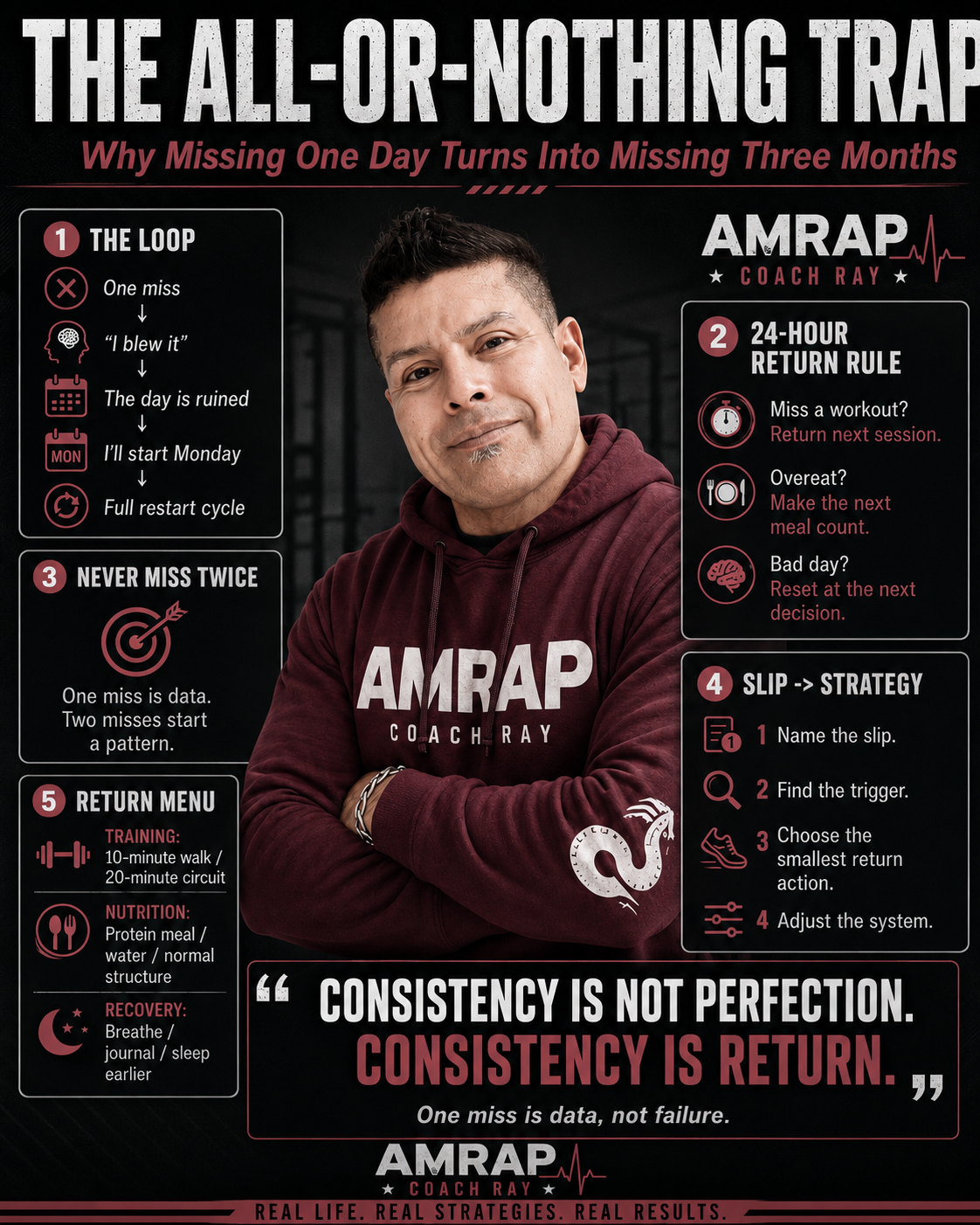
AMRAP Real-Life Reset Series — Entry 5 of 6
The problem is not that you missed one workout.
The problem is what you decided that miss meant.
One skipped workout is not a disaster.
One imperfect meal is not a collapse.
One low-energy day is not proof that you failed.
One weekend off schedule is not a reason to abandon the entire plan.
But for many adults, one mistake does not stay one mistake.
It becomes a story.
The story sounds like:
“I already messed up.”
Then:
“The day is ruined.”
Then:
“The week is ruined.”
Then:
“I’ll restart Monday.”
And Monday becomes one of the most dangerous words in fitness.
Because Monday often gives people permission to quit on Tuesday, Wednesday, Thursday, Friday, Saturday, and Sunday.
That is the all-or-nothing trap.
It is the mindset that turns a small break in the plan into a full identity collapse.
The person does not simply miss a workout.
They become “someone who can’t stay consistent.”
They do not simply eat one meal outside the plan.
They become “someone with no discipline.”
They do not simply have a hard week.
They become “a failure.”
That interpretation causes more damage than the original mistake.
This article is about learning how to stop turning small misses into long absences.
Because long-term success is not built by never slipping.
It is built by returning faster.
Opening Device: The Meal That Became a Month
It starts with one meal.
You had a stressful day.
You were tired.
You were hungry.
You ate more than planned.
Maybe it was pizza.
Maybe it was fast food.
Maybe it was snacks after dinner.
Maybe it was something you told yourself you “shouldn’t” have.
The meal ends.
But instead of moving on, the mind begins negotiating.
“I blew it.”
Then comes the dangerous logic:
“Since I already ruined today, I might as well keep going.”
Now one meal becomes a night.
The night becomes a weekend.
The weekend becomes:
“I’ll start fresh Monday.”
Monday comes.
You feel heavy, guilty, and behind.
You try to compensate.
You cut food too aggressively.
You train too hard.
You promise yourself this time will be different.
But the pressure is already too high.
By Wednesday, you are tired again.
By Friday, the cycle is back.
The original problem was one imperfect meal.
The real damage came from the belief that imperfection canceled the plan.
What Is All-or-Nothing Thinking?
All-or-nothing thinking is the habit of interpreting behavior in extremes.
Perfect or failed.
On plan or off plan.
Disciplined or lazy.
Successful or hopeless.
Clean eating or ruined.
Full workout or nothing.
Good day or bad day.
This mindset leaves no middle ground.
And the middle ground is where real consistency lives.
Recent exercise-behavior research describes all-or-nothing thinking with exercise as the pattern of choosing not to exercise at all when the original plan cannot be followed perfectly. In plain language: if the plan was 60 minutes and only 20 minutes are available, the all-or-nothing mind chooses zero instead of twenty.
That matters because most adult lives are imperfect.
Work runs late.
Sleep gets interrupted.
Children need help.
Stress spikes.
Meals are not always ideal.
Energy changes.
Plans break.
A fitness system that only works on perfect days is not a system.
It is a fantasy.
The Hidden Cost of Perfectionism
Perfectionism often sounds like a high standard.
Sometimes it is.
High standards can be useful.
They can help a person train hard, eat better, and pursue excellence.
But perfectionism becomes harmful when the standard is so rigid that anything less than perfect feels worthless.
That is where adults get stuck.
They say:
“If I can’t do the full workout, why bother?”
“If I ate badly at lunch, the day is ruined.”
“If I miss Monday, I’ll start next week.”
“If I can’t do it perfectly, I don’t want to do it at all.”
The problem is not the desire for excellence.
The problem is the inability to value partial success.
But partial success is not weakness.
Partial success is how real-life consistency is built.
A 20-minute workout on a chaotic day is not a failed 60-minute workout.
It is a successful 20-minute workout.
A protein-centered dinner after an imperfect lunch is not pointless.
It is a return.
A 10-minute walk after a stressful day is not “nothing.”
It is identity maintenance.
The all-or-nothing mindset only respects perfect execution.
The professional mindset respects useful execution.
The Science Signal: Lapses Are Normal. Return Speed Matters.
Behavior change is rarely perfectly linear.
People miss workouts.
People have eating episodes they did not plan.
People experience stress, travel, fatigue, and schedule disruptions.
That does not mean they are broken.
It means they are human.
Self-monitoring has long been used in behavioral weight-loss programs because it helps people observe patterns instead of relying only on emotional memory. A systematic review found support for self-monitoring of diet, physical activity, and weight as part of behavioral weight-loss treatment.
Planning also matters. Implementation intentions—specific “if–then” plans—have been studied as a way to help adults follow through with physical activity. A systematic review and meta-analysis found that implementation-intention strategies can improve adult physical-activity practice, though planning works best when it is realistic and repeated.
Self-compassion is relevant too. A review of the literature linked self-compassion with healthier body-image and eating-related outcomes, which supports the idea that people do not need self-attack to improve.
The coaching translation is simple:
The goal is not to avoid every lapse. The goal is to prevent a lapse from becoming a lifestyle.
That is a skill.
And it can be trained.
Why “Restart Monday” Is So Dangerous
“Restart Monday” feels clean.
It feels organized.
It gives the mind a future date where everything becomes perfect again.
But psychologically, it often does something harmful.
It gives permission to abandon the present.
If today is already ruined, then today no longer matters.
If the week is already ruined, then the next several days become disposable.
This is how one off-plan moment becomes a full relapse.
The professional correction is:
Never wait for a calendar reset when a behavioral reset is available right now.
You do not need Monday.
You need the next decision.
The All-or-Nothing Loop
The loop usually looks like this:
Step 1: High-pressure plan
The person creates a plan that requires near-perfect execution.
Step 2: Real life interrupts
Work, stress, sleep, family, emotion, travel, or fatigue breaks the plan.
Step 3: The miss becomes a meaning
The person interprets the miss as failure.
Step 4: Shame rises
The person feels disappointed, embarrassed, or hopeless.
Step 5: The plan is abandoned
The person stops training, overeats, avoids tracking, or disconnects.
Step 6: The restart fantasy appears
The person promises a stricter restart later.
Step 7: The cycle repeats
The new plan is again too rigid, and the next imperfection starts the loop again.
The solution is not more intensity.
The solution is more resilience.
The AMRAP Return-Speed Principle
This is the central framework.
Consistency is not perfection. Consistency is return speed.
The faster you return, the less damage a lapse can create.
If you miss one workout and return the next day, you are consistent.
If you eat one unplanned meal and return at the next meal, you are consistent.
If you have a hard weekend and return Monday morning without punishment, you are consistent.
Consistency does not mean every line on the calendar is perfect.
It means the gaps stay small.
The all-or-nothing person asks:
“Did I fail?”
The professional asks:
“How fast did I return?”
That question changes everything.
The 24-Hour Return Rule
Here is the rule:
After any miss, return within 24 hours.
Not with punishment.
Not with panic.
Not with starvation.
Not with a heroic workout.
Return with the next reasonable action.
If you miss a workout
Do not double the next session to punish yourself.
Return with:
the next scheduled workout
a 20-minute minimum session
a walk
mobility
one basic strength circuit
If you overeat
Do not skip the next meal.
Return with:
protein
produce
water
a normal meal structure
a short walk if helpful
If sleep falls apart
Do not force a brutal training session to prove toughness.
Return with:
lower training cost
hydration
light movement
earlier downshift that night
If stress derails you
Do not wait until you feel calm to reenter the plan.
Return with:
breathing
journaling
a walk
one simple prepared meal
asking for support
The rule is not:
“Fix everything in 24 hours.”
The rule is:
“Do not let the break become your new identity.”
The “Never Two” Standard
Another practical standard:
Never miss the same habit twice in a row when it is reasonably within your control.
Miss one workout?
Return with the next one.
Miss one protein-centered meal?
Make the next meal protein-centered.
Miss one walk?
Walk tomorrow.
Miss one bedtime boundary?
Protect the next night.
This is not about obsession.
It is about preventing drift.
A single miss is a data point.
Repeated misses become a pattern.
The “Never Two” standard protects the pattern.
The Minimum Counts
This is where many people struggle.
They believe a reduced version does not count.
But minimums are not meaningless.
Minimums are identity preservers.
A minimum workout may be:
10 minutes of walking
2 rounds of squats, push-ups, rows, and carries
15 minutes on the bike
5 mobility drills
one set of each major movement pattern
A minimum nutrition return may be:
one protein-centered meal
one bottle of water
one planned breakfast
one grocery pickup
one meal eaten seated and intentionally
A minimum recovery return may be:
5 minutes of breathing
phone off 30 minutes earlier
one short journal entry
a quiet walk
a consistent wake time
The minimum is not the ceiling.
It is the floor.
And floors matter because they prevent free fall.
Stop Turning Data Into Drama
A mistake is information.
It tells you something.
Maybe the plan was too rigid.
Maybe lunch was too small.
Maybe stress was too high.
Maybe sleep was too poor.
Maybe the workout was scheduled at the wrong time.
Maybe the weekend had no structure.
Maybe the environment was not prepared.
That is useful.
But the all-or-nothing mind turns data into drama.
Instead of asking:
“What happened?”
It says:
“What is wrong with me?”
That question rarely helps.
A better question is:
“What condition made this miss more likely, and what can I adjust?”
This is how professionals think.
They do not moralize every mistake.
They study it.
Then they update the system.
Accountability vs. Self-Punishment
Accountability means telling the truth and adjusting behavior.
Self-punishment means using pain or shame to pay for imperfection.
They are not the same.
Accountability sounds like:
I missed the workout.
I know why it happened.
I will return tomorrow.
I need a better backup plan.
I will protect my sleep tonight.
Self-punishment sounds like:
I’m pathetic.
I ruined everything.
I have no discipline.
I need to suffer tomorrow.
I’ll starve or do extra cardio to make up for it.
One builds a better system.
The other creates emotional damage.
Top-tier coaching does not remove standards.
It removes cruelty from the process.
Why “Making Up for It” Often Backfires
After a mistake, people often try to compensate.
They may:
skip meals
slash calories
do excessive cardio
train through exhaustion
remove all enjoyable food
set a stricter plan
That can feel responsible.
But it often creates the next crash.
Severe restriction can increase hunger.
Punishment workouts can increase fatigue.
All-or-nothing rules increase pressure.
Pressure increases the chance of another lapse.
The better approach is not compensation.
It is normalization.
Return to the plan.
Eat normally.
Train reasonably.
Walk.
Hydrate.
Sleep.
You do not need to pay for the mistake.
You need to stop extending it.
The Middle Path Is Not Mediocrity
Many high-achieving people dislike moderation because it sounds weak.
They want intensity.
They want standards.
They want proof that they are serious.
But the middle path is not laziness.
The middle path is skill.
It is the ability to adapt without quitting.
It is the ability to reduce the plan without abandoning the goal.
It is the ability to train for 20 minutes when 60 is unavailable.
It is the ability to eat a reasonable dinner after a difficult lunch.
It is the ability to protect the next step instead of dramatizing the last one.
Mediocrity is not doing the minimum on hard days.
Mediocrity is quitting because the ideal was unavailable.
The AMRAP Slip-to-Strategy Method
When you slip, use this framework.
1. Name the slip without drama
Example:
“I missed today’s workout.”
Not:
“I’m a failure.”
2. Identify the condition
Ask:
Was I tired?
Was I unprepared?
Was I hungry?
Was I stressed?
Was the plan unrealistic?
Was the environment working against me?
3. Choose the smallest return action
Examples:
10-minute walk
next planned meal
water bottle
5-minute mobility
write tomorrow’s workout
4. Adjust the system
Examples:
pack clothes earlier
create a backup meal
move workout time
reduce weekday volume
schedule recovery
ask for accountability
5. Record the return
This matters.
Write:
“I returned.”
That creates evidence.
The return is the win.
The Return Menu
When you feel off track, do not wait to feel motivated.
Choose from the menu.
Training return
10-minute walk
20-minute full-body circuit
Zone 2 bike
mobility flow
sled drag
one lift and two accessories
Nutrition return
protein-centered breakfast
water before coffee
planned lunch
grocery pickup
fruit and Greek yogurt
simple dinner plate
Recovery return
lights down earlier
phone away
5-minute journal
slow breathing
short walk outside
stretch and sleep
Mindset return
one honest note
one text to accountability partner
one sentence: “The next choice matters.”
one review of what triggered the slip
The menu exists so your return does not depend on creativity during stress.
The Weekly “Gaps Stayed Small” Review
At the end of the week, do not only ask:
“Was I perfect?”
Ask:
Where did I miss?
How quickly did I return?
What helped me return?
What made the gap bigger?
What system needs adjustment?
Which minimum protected me?
What is one improvement for next week?
This review trains the skill that most people lack:
repair.
Not perfection.
Repair.
The Emotional Side of All-or-Nothing Thinking
Sometimes all-or-nothing behavior is not just about habits.
It is about emotion.
People may quit because they feel:
ashamed
exposed
tired of trying
afraid of failing again
angry at themselves
discouraged by slow results
embarrassed to ask for help
overwhelmed by how far they think they have to go
This is where compassion matters.
Not softness.
Compassion.
Self-compassion is not saying:
“It does not matter.”
It says:
“This matters, and I will respond without destroying myself.”
That is stronger.
That response helps people keep going after difficult moments instead of disappearing into shame.
Coaching Reality: The Return Is the Program
Many people think the program is the workout plan.
Or the nutrition plan.
Or the calorie target.
Or the step goal.
Those matter.
But for real adults, the return is part of the program.
Because disruption is guaranteed.
You will have:
stressful weeks
travel
illness
family obligations
low motivation
poor sleep
emotional triggers
schedule changes
A program that does not teach return skills is incomplete.
If your plan only tells you what to do when life is perfect, it is not ready for your life.
A complete coaching system teaches:
Plan A
Plan B
minimums
rescue meals
shortened workouts
accountability
relapse prevention
recovery weeks
return rules
That is how consistency becomes realistic.
Common Mistakes—and the Professional Correction
Mistake 1: Treating one miss as failure
Correction: One miss is data. Repeated misses are a pattern. Respond early.
Mistake 2: Waiting until Monday
Correction: Return at the next decision.
Mistake 3: Punishing yourself after overeating
Correction: Resume normal structure. Do not create the next rebound.
Mistake 4: Refusing minimum workouts
Correction: Minimums protect identity and momentum.
Mistake 5: Using shame as accountability
Correction: Accountability tells the truth and adjusts the plan.
Mistake 6: Chasing a stricter restart
Correction: Build a more resilient system, not a harsher one.
Mistake 7: Believing consistency means never slipping
Correction: Consistency means the gaps stay small.
The Seven-Day Return-Speed Challenge
For one week, do not aim for perfect.
Aim for fast returns.
Day 1: Identify your all-or-nothing phrase
Examples:
“I blew it.”
“I’ll start Monday.”
“The day is ruined.”
“I have no discipline.”
Replace it with:
“The next choice matters.”
Day 2: Create your minimum workout
Write a 10–20-minute version.
Day 3: Create your minimum meal
Choose one protein-centered meal you can use after a slip.
Day 4: Practice a return on purpose
If the day changes, use Plan B without drama.
Day 5: Track one gap
Notice how long the gap lasted.
Not to judge.
To learn.
Day 6: Ask for accountability
Tell someone:
“If I miss, I need help returning—not help shaming myself.”
Day 7: Review
Ask:
Did I return faster?
What helped?
What made the gap longer?
What system needs improvement?
The goal is not a flawless week.
The goal is becoming someone who comes back quickly.
The AMRAP Return Contract
Use this:
I will not turn one mistake into an identity.
I will not wait for Monday when the next decision is available now.
I will value minimum actions because they protect momentum.
I will use mistakes as data, not evidence that I am hopeless.
I will practice return speed.
I will stop punishing myself for being human.
I will keep the gaps small.
I will remember that consistency is not perfection.
Consistency is return.
That is the standard.
Self-Assessment
Answer honestly:
Do I quit when I cannot do the full plan?
Do I treat one imperfect meal as permission to keep going off track?
Do I use the phrase “I’ll start Monday” often?
What is my most common all-or-nothing thought?
Do I have a minimum workout?
Do I have a minimum meal?
Do I punish myself after mistakes?
How long does it usually take me to return?
What conditions make my gaps longer?
What would change if I returned within 24 hours every time?
Your answers are not judgment.
They are your return map.
Closing: The People Who Win Are Not Perfect
The people who win long-term are not the people who never miss.
They are the people who do not disappear after missing.
They return.
They adjust.
They learn.
They keep the gap small.
They stop turning every imperfect moment into a verdict on their character.
They understand that one workout matters, but one missed workout does not define them.
One meal matters, but one imperfect meal does not erase the plan.
One hard week matters, but one hard week does not mean the year is lost.
This is the skill most people were never taught.
They were taught intensity.
They were taught restriction.
They were taught motivation.
They were taught “no excuses.”
But they were not taught repair.
They were not taught return.
They were not taught how to stay in the game after the first break in perfection.
So learn that now.
When the plan breaks, return.
When the meal is imperfect, return.
When the workout is missed, return.
When the week gets difficult, return.
Not Monday.
Not next month.
Not after you punish yourself enough.
Return at the next reasonable opportunity.
Because the goal is not to build a perfect streak.
The goal is to build a durable identity.
And durable people do not avoid every fall.
They get up faster.
Resources
Segar ML, et al. The secret life of all-or-nothing thinking with exercise: new insights into an overlooked barrier. This paper defines exercise-related all-or-nothing thinking as choosing not to exercise when the original plan cannot be followed perfectly.
Burke LE, Wang J, Sevick MA. Self-monitoring in weight loss: a systematic review of the literature. This review summarizes evidence on self-monitoring of diet, physical activity, and weight in behavioral weight-loss treatment.
Silva MAV, São-João TM, Brizon VC, Franco DH, Mialhe FL. Impact of implementation intentions on physical activity practice in adults: a systematic review and meta-analysis of randomized clinical trials. This review found that if–then planning can support adult physical-activity practice.
Braun TD, Park CL, Gorin A. Self-compassion, body image, and disordered eating: a review of the literature. This review links self-compassion with healthier body-image and eating-related outcomes.
Centers for Disease Control and Prevention. Adult Activity: An Overview. The CDC summarizes adult physical-activity guidance, including weekly aerobic and muscle-strengthening recommendations.