
The 40+ Weekly Template: Train Hard Enough to Progress, Smart Enough to Recover
(AMRAP Longevity Series — Post 5 )
The problem after 40 isn’t effort.
It’s cost.
Most adults who train consistently aren’t lacking discipline.
They’re lacking a system that matches real life.
Because after 40, training isn’t happening in a vacuum.
It’s happening inside:
a job
a family schedule
sleep fluctuations
stress spikes
joints with history
recovery windows that are tighter than they used to be
So the question isn’t:
“How much can I do?”
The question is:
“What can I do consistently, progress on, and recover from—for decades?”
That is the 40+ standard.
This post is a pillar-style introduction to minimal effective dose training—not minimal results.
Minimal effective dose means:
enough stimulus to adapt
with a cost you can pay
inside a real adult life
Later deep dives will include:
strength programming for fat loss vs muscle gain
deload strategies that actually work
integrating sled, Earthquake Bar, and prehab without clutter
travel-week templates
injury history modifications
Today we build the operating system.
Opening Device: The Week Where Your Plan Collapsed
Most people don’t stop training because they stop caring.
They stop because their plan breaks under pressure.
A hard week hits:
sleep drops
stress rises
meetings stack
parenting demands spike
And the plan you wrote for a perfect life becomes impossible.
So you miss a day.
Then two.
Then you feel behind.
Then you try to “make up” for it.
Then you go too hard.
Then you get sore and irritated.
Then you miss more.
That’s the loop.
The loop isn’t a motivation problem.
It’s a design problem.
Professionals don’t build plans that require perfect weeks.
They build plans that survive imperfect weeks.
The Longevity Version of Training: Three Goals
If we strip away ego and trends, the 40+ training mission is simple:
Maintain and build strength (protect muscle, joints, bone, and function)
Build an aerobic base (recovery engine, heart health, fatigue resistance)
Stay pain-resilient and trainable (avoid flare-ups that kill consistency)
A good weekly template must serve all three.
Not in theory.
In practice.
The Science Signal (What the Evidence Consistently Supports)
1) Strength training supports health across the lifespan
Resistance training is associated with improvements in strength, function, and a wide range of health outcomes, and it’s a foundational recommendation in healthy aging discussions.
2) Cardiorespiratory fitness is strongly associated with longevity outcomes
Higher fitness levels are consistently associated with lower morbidity and mortality risk across large datasets.
3) Overuse and breakdown often come from load errors
Training problems are frequently not from training itself—but from how load increases (volume/intensity/frequency spikes) relative to tolerance.
Coaching translation:
You don’t need more brutality.
You need better structure and smarter progression.
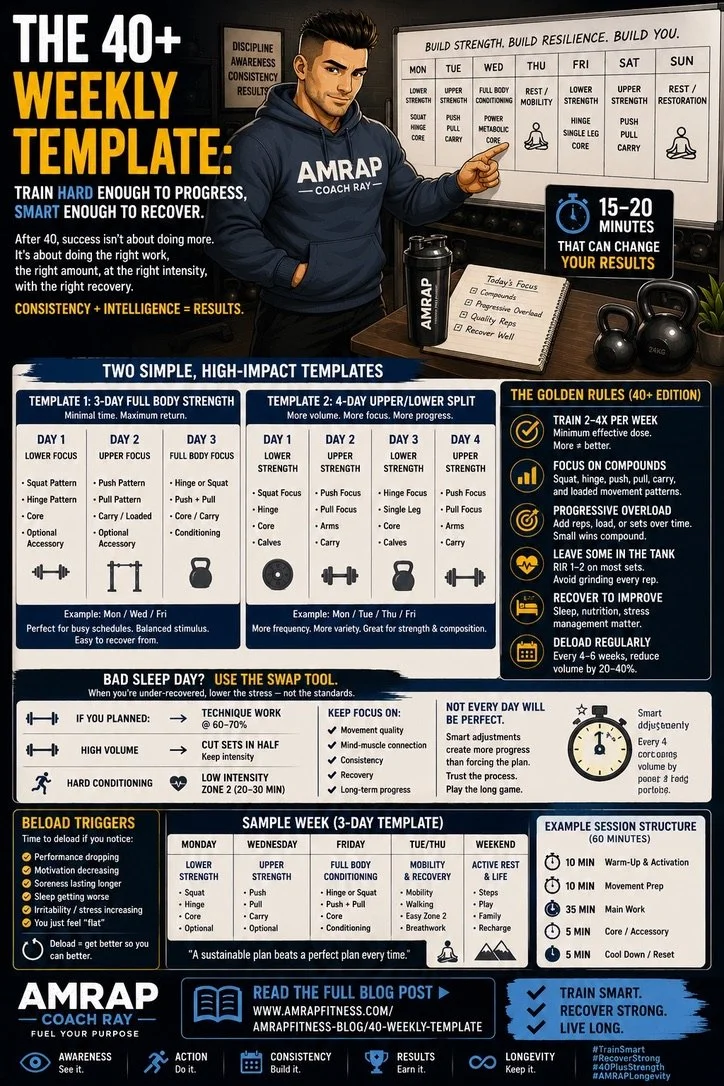
The AMRAP 40+ Weekly Template System
This is the system.
Simple.
Repeatable.
Expandable.
We’ll build it in layers:
Base Template (3 days strength + 2 days Zone 2)
Upgrade Template (4 days strength + 2 days Zone 2)
Bad Sleep / High Stress Rules
Deload Triggers
Minimum Plan for Hard Weeks
Template A: The 3-Day Strength Week (Best for Busy Adults)
If you can commit to three strength sessions, you can progress for years.
Weekly schedule
Mon — Strength A (Lower + Push)
Wed — Strength B (Hinge + Pull)
Fri — Strength C (Full Body + Carry)
Tue/Thu — Zone 2 (20–45 min)
Daily — 7–10 min walk after meals (optional but powerful)
Strength A (Lower + Push)
Squat pattern (or split squat): 3–5 sets of 3–8
Horizontal press: 3–5 sets of 4–10
Accessory: 2–3 sets (core or upper back)
Strength B (Hinge + Pull)
Hinge pattern (deadlift/RDL): 3–5 sets of 3–8
Pull pattern (row/pull-down): 3–5 sets of 6–12
Accessory: 2–3 sets (hamstring/carry/core)
Strength C (Full Body + Carry)
Single-leg or front-loaded squat: 3–4 sets of 5–8
Overhead or incline press (joint-friendly): 3–4 sets of 5–10
Carry (farmer/suitcase): 4–6 rounds of 20–45 sec
Intensity rule
Most sets stop 1–3 reps in reserve.
If you train to failure constantly, the cost becomes too high.
The goal is progress you can recover from.
Template B: The 4-Day Strength Week (For Higher Tolerance)
This template adds volume while protecting recovery.
Weekly schedule
Mon — Lower 1 (Squat emphasis)
Tue — Upper 1 (Push/Pull)
Thu — Lower 2 (Hinge emphasis)
Fri — Upper 2 (Shoulder + Back + Carry)
Wed/Sat — Zone 2 (20–45 min)
Lower 1
Squat: 4–6 sets of 3–6
Split squat or step-down: 2–3 sets of 6–10
Core: 2–3 sets
Upper 1
Bench or incline: 4–6 sets of 4–8
Row: 4–6 sets of 6–12
Shoulder health: 2–3 sets
Lower 2
Hinge: 4–6 sets of 3–6
Posterior chain accessory: 2–3 sets
Calves/tibialis (optional): 2 sets
Upper 2
Overhead press (joint-friendly): 3–5 sets of 5–10
Pull: 3–5 sets
Carry: 4–6 rounds
Again:
Most work is not failure.
You’re building capacity, not proving toughness.
The “Bad Sleep Day” Rules (Anti-Fragile Programming)
If you slept poorly or stress is high, you do NOT default to punishment.
You default to protection.
Rule 1 — Keep training, reduce cost
Cut volume ~30–40%
Keep technique crisp
Avoid grinding reps
Rule 2 — Swap intensity for Zone 2
Zone 2 or long walk instead of high intensity
Rule 3 — No makeup workouts
You don’t stack missed volume on top of a stressed system.
That’s how injuries happen.
Deloading: The Longevity Multiplier
Deloading is not weakness.
It is how you bank progress.
Simple deload rule (every 4–8 weeks)
Reduce volume 30–50%
Keep some intensity but fewer sets
Focus on quality
Deload triggers (do not ignore)
If 2+ appear for 7–10 days:
performance dropping
soreness lingering
irritations increasing
sleep quality decreasing
motivation turning into dread
Deload before you’re forced to.
The Minimum Plan for Hard Weeks (This is the real pro move)
Most people lose months because they think:
“If I can’t do it all, I won’t do anything.”
Professionals do the opposite.
They protect the identity.
The Minimum Week
2 strength sessions (short, full-body)
2 Zone 2 sessions (20–30 min)
Daily movement (even 10 minutes)
Protein at each meal
Sleep window protected
That’s enough to maintain momentum.
Hard weeks don’t become hard seasons.
How to Progress Without Burning Out
Progression should be boring.
Boring is sustainable.
Choose ONE progression variable each block:
Add 1 rep per set
Add 2.5–5 lbs
Add 1 set (only if recovery supports it)
Improve technique and range
Avoid stacking multiple progression variables at once.
Common Mistakes (and the Pro Fix)
Mistake 1: Too much intensity too often
Fix: keep most work 1–3 reps in reserve.
Mistake 2: No Zone 2 base
Fix: 2–3 sessions/week, conversational pace.
Mistake 3: No deload plan
Fix: schedule it or use triggers.
Mistake 4: Trying to train like your 20s
Fix: train hard enough, recover hard enough.
Mistake 5: No minimum plan
Fix: protect identity during chaos.
Self-Assessment (Reader Tool)
Answer honestly:
Does my plan survive a stressful week?
Do I train too close to failure too often?
Do I have a Zone 2 habit—or only intensity?
Do I deload before I break?
Do I have a minimum plan when life hits?
Your answers aren’t judgment.
They’re your next upgrade.
Closing: The Goal Is Decades
The best training plan is the one you can:
repeat
progress
recover from
…for decades.
Train hard enough to move forward.
Recover smart enough to keep going.
That’s the 40+ standard.
Resources
Behm DG, et al. Resistance training and health outcomes across the lifespan (review). 2017. https://pubmed.ncbi.nlm.nih.gov/28959731/
Lang JJ. Cardiorespiratory fitness predicts morbidity and mortality: overview of meta-analyses. 2024. (As referenced in your earlier series framework.)
Gabbett TJ. The training—injury prevention paradox. 2016. https://pubmed.ncbi.nlm.nih.gov/26758673/
American College of Sports Medicine guidance on exercise prescription across adult populations (foundational consensus references).