Thanksgiving Without the Food Hangover: The AMRAP Holiday Plate Strategy
AMRAP Holiday Balance Series — Entry 4 of 6
Thanksgiving dinner is not the problem.
The way we build the entire day around Thanksgiving dinner can become the problem.
Think about the traditional strategy.
Wake up.
Skip breakfast.
Maybe work out extra hard.
Tell yourself:
“I’m saving my calories.”
Stay hungry.
Pick at food while cooking.
Have a drink.
Eat appetizers.
Finally sit down ravenous.
Build a plate large enough for three people.
Eat quickly.
Go back for seconds because everyone else does.
Have dessert.
Have another dessert.
Sit on the couch feeling miserable.
Then somebody pulls the leftovers back out three hours later.
And suddenly Thanksgiving dinner has become an all-day endurance event.
Then Friday comes.
There are leftovers.
Saturday comes.
There is another family gathering.
Sunday becomes:
“Well, I’ll get back on track Monday.”
That is exactly what we are trying to prevent.
Not Thanksgiving.
Not stuffing.
Not pie.
Not traditions.
We are preventing one celebration from becoming a four-day nutritional disappearance.
You should be able to enjoy Thanksgiving.
You should be able to eat foods you genuinely love.
You should be able to sit at the table with your family without mentally calculating every bite.
And you should also be able to leave the table without feeling like you need to unbutton your pants, lie completely still, and apologize to your digestive system.
There is a middle ground.
That middle ground is what this article is about.
Opening Device: You Do Not Need to Earn Thanksgiving
Thanksgiving morning.
You wake up thinking:
“Big dinner tonight.”
Then comes the negotiation.
Maybe I should skip breakfast.
Maybe I should do extra cardio.
Maybe I should barely eat lunch.
Maybe I can “save” 2,000 calories.
And on the surface, the logic seems reasonable.
If dinner will be large, why not eat as little as possible beforehand?
But there is a difference between planning around a large meal and intentionally arriving at that meal extremely hungry.
You know what happens when you become genuinely ravenous.
Your decision-making changes.
Food smells better.
You eat faster.
Portions get bigger.
Waiting feels harder.
The appetizer tray suddenly becomes irresistible.
You are not weak.
You are hungry.
That is biology.
So let me make something clear:
You do not need to earn Thanksgiving dinner.
You do not need punishment cardio.
You do not need starvation.
You do not need to “bank” every calorie you possibly can.
And you do not need to spend Friday trying to repay a debt to your body.
If you normally eat breakfast, having a reasonable breakfast is fine.
If you normally do not eat breakfast, I am not telling you that Thanksgiving is the day you suddenly need one.
Research does not support the simplistic claim that everyone must eat breakfast to control body weight; randomized-trial evidence has found that adding breakfast is not inherently a weight-loss strategy.
The point is simpler:
Do not deliberately create extreme hunger as your holiday strategy.
Arrive ready to enjoy dinner.
Not desperate to attack it.
Thanksgiving Is a Meal, Not a Metabolic Emergency
One holiday meal will not determine your health.
Your repeated pattern does.
That is good news.
Because it means you do not have to make Thanksgiving nutritionally perfect.
You need to keep it in perspective.
Research on festive periods shows that average holiday weight gain tends to be modest—often around a pound or two rather than the mythical five, ten, or twenty pounds people casually claim—although there is wide individual variation.
The bigger concern is the repeated pattern:
Thanksgiving.
Leftovers.
December parties.
Christmas.
More leftovers.
New Year's.
Then January starts with the feeling:
“I need to repair the damage.”
That is why our strategy is not about controlling one dinner with military precision.
It is about maintaining enough structure around the dinner that the season does not swallow the habits you spent the year building.
Did You Know? Your Eyes Can Influence Your Stomach
Portion size matters.
Strong evidence from randomized studies shows that when adults are served larger portions, they generally consume more food and energy. Smaller pre-portioned amounts tend to reduce intake.
That is incredibly relevant on Thanksgiving.
Because Thanksgiving plates are often enormous.
And the food is often served family-style or buffet-style.
So instead of asking:
“Can I eat stuffing?”
Ask:
“How much stuffing do I actually want?”
Instead of:
“Can I have mashed potatoes?”
Ask:
“What portion lets me enjoy them without crowding out everything else?”
Food does not have to disappear.
Automatic portions do.
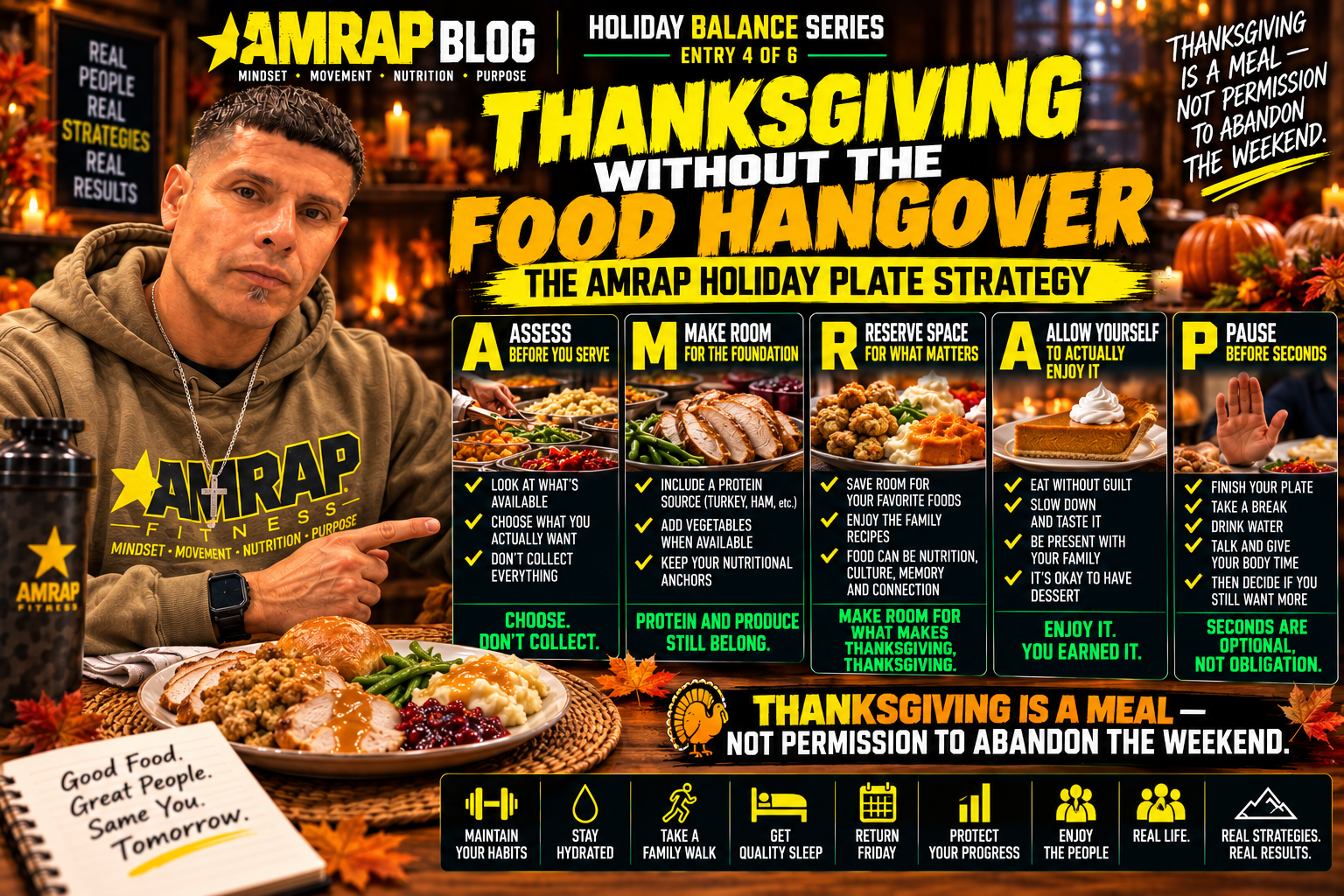
The AMRAP Thanksgiving Plate Strategy
Here is our practical system.
No food scale.
No calorie app required at the table.
No measuring cups next to Grandma.
Use AMRAP.
A — ASSESS BEFORE YOU SERVE
Do not immediately start building the plate.
Look first.
What is available?
What do you genuinely care about?
What is there simply because it is Thanksgiving?
This is where people often make the first mistake.
They take:
turkey
ham
rolls
stuffing
potatoes
macaroni
sweet potatoes
cranberry sauce
every casserole
every appetizer
every side
because they feel like Thanksgiving requires sampling everything.
It does not.
Before touching the serving spoon, ask:
“What am I actually excited to eat?”
Maybe stuffing is your favorite.
Maybe mashed potatoes do not matter much to you.
Maybe you love your aunt's sweet potatoes.
Maybe dinner rolls are something you can have any day.
Maybe the macaroni and cheese is the reason you have been looking forward to this meal.
There is no correct answer.
The point is to choose instead of collect.
M — MAKE ROOM FOR THE FOUNDATION
Thanksgiving food can absolutely include structure.
Start by identifying:
A protein source
Turkey.
Ham.
Fish.
Roast.
Beans or another plant protein.
Whatever fits your family's table.
Produce when it is available
Vegetables.
Salad.
Greens.
Roasted vegetables.
Fruit.
Again, this is not a mandate that half of your Thanksgiving plate must be raw broccoli.
It is Thanksgiving.
Relax.
The goal is simply to keep some of your usual nutritional anchors in the meal.
Then make room for the holiday foods.
Stuffing.
Potatoes.
Macaroni and cheese.
Cultural dishes.
Family recipes.
Those foods belong too.
Protein Is Helpful—but It Is Not a Magic Shield
Protein deserves a place at the meal because it supports muscle and can contribute to fullness.
A systematic review in adults with overweight or obesity found that higher-protein diets enhanced fullness or satiety in several studies, although the evidence was heterogeneous and the authors rated its overall certainty as limited.
So:
Yes, have protein.
No, you do not need to consume a giant protein shake right before Thanksgiving dinner to “block” hunger.
In fact, studies of protein preloads do not consistently show reductions in total energy intake, and in older men one whey preload actually increased total intake because the calories from the drink were not fully offset at the meal.
That is a good reminder.
Nutrition strategies should make sense—not just sound fitness-like.
Eat the turkey.
You probably do not need to turn Thanksgiving into a protein-preload experiment.
R — RESERVE SPACE FOR WHAT MATTERS
This may be the most important part.
Do not fill the plate completely with “healthy” food and then feel deprived.
And do not fill it completely with every holiday food simply because it is available.
Reserve room for the foods that make Thanksgiving Thanksgiving for you.
Your mother's stuffing.
Your grandfather's recipe.
A cultural dish your family makes once a year.
The macaroni you have been thinking about all week.
That food has value beyond its nutrient profile.
Food can be:
nutrition
culture
memory
family
celebration
connection
A healthy relationship with nutrition has room for all of those things.
The goal is not:
“How can I make Thanksgiving look exactly like Tuesday's meal prep?”
The goal is:
“How can I enjoy Thanksgiving while still feeling like myself?”
A — ALLOW YOURSELF TO ACTUALLY ENJOY IT
This is where people sabotage themselves mentally.
They choose the food.
Then feel guilty while eating it.
They think:
“I shouldn't be having this.”
Then eat it anyway.
Then feel worse.
Then decide they already failed.
If you chose it intentionally:
Eat it.
Taste it.
Enjoy it.
Slow down enough to experience it.
Mindful-eating research is not magic, but a 2026 systematic review and meta-analysis found that mindfulness and mindful-eating interventions modestly reduced food intake in controlled studies, although the effect was larger in laboratory settings and did not significantly change subjective hunger or fullness.
The practical lesson is not:
Meditate over your turkey.
It is:
Pay attention while you eat.
Conversation is good.
Laughter is good.
But every few minutes, check back in.
How does the food taste?
How does your stomach feel?
Do you still want more?
That awareness matters.
P — PAUSE BEFORE SECONDS
This may be the most effective Thanksgiving habit in the entire article.
You finish your plate.
Do not immediately stand up and refill it.
Pause.
Talk.
Drink some water.
Give yourself a little time.
Then ask:
“What do I want more of?”
Not:
“Should I get another whole plate?”
Maybe you genuinely want more turkey.
Great.
Maybe more stuffing.
Fine.
Maybe you realize you are actually satisfied.
Also fine.
Seconds are not forbidden.
They are optional.
There is a big psychological difference between:
“I cannot have more.”
and:
“I can have more if I still want it.”
The second creates choice.
And choice is what moderation is built on.
The First Plate Does Not Need to Be a Masterpiece
Do not overthink the perfect Thanksgiving plate.
If you start trying to mathematically optimize:
33% protein.
27% vegetables.
19% stuffing.
11% sweet potatoes.
You are going to miss the point.
Use visual common sense.
Take reasonable portions.
You can always go back.
That one principle takes advantage of what portion-size research consistently shows:
When the starting portion gets larger, people generally eat more.
Start reasonable.
Let seconds remain available.
Did You Know? Smaller Does Not Automatically Mean Hungrier All Day
People often fear that taking a somewhat smaller portion will cause them to compensate massively later.
That does not always happen.
In a randomized crossover trial in adults with overweight, reducing breakfast portion size increased subjective hunger after the larger reduction, but participants did not compensate by eating more at lunch or over the remainder of the day.
That does not prove the exact same thing happens at Thanksgiving.
But it reinforces an important idea:
Your body does not require you to take the largest possible portion now because you fear you will never survive otherwise.
More remains available.
Appetizers Count
One of the easiest ways to lose perspective on Thanksgiving is to mentally treat appetizers as if they happened in another dimension.
Cheese.
Crackers.
Nuts.
Chips.
Dips.
Meatballs.
Bread.
Alcohol.
Then:
“Dinner hasn't even started yet.”
Technically true.
Physiologically?
You have been eating for two hours.
There is nothing wrong with appetizers.
But acknowledge them.
If dinner is soon, you may want a few things you genuinely enjoy rather than grazing continuously.
Again:
Choose. Do not collect.
The Kitchen-Grazing Problem
This one gets almost everybody who cooks.
Taste the stuffing.
Taste the potatoes.
Try a piece of turkey.
Grab a roll.
Taste the dessert filling.
Grab another piece of cheese.
None of these feels like eating.
But your body does not care whether you sat at the table.
Food is food.
If you are cooking:
Taste what needs tasting.
But notice the difference between cooking and grazing.
You do not need to become rigid.
You simply need awareness.
The Plate Is Not the Only Source of Calories
Holiday drinks can quietly become a major part of the meal.
Wine.
Beer.
Cocktails.
Eggnog.
Sweetened beverages.
Coffee drinks.
Again, no morality.
But they count.
A systematic review and meta-analysis of controlled alcohol studies found that adults generally did not compensate for alcohol calories by eating less food; alcohol increased both food energy intake and total energy intake. The studies primarily involved younger adults, so we should be cautious about generalizing exact effects across the entire AMRAP age range.
If you drink:
Decide intentionally.
Alternate with water if useful.
Know when you are done.
The holiday does not become more meaningful because you stopped noticing how many drinks you had.
Dessert Is Allowed
Let me save everyone some anxiety.
You can have dessert.
If you want it.
The better strategy is not:
“I cannot have pie.”
It is:
“Which dessert do I actually care about?”
Look first.
Choose.
Maybe one slice.
Maybe two smaller portions of things you love.
Maybe you genuinely do not want dessert.
All three are acceptable.
The problem comes when dessert becomes:
one piece of pie
plus cookies
plus brownies
plus candy
plus another slice later
not because you wanted all of it, but because all of it was there.
That is the same theme we keep returning to:
Availability is not obligation.
The Thanksgiving “Worth It” Test
Before serving something, rate it mentally.
5 — I wait all year for this.
Absolutely.
4 — I really enjoy this.
Worth making room for.
3 — Pretty good.
Your choice.
2 — It is there.
Probably skip.
1 — I do not even like this.
Why are you eating it?
This is not about calorie mathematics.
It is about maximizing meaning and enjoyment.
If you are going to eat something simply for pleasure, let it actually provide pleasure.
The Comfortably-Full Target
The Thanksgiving goal is not to finish hungry.
It is also not to finish in pain.
There is a zone between the two.
You should be able to say:
“That was an excellent meal. I am satisfied.”
Rather than:
“I physically cannot move.”
Overfullness has become almost comedic Thanksgiving tradition.
We joke about food comas.
Unbuttoning pants.
Falling asleep.
But physical discomfort is not required for holiday enjoyment.
You can stop before misery.
The food will still have been good.
The holiday will still count.
Do You Need to Finish the Plate?
No.
You are an adult.
The Clean Plate Club membership can expire.
If you served too much, leaving something behind is information for next time.
You do not need to use your stomach as a disposal system because food remains on the plate.
Take less initially if food waste bothers you.
That is another reason reasonable first portions work.
Take the Family Walk
Now we get to one of my favorite Thanksgiving traditions.
After dinner:
Go for a walk.
Not because you need to burn off pie.
Not because you ate “bad.”
Not because the treadmill is punishment.
Walk because:
movement feels good
sitting for another four hours usually does not
you can talk with family
you can get outside
it can support post-meal glucose regulation
it creates another holiday memory
Recent systematic-review evidence shows that interrupting prolonged sitting with activity breaks reduces post-meal glucose and insulin responses, with walking breaks among the most effective approaches studied.
A separate meta-analysis found that exercise performed after meals reduced postprandial glucose excursions compared with inactivity, although another later review found the evidence is not yet strong enough to declare one universal pre- versus post-meal timing strategy for every adult.
So the message is not:
“You must walk exactly 17 minutes immediately after pie.”
It is:
A comfortable post-meal walk is a very reasonable habit.
And it is probably better than collapsing into six straight hours of sitting.
Did You Know? Tiny Movement Breaks Can Matter
A 2026 systematic review and meta-analysis found that short bouts of exercise accumulated throughout the day significantly improved post-meal glucose and insulin responses compared with continuous sedentary behavior.
Another 2026 meta-analysis found short activity interruptions reduced postprandial glucose, insulin, and—within the pooled analysis—triglyceride responses in sedentary adults.
Again:
This does not make walking punishment for eating.
It reinforces a broader principle.
Bodies like movement.
Even on Thanksgiving.
The Thanksgiving Workout Question
Should you train Thanksgiving morning?
If you normally train and you want to:
Absolutely.
Train.
Walk.
Ride.
Lift.
Do a Turkey Trot.
Drag a sled.
Have fun.
But I want you to examine the reason.
Good reason:
“Training is part of my routine and I feel great afterward.”
Less useful reason:
“I need to burn enough calories so I deserve dinner.”
Those are psychologically very different.
Exercise is something you do because it supports your health.
It is not admission payment for mashed potatoes.
What If the Holiday Schedule Ruins Your Workout?
Then shorten it.
This is where the all-or-nothing lesson returns.
You planned an hour.
Family arrives early.
You have 20 minutes.
Train for 20.
You planned the gym.
It is closed.
Walk.
Do bodyweight work.
Mobility.
Sled drag at home if you have access.
You are not trying to set a personal record on Thanksgiving.
You are keeping the identity alive.
Thanksgiving for Adults 30 to 70
Our strategy needs to respect different stages of life.
In your 30s
You may be traveling between multiple houses, managing young children, going out the night before Thanksgiving, or juggling several celebrations.
Your major challenge may be environmental chaos.
Plan the basics.
In your 40s
You may be the host.
The cook.
The parent.
The person coordinating everything.
Your challenge may be spending the entire day taking care of everyone else and then eating reactively when you finally stop.
Do not disappear from your own plan.
In your 50s
Cardiometabolic health, maintaining muscle, sleep, recovery, and joint health become increasingly valuable.
Your body may no longer tolerate the combination of huge meals, alcohol, poor sleep, and inactivity the way it once did.
That is not failure.
It is information.
In your 60s and 70s
Protein, muscle preservation, mobility, social connection, and adequate nutrition can become particularly important.
And here is a crucial distinction:
Not every older adult needs to eat less.
Some older adults are at risk of inadequate energy or protein intake.
That is why blanket dieting advice is inappropriate.
The goal should match the individual.
If You Have Diabetes or Another Medical Condition
Thanksgiving nutrition may require more individualized planning if you are managing:
diabetes
kidney disease
heart failure
food allergies
gastrointestinal disease
celiac disease
hypertension
medication interactions
other medical nutrition concerns
Do not use a generic blog post as a replacement for your treatment plan.
Work with your physician, registered dietitian, diabetes care team, or other qualified provider.
The broader strategies—intentional portions, movement when appropriate, hydration, and returning to normal structure—may still be useful.
But the details should fit your health.
Thanksgiving Morning: The Practical Plan
Here is what I would recommend for most generally healthy adults.
Wake up normally
Do not begin the morning with panic about dinner.
Hydrate
Start the day with water.
Eat according to your normal pattern
If you usually eat breakfast, eat a reasonable breakfast.
If you normally eat later, you do not need to force food.
Do not intentionally starve yourself simply because dinner is coming.
Move
Workout.
Walk.
Mobility.
Whatever fits.
Get some protein earlier if it fits your routine
Not as a hack.
As part of your normal nutrition.
Continue drinking water
Particularly if alcohol will be involved later.
Then go enjoy Thanksgiving.
Ten Minutes Before the Meal
This is your reset.
Before the plate:
Pause.
Drink some water.
Look at the food.
Talk.
Breathe.
There is no emergency.
You do not need to rush because the stuffing might disappear.
That simple mental downshift changes the beginning of the meal.
During the Meal
Remember:
Assess.
What do I want?
Make room for the foundation.
Protein and some produce when practical.
Reserve space.
Choose the meaningful foods.
Allow enjoyment.
Eat without guilt.
Pause.
Seconds remain available.
That is your AMRAP plate.
After the Meal
Do not immediately begin the analysis.
“How many calories was that?”
“Did I ruin everything?”
No.
You ate Thanksgiving dinner.
Now:
Talk.
Help clean.
Watch football.
Play a game.
Take a walk.
Have coffee.
Enjoy your family.
The meal should not remain mentally active for the next eight hours.
The Leftover Strategy
This may determine whether Thanksgiving stays one day.
Leftovers are not bad.
But you do not need to recreate Thanksgiving three times per day until Monday.
Use them differently.
Breakfast
Normal breakfast if that is your routine.
Lunch
Turkey sandwich.
Turkey salad.
Turkey with vegetables.
Dinner
A reasonable leftover plate.
Dessert
Have leftover pie intentionally if you want it.
The goal is to incorporate leftovers into normal eating instead of remaining in feast mode indefinitely.
Friday Is Not Thanksgiving 2
This is worth making its own section.
Friday morning:
You do not need to fast as punishment.
You do not need a detox tea.
You do not need two hours of cardio.
You also do not need another full Thanksgiving meal at 10 a.m. just because leftovers exist.
Friday is Friday.
Return to your normal structure.
That is exactly what we have been teaching throughout this series.
What If You Overeat Anyway?
You might.
You are human.
Maybe dinner was so good that you ate past comfort.
Maybe dessert got away from you.
Maybe alcohol lowered your awareness.
Maybe family pressure worked.
Now what?
Nothing dramatic.
Do not convert one overeating episode into a four-day binge.
Friday:
Water.
Normal food.
Walk.
Training if planned.
Sleep.
Proceed.
One imperfect meal does not need a correction.
It needs a return.
What the Scale May Do Friday Morning
You may weigh more.
Potentially noticeably more.
Do not immediately assume you gained that amount of body fat.
Holiday meals tend to contain more:
sodium
carbohydrate
total food mass
fluids
alcohol
These can influence short-term scale weight through water retention, glycogen storage, and food still moving through the digestive tract.
If you weigh yourself, interpret the number appropriately.
One measurement after Thanksgiving is not a verdict.
Watch the trend.
Thanksgiving and Your January Resolution
Now we return to the bigger purpose.
Remember January?
Remember what you said you wanted?
Thanksgiving is not a reason to forget it.
It is an opportunity to practice the exact skill that determines whether that goal survives real life:
flexibility without abandonment.
You have roughly another month after Thanksgiving before the year ends.
That is meaningful time.
If Thanksgiving is fantastic and you return the next day, you still have December.
If your goal is fat loss, there is still progress available.
If your goal is maintenance, protect it.
If your goal is strength, keep training.
If your goal is better sleep, keep working on it.
If your goal is consistency, Thanksgiving may become one of your best tests.
Not:
“Can I eat perfectly?”
But:
“Can I celebrate and still remain connected to who I am becoming?”
That is much more powerful.
Did You Know? Holiday Self-Monitoring Can Help Some People
A randomized study found that adults using daily self-weighing with graphical feedback maintained weight across the holiday period, while the control group gained weight.
Another randomized Christmas intervention combining regular self-weighing with behavioral guidance produced a modest advantage in holiday weight control compared with general healthy-living information.
That does not mean everyone should weigh daily.
For some people, frequent weighing can be psychologically unhelpful.
But it supports the larger principle:
Staying engaged with your goals during the holidays is more useful than disappearing from them.
Your monitoring tool may be:
body weight
steps
workouts
protein
sleep
meal structure
journaling
waist measurement
how your clothes fit
Use the feedback that supports you rather than punishes you.
The Thanksgiving Non-Negotiables
If everything else becomes chaotic, protect these five:
1. Water
Especially if travel, salty food, and alcohol are involved.
2. Movement
Walk or train.
Not as punishment.
As lifestyle.
3. Protein
Keep it present.
4. Sleep
Protect what you reasonably can.
5. Return
This one is the most important.
No lost weekend.
The AMRAP Thanksgiving Checklist
Before Thanksgiving, ask:
What time are we eating?
Am I planning to starve beforehand?
What foods matter most to me?
Which foods could I easily skip?
What protein will be available?
Do I want alcohol?
If yes, what is my plan?
What dessert do I actually care about?
Will I take a walk afterward?
What does Friday morning look like?
What leftovers do I want to keep?
What January goal am I still protecting?
If you know those answers, Thanksgiving becomes much easier.
The 24-Hour Thanksgiving Challenge
From Thanksgiving morning through Friday morning:
Move once.
Hydrate throughout the day.
Eat normally before the celebration rather than deliberately starving.
Choose the foods you actually care about.
Use reasonable first portions.
Eat slowly enough to experience them.
Pause before seconds.
Have dessert intentionally.
Walk afterward if appropriate.
Wake up Friday and return to normal.
That is the challenge.
Not perfection.
Not dieting.
Balance.
Common Mistakes—and the Professional Correction
Mistake 1: “I need to save every calorie for dinner.”
Correction: Avoid deliberately creating extreme hunger. Use your normal meal pattern intelligently.
Mistake 2: “I have to sample everything.”
Correction: Choose what genuinely matters to you.
Mistake 3: “A smaller first portion means deprivation.”
Correction: Seconds remain available.
Mistake 4: “I have to earn dinner with exercise.”
Correction: Exercise supports health. It is not payment for food.
Mistake 5: “A walk afterward burns off dinner.”
Correction: Walk because movement is beneficial and enjoyable—not as punishment.
Mistake 6: “I gained five pounds overnight.”
Correction: Short-term scale changes after a large meal are influenced by multiple factors beyond body fat.
Mistake 7: “I overate, so the weekend is ruined.”
Correction: Friday is another day. Return immediately.
The AMRAP Thanksgiving Contract
I will not starve myself to earn Thanksgiving.
I will not punish myself for enjoying Thanksgiving.
I will look before I fill my plate.
I will choose foods that actually matter to me.
I will keep protein and some nutritional structure present.
I will enjoy family recipes without guilt.
I will use reasonable first portions because more remains available.
I will pause before seconds.
I will have dessert intentionally if I want it.
I will move because movement supports my life—not because food requires punishment.
I will enjoy my family.
And when Thanksgiving ends, I will return.
Self-Assessment
Answer honestly:
Do I normally starve myself before holiday meals?
What usually happens when I become extremely hungry?
Which Thanksgiving foods genuinely matter to me?
Which foods do I take out of habit?
Do large plates encourage me to eat more?
Can I start with smaller portions knowing seconds exist?
Do I eat appetizers without mentally counting them as part of the meal?
Do I graze while cooking?
What dessert do I actually want?
Does alcohol make my eating less intentional?
Do I use exercise to support health or to punish eating?
Could a family walk become part of Thanksgiving?
How long does Thanksgiving usually continue in my house?
What will Friday morning look like this year?
What goal from January am I still carrying into December?
These questions are not rules.
They are preparation.
And preparation creates freedom.
Closing: Eat the Thanksgiving Dinner
Eat it.
Really.
This series is not building toward a Thanksgiving dinner where you sit at the table eating dry turkey and steamed broccoli while staring sadly at everyone else's stuffing.
That is not balance.
Have the stuffing.
Have potatoes.
Have the cultural food.
Have the recipe that reminds you of someone you love.
Have pie.
Sit with your family.
Give thanks.
Laugh.
Watch football.
Tell stories.
Remember the people who are no longer at the table.
Appreciate the people who still are.
That is part of health too.
But do not confuse celebration with self-abandonment.
You do not need to arrive starving.
You do not need the biggest first portion.
You do not need every dish.
You do not need three desserts simply because they exist.
You do not need to eat until pain tells you the meal is finished.
And you definitely do not need to spend Friday punishing yourself.
Thanksgiving is a meal.
A meaningful one.
An enjoyable one.
Sometimes a large one.
But still a meal.
Your health existed before it.
Your health exists after it.
And the promise you made to yourself in January?
That still exists too.
So enjoy Thanksgiving.
Then wake up Friday.
Drink water.
Walk.
Train if it is your day.
Eat normally.
Live normally.
Return.
Because the goal was never to become perfect at Thanksgiving.
The goal was to become the kind of person who can enjoy Thanksgiving without losing themselves afterward.
That is balance.
That is moderation.
And that is how you enter December still moving toward the person you said you wanted to become.
Resources
U.S. Dietary Guidelines Evidence Review — Portion Size and Energy Intake. Randomized evidence shows larger portions increase food and energy intake in adults and older adults, while smaller pre-portioned amounts can reduce intake.
Ahmadyar K, et al. Effects of Mindfulness and Mindful Eating on Food Intake and Appetite: A Systematic Review and Meta-Analysis. Mindfulness and mindful eating produced a modest reduction in food intake in experimental studies, though effects were larger in laboratory settings and appetite ratings were not significantly changed.
Kohanmoo A, et al. Dietary Protein and Appetite Sensations in Individuals With Overweight and Obesity: A Systematic Review. Several included studies found greater fullness or satiety with higher-protein diets, although evidence quality was limited by heterogeneity and risk of bias.
Giezenaar C, et al. Effects of Timing of Whey Protein Intake on Appetite and Energy Intake in Healthy Older Men. A whey-protein preload did not reduce buffet intake and increased total energy intake, illustrating why protein “preloading” is not a universal holiday strategy.
Effect of Breakfast on Weight and Energy Intake: Systematic Review and Meta-Analysis of Randomised Controlled Trials. Evidence does not support recommending breakfast as a universal weight-loss strategy, reinforcing the importance of individualized meal patterns rather than blanket rules.
Lewis HB, et al. Effect of Reducing Portion Size at a Compulsory Meal on Later Energy Intake, Gut Hormones, and Appetite in Overweight Adults. Smaller portions increased some hunger ratings but did not lead to compensatory increases in later intake in this randomized crossover study.
Kwok A, et al. Effect of Alcohol Consumption on Food Energy Intake: A Systematic Review and Meta-Analysis. Alcohol increased food intake and total energy intake in controlled studies, although most participants were young adults and generalizability is limited.
The Acute Effects of Interrupting Prolonged Sitting With Regular Activity Breaks on Postprandial Glucose and Insulin in Adults: A Systematic Review and Meta-Analysis. Activity breaks reduced postprandial glucose and insulin responses; walking showed particularly favorable effects.
After Dinner Rest a While, After Supper Walk a Mile? Systematic Review and Meta-Analysis. Post-meal exercise reduced acute postprandial glucose excursions compared with inactive conditions in the included trials.
The Effect of Preprandial Versus Postprandial Physical Activity on Glycaemia: Meta-Analysis of Human Intervention Studies. This later review found insufficient evidence to establish a universally superior pre- versus post-meal timing strategy, supporting a flexible interpretation of exercise timing.
Effects of Short-Bout Accumulated Exercise on Postprandial Metabolism in Adults: Systematic Review and Meta-Analysis. Short accumulated exercise bouts reduced post-meal glucose and insulin responses compared with continued sedentary behavior.
Daily Self-Weighing to Prevent Holiday-Associated Weight Gain in Adults. Adults assigned to daily self-weighing with graphical feedback maintained weight across the holiday period while the control group gained weight.
Effectiveness of a Brief Behavioural Intervention to Prevent Weight Gain Over the Christmas Holiday Period: Randomised Controlled Trial. Behavioral guidance and regular self-weighing produced a modest advantage in preventing seasonal weight gain.
The Relationship Between Feasting Periods and Weight Gain: A Systematic Scoping Review. Across festive-period studies, average observed gain was modest but consistent enough to support maintaining engagement with health habits throughout the season.