
Stress Journaling 101: How to Stop Carrying Stress in Your Body
(AMRAP Longevity Series — Post 3 )
Stress is not just “in your head.”
It shows up in your body.
If you’ve trained long enough, you’ve felt it.
A week where your life load rises and suddenly:
your sleep gets lighter
your cravings get louder
your patience gets shorter
your joints feel more sensitive
your training feels heavier
your recovery feels slower
That’s not weakness.
That’s physiology.
Stress changes the way you breathe, the way you digest, the way you sleep, the way you recover, the way you make decisions, and the way you move.
So if we’re serious about longevity, we can’t treat stress as a side topic.
We have to treat it like a training variable.
This post is a pillar-style introduction to one of the most underrated tools for stress resilience:
journaling — not as a diary, not as “venting,” not as a motivational quote book…
…but as a system:
to discharge pressure
to identify patterns
to protect sleep
to stabilize nutrition
to keep training identity alive under hard seasons
Later, we’ll deep dive:
journaling for anxiety loops
journaling for grief and identity change
journaling for sleep quality
journaling for decision-making and cravings
Today, we build the foundation.
Opening Device: The Night Your Body Is Tired, But Your Mind Won’t Power Down
There’s a specific kind of exhaustion that breaks people.
You’re tired.
You did the work.
You want to sleep.
But your mind is still running.
It replays.
It forecasts.
It negotiates.
It worries.
And even if you fall asleep, you wake up too early—wired, tense, and not restored.
The next day you don’t just feel tired.
You feel:
reactive
impatient
hungry in a weird way
less tolerant to discomfort
And then a dangerous story starts:
“What’s wrong with me?”
Sometimes the answer is simple.
Your nervous system didn’t downshift.
And when your nervous system doesn’t downshift, everything costs more.
Journaling is one of the fastest ways to create a downshift cue—because it helps your brain finish the loop.
What Stress Journaling Actually Is
Stress journaling is not writing poetry.
It’s not forcing positivity.
It’s not “manifestation.”
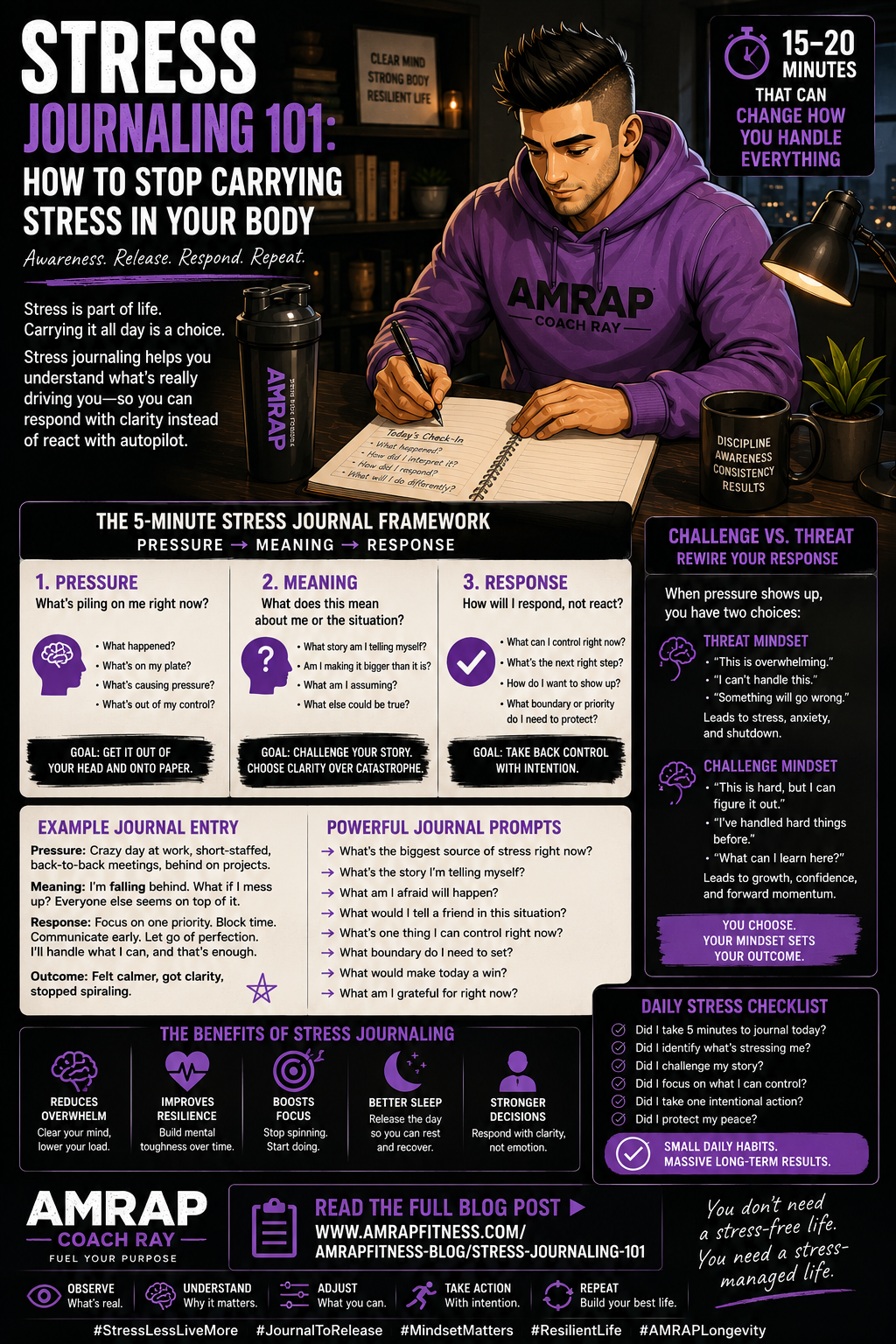
Stress journaling is structured emotional processing + pattern detection.
A professional stress journal does three things:
Names the pressure (so it stops living as vague tension)
Clarifies meaning (so your brain stops spinning worst-case stories)
Chooses a response (so you regain agency)
That’s it.
If you do those three things consistently, you reduce the amount of stress you carry unconsciously.
And that changes your behavior.
Why This Matters for Longevity
Longevity is not just how strong your muscles are.
It’s how stable your life systems stay under load.
Stress affects longevity through multiple pathways:
sleep disruption
inflammation-related signaling
blood pressure and cardiovascular strain
appetite and cravings
alcohol/sugar coping behaviors
reduced physical activity
The biggest cost of stress isn’t just the feeling.
It’s the downstream behaviors.
Stress journaling is a tool that reduces downstream damage.
Not by pretending stress doesn’t exist.
By improving how you process it.
The Science Signal (What Research Supports)
There’s a long research history around structured writing and mental/physical health outcomes.
1) Expressive writing can improve psychological outcomes
Across studies, structured expressive writing (writing about emotional experiences) has been associated with small-to-moderate improvements in certain mental health outcomes for some people, especially when done consistently and with structure.
2) Journaling can support emotional regulation and clarity
When you externalize thoughts onto paper, you reduce cognitive load—your brain stops trying to “hold everything.”
3) Behavior change improves when you track patterns
Self-monitoring is one of the most consistently supported behavior change techniques. Journaling is self-monitoring for your internal world.
Important note (professional honesty):
Journaling isn’t a magic cure. Some people benefit more than others, and the style matters. Unstructured rumination on paper can make some people feel worse.
That’s why we use a system.
The AMRAP Stress Journal Framework
This is the core of the post.
It’s simple enough to do daily.
And strong enough to change outcomes.
The 5-Minute “PMR” Method
P = Pressure
M = Meaning
R = Response
Step 1 — Pressure (1–2 minutes)
Write:
What is weighing on me right now?
What feels unresolved?
What am I carrying that I haven’t named?
One paragraph.
No filtering.
Step 2 — Meaning (2 minutes)
Write:
What story am I telling myself about this?
What am I afraid this means?
What is the worst-case narrative my brain is running?
This step is powerful because it exposes threat-thinking.
Step 3 — Response (1 minute)
Write:
What is one action I can take in the next 24 hours?
What is one thing that can wait?
What is one boundary I need?
This returns agency.
Finish (15 seconds)
Write one line:
“Today I will protect ____.”
Examples:
my sleep window
my nutrition structure
my training identity
my morning walk
The “Challenge vs Threat” Reframe (1 minute)
Stress becomes toxic when it is interpreted as threat without control.
Use this prompt:
Threat story: “This will break me because ____.”
Challenge story: “This is hard, but I can respond by ____.”
You’re not lying.
You’re choosing a useful frame.
The Anti-Rumination Rules (So Journaling Helps, Not Hurts)
Some people journal and feel worse because they:
spiral
repeat the same story
rehearse fear
So we use guardrails:
Rule 1 — Time cap
Set a timer: 5–8 minutes.
Stop when the timer ends.
Rule 2 — Always end with response
Never end on pressure.
End on agency.
Rule 3 — No legal brief on paper
You’re not building a case.
You’re building clarity.
Rule 4 — Don’t journal in peak activation
If you’re emotionally flooded, do 2 minutes of slow breathing first.
Then write.
How Stress Journaling Improves Training (The Coaching Reality)
When stress is high:
people skip warm-ups
they rush sessions
they chase intensity as relief
they under-eat protein
they overeat at night
they drink more caffeine
they sleep worse
Journaling doesn’t remove stress.
It reduces the spillover.
It helps you say:
“Today is a high-stress day. I’m running the minimum plan.”
That is not quitting.
That is professionalism.
The Minimum Plan for High-Stress Days
This is what you do when life is loud.
Training: 20–40 minutes Zone 2 or a short strength session (leave 3 reps in reserve)
Nutrition: protein at each meal + one default meal
Recovery: lights down earlier + 5-minute PMR journaling
High stress is not the time to prove toughness.
It’s the time to preserve continuity.
The “Trend Detector” (Weekly Review)
Once per week, read the last 7 days.
Look for these patterns:
What triggers my stress spikes?
What triggers my cravings?
What breaks my sleep?
What restores me?
What routines protect me?
Then write one adjustment:
“Next week I will protect ____ by ____.”
This is how you stop living reactively.
Common Mistakes (and Pro Fixes)
Mistake 1: Journaling only when you feel good
Fix: journal especially during hard weeks.
Mistake 2: Using journaling to rehearse fear
Fix: PMR structure + time cap.
Mistake 3: Thinking journaling replaces action
Fix: response step must include one small action.
Mistake 4: Making journaling too long
Fix: keep it 5–8 minutes. Consistency beats depth.
Self-Assessment (Reader Tool)
Answer honestly:
Does stress show up in my sleep?
Does stress show up in my eating?
Does stress show up in my pain sensitivity?
Do I have a consistent downshift ritual?
When life hits, do I spiral—or do I have a minimum plan?
Your answers aren’t judgment.
They’re the blueprint.
Closing: Journaling Is a Recovery Tool
Stress journaling is not about being emotional.
It’s about being effective.
It helps you:
finish mental loops
discharge pressure
regain agency
protect sleep
stabilize nutrition
train consistently
That is longevity.
Not because life gets easier.
Because your response gets smarter.
Resources
Pennebaker JW. Expressive writing and health (foundational research and theory; multiple studies across decades).
Frattaroli J. Experimental disclosure and its moderators: a meta-analysis. Psychological Bulletin. 2006. (Meta-analysis on expressive writing/disclosure effects.)
Smyth JM. Written emotional expression: effect sizes, outcome types, and moderators. (Research synthesis on expressive writing.)
Michie S, et al. Behavior Change Technique Taxonomy (v1). 2013. (Self-monitoring as a core technique.)