
Recovery Tracking Journal 101: The 3 Signals That Predict Burnout Before It Hits
(AMRAP Longevity Series — Post 6 )
Most people don’t break because they’re weak.
They break because they miss the warning signs.
The problem with burnout isn’t that it arrives out of nowhere.
It’s that it arrives quietly.
First you feel slightly more tired.
Then your workouts feel heavier.
Then your sleep gets lighter.
Then your appetite gets louder.
Then little aches last longer.
Then one day you tell yourself:
“I’m just off.”
And because you don’t have data, you make the most common high-drive mistake:
You push harder.
You add intensity.
You chase a win.
You try to “prove” you’re still disciplined.
That’s when people get hurt.
That’s when people binge.
That’s when people spiral.
A recovery tracking journal is how professionals avoid that.
Not because they’re paranoid.
Because they respect the simplest truth in training:
Adaptation requires recovery.
This is a pillar-style intro entry.
Later we’ll deep dive into:
HRV and wearable interpretation
deload design (how to plan it, not guess it)
recovery protocols for high stress seasons
how recovery data changes nutrition decisions
Today we build the foundation.
Opening Device: The Season Where Everything Costs More
You know the season.
You’re still doing the work.
But everything costs more.
Warm-ups feel longer.
Weights feel heavier.
Conditioning feels more suffocating.
Your patience is shorter.
Your cravings are sharper.
Your body feels less forgiving.
You keep telling yourself:
“I just need to lock in.”
But what you really need is to identify whether you are:
under-recovered
under-fueled
under-slept
over-stressed
or overreaching from training load
Because each one has a different solution.
A recovery journal helps you diagnose reality.
And diagnosis is what separates pros from people who keep repeating the same breakdown.
What Recovery Tracking Actually Is
Recovery tracking is not a bunch of gadgets.
It’s not obsessing over numbers.
It’s a simple habit:
observe your recovery signals and adjust training before the crash.
A recovery journal answers one key question every day:
“Am I ready to push—or should I protect?”
If you can answer that accurately, you can train for decades.
If you can’t, you train on emotion.
And training on emotion is how people get injured.
Why This Matters More After 40
After 40, your body can still adapt.
But recovery capacity is more sensitive to life load:
stress
sleep
hydration
nutrition
emotional strain
travel
The “cost” of poor recovery becomes higher.
A poor decision today can mean:
a flare-up that lasts weeks
a sleep spiral
an appetite spiral
a “start over Monday” month
So the goal is not perfection.
The goal is early detection.
Recovery tracking is the early warning system.
The Science Signal (What We’re Using)
Across training science and coaching consensus, the principles are consistent:
Too much training load without adequate recovery can lead to maladaptation and increased injury risk.
Monitoring athlete readiness (subjective + objective measures) helps inform training decisions.
Simple self-report measures can be practical and meaningful when done consistently.
Professional honesty:
Wearables can help, but they are not required.
The best recovery metric is the one you actually track.
The AMRAP Recovery Tracking Journal System
This is the method.
It is intentionally simple.
You can do it in 30–60 seconds per day.
It is designed to prevent burnout and overuse.
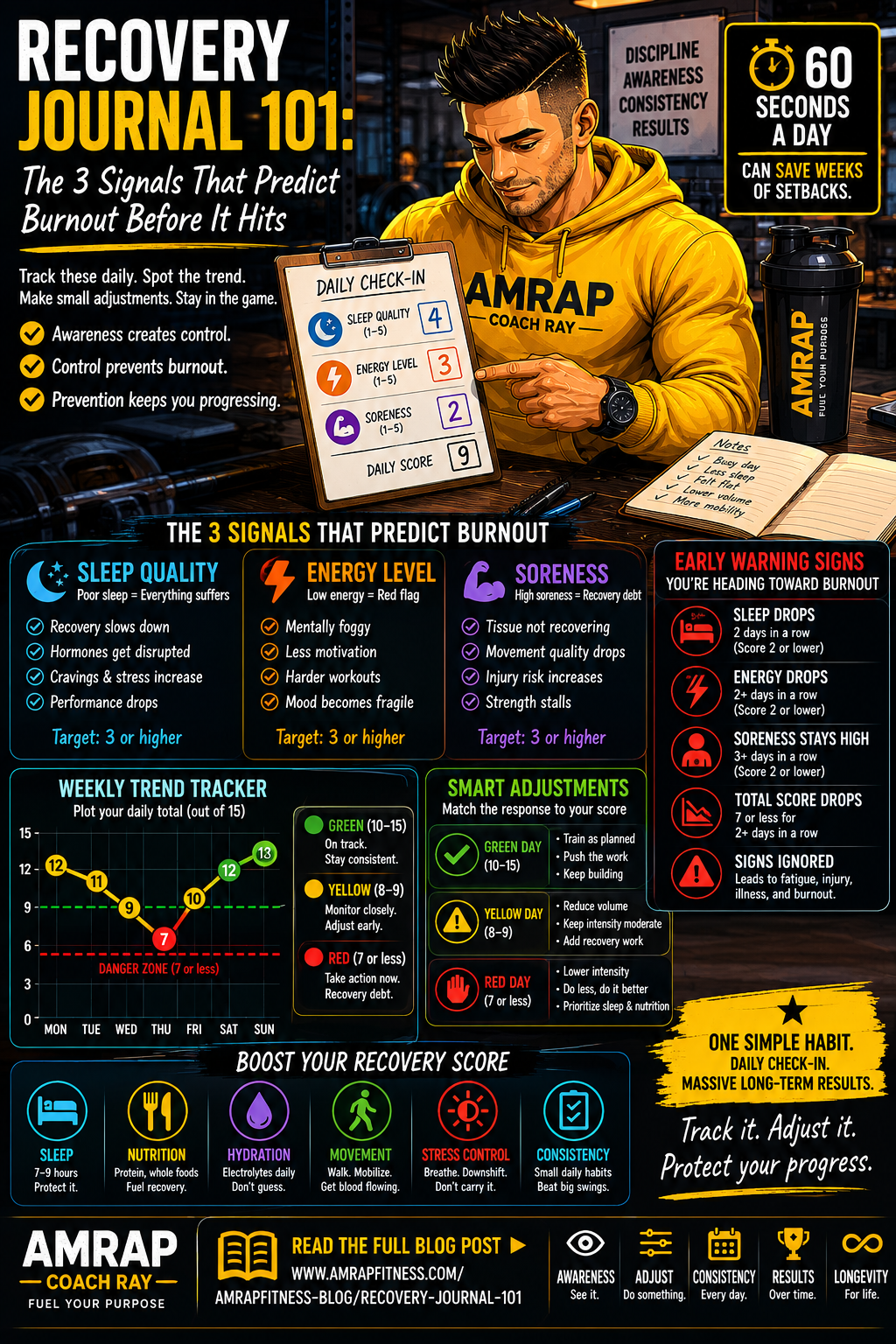
The 3 Signals That Matter
Every morning, rate these 1–5:
Sleep Quality
Energy
Soreness / Joint Status
That’s it.
No essays.
No perfection.
Just honest scores.
How to Score (Make It Simple)
Sleep Quality (1–5)
1 = terrible / fragmented / wired
3 = okay
5 = deep / restored
Energy (1–5)
1 = heavy / foggy / drained
3 = normal
5 = sharp / ready
Soreness / Joint Status (1–5)
1 = pain or soreness changes movement
3 = normal training soreness
5 = springy / no issues
Rule: Be consistent with your own rating scale.
The point is trends, not perfection.
The Traffic Light Decision System
This is where the journal becomes actionable.
Green Day
If 2+ scores are 4–5 and none are 1:
you can push
progress normally
Yellow Day
If 2+ scores are 2–3:
train, but reduce cost
avoid grinders
keep quality
Red Day
If 2+ scores are 1–2:
protect recovery
run minimum plan
no “prove it” workouts
This single system prevents most spirals.
The “Reduce Cost” Training Menu (Yellow Days)
Yellow days are where longevity athletes win.
You still train.
But you reduce the recovery tax.
Strength (Yellow Day)
keep main lifts
cut volume 30–40%
stop 2–3 reps shy of failure
focus on perfect technique
Conditioning (Yellow Day)
Zone 2 only (20–40 minutes)
or a long walk
Accessories (Yellow Day)
keep joint-friendly work:
carries
sled drags
controlled tempo
core anti-rotation
The goal is to leave feeling better—not drained.
The Minimum Plan (Red Days)
Red days are not quitting.
Red days are professional decision-making.
Minimum Plan (30–45 minutes)
20–30 minutes easy walk or Zone 2
mobility/activation (8–10 minutes)
hydration + protein emphasis
early downshift breathing at night
If you do this, you maintained identity.
You did not fall off.
You protected the system.
The 7-Day Trend Review (This is the multiplier)
Daily scores are useful.
But weekly trends are where the insight lives.
Once per week, look at your last 7 days and ask:
Are my sleep scores trending down?
Is energy dropping even with normal training?
Are soreness/joint scores becoming more sensitive?
Did stress increase?
Did hydration/nutrition structure slip?
Then decide one adjustment:
“Next week, I will protect ____ by ____.”
Examples:
protect sleep window by cutting late caffeine
protect recovery by adding a deload
protect joints by swapping HIIT for Zone 2
protect nutrition by using default meals
This is how you prevent the crash.
The 4 Burnout Patterns (So You Know What You’re Looking At)
A recovery journal doesn’t just tell you numbers.
It helps you interpret patterns.
Pattern 1: Training Overreach
soreness trending up
performance trending down
sleep may be okay but body feels heavy
Fix: deload, reduce volume, keep movement quality.
Pattern 2: Stress Overload
sleep trending down
energy trending down
cravings rising
Fix: minimum plan week + downshift routines + protect schedule.
Pattern 3: Under-Fueling
energy low
mood low
training feels like it has no “pop”
Fix: protein at every meal + stable carbs + hydration.
Pattern 4: Hydration / Electrolyte Depletion
headaches
flat training
fatigue that feels sudden
Fix: hydration floor + electrolytes matched to sweat.
The journal doesn’t diagnose disease.
But it gives you the map for smart decisions.
The Deload Trigger System (Simple and Reliable)
A lot of people wait too long.
They deload only when they break.
Pros use triggers.
Deload triggers (any 2 for 7–10 days)
performance dropping across 2+ sessions
sleep scores trending down
soreness staying elevated
motivation turning into dread
nagging pains increasing
If you hit triggers, you deload.
Deload is not weakness.
Deload is strategy.
The AMRAP Recovery Journal Template (Copy/Paste)
Daily (30–60 seconds)
Date: ____
Sleep (1–5): ____
Energy (1–5): ____
Soreness/Joints (1–5): ____
Stress (Low/Med/High): ____
Today is:
☐ Green (push)
☐ Yellow (reduce cost)
☐ Red (minimum plan)
One sentence:
“Today I will protect ____.”
Weekly Review (5 minutes)
Trend I noticed: ____
My biggest limiter: ____
One adjustment next week: ____
Common Mistakes (and Pro Fixes)
Mistake 1: Tracking only when you feel good
Fix: hard weeks are where tracking matters most.
Mistake 2: Ignoring the data
Fix: if the journal says Red, don’t run a Red day like a Green day.
Mistake 3: Using tracking to judge yourself
Fix: recovery scores are information, not identity.
Mistake 4: Making it too complicated
Fix: 3 signals + traffic light is enough.
Self-Assessment (Reader Tool)
Answer honestly:
Do I notice fatigue early—or only when I’m broken?
Do I have rules for Yellow/Red days?
Do I have deload triggers—or do I wait for injury?
Do I know the difference between stress overload and training overload?
Do I train based on data—or based on emotion?
Your answers aren’t judgment.
They’re your next upgrade.
Closing: Recovery Tracking Is How You Earn Decades
The most impressive people in fitness are not the ones who destroy themselves.
They are the ones who keep showing up.
Recovery tracking is not a weakness tool.
It’s a longevity tool.
It helps you:
adjust before you break
protect joints and tendons
keep progress sustainable
stay consistent through real life
That is the standard.
Train hard enough to progress.
Recover smart enough to last.
Resources
Meeusen R, et al. Prevention, diagnosis, and treatment of the Overtraining Syndrome: joint consensus statement (ECSS/ACSM). 2013.
Saw AE, et al. Monitoring the athlete training response: subjective measures and practical application. (Literature on self-reported readiness and monitoring.)
Halson SL. Monitoring training load to understand fatigue and adaptation. (Review/position-style work on load, recovery, and performance.)
Gabbett TJ. The training–injury prevention paradox. 2016. (Load errors and injury risk.)