
Movement Is Medicine: The Lifestyle Prescription Too Many People Underestimate
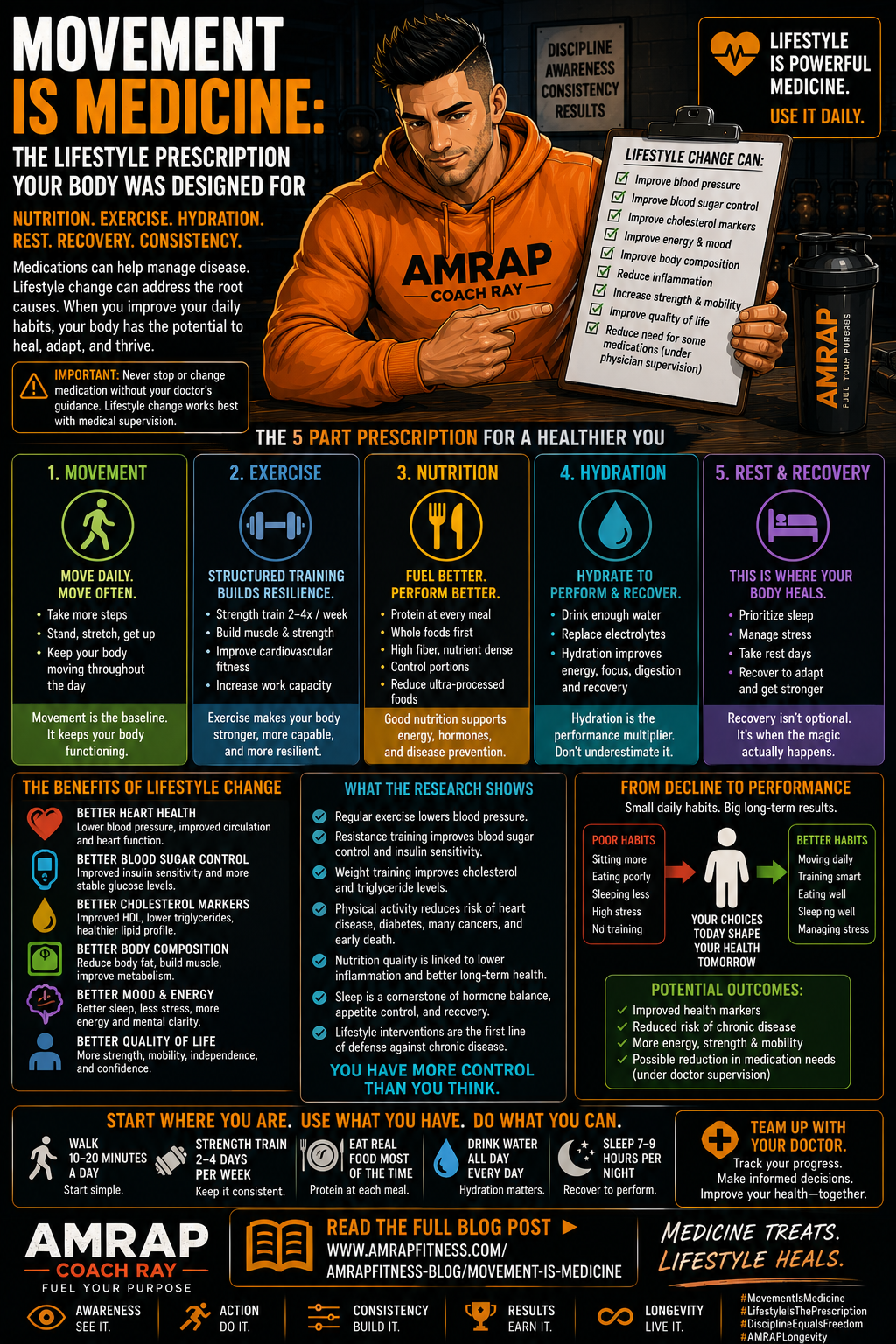
(AMRAP Longevity Series — Special Entry)
Most people understand medicine as something you take.
Far fewer understand that some of the most powerful medicine is something you do.
That matters.
Because in today’s world, a lot of adults are living with:
high blood pressure
elevated blood sugar
poor cholesterol markers
excess body fat
chronic stress
low energy
poor sleep
rising dependency on medications just to keep things controlled
And in many cases, they start believing a dangerous story:
“My body is fragile now. I need to be careful. I should probably do less.”
That story sounds safe.
But for many people, it leads in the wrong direction.
Because while medicine can be necessary, helpful, and even life-saving, many of the most common chronic conditions are also deeply influenced by something else:
lifestyle.
That means:
movement
strength training
conditioning
walking
nutrition
hydration
sleep
recovery
stress management
These are not “extras.”
They are not optional wellness fluff.
They are the foundation of how the human body is supposed to function.
And when that foundation improves, the body often improves with it.
Sometimes that means:
better blood pressure
better blood sugar control
better cholesterol markers
better energy
better body composition
less pain
more mobility
more independence
and in some cases, under medical supervision, a reduced need for certain medications
That last part is important.
This is not an anti-medication article.
This is not “throw your prescriptions away.”
This is not reckless health advice.
This is a professional message:
Lifestyle is powerful medicine.
And for too many people, it is the most underused medicine they have.
Opening Device: The Quiet Decline That Feels “Normal”
It usually doesn’t happen all at once.
A person starts moving less.
They sit more.
They walk less.
They stop training.
They feel more tired.
Their joints get stiffer.
Their body weight creeps up.
Their sleep gets worse.
Their stress goes up.
Their food choices become more reactive.
Then the labs begin to shift.
Blood pressure rises.
Blood sugar rises.
Triglycerides rise.
Energy drops.
Confidence shrinks.
Then comes the belief:
“I guess this is just what happens when you get older.”
That belief costs people years.
Because while aging is real, decline is not always as inevitable as people think.
Aging may be unavoidable.
Deconditioning is not.
And too often, what people call “getting older” is actually a long season of:
reduced movement
reduced muscle
reduced cardiovascular fitness
reduced recovery quality
reduced metabolic health
That’s not just aging.
That’s a body that has been under-dosed on movement and overexposed to modern stress.
And the hopeful part is this:
A body that changes in the wrong direction can often change in the right direction too.
What “Movement Is Medicine” Actually Means
The phrase can sound inspirational.
But this is not just motivation.
“Movement is medicine” means that appropriately dosed physical activity has measurable effects on human health.
Movement influences:
cardiovascular function
insulin sensitivity
blood pressure regulation
lipid metabolism
body composition
muscle mass
bone density
mental health
inflammation-related pathways
mobility and independence
That is not poetic language.
That is physiology.
When you move consistently, the body receives signals:
preserve muscle
improve circulation
use glucose more efficiently
strengthen the heart
improve energy systems
reduce stiffness
improve tissue quality
improve resilience
When you stop moving, the opposite happens.
So when we say movement is medicine, we mean:
the body responds to movement the way it responds to treatment.
And in many cases, it does so with effects that compound across years.
The Big Mistake: Waiting Until You “Feel Better” to Start Moving
One of the most common traps is this:
A person feels:
tired
heavy
scared
inflamed
discouraged
“not ready”
So they wait.
They think:
“I should rest more first.”
“I need to get my motivation back.”
“I don’t want to make things worse.”
“Maybe I should wait until the numbers improve.”
But in many cases, the lack of movement is part of why the numbers are worsening.
That doesn’t mean someone should jump into extreme exercise.
It means they need the right dose of movement.
Because medicine is always about dose.
Too much can be harmful.
Too little can be ineffective.
The right amount creates change.
That is how we need to think about exercise and movement:
not punishment,
not random effort,
but intelligent dosage.
The Science Signal: Why Lifestyle Has Medical Power
We don’t need to exaggerate this.
The evidence is already strong enough.
Across decades of research, physical activity and exercise have been associated with improvements in:
blood pressure
glycemic control
insulin sensitivity
body composition
cardiorespiratory fitness
mortality risk
quality of life
function and independence
Resistance training improves:
muscle mass
muscular strength
glucose handling
functional ability
aging resilience
Aerobic exercise improves:
cardiovascular health
endurance
recovery capacity
metabolic health
blood pressure responses
Walking improves:
daily energy expenditure
blood sugar control after meals
joint mobility
stress regulation
movement confidence
Nutrition, hydration, sleep, and recovery further amplify those benefits.
This is why many clinical guidelines support lifestyle intervention as a foundational part of managing chronic disease risk.
And this is also why physicians often encourage patients to improve:
physical activity
nutrition
body weight
recovery habits
sleep quality
Not because it sounds nice.
Because it works.
Important Professional Note: Medication Has a Role
This needs to be said clearly.
Some people genuinely need medication.
Some need it temporarily.
Some need it long-term.
Some need it while building healthier habits.
Some need it because their condition is advanced, genetic, or medically complex.
There is no shame in that.
This article is not saying:
medications are bad
doctors are wrong
movement replaces all medicine
everyone can come off medication
What it is saying is this:
For many people, medication works best when it is paired with lifestyle change.
And for some people, consistent improvement in:
exercise
nutrition
hydration
body composition
sleep
recovery
…may improve their health enough that their physician can reevaluate dosage or need over time.
That decision belongs to the patient and their doctor.
Not to social media.
Not to guesswork.
Not to ego.
The professional standard is:
Use lifestyle to improve the body. Use medical supervision to manage medication safely.
The 5-Part “Medicine” Model
If we are going to say movement is medicine, we need to define the full prescription.
Because movement works best when it sits inside a complete lifestyle system.
1. Movement
This includes:
walking
daily activity
mobility work
general physical movement
Movement is the baseline.
It tells the body:
“Stay alive. Stay functional. Stay adaptive.”
The human body is not designed for stillness.
2. Exercise
This is structured movement with purpose.
That includes:
strength training
conditioning
zone 2 aerobic work
resistance training
joint-friendly work like sled dragging
Exercise is how we deliberately build:
muscle
cardiovascular fitness
resilience
metabolic health
3. Nutrition
You cannot out-train poor fuel.
Nutrition affects:
blood sugar stability
body composition
energy
appetite regulation
inflammation-related responses
recovery
A good nutrition system usually includes:
protein at each meal
high-quality whole foods
fiber-rich foods
consistent meal structure
reduced reliance on ultra-processed convenience foods
4. Hydration
Hydration is one of the most underestimated performance and health tools.
Poor hydration can worsen:
fatigue
headaches
cravings
training quality
recovery
It also affects how the body feels day to day.
5. Rest and Recovery
This is where the body actually adapts.
Without sleep and recovery:
appetite regulation worsens
blood sugar control worsens
training adaptation worsens
mood worsens
pain sensitivity rises
People often want more intensity.
What they need is a more complete system.
Why Strength Training Is Part of the Prescription
If movement is medicine, strength training is one of its most powerful ingredients.
Because muscle is not just for aesthetics.
Muscle is a metabolic asset.
It supports:
glucose disposal
insulin sensitivity
joint protection
functional ability
fall prevention
independence
resting metabolic support
Loss of muscle with aging is associated with greater fragility and lower function.
Preserving muscle helps preserve life quality.
This is why strength training after 40 is not optional for longevity-minded adults.
It doesn’t need to be extreme.
It needs to be consistent.
A professional minimum:
2–4 days per week
full body focus
basic movement patterns
progression over time
That’s enough to create change.
Why Walking Is Still One of the Most Powerful Tools
A lot of people underestimate walking because it does not look intense.
That is a mistake.
Walking improves:
circulation
blood sugar response
recovery
calorie expenditure
mental clarity
stress regulation
joint function
It is also one of the most accessible forms of medicine a person can use immediately.
Especially after meals, brief walks can be powerful.
The goal is not to act like walking solves everything.
The goal is to stop dismissing simple tools because they look simple.
Why Fear Makes People Less Healthy
A lot of people living with chronic disease markers become more afraid of movement.
They think:
“What if my heart rate goes up too much?”
“What if I hurt myself?”
“What if exercise makes it worse?”
“What if I’m too out of shape?”
These fears are understandable.
But often, the greater risk is doing less and less until deconditioning becomes the dominant force.
The answer is not recklessness.
The answer is:
medical clearance when needed
smart programming
appropriate intensity
gradual progression
consistency over heroics
A body that is frightened by movement often needs movement even more — just in the right form.
The AMRAP Lifestyle Prescription
This is the practical part.
If we want to treat lifestyle like medicine, we need a prescription that people can actually follow.
Step 1 — Start With Walking
10–20 minutes most days
or 5–10 minutes after meals
or build a daily step baseline
Walking is the lowest-friction entry point.
Step 2 — Add Strength 2–3 Days Per Week
Focus on:
squat or sit-to-stand pattern
hinge pattern
push
pull
carry
core
Keep it simple.
Keep it sustainable.
Step 3 — Build an Aerobic Base
2–4 sessions per week:
20–40 minutes
conversational pace
low impact if needed
This improves the engine without excessive recovery cost.
Step 4 — Stabilize Nutrition
Start with:
protein at every meal
more whole foods
fewer liquid calories
fewer unplanned snacks
more meal predictability
You do not need perfection.
You need consistency.
Step 5 — Protect Recovery
sleep window
hydration floor
reduce late-night overstimulation
manage training volume
use active recovery
This is how the medicine works.
What Happens When Lifestyle Improves
When people improve their lifestyle consistently, several things often happen:
They become:
less winded
less stiff
more mobile
stronger
more confident
more energetic
Their markers may improve:
blood pressure may improve
blood sugar control may improve
body composition may improve
resting heart rate may improve
fitness may improve
stress tolerance may improve
Sometimes this changes medication conversations.
Sometimes it doesn’t.
But even when medication remains necessary, the person is still healthier.
That’s important.
Because the goal is not just fewer pills.
The goal is:
better function
better vitality
better independence
better quality of life
The Most Professional Way to Talk About This
We need precision here.
The right message is not:
“Exercise replaces your doctor.”
The right message is:
“Lifestyle raises the ceiling of what your body can do, and may improve your health enough that your physician can safely reassess treatment.”
That is honest.
That is medically respectful.
That is powerful.
That is credible.
Common Mistakes (and the Professional Fix)
Mistake 1: Thinking movement must be intense to matter
Fix: consistent walking and basic training matter tremendously.
Mistake 2: Waiting until you feel “ready”
Fix: readiness often grows after action, not before it.
Mistake 3: Viewing medication and lifestyle as enemies
Fix: they often work best together.
Mistake 4: Starting too aggressively
Fix: build gradually. Progressions matter.
Mistake 5: Ignoring recovery
Fix: health change requires sleep, hydration, and restoration too.
Self-Assessment
Answer honestly:
Am I moving enough to support my health?
Do I rely on medication while neglecting the habits that could help my body?
Do I have a basic weekly exercise structure?
Is fear keeping me from moving more?
Am I treating sleep, hydration, and nutrition as part of my health system?
If my doctor looked at my daily habits, would they see a lifestyle that supports healing?
Am I waiting for a perfect moment instead of beginning with what I can do now?
Your answers are not judgment.
They are a starting point.
Closing: The Goal Is Not Just to Live Longer
It’s to live more capably.
Movement is medicine because it changes the body from the inside out.
It helps:
the heart work better
the muscles stay alive
the joints stay usable
the metabolism stay more stable
the mind stay more resilient
And when you combine movement with:
better nutrition
better hydration
better sleep
better recovery
better consistency
…you are no longer just “working out.”
You are building a health system.
A system that can improve:
health markers
energy
mobility
confidence
and in some cases, under physician supervision, even reduce dependence on certain treatments
That is not hype.
That is what lifestyle medicine has been trying to tell people for years.
Your body wants signals that support life.
Movement is one of the strongest signals you can give it.
So the question is not whether movement is medicine.
The question is whether you are taking your medicine consistently enough.
Resources
American College of Sports Medicine. Exercise is Medicine initiative and public-health guidance.
Garber CE, Blissmer B, Deschenes MR, et al. Quantity and Quality of Exercise for Developing and Maintaining Cardiorespiratory, Musculoskeletal, and Neuromotor Fitness in Apparently Healthy Adults. Medicine & Science in Sports & Exercise. 2011.
Pedersen BK, Saltin B. Exercise as Medicine – Evidence for Prescribing Exercise as Therapy in 26 Different Chronic Diseases. Scandinavian Journal of Medicine & Science in Sports. 2015.
Warburton DER, Bredin SSD. Health Benefits of Physical Activity: A Systematic Review of Current Systematic Reviews. Current Opinion in Cardiology. 2017.
Booth FW, Roberts CK, Laye MJ. Lack of Exercise Is a Major Cause of Chronic Diseases. Comprehensive Physiology. 2012.