
Maintenance Is a Win: Protecting Your Progress Through December
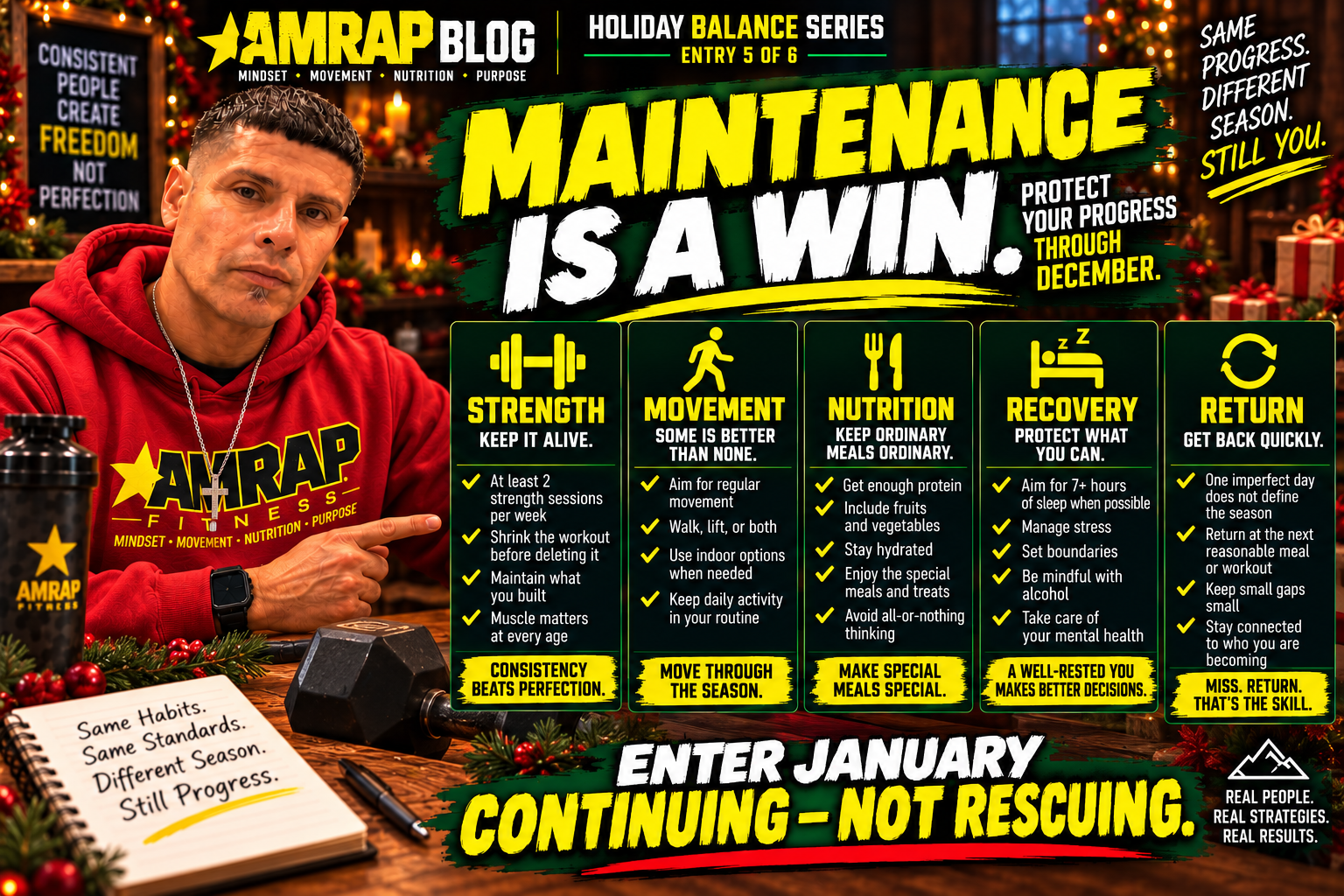
AMRAP Holiday Balance Series — Entry 5 of 6
What if December did not have to be about losing more?
What if your goal was simply:
Do not lose yourself.
Maintain your strength.
Maintain your movement.
Maintain your routines.
Maintain your relationship with food.
Maintain your sleep as reasonably as possible.
Maintain the progress you spent January through November building.
That may not sound exciting.
It may not sell a dramatic transformation challenge.
But it may be one of the smartest things you do all year.
Because December is different.
Schedules change.
Work gets hectic.
Children have events.
Schools have concerts.
Offices have parties.
Families travel.
People shop.
People host.
People stay up later.
Food appears everywhere.
Alcohol appears more often.
Weather gets colder.
Daylight disappears earlier.
Normal routines get disrupted.
And a lot of people make a mistake.
They look at a month that is unusually demanding and say:
“If I cannot keep making aggressive progress, I might as well stop trying.”
That is the all-or-nothing trap wearing a Santa hat.
You do not have to choose between:
losing weight aggressively
and
completely abandoning your health until January.
There is another option.
Maintain.
Maintenance is not failure.
Maintenance is not laziness.
Maintenance is not giving up.
Maintenance means:
“I built something this year, and I am going to protect it while life gets unusually busy.”
That is a skill.
And the people who learn that skill are the people who stop having to rebuild the same version of themselves every January.
Opening Device: Imagine January Without a Rescue Mission
Imagine waking up January 2.
You step on the scale if weighing is part of your routine.
Maybe your weight is almost exactly where it was before Thanksgiving.
Maybe it moved slightly.
Your clothes still fit.
Your strength is still there.
You trained through most of December.
Not perfectly.
But enough.
You walked.
You enjoyed Christmas dinner.
You went to the parties.
You had dessert.
You spent time with your family.
You missed a few workouts.
But you never disappeared.
You kept drinking water.
You kept eating normal meals between celebrations.
You kept getting protein.
You protected sleep where you could.
You did not spend four straight weeks treating every day like Christmas Day.
And now January arrives.
You do not need a detox.
You do not need a punishment plan.
You do not need to lose the same weight you already lost once.
You do not need to “get back” to the gym.
You never really left.
Think about how different that feels.
January becomes:
“Let's keep going.”
Instead of:
“What the hell happened?”
That is why maintenance matters.
The Fitness Industry Has Taught People to Undervalue Maintenance
Most marketing celebrates change.
Lose 20 pounds.
Gain muscle.
Drop inches.
Hit a personal record.
Transform your body.
Those goals can be great.
But there is another phase of health that does not photograph as dramatically:
keeping the result.
And keeping the result is often harder than achieving it temporarily.
Research on long-term weight management consistently shows that maintenance requires ongoing behavior rather than a one-time intervention. A 2026 systematic review and meta-analysis found that successful behavioral interventions commonly used strategies such as goal setting, feedback, self-monitoring, instructions, conserving mental resources, and other behavioral supports. The authors also noted that the demands of maintenance may differ from the active weight-loss phase, with coping, emotional regulation, and social pressure becoming particularly important over time.
That sounds exactly like December.
Stress.
Emotions.
Family.
Food.
Pressure.
Schedule disruption.
Maintenance is where the lifestyle gets tested.
Maintenance Is Different From Stagnation
This distinction matters.
A plateau happens when you are trying to create change but nothing is changing.
Maintenance happens when:
the lack of change is the goal.
Those are completely different situations.
If you lost 25 pounds this year and maintain those 25 pounds of progress through Christmas:
That is success.
If you built strength and preserve most of it through a chaotic month:
Success.
If you developed a walking habit and continue walking through winter:
Success.
If you improved your blood sugar, blood pressure, sleep, or food preparation and keep those behaviors alive:
Success.
Do not look at intentional stability and call it failure.
Stability may be exactly what your body and mind need during a demanding season.
Did You Know? Holiday Weight Gain Is Small on Average—but It Can Accumulate
Research suggests that average weight gain during the December holiday period is typically around 0.4 to 0.9 kilograms, roughly one to two pounds, rather than the dramatic numbers people often report casually. A 2024 systematic review noted that holiday-period weight gain can represent a meaningful portion of annual weight gain and that some of it may not be lost afterward.
That means the real problem is not necessarily:
“I gained 20 pounds at Christmas.”
The more realistic concern is:
“I gain a little every holiday season and never completely remove it.”
Repeat that pattern for years and the math starts to matter.
So preventing gain can be meaningful progress.
Maintenance today may prevent a larger problem tomorrow.
December Changes the Goalposts
Imagine you are training for a race.
Halfway through, the weather changes dramatically.
The surface gets slippery.
Visibility drops.
Do you continue running exactly the same pace regardless of conditions?
Maybe not.
You adapt.
Health goals work the same way.
January and December are not identical environments.
January may offer:
fewer parties
fewer family obligations
fewer travel days
less holiday food
more routine
December may offer:
multiple celebrations
work deadlines
travel
school events
family expectations
disrupted sleep
more social eating
less daylight
A smart plan respects the environment.
That does not mean surrendering to it.
It means changing the target.
Maybe your normal goal was:
Lose one pound per week.
Your December goal becomes:
Maintain within a reasonable range.
Maybe your normal training is four days.
Your December floor becomes:
Two non-negotiable strength sessions plus walking.
Maybe you normally meal prep seven days.
December becomes:
Prepare enough basics so the chaotic days have backup options.
That is not lowering your standards.
That is intelligently adjusting them.
The AMRAP December Maintenance Floor
We need a system.
Not a perfect December.
A floor.
A floor is the minimum behavior below which you do not want to fall.
Your ceiling can change.
If you have an amazing week and train five times?
Great.
If you hit your nutrition perfectly?
Great.
But when the week becomes chaotic, protect the floor.
Use AMRAP.
A — Anchor Your Week
Before December begins—or at the beginning of every week—identify what absolutely needs to happen.
Not ten things.
A few.
For example:
two strength workouts
three walks
grocery basics
normal breakfasts
reasonable bedtime on work nights
Put those anchors on the calendar before everything else fills the space.
A calendar does not magically create discipline.
But if something matters and never appears anywhere in the week, it becomes extremely easy to sacrifice.
Ask:
What are the two or three health behaviors that keep me feeling like myself?
Protect those first.
M — Maintain Movement
December does not require peak fitness.
But zero movement is a terrible default.
Current CDC guidance recommends adults accumulate at least 150 minutes of moderate-intensity activity per week or an equivalent amount of vigorous activity, plus muscle-strengthening work on at least two days each week. The activity can be divided into smaller chunks, and CDC emphasizes that some physical activity is better than none.
For adults 65 and older, aerobic and strength recommendations remain, with balance activity also emphasized.
Now, that is the public-health target.
Your chaotic December week may not always look perfect.
The coaching rule is:
Shrink the workout before deleting the workout.
Planned 60 minutes?
Have 30?
Train for 30.
Have 20?
Train for 20.
Can only walk?
Walk.
Cannot reach the gym?
Bodyweight.
Bands.
Sled.
Stairs.
Mobility.
Do not confuse modified with meaningless.
The Two-Workout December Floor
For many of my readers, I would rather see:
Two strength sessions every week for six weeks
than:
Five workouts during the first week of December followed by zero until January.
Consistency beats the heroic burst.
A minimum strength plan might include:
Day 1
squat or sit-to-stand
push
row
hinge
carry
trunk
Day 2
split squat or step
overhead or incline press
pull
hip dominant movement
carry
trunk
Thirty to forty-five minutes.
Maybe less.
You can maintain a lot with less training volume than people think, especially compared with doing nothing.
And if fat loss is still part of your goal, resistance training is especially valuable because recent systematic-review evidence indicates that adding resistance exercise during diet-induced weight loss can help preserve fat-free mass, improve strength, and increase fat-mass loss compared with dieting without resistance training.
Muscle is worth protecting.
Particularly as we age.
R — Retain Nutritional Structure
December food should not become a month-long buffet.
You already learned moderation.
Now use it.
Keep ordinary meals ordinary.
That means:
If Tuesday is not a celebration, Tuesday does not need to eat like Christmas.
Keep:
protein
fruits and vegetables
water
normal breakfasts
normal lunches
reasonable portions
Then enjoy the celebration.
This single principle may be one of the strongest tools in the entire series:
Make special meals special by keeping ordinary meals ordinary.
If every meal becomes festive, festive stops meaning anything.
Do Not Diet Harder to Compensate
This is an important distinction.
Some people hear:
“Maintain through December.”
And think:
“Great. I’ll eat almost nothing Monday through Thursday so I can go crazy Friday through Sunday.”
That is not maintenance.
That is restriction followed by compensation.
The same problematic cycle appears:
Restrict.
Get hungry.
Overeat.
Feel guilty.
Restrict harder.
December becomes exhausting.
Instead:
Eat normally.
Celebrate intentionally.
Return.
The rhythm should feel sustainable enough that you could continue it in January.
A — Allow Flexibility
There will be imperfect weeks.
You may:
miss training
eat more than intended
stay up late
travel
drink more than usual
eat restaurant food
have several celebrations close together
The goal is not to prevent every deviation.
The goal is to stop deviations from becoming new defaults.
If Tuesday was chaotic:
Wednesday still exists.
If Saturday's party went late:
Sunday can include a walk, water, normal food, and an earlier bedtime.
If a workout disappeared:
The next scheduled workout does not need to disappear too.
Flexibility is not abandoning structure.
It is the reason structure survives.
P — Protect Recovery and Return
This final letter connects everything.
Protect sleep where you can.
Protect hydration.
Protect quiet.
Protect your mental health.
Protect the next decision.
Then return quickly when life interrupts.
Adults are generally advised to get at least seven hours of sleep regularly for health, and insufficient sleep is associated with impaired mood, performance, metabolic health, and other adverse outcomes.
December will challenge sleep.
Late parties.
Travel.
Shopping.
Cooking.
Alcohol.
Family.
You may not control every night.
But avoid letting one late night create five.
Sleep is not simply about weight.
It supports your ability to make reasonable decisions the next day.
Did You Know? Alcohol May Help You Fall Asleep—but It Does Not Mean Better Sleep
Alcohol is often treated as relaxation during the holidays.
And it can make people feel sleepy.
But a recent review of evidence from 2015–2025 found that although alcohol may shorten the time it takes to fall asleep, it can disrupt sleep architecture, reduce REM sleep, increase sleep fragmentation, and worsen sleep-disordered breathing, particularly later in the night.
That does not mean everyone must avoid alcohol completely.
It means understand the tradeoff.
If you want better sleep, another round may not help as much as it feels like it will.
The Five Things I Want You to Maintain
If December becomes overwhelming, narrow your focus.
Protect these five.
1. Strength
At least enough strength work to keep your body engaged.
2. Walking and general movement
Do not let colder weather turn your entire day sedentary.
3. Nutritional anchors
Protein.
Produce.
Hydration.
Normal meals.
4. Sleep
Protect the nights you control.
5. Return speed
Miss.
Return.
Overeat.
Return.
Travel.
Return.
Late night.
Return.
This fifth one holds the first four together.
Maintenance Is Especially Important After Weight Loss
If you lost weight this year, your work is not finished when the scale reaches a number.
Maintenance is the next phase.
A 2024 systematic review on self-monitoring found that more frequent weight self-monitoring—particularly when combined with other behavioral tools—was associated with improved weight loss or weight maintenance compared with infrequent or no monitoring.
A newer 2026 systematic review of behavioral weight-management interventions similarly identified tools such as goal setting, feedback, self-monitoring, behavioral instruction, and conserving mental resources among the strategies associated with better long-term outcomes.
The message is not:
“Obsess over everything.”
It is:
“Keep enough feedback in your life that you notice drift before it becomes a crisis.”
Should You Weigh Yourself Through December?
Maybe.
It depends on you.
For some people, weighing several times per week or daily helps reduce denial and keeps behavior connected to reality.
For others, frequent weighing creates:
anxiety
obsessive thinking
severe restriction
bingeing
mood changes
If weighing is useful data:
Use it.
If weighing becomes emotionally destructive:
Use other measures.
Track:
training sessions
steps
waist measurement
clothing fit
energy
sleep
meal consistency
alcohol intake
journaling
blood pressure if medically appropriate
The goal is feedback, not surveillance.
Scale Weight Is Noisy in December
This deserves repeating.
The scale may fluctuate dramatically around:
restaurant meals
alcohol
higher carbohydrate intake
salty foods
travel
constipation
menstrual-cycle changes
poor sleep
Do not interpret every short-term increase as body-fat gain.
Look at the trend.
If you know a Thanksgiving meal was salty and high in carbohydrates and the next morning the scale jumps several pounds, your body did not manufacture several pounds of fat overnight.
Use data intelligently.
What Maintenance Might Look Like Numerically
I do not want to create one universal acceptable weight range because bodies differ.
But conceptually, maintenance means:
You define a reasonable range rather than demanding one exact number.
For example:
Maybe your personal maintenance range is a few pounds wide.
When you remain inside it:
No drama.
If the trend begins climbing beyond it for several weeks:
That is useful feedback.
You adjust.
The point is to notice early.
Not panic late.
The December Calendar Audit
Before the month begins, physically look at your calendar.
Mark:
work parties
family gatherings
travel
Christmas Eve
Christmas Day
New Year's events
dinners
school functions
social events
Now look at what remains.
You may discover something surprising.
There are many normal days.
That matters.
If you have six special events in December, you still have twenty-five other days.
Do not mentally convert six events into a 31-day holiday.
The “Ordinary Day” Strategy
On normal December days:
Eat normal food.
There is no need for cookies at breakfast because the office party is Friday.
There is no reason Wednesday needs cocktails because Christmas is next week.
There is no need for nightly dessert because there is a tree in your living room.
Keep ordinary days boring enough to support the extraordinary ones.
That is freedom.
The Minimum Viable Workout
When schedules tighten, decide in advance what counts.
Maybe:
20-minute version
5-minute warm-up
squat
push
pull
hinge
carry
Or:
3 rounds
10 goblet squats
10 push-ups
10 rows
10 Romanian deadlifts
30-second carry
Done.
Not your greatest workout ever.
But the habit survived.
That matters.
Cold Weather Is Not an Excuse—But It Is a Real Barrier
November and December change the environment.
Cold.
Darkness.
Rain.
Snow.
Shorter days.
Walking outside may genuinely become harder.
So build backups.
If outdoor walking does not work:
treadmill
mall walking
stairs
indoor bike
marching
sled work if weather allows
short circuits
walking inside during calls
A barrier should trigger a backup.
Not abandonment.
The December Food Environment
December may be the most aggressive food environment of the year.
Cookies appear without invitation.
Candy arrives at work.
Someone gives you chocolate.
Clients bring food.
Neighbors bake.
Parties create buffets.
People send gift baskets.
The solution is not perfect resistance.
It is environment management.
Ask:
Which foods do I genuinely want?
Keep those.
Share the rest.
Freeze some.
Bring some to work.
Donate appropriate unopened food.
Move food out of constant sight.
Food sitting directly in front of you repeatedly creates decision fatigue.
You do not need fifty daily negotiations with a cookie tin.
Did You Know? Behavioral Holiday Interventions May Help—but Science Does Not Have One Magic Formula
A 2024 systematic review examining weight-gain-prevention interventions during festive and holiday periods found a direction of effect favoring intervention groups in adults, but the overall evidence was rated very low certainty because studies were limited, heterogeneous, and often at high risk of bias.
That matters.
There is no scientifically proven perfect Christmas diet.
What we do have are behavioral principles with broader evidence:
self-monitoring
goals
feedback
physical activity
planning
flexible control
returning after setbacks
That is what we use.
Maintenance Is Not About Staying “Perfect”
A successful December could include:
Three missed workouts.
Christmas dessert.
A few restaurant meals.
A couple of late nights.
Several drinks over the month.
A vacation.
A week where movement was lower.
And still be successful.
Why?
Because success is measured across the pattern.
Did you:
Return?
Keep training enough?
Stay reasonably active?
Maintain your normal food structure most days?
Protect what you could?
Avoid turning imperfections into surrender?
If yes:
You maintained the system.
Maintenance for the Person Still Trying to Lose Weight
What if you still want fat loss?
You can continue if:
your plan is reasonable
your body is responding well
your schedule supports it
your clinician or dietitian agrees when medical factors are involved
But I want you to release the expectation that December must produce maximum loss.
If you lose:
Great.
If you maintain while navigating the most demanding part of the year:
Still great.
You can resume a more focused deficit when life becomes more predictable.
The long game wins.
Maintenance for the Person Who Has Reached Their Goal
This may actually be harder mentally.
The excitement of active loss is gone.
People stop complimenting you.
The scale is no longer dropping.
There are fewer obvious wins.
Now you simply have to live.
This is where identity matters.
You are no longer:
“Someone trying to lose weight.”
You are:
“Someone who lives in a way that supports this body.”
That shift matters.
Maintenance for Adults in Their 30s
You may still be able to recover from chaotic weekends fairly quickly.
That can create false confidence.
Do not wait until your body becomes less forgiving before learning moderation.
Build maintenance skills now.
Maintenance in Your 40s
Work.
Children.
Caregiving.
Financial responsibilities.
Holiday planning.
There may be very little spare time.
The goal may be protecting a few key habits rather than maximizing everything.
Two workouts.
Walking.
Normal meals.
Sleep.
That may be enough to keep the foundation intact.
Maintenance in Your 50s
Muscle preservation becomes increasingly valuable.
So does mobility.
Metabolic health.
Recovery.
You may notice alcohol, overeating, and poor sleep affect you differently than twenty years ago.
That is not weakness.
It is information.
Use it.
Strength work becomes especially important.
Maintenance in Your 60s and 70s
The goal often becomes even broader than weight.
Protect:
muscle
balance
walking capacity
independence
bone health
social connection
nutrition adequacy
CDC guidance for adults 65 and older includes aerobic activity, strength work, and balance activities.
Aggressive calorie restriction is not automatically appropriate for every older adult.
The individual matters.
Health matters more than chasing a smaller number.
The Holiday Caregiver Problem
December often becomes a giant list of things you are doing for other people.
Buying.
Wrapping.
Cooking.
Driving.
Planning.
Hosting.
Helping.
Serving.
And once again, you disappear.
Remember what we discussed earlier in this blog series:
Your body is how you do all those things.
You cannot endlessly withdraw from an account you never deposit into.
Your 30-minute workout may make you more patient.
Your walk may clear your mind.
Your normal breakfast may keep you from becoming ravenous.
Your sleep may make Christmas morning more enjoyable.
Self-care does not steal from your family.
Done properly, it improves what you bring to them.
The “I’ll Do It After the Holidays” Trap
What exactly happens after the holidays?
Your job disappears?
Your family stops needing you?
Stress stops?
Birthdays vanish?
Vacation ends forever?
Life becomes perfectly predictable?
Of course not.
If your health plan only works when nothing is happening, the plan does not work.
December gives you a chance to practice:
How do I stay connected when life is imperfect?
That is a much more useful skill than waiting for ideal conditions.
The AMRAP December Weekly Scorecard
Every Sunday, score five categories from 0–2.
Movement
0 = none
1 = some
2 = hit my floor
Strength
0 = none
1 = one session
2 = two or more
Nutrition structure
0 = mostly reactive
1 = mixed
2 = normal meals around celebrations
Recovery
0 = ignored
1 = inconsistent
2 = protected reasonably
Return
0 = one slip became several days
1 = returned eventually
2 = returned at next reasonable opportunity
Maximum score:
10.
Do not chase 10 every week.
Use the score to notice drift.
A 6 is information.
A 9 is information.
No shame.
Adjust.
The Two-Day Rule
Here is another powerful maintenance tool.
Try not to let the same foundational behavior disappear two times in a row when it is reasonably within your control.
Miss Tuesday's workout?
Try to make the next scheduled session.
One night of poor sleep?
Protect the following night where possible.
One celebration meal?
Return to normal the next meal.
This is not obsession.
It keeps gaps small.
Your December “Emergency Meal”
Everyone needs at least one meal requiring almost no thought.
Examples:
rotisserie chicken + frozen vegetables + rice
eggs + toast + fruit
Greek yogurt + berries + oats
tuna + microwave rice + vegetables
sandwich + fruit + yogurt
protein shake + simple whole-food meal later
Not glamorous.
Useful.
When December gets chaotic, convenience will win.
So create healthier convenience before chaos chooses for you.
Your December “Emergency Workout”
Likewise:
Have a workout that requires no planning.
For example:
15 minutes
3–5 rounds:
10 squats
8–15 push-ups or modified push-ups
10 rows
10 hinges
30-second carry or plank
Or:
15-minute brisk walk plus mobility.
The emergency workout is not meant to replace good programming permanently.
It prevents nothing from winning.
Sleep Is a December Performance Tool
Sleep gets sacrificed because holiday obligations feel more urgent.
But sleep affects the quality of everything the next day.
Work.
Training.
Mood.
Food choices.
Relationships.
Patience.
Adults are generally advised to get at least seven hours regularly, although individual needs vary.
You may not get perfect sleep every night.
Protect the nights you control.
Especially after the nights you do not.
Alcohol and the Maintenance Goal
Alcohol is one of the easiest places for “special occasion” behavior to quietly become routine.
Friday party.
Saturday dinner.
Sunday football.
Tuesday work event.
Thursday holiday gathering.
Suddenly alcohol has appeared five nights in one week.
If you drink:
Track frequency mentally.
You do not need to eliminate it.
But do not let December normalize a level of drinking you would not choose in February.
Also remember:
Alcohol may make you sleepy without improving sleep quality.
You Are Allowed to Say “Enough”
Enough food.
Enough drinks.
Enough parties.
Enough commitments.
Enough late nights.
Enough shopping.
Enough.
December wellness also requires boundaries around time.
Sometimes the healthiest decision is:
“We are not going to that event.”
or:
“I'm leaving early.”
or:
“I need tonight at home.”
Health is not only what happens in the gym.
Did You Know? Some Activity Is Better Than None
One of the most useful lines in current CDC guidance is simple:
Some physical activity is better than none.
That is the perfect December principle.
Stop treating a 20-minute workout like a failure because it was not 60.
Stop treating 6,000 steps like nothing because the goal was 10,000.
Stop treating two lifting days as useless because you normally train four.
The reduced version is often what saves the habit.
The Four December Traps
Trap 1: “There is no point until January.”
Correction:
There are several weeks of health between now and January.
Trap 2: “Maintenance means I stopped progressing.”
Correction:
Keeping what you earned is progress.
Trap 3: “I missed the week.”
Correction:
You missed part of a week.
Start today.
Trap 4: “I have to do everything.”
Correction:
Protect the floor.
The Seven-Day Maintenance Practice
Before December gets busy, practice maintenance for one week.
Day 1 — Set the floor
Write your minimum:
strength
walking
nutrition
sleep
Day 2 — Schedule two workouts
Put them somewhere real.
Day 3 — Build an emergency meal
Buy the ingredients.
Day 4 — Build an emergency workout
Write it down.
Day 5 — Audit your December calendar
Mark the celebrations.
Day 6 — Identify one recovery boundary
Phone cutoff?
Alcohol limit?
Earlier bedtime?
Quiet evening?
Day 7 — Review
Ask:
What would maintaining myself through December actually require?
Now you have the plan.
The AMRAP December Maintenance Contract
I will not confuse maintenance with failure.
I will protect what I spent the year building.
I will anchor my week with the habits that matter most.
I will shrink workouts before deleting them.
I will keep ordinary meals ordinary.
I will enjoy celebrations without turning every day into a celebration.
I will allow flexibility without abandoning structure.
I will protect recovery where I can.
I will use feedback without using it to punish myself.
I will return quickly after disrupted days.
I will remember that keeping my progress is progress.
I will enter January continuing—not rescuing.
Self-Assessment
Ask yourself:
What did I build this year that I most want to protect?
Is December a realistic time for aggressive fat loss for me?
Would maintenance actually be the smarter goal?
What is my minimum strength-training frequency?
What is my minimum weekly movement goal?
Which meals can remain completely normal during December?
How many true celebrations are actually on my calendar?
Am I mentally turning six events into an entire month?
What will my emergency meal be?
What will my emergency workout be?
What sleep boundary can I reasonably protect?
How does alcohol usually affect my sleep, eating, or next-day training?
What monitoring method helps me without making me obsessive?
What happens after I miss one workout?
What happens after I overeat once?
Am I skilled at returning?
What would January feel like if I maintained instead of abandoned?
Would I be proud to enter 2027 without needing to rebuild?
Those answers matter.
Because December success should be defined before December begins.
Closing: Protect What You Built
January gets all the attention.
December deserves more respect.
Because January asks:
“What do you want to change?”
December asks:
“Can you protect what already changed?”
That may be the harder question.
You have spent this year trying.
Training.
Walking.
Learning.
Cooking.
Restarting.
Improving.
Failing.
Returning.
Building.
Maybe you reached every goal.
Maybe you reached half.
Maybe you barely got started.
Whatever progress exists today deserves protection.
Do not dismiss it because December is busy.
Do not tell yourself:
“I'll just start again.”
You do not need to start again.
You need to keep a few important things alive.
Your strength.
Your movement.
Your normal meals.
Your hydration.
Your sleep.
Your identity.
And your ability to return.
Enjoy the party.
Enjoy Christmas dinner.
Eat the cookies you actually love.
Travel.
Stay up late sometimes.
See your family.
Celebrate.
But between those moments:
Live normally.
That is maintenance.
And maintenance is not a boring pause between transformations.
Maintenance is proof that transformation became part of your life.
Imagine January arriving and realizing:
I did not lose myself this year.
Not:
I was perfect.
Not:
I lost ten pounds in December.
Not:
I never ate dessert.
But:
I stayed connected.
I moved.
I trained.
I ate normally most of the time.
I enjoyed the holidays.
I returned after the imperfect moments.
I kept what I built.
That is a win.
A significant one.
And sometimes the strongest finish to the year is not pushing harder.
It is holding onto the ground you already fought to gain.
Resources
Guerrero-Magaña DE, et al. Interventions for the Prevention of Weight Gain During Festive and Holiday Periods in Children and Adults: A Systematic Review. Adult festive-period interventions showed potential to limit weight gain, but the evidence was rated very low certainty because studies were few, heterogeneous, and often at risk of bias.
The Relationship Between Feasting Periods and Weight Gain: A Systematic Scoping Review. Seventy percent of observational studies examining festive periods reported significant weight gain, averaging about 0.7 kg; self-monitoring approaches showed promise in intervention studies.
Winter Holidays and Their Impact on Eating Behavior: A Systematic Review. This review examined behavioral and psychological contributors to holiday weight change and noted concern that some seasonal gain may persist afterward, particularly in people with obesity.
Hallock R, Ufholz K, Patel N. Self-Monitoring of Weight as a Weight Loss Strategy: A Systematic Review. More frequent self-weighing was generally associated with improved weight loss or maintenance, particularly when combined with other behavioral tools.
Preuhs K, et al. Effective Behavior Change Techniques for Successful Weight Loss and Weight Loss Maintenance Among Adults With Overweight and Obesity: A Systematic Review and Meta-Analysis. Goal setting, feedback, self-monitoring, behavioral instruction, conserving mental resources, and several other techniques were associated with stronger long-term outcomes.
Krukowski RA, et al. Impact of Feedback Generation and Presentation on Self-Monitoring Behaviors, Dietary Intake, Physical Activity, and Weight: A Systematic Review and Meta-Analysis. This review examined feedback within self-monitoring interventions for diet, activity, and body weight.
Effect of Resistance Exercise on Body Composition, Muscle Strength and Cardiometabolic Health During Dietary Weight Loss: A Systematic Review and Meta-Analysis. Adding resistance exercise during diet-induced weight loss helped preserve fat-free mass, increased fat-mass loss, and improved strength.
Centers for Disease Control and Prevention. Adult Activity: An Overview. Adults are advised to accumulate at least 150 minutes of moderate-intensity activity weekly—or an equivalent amount of vigorous activity—and muscle-strengthening activity on at least two days. CDC emphasizes that some activity is better than none.
Centers for Disease Control and Prevention. Older Adult Activity: An Overview. Adults 65 and older are advised to combine aerobic activity, muscle-strengthening exercise, and balance activity, with activity adapted to abilities and health status.
American Academy of Sleep Medicine and Sleep Research Society. Recommended Amount of Sleep for a Healthy Adult. Adults should generally sleep at least seven hours per night regularly to promote optimal health.
Alcohol, Wine, and Sleep in Adults: Insights From a Narrative Review. Evidence reviewed from 2015–2025 indicates that alcohol may shorten sleep-onset time but can disrupt sleep architecture, reduce REM sleep, increase fragmentation, and worsen sleep-disordered breathing.
CDC. Physical Activity and Your Weight and Health. CDC emphasizes regular physical activity as an important component of weight maintenance and notes that individual activity needs for maintaining body weight vary considerably.