
“Come On, It’s the Holidays”: How to Handle Food Pressure Without Losing Yourself
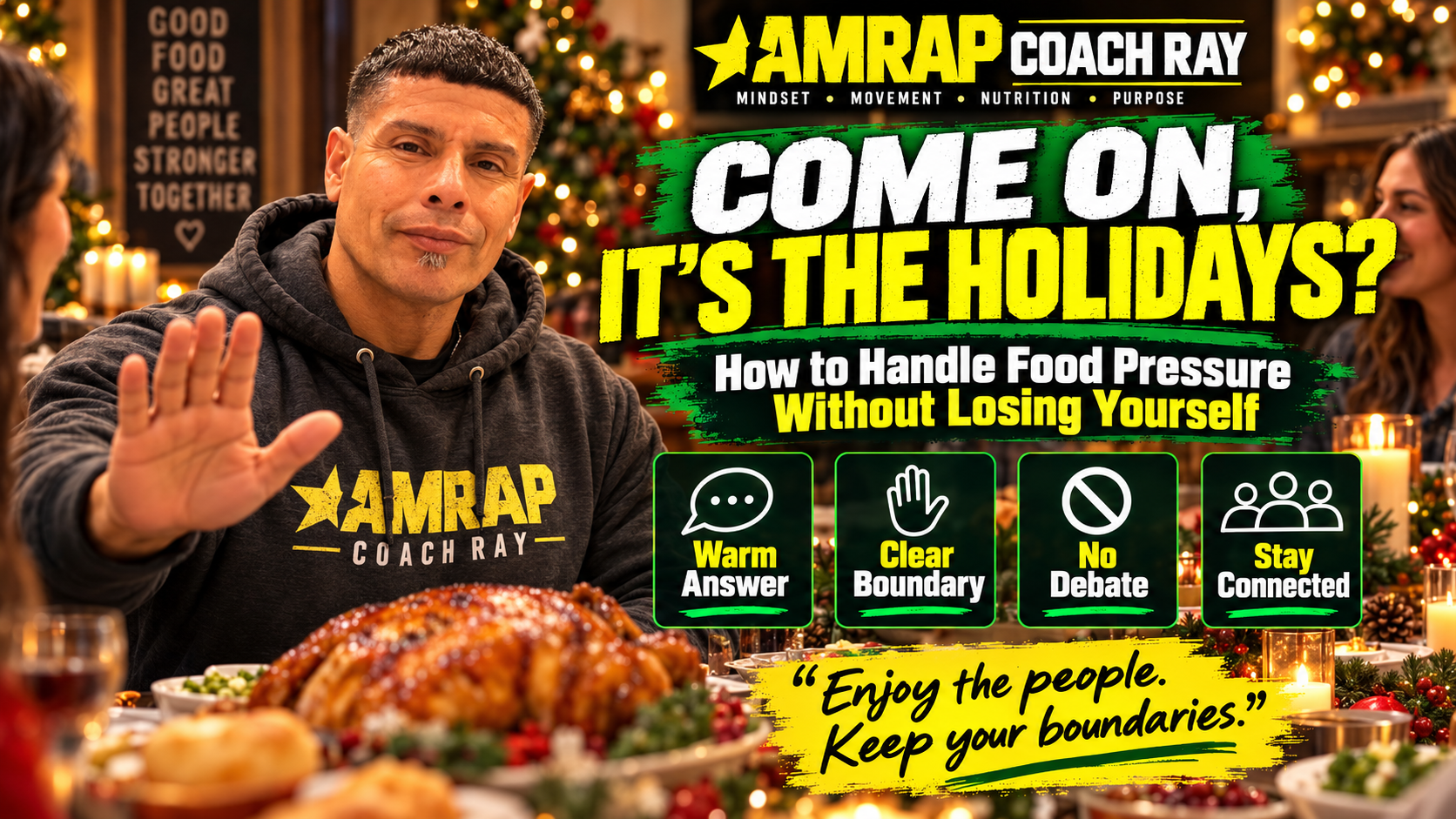
AMRAP Holiday Balance Series — Entry 3 of 6
Sometimes the hardest thing to manage at the holiday table is not the food.
It is everyone else.
You know the comments.
“Come on. Have another.”
“You barely ate.”
“It’s Thanksgiving!”
“You only get this once a year.”
“One more isn’t going to hurt you.”
“Why are you dieting during Christmas?”
“You work out all the time. You can eat it.”
“I made this especially for you.”
“What, you don’t like my cooking anymore?”
Sometimes the pressure is playful.
Sometimes it comes from love.
Sometimes it comes from tradition.
Sometimes the person offering the food genuinely wants you to enjoy yourself.
Sometimes food is how a family expresses affection.
And sometimes your decision to change makes someone else uncomfortable.
That is what makes this issue complicated.
You do not want to insult Grandma.
You do not want to lecture your family about calories.
You do not want Thanksgiving dinner to become a debate about your diet.
You do not want to be the person who makes everyone uncomfortable because you are “on a plan.”
But you also should not have to eat until you are physically uncomfortable simply to prove that you love someone.
You should not have to drink because someone else wants another round.
You should not have to abandon a year's worth of progress because somebody says:
“Relax. It’s the holidays.”
This article is not about becoming antisocial.
It is about learning how to stay connected to people without disconnecting from yourself.
Opening Device: “But I Made It for You”
Picture this.
You have already eaten.
The meal was great.
Turkey.
Stuffing.
Potatoes.
Vegetables.
Your favorite family recipe.
You are comfortably satisfied.
Then someone appears with dessert.
You genuinely want a piece.
So you have one.
You enjoy it.
You are done.
Then someone says:
“Try the cheesecake.”
You say:
“It looks great, but I’m full.”
Then:
“Oh, come on.”
You smile.
“Seriously, I’m good.”
Then:
“I made it for you.”
Now the situation changes.
It is no longer just about cheesecake.
Now saying no feels like rejecting the person.
So you eat it.
Then someone else offers cookies.
Then a drink.
Then leftovers.
By the end of the night, your body has been overruled several times—not because you wanted more food, but because you wanted to avoid disappointing people.
That is an important distinction.
Sometimes holiday overeating is not hunger.
It is social compliance.
Eating Is Social
Humans do not eat in isolation from their environment.
We eat with families.
Friends.
Partners.
Coworkers.
Communities.
Religious groups.
Sports teams.
Cultures.
Holiday traditions.
And those environments influence behavior.
A major systematic review and meta-analysis found strong evidence that people tend to eat more when eating with friends than when eating alone. The effect was substantially stronger with familiar people than with strangers or acquaintances. Researchers suggested that longer meals, social norms, and the nature of familiar relationships may help explain the effect.
That does not mean eating with family is unhealthy.
In fact, social eating can be joyful, meaningful, and important for connection.
The lesson is simply:
The people around you influence how you eat—even when nobody explicitly pressures you.
That means holiday nutrition cannot be treated only as an individual willpower problem.
The environment matters.
Did You Know?
In the social-facilitation review, some diary studies found meals eaten with other people were roughly 29% to 48% larger than meals eaten alone, although estimates varied considerably among studies and methods.
That does not mean your Thanksgiving plate will automatically be 48% larger.
It means something more useful:
Social eating changes normal behavior.
You may sit longer.
Food stays available longer.
You may eat while talking.
Others take seconds.
Dessert arrives.
Drinks continue.
Someone offers more.
The meal has no clear ending.
Once you understand that, you can plan for it without fearing it.
The Social Norm Effect
We also tend to look at other people to determine what is “normal.”
If everyone goes back for seconds, seconds feel normal.
If everyone keeps drinking, another drink feels normal.
If everyone is eating dessert, dessert feels expected.
If everyone talks about “being bad” for the holidays, abandoning structure can feel culturally acceptable.
Research on eating norms has consistently shown that people use others' behavior as information about what and how much is appropriate to eat. Experimental research and reviews have found that people often model the food intake or food choices of others, particularly when those others are perceived as part of their social group.
That is powerful.
Because sometimes nobody even says:
“Eat more.”
You simply observe everyone else and unconsciously follow.
Moderation requires awareness of that effect.
Food Is Often Love
This is why I do not want this article to demonize the so-called “food pusher.”
For some families, feeding people is love.
It is hospitality.
It is cultural identity.
It is tradition.
It is generosity.
It is memory.
A grandmother may not be thinking:
“I want to sabotage your health goals.”
She may be thinking:
“I spent all morning making something for you because I love you.”
A parent may associate a full plate with being a good host.
Someone may come from a background where refusing food is considered rude.
Those feelings are real.
But your body is real too.
You can honor the person without ignoring your own fullness.
That is the balance.
Appreciation Does Not Require Overeating
This is one of the strongest lessons you can learn:
You can appreciate food without finishing everything offered to you.
You can say:
“That was delicious.”
That communicates appreciation.
You can ask for the recipe.
You can compliment the cook.
You can tell them what you especially liked.
You can take leftovers home.
You can sit and talk.
You can express gratitude.
Love does not require physical discomfort.
You do not have to prove affection with a second plate.
Why Boundaries Feel Uncomfortable
Boundaries are uncomfortable because they create a moment where you choose your own decision instead of automatically following someone else's expectation.
That can feel selfish if you are not used to it.
Especially if you are:
a caretaker
a people pleaser
conflict avoidant
used to keeping everyone happy
worried about appearing rude
trying not to draw attention to your eating
But a boundary is not an attack.
A boundary simply says:
“This is what works for me right now.”
You are not controlling what other people eat.
You are not telling them what they should do.
You are deciding what you will do.
That is very different.
The AMRAP Holiday Boundary Rule
Use this principle:
Warm tone. Short answer. No debate.
The more you explain, the more people sometimes feel invited to negotiate.
Compare:
“No thanks, I’m good.”
with:
“No thanks, because I’ve been trying to lose weight and I already had 600 calories and I have to train tomorrow and my coach says…”
The second answer opens a courtroom.
Now someone can say:
“One meal won’t hurt.”
“You work out enough.”
“Calories don’t count at Christmas.”
Keep it simple.
Warm.
Confident.
Finished.
The Three-Level Response
Here is one of the most practical tools in this article.
Level 1: Warm
Someone offers something.
Say:
“That looks great. I’m good right now, thank you.”
Most situations end here.
Level 2: Clear
They offer again.
Say:
“I really enjoyed everything. I’m full.”
Still warm.
Still respectful.
But clearer.
Level 3: Closed
They continue pushing.
Say:
“Seriously, I’m good. But thank you.”
Then change the subject.
No anger.
No argument.
No nutrition lecture.
You do not need a fourth round.
You Do Not Need to Announce Your Diet
A common mistake is walking into a holiday gathering and immediately announcing:
“I’m dieting.”
Now everyone is watching your plate.
Some people become supportive.
Others become curious.
Others joke.
Others challenge you.
Others monitor what you eat.
Unless there is a real reason to discuss your nutrition, you often do not need to announce anything.
Simply eat according to your plan.
You are allowed to quietly make choices.
Do Not Make Your Plate a Political Debate
We have all seen this happen.
One person says:
“I’m not eating carbs.”
Someone else says:
“Carbs aren’t bad.”
Someone says:
“Seed oils are killing everyone.”
Someone starts talking about fasting.
Someone else brings up Ozempic.
Now Christmas dinner has become a nutrition podcast nobody asked for.
You do not need to defend your approach.
Your goal is not to win a debate.
Your goal is to enjoy the people at the table.
Nutrition boundaries work better when they remain personal.
“You Only See Us Once a Year”
This is one of the strongest forms of emotional pressure.
And it contains some truth.
You may only see certain relatives once per year.
Which is exactly why the focus should be on them, not how much food you can eat.
Seeing someone once per year does not require:
three servings
five desserts
four drinks
abandoning your sleep
skipping tomorrow's workout
You can celebrate the person without eating continuously.
In fact, imagine changing the mindset from:
“We only see each other once a year, so we have to eat everything.”
to:
“We only see each other once a year, so I want to actually be present with you.”
That is a much richer holiday.
Did You Know? Familiar People May Influence Eating More Than Strangers
The same systematic review found strong social-facilitation effects specifically when people ate with friends, whereas studies involving strangers or acquaintances did not show the same clear effect.
Think about that.
The people you love may unintentionally influence your eating more than strangers would.
Not because they are sabotaging you.
Because comfort changes behavior.
That is why family gatherings deserve a strategy.
The “Take Some Home” Strategy
One useful response when you genuinely want the food but are full:
“That looks amazing. Can I take some home?”
This does several things.
It honors the person who prepared it.
It communicates that you want the food.
It removes the pressure to eat it immediately.
And later, you get to enjoy it when you are actually hungry.
This is moderation.
Not avoidance.
Timing.
Food Pressure Can Also Be Alcohol Pressure
Holiday pressure is not only food.
It may sound like:
“One more drink.”
“We’re celebrating.”
“Don't make me drink alone.”
“You’re driving? Stay longer.”
Your answer does not need to be complicated.
“I’m good.”
“I’m switching to water.”
“I’ve had enough.”
“I’m driving.”
“I feel good where I am.”
You do not owe someone alcohol consumption simply because they would prefer company.
If you choose to drink, choose intentionally.
If you choose not to drink, that decision is complete.
The Workout Pressure Nobody Talks About
Social pressure can work against exercise too.
You say:
“I’m going to train in the morning.”
Someone says:
“Seriously? On Thanksgiving?”
Or:
“You’re working out on vacation?”
Remember:
You are not training to punish yourself for dinner.
You may simply enjoy moving.
A workout can be:
routine
stress relief
time for yourself
physical maintenance
something that makes you feel good
You do not have to stop exercising to prove that you are relaxed.
Just do not use exercise as payment for food.
Movement and celebration can coexist.
When Your Progress Makes Someone Else Uncomfortable
This happens.
You lose weight.
You stop drinking as much.
You train consistently.
You start saying no.
You prioritize sleep.
You change.
Sometimes people who knew the previous version of you become uncomfortable.
Not necessarily because they are bad people.
Your change may highlight something they are not ready to change.
You ordering differently may make them think about their choices.
You stopping after one drink may make someone else more aware of their fifth.
That discomfort belongs to them.
You do not need to shrink your progress to make someone else comfortable.
But you also do not need to become self-righteous about it.
Quiet consistency is enough.
Social Support Is Complicated
It would be easy to say:
“Just surround yourself with supportive people.”
Real life is more complicated.
Family members can support you in one way and undermine you in another.
Friends may genuinely encourage you but unintentionally pressure you socially.
Research on long-term weight maintenance shows that psychosocial and social-support variables are complex rather than uniformly helpful or harmful. In a large weight-loss-maintenance trial, different forms of perceived encouragement and discouragement showed differing associations with weight regain, and researchers emphasized the need for individualized approaches rather than assuming all “support” works the same way.
That fits real life.
Sometimes:
“Come on, have one more”
is affection.
Sometimes:
“You really shouldn't eat that”
is technically health-related encouragement but feels like judgment.
Good support should help you make your own decisions.
Not police you.
Ask for the Support You Actually Need
People cannot always guess.
Instead of hoping your spouse or family knows what to do, tell them.
You could say:
“I want to enjoy the holidays. I’m not trying to be restrictive. I just don’t want to fall completely out of my routine. The best thing you can do is let me make my own food decisions without making a big deal about them.”
That is reasonable.
You are not asking everyone to eat like you.
You are asking them to respect your autonomy.
Turn Allies Into Part of the Plan
Maybe there is one person in your family who understands.
Tell them your goal.
Not:
“Stop me from eating.”
Try:
“I want to enjoy dinner but not leave feeling miserable. Help me remember that if I start getting into the 'whatever, it's the holidays' mindset.”
Or:
“Let's walk tomorrow morning.”
Or:
“Let's train together before everyone wakes up.”
Or:
“If I say I'm done eating, don't let everybody talk me into another plate.”
This creates supportive accountability without food policing.
The AMRAP Social Pressure Plan
Before the event, answer four questions.
Who usually pressures me?
Think ahead.
Not judgmentally.
Realistically.
What usually gets said?
Know the phrase.
“Have another.”
“Drink with us.”
“You're too strict.”
What will I say?
Prepare your answer before the moment.
Short.
Warm.
Clear.
What will I do afterward?
Change subject.
Walk away from the food area.
Help clean.
Talk to someone.
Get water.
Having a plan matters because decisions are harder when you are surprised.
Use If-Then Planning
This is one of the strongest behavior-change concepts we can borrow.
An if-then plan connects a predictable situation to a predetermined action.
Instead of:
“I’ll try to be good.”
Use:
“If someone offers seconds and I am full, then I will say, ‘It was great, but I’m good.’”
“If everyone orders another drink and I am done, then I’ll switch to sparkling water.”
“If I start grazing while talking, then I’ll move away from the food table.”
“If dinner runs late, then I’ll do my workout tomorrow rather than abandoning the whole week.”
Planning removes some decision-making from the high-pressure moment.
That is useful because behavioral science has repeatedly found that specific if-then planning can help translate intentions into action across health behaviors.
Culture Deserves Respect
Food is deeply cultural.
Holiday meals may carry:
ethnicity
family history
immigration stories
religion
geography
childhood memories
loved ones who are no longer alive
That matters.
A family recipe is not nutritionally equivalent to a random office cookie in terms of meaning.
This is exactly why the Worth It Test from Entry 2 matters.
If a food carries deep meaning and you love it:
Eat it.
This series is not trying to sterilize the holidays.
But culture does not require unconscious overeating either.
You can honor tradition while still listening to your body.
The Caretaker Problem Returns During the Holidays
Many readers will recognize this.
You are doing everything for everyone.
Shopping.
Cooking.
Cleaning.
Hosting.
Driving.
Planning.
Buying gifts.
Managing children.
Helping aging parents.
Working.
Attending school events.
And somewhere in the process, your needs disappear.
Then food becomes one of the only rewards left.
At 9:30 p.m., after serving everyone else, you finally sit down and eat whatever is available.
This is not only food pressure from others.
It is life pressure.
This is why your holiday plan must include:
your meals
your water
your movement
your sleep
your quiet
your training
You do not have to earn the right to care for yourself by taking care of everyone else first.
Saying No Is Not Rejecting the Holiday
This sentence is important:
A boundary around food is not a boundary around love.
You can say no to seconds and yes to family.
No to another drink and yes to the celebration.
No to staying out until 2 a.m. and yes to seeing everyone.
No to eating beyond fullness and yes to Grandma's cooking.
No to abandoning your workout for six weeks and yes to holiday travel.
People sometimes frame health choices as rejecting fun.
They are not the same thing.
Did You Know? We Model What Our Group Does
A 2024 experiment found that participants exposed to a healthy food norm made healthier menu choices than participants exposed to an unhealthy norm—but the effect appeared primarily when the person modeling the behavior belonged to a group the participant identified with.
The population in that study was young women, so we should not automatically generalize it to everyone from 30 to 70.
But the principle fits a broader body of evidence:
Groups influence behavior.
That means you can also become a positive influence.
You do not have to preach.
Maybe you:
take a walk
stop eating when comfortable
drink water
choose a smaller portion
eat normally the next morning
avoid complaining about your body
Someone else may quietly notice.
Healthy behavior can become part of the group norm too.
Do Not Comment on Other People's Plates
If you want others to respect your choices, return the favor.
Avoid:
“You're eating all that?”
“That's a lot of dessert.”
“I thought you were dieting.”
“Should you really have another?”
Your plate is your responsibility.
Their plate is theirs.
Unless someone has specifically asked for your support or coaching, do not turn the holiday table into a surveillance system.
Respect works both ways.
Do Not Turn Your Progress Into a Performance
There is another trap.
You become proud of your progress.
Good.
You should be proud.
But then every meal becomes an opportunity to demonstrate discipline.
You refuse things you actually want.
You talk about calories constantly.
You mention your weight loss repeatedly.
You secretly judge everyone else's plate.
That is not balance.
Your progress should make you freer.
Not more consumed.
Eat according to your goals.
Then talk about something else.
The Compliment Trap
This can be surprisingly difficult.
You lose weight.
Someone says:
“You look amazing!”
Another says:
“Don't lose any more.”
Someone else:
“You're too skinny now.”
Another:
“What's your secret?”
Suddenly your body becomes the conversation.
Remember:
You do not owe everyone a detailed explanation of your body.
A simple:
“Thank you. I've been working on my health.”
is enough.
Then redirect.
Your body does not have to become holiday entertainment.
The “I Don't Want to Be Rude” Test
Ask yourself:
If I said no to another coffee, would that be rude?
Probably not.
If you say no to another serving, why should that be different?
Respect matters.
Tone matters.
But agreement is not required.
You can be grateful and still decline.
A Real Holiday Conversation
Relative:
“Have more potatoes.”
You:
“They were awesome. I’m good.”
Relative:
“Come on, it’s Thanksgiving.”
You:
“I know. I loved them. I’m just full.”
Relative:
“You can work it off tomorrow.”
You:
“I’m good, seriously. How’s your new job going?”
Done.
Notice what did not happen.
No argument.
No calorie discussion.
No defending yourself.
No insult.
Redirect.
That is a skill.
What If They Still Will Not Stop?
At some point, persistence becomes disrespect.
You can become firmer without becoming hostile.
“I appreciate you offering, but I really don't want any more.”
If necessary:
“Please stop asking. I’m good.”
That is allowed.
Being kind does not require having no boundaries.
Holiday Pressure Around Children and Grandchildren
Adults also model holiday relationships with food for younger people.
Be cautious with language such as:
“I was so bad today.”
“I have to work this off.”
“I can't eat tomorrow after this.”
“I'm being disgusting.”
Children hear more than we realize.
It is possible to enjoy holiday food while modeling a calmer relationship with eating.
You can say:
“That was delicious. I’m full.”
That teaches something very different.
The January Resolution Connection
Remember the larger mission of this series.
You still have meaningful time left in the year.
Your holiday goal does not need everyone else's approval.
If your January goal was:
lose fat
build strength
improve blood sugar
lower blood pressure
improve mobility
walk more
drink less
become more consistent
the people at your holiday table do not have to understand the goal perfectly.
You do.
The most dangerous mindset would be:
“Everybody else is eating this way, so I'll come back to my goals in January.”
January is not a rescue mission.
You can stay connected now.
What Progress Might Look Like
Maybe the strongest holiday progress for you is not losing ten pounds.
Maybe it is:
Saying no without guilt.
Stopping when satisfied.
Training twice per week.
Walking with your family.
Having two drinks instead of six.
Eating dessert intentionally instead of grazing all day.
Maintaining the weight you already lost.
Keeping your breakfast routine.
Getting back to normal the next morning.
Those behaviors build identity.
And identity survives longer than a holiday diet.
The Seven-Day Boundary Practice
Do not wait for Thanksgiving to learn this skill.
Practice this week.
Day 1: Say no politely to something you genuinely do not want.
Day 2: Eat one meal without commenting on anyone else's food.
Day 3: Practice your response: “That was great. I’m good.”
Day 4: Tell one supportive person what your holiday health goal is.
Day 5: Notice one place where you eat because others are eating.
Day 6: Make one if-then plan for a predictable holiday pressure situation.
Day 7: Reflect: Did saying no actually damage the relationship—or did the moment simply pass?
Most of the time, the moment passes.
That realization builds confidence.
The AMRAP Holiday Social Contract
I will enjoy people without using food as the only way to participate.
I will appreciate what others prepare without eating beyond what I want.
I will use warm, clear boundaries rather than arguments.
I will not announce or defend every nutrition choice.
I will respect other people's plates and expect the same respect for mine.
I will remember that family influence is powerful, so I will prepare for it instead of blaming myself afterward.
I will ask for support when I need it.
I will not abandon my goals merely because someone else does not share them.
I will celebrate the people, the traditions, and the season without abandoning myself.
Self-Assessment
Who tends to influence my eating most during the holidays?
Do I eat more around family or close friends than I do normally?
What phrase usually gets me to change my decision?
Do I confuse declining food with being rude?
Do I eat because I am hungry—or because someone is offering?
Which cultural or family foods genuinely matter to me?
Which holiday foods am I eating simply because they are available?
Do I feel pressure to drink alcohol socially?
Am I comfortable saying, “I’m full”?
Who in my family could become an ally?
What boundary do I need to practice before the next gathering?
What if-then plan would make the biggest difference?
Do I comment on other people's plates while asking them not to comment on mine?
What January goal am I protecting through the holiday season?
What would it feel like to leave a holiday gathering satisfied, connected, and still proud of my choices?
These questions are not about judging your family.
They are about understanding your environment.
Because you can prepare for an environment you understand.
Closing: The Holiday Is About People
Years from now, you probably will not remember exactly how many calories you ate on Thanksgiving.
You may not remember whether you had one serving of stuffing or two.
You will remember who was there.
The stories.
The laughter.
The traditions.
The people who are no longer sitting at the table.
The children who grew up.
The relatives who traveled home.
The conversations.
The moments.
That is why I do not want health goals to pull you away from the holiday.
I want them to help you be present for it.
But presence is not the same as overindulgence.
You can love the cook without eating until you hurt.
You can celebrate Christmas without drinking more than you want.
You can enjoy Thanksgiving without turning one dinner into four days of surrender.
You can visit family without giving everyone else control over your body.
You can politely say:
“I'm good.”
And still stay at the table.
Still laugh.
Still talk.
Still celebrate.
Still belong.
This is the deeper lesson.
Health should not isolate you from people.
But people should not require you to abandon your health in order to belong.
There is a middle ground.
Warmth.
Confidence.
Moderation.
Boundaries.
Connection.
That is where we want to live.
Because the holidays are not really about proving how much food you can eat.
They are about the people with whom you get to share the table.
So eat the foods that matter.
Honor your traditions.
Thank the people who prepared them.
Have dessert.
Celebrate.
But when your body says:
“That's enough,”
learn to trust it.
And when someone says:
“Come on, it's the holidays,”
remember:
Yes.
It is the holidays.
And your health still belongs in your life.
Resources
Ruddock HK, Brunstrom JM, Vartanian LR, Higgs S. A Systematic Review and Meta-Analysis of the Social Facilitation of Eating. This review of 42 studies found strong evidence that people eat more when eating with familiar others such as friends, while the effect was not clearly demonstrated with strangers and acquaintances.
Robinson E, Thomas J, Aveyard P, Higgs S. What Everyone Else Is Eating: A Systematic Review and Meta-Analysis of the Effect of Informational Eating Norms on Eating Behavior. This review examined how information about what others eat can influence an individual's own food intake and choices.
Gleaves JM, Kemps E, Prichard I, Tiggemann M. I'll Have What She's Having: The Moderating Role of Group Membership in the Effect of Social Norms on Food Choice in an Online Environment. This 2024 study found that healthy and unhealthy food norms influenced choices more strongly when the model was perceived as belonging to the participant's own social group.
Cruwys T, Bevelander KE, Hermans RCJ. Social Modeling of Eating: A Review of When and Why Social Influence Affects Food Intake and Choice. This review examines the strong tendency for people to model the eating behavior of others and the social mechanisms underlying those effects.
Higgs S. Social Norms and Their Influence on Eating Behaviours. This review discusses how perceived social norms help people determine what and how much is appropriate to eat in uncertain social situations.
Brantley PJ, et al. Psychosocial Predictors of Weight Regain in the Weight Loss Maintenance Trial. In more than 1,000 adults who had successfully lost weight, psychosocial factors—including different forms of perceived social support—showed complex relationships with long-term weight maintenance, underscoring that not all “support” affects people the same way.
Varkevisser RDM, et al. Determinants of Weight Loss Maintenance: A Systematic Review. This review examined behavioral, psychological, social, and environmental factors related to long-term weight-loss maintenance and found social-environmental evidence to be important but still limited and complex.
Gleaves JM, et al. Group Membership and Online Food Norms. The findings provide more recent evidence that people may be particularly responsive to food norms communicated by groups with which they identify, reinforcing why family and social context deserve attention in eating behavior.