
Cardiovascular Resilience: The “Breath Budget” That Determines How You Age
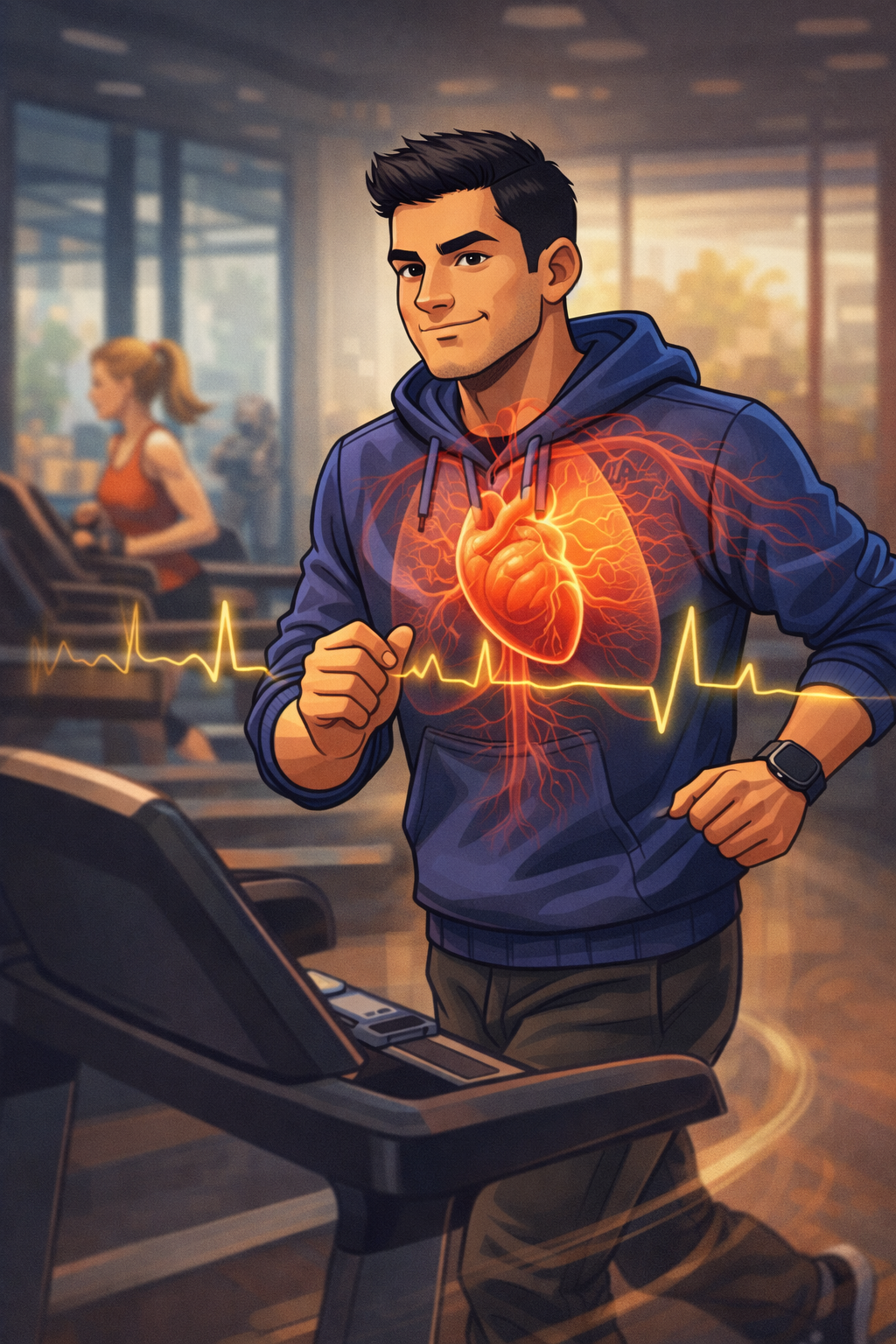
Longevity isn’t just about living longer.
It’s about whether you can still carry your life without feeling like life is carrying you.
Opening Device: The Day You Didn’t Expect
Nobody schedules the day they discover their “breath budget” is low.
It happens in normal moments:
You carry groceries up one flight of stairs… and your chest tightens more than it should.
You walk fast in a parking lot… and your breathing spikes like you just sprinted.
You’re late, stressed, sleep-deprived… and you feel like your body is “revving” too high.
You try to return to training after a rough few weeks… and everything feels harder than it used to.
And it’s not because you’re weak.
It’s not because you “fell off.”
It’s because your cardiovascular resilience—your ability to produce energy, clear fatigue, and stay calm under physical and emotional demand—has a limit.
That limit is your breath budget.
And the people who age well?
They don’t just build muscle and mobility.
They build a bigger breath budget.
What Cardiovascular Resilience Really Is
Cardiovascular resilience isn’t “cardio.”
It’s the integrated capacity of your:
heart (pumping power)
lungs (oxygen exchange)
blood vessels (delivery system)
muscles (using oxygen efficiently)
nervous system (regulating stress response)
It’s your ability to do more with less stress.
To climb stairs without panic-breathing.
To recover faster between sets.
To walk and talk at the same time without feeling “spent.”
To sleep better because your system isn’t running hot all the time.
This is why cardiorespiratory fitness (CRF) shows up again and again as a major predictor of health outcomes across the lifespan.
But here’s the key:
This isn’t about becoming a runner.
It’s about becoming hard to exhaust.
The Longevity Question Nobody Asks
Most fitness marketing asks:
“How shredded can you get?”
“How hard can you go?”
“How much can you suffer?”
Longevity asks something different:
How fast can you recover—and how calm can you stay—under load?
Because life is load.
Work stress is load.
Bad sleep is load.
Caretaking is load.
Financial pressure is load.
Parenting is load.
Cardiovascular resilience is the system that helps you carry that load without spiraling into:
constant fatigue
anxiety-like breathing
energy crashes
inconsistent training
overeating from stress
“I can’t get back on track” weeks
The “Red Flag” Signs Your Breath Budget Is Low
You don’t need a lab to start noticing patterns.
Here are real-world indicators:
Stairs feel like a sprint
You’re not gasping because you’re out of shape morally—you’re gasping because your engine is small.You recover slowly between efforts
You need long rest just to feel normal again.You dread movement when stressed
Because stress already consumes your breath budget.Your sleep is light and your nervous system feels “wired”
Low aerobic capacity often pairs with poor downshift ability.Your “easy pace” isn’t easy
If you can’t maintain a conversational pace for 20–30 minutes, you’re missing a major longevity lever.
Did You Know? The “Talk Test” Is Elite-Level Simple
One of the cleanest self-tests for aerobic base is the ability to maintain a pace where you can breathe through your nose or speak in full sentences.
Not because nose breathing is magic—
but because it’s a proxy for manageable intensity.
If you have to fight for air, you’ve left the “build the base” zone.
The Coaching Truth: You Don’t Need More Intensity
Most people who feel “stuck” after 35 don’t need more punishment.
They need a bigger engine.
Because when your engine is bigger:
strength training feels better
recovery improves
appetite stabilizes
stress feels less catastrophic
you return to baseline faster after disruption
It becomes harder for life to knock you off your routine.
That’s the point.
Tactical Application: Build Your Breath Budget (Without Burning Out)
Layer 1 — Zone 2 (The Base Builder)
This is the aerobic work you can recover from.
Prescription:
2–4 sessions/week
25–45 minutes
conversational pace (you can speak in full sentences)
choose: incline walk, bike, row, easy jog, sled pushes at low strain
Rule: you should finish feeling better, not wrecked.
Layer 2 — “Micro-Intervals” (The Real-Life Shock Absorber)
Zone 2 builds the base.
But life isn’t steady-state.
You need short exposures to higher breathing—done intelligently.
Micro-interval option (1x/week):
10 minutes easy warm-up
6–10 rounds: 30 seconds brisk + 90 seconds easy
5 minutes cool down
This is not a death workout.
This is controlled practice for “life spikes.”
Layer 3 — Recovery Walks (The Nervous System Downshift)
This is the most underrated lever.
After meals (7–10 minutes) or after work:
easy walk
breathe slower
let your system settle
This improves adherence more than “perfect plans.”
The Anti-Fatigue Framework (How You Know It’s Working)
You’ll notice results before you see them.
Signs your breath budget is improving:
you stop dreading stairs
you recover faster between sets
your resting breathing feels calmer
your “easy pace” becomes truly easy
you can train consistently without feeling like you’re fighting your body
That’s anti-fatigue.
Not hype. Not motivation.
Physiology.
A Simple Self-Assessment (Reader Tool)
Answer honestly:
When I’m stressed, does movement feel easier—or impossible?
Can I maintain 30 minutes at a pace where I can speak in full sentences?
How long does it take me to feel normal after exertion—minutes, or hours?
Do I feel “wired” at night even when I’m exhausted?
Do I recover in days after disruption—or do I lose months?
Your answers aren’t shame.
They’re a map.
Closing: The Calm Body Wins
Cardiovascular resilience gives you something deeper than fitness.
It gives you capacity.
A bigger breath budget means:
more patience
more stability
more consistency
more confidence
less fragility
It’s not just training.
It’s preparation for the decade you’re walking into.
Resources (for this entry)
Large bodies of research consistently associate higher cardiorespiratory fitness with lower all-cause mortality and better health outcomes across populations.
Zone 2 / moderate-intensity aerobic work is widely used in endurance and clinical exercise settings to build aerobic capacity while supporting recovery.
Interval training has evidence for improving fitness efficiently when applied at sustainable doses.
(When we publish the final set, I’ll format these as full citations like your prior entries.)