
All Grind, No Life: Why Fun, Play, and Recovery Belong in a Serious Fitness Plan
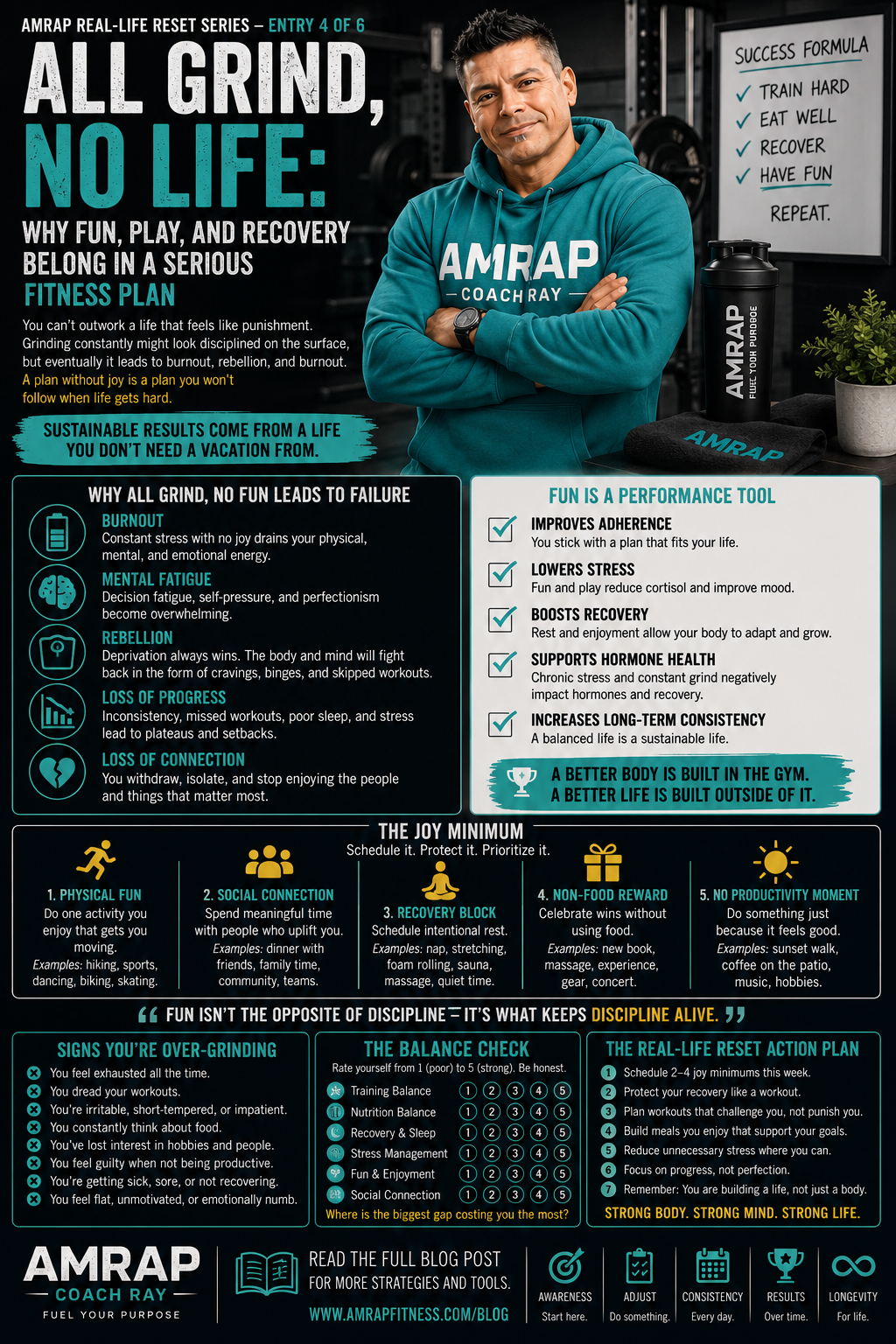
AMRAP Real-Life Reset Series — Entry 4 of 6
Discipline matters.
But discipline without joy eventually starts to feel like a sentence.
A lot of driven adults are excellent at grinding.
They work hard.
They train hard.
They push through fatigue.
They handle responsibility.
They keep moving.
They do what needs to be done.
From the outside, that can look admirable.
And in many ways, it is.
The ability to work hard is valuable.
The ability to sacrifice is valuable.
The ability to stay committed when things are difficult is valuable.
But there is a point where the grind stops building you and starts consuming you.
You stop laughing.
You stop playing.
You stop connecting.
You stop resting without guilt.
You stop doing anything that does not have an obvious productivity return.
Every hour has to be useful.
Every meal has to be controlled.
Every workout has to prove something.
Every day has to be earned.
And eventually, the plan that was supposed to improve your life begins shrinking it.
This article is about a truth that serious adults often resist:
Fun is not the enemy of discipline.
Play is not the enemy of progress.
Recovery is not laziness.
Joy is not a distraction from the plan.
When used wisely, joy is one of the reasons the plan becomes sustainable.
Opening Device: The Person Who Has No Off Switch
Some adults wake up already behind.
They are thinking about work before their feet hit the floor.
They train because they “have to.”
They eat because the meal plan says so.
They answer messages between sets.
They rush from one responsibility to the next.
They measure the day only by what they accomplished.
Then someone asks:
“What do you do for fun?”
They pause.
Not because they do not understand the question.
Because they genuinely do not know anymore.
Fun feels childish.
Rest feels irresponsible.
Play feels unproductive.
Connection feels like a luxury.
So they keep grinding.
They tell themselves:
“This is what it takes.”
Sometimes that mindset creates short-term success.
But over time, something changes.
Training begins to feel heavy.
Nutrition begins to feel like punishment.
Sleep gets worse.
Cravings rise.
Motivation becomes colder.
The person keeps doing the work, but the work no longer gives anything back.
That is not discipline.
That is depletion wearing discipline’s clothing.
The Problem With an All-Grind Identity
The all-grind identity sounds powerful at first.
It says:
no excuses
no days off
outwork everyone
pain is weakness
rest is for the soft
fun can wait
sleep when you are dead
This language can create urgency.
It can push someone through a hard season.
It can even help a person build early momentum.
But as a long-term identity, it has a serious flaw:
It treats the body and mind like machines.
Humans are not machines.
We adapt.
We fatigue.
We need sleep.
We need connection.
We need recovery.
We need periods of lower demand.
We need reasons to keep going that are bigger than punishment.
A fitness plan built only on pressure may produce effort.
But a life built only on pressure eventually produces rebellion.
That rebellion may show up as:
skipped workouts
binge eating
late-night scrolling
resentment
emotional eating
loss of interest
training burnout
“I don’t care anymore” moments
The body and mind do not ask for balance politely forever.
Eventually, they take it.
The Science Signal: Recovery Is Not Optional
Recovery is not just time away from work or training.
It is a psychological and physiological process.
Research on recovery from work has identified key recovery experiences such as psychological detachment, relaxation, mastery, and control. These recovery experiences are linked with well-being, lower exhaustion, improved sleep, and better overall function.
That matters for fitness because a person does not leave stress in one compartment of life.
Work stress affects sleep.
Poor sleep affects training.
Training fatigue affects patience.
Stress affects cravings.
Low recovery affects motivation.
Everything talks to everything.
A serious fitness plan must therefore account for recovery, not as a bonus, but as part of the system.
Enjoyment Helps Adherence
Exercise does not have to feel fun every second.
Some training is hard.
Some days require discipline.
Some sessions are uncomfortable.
But if the entire process feels like punishment, long-term adherence becomes harder.
People are more likely to repeat behaviors that give them something worth coming back to.
That does not mean every workout must be easy.
It means the larger lifestyle must contain enough reward, meaning, connection, and recovery to make the work sustainable.
The professional translation is simple:
Discipline gets you moving. Joy helps you continue.
The Difference Between Pleasure and Purposeful Joy
This distinction matters.
When people hear “have fun,” they sometimes think it means:
abandoning structure
eating everything
skipping training
ignoring goals
chasing constant comfort
avoiding hard work
That is not what this article means.
There is a difference between impulsive escape and purposeful joy.
Impulsive escape
This often happens when someone is depleted.
It may look like:
overeating at night
excessive alcohol
hours of scrolling
skipping responsibilities
spending money impulsively
using food as the only reward
avoiding sleep while claiming to relax
This may provide temporary relief, but it often leaves the person feeling worse.
Purposeful joy
This is restorative.
It may look like:
walking with a friend
playing a sport recreationally
hiking
dancing
laughing with family
learning something new
creative hobbies
time outdoors
music
prayer
community
relaxing without guilt
doing something physical with no performance target
Purposeful joy does not destroy the plan.
It helps a person return to the plan with more life in them.
Why Serious People Resist Fun
Highly responsible adults often resist fun for understandable reasons.
Reason 1: They associate fun with losing control
Maybe past “fun” meant overeating, drinking too much, staying out too late, or abandoning discipline.
So they begin believing fun itself is dangerous.
The correction is not to remove fun.
It is to choose better forms of it.
Reason 2: They believe rest must be earned
Some people feel they can only rest after everything is finished.
But everything is never finished.
The inbox refills.
The house gets messy again.
The next obligation appears.
If rest requires a completed life, rest never arrives.
Reason 3: They confuse seriousness with suffering
They believe a goal is only legitimate if it hurts.
But suffering is not the same as commitment.
A plan can be serious without being miserable.
Reason 4: They fear falling behind
They think if they slow down, someone else will pass them.
But chronic overreaching often creates the exact setback they feared.
Reason 5: They forgot what they enjoy
This is common.
Years of responsibility can erase playful identity.
The person has to rediscover what actually restores them.
The Fitness Plan That Feels Like Punishment
A plan becomes emotionally unsustainable when everything inside it feels like debt repayment.
You eat well because you are afraid.
You train because you feel guilty.
You avoid rest because you feel undeserving.
You weigh yourself because you need reassurance.
You do cardio because you ate something.
You call every indulgence a failure.
You treat the body like a project that is always behind schedule.
That is not health.
That is a stressful relationship with improvement.
The professional correction is:
Build a plan that creates progress without making life feel like punishment for having a body.
That means:
strength training
nutrition structure
walking
sleep
recovery
flexibility
social connection
enjoyable movement
hobbies
purposeful rest
The plan should improve the life.
It should not replace it.
The AMRAP Joy Minimum
This is the central framework.
Every week, schedule five things.
Not five huge things.
Five intentional things.
1. One physical fun activity
This is movement that does not feel like a test.
Examples:
hiking
basketball
swimming
dancing
bike ride
recreational sport
long walk somewhere beautiful
playing outside with children
mobility flow with music
The goal is to remember that your body is not only for performance.
It is for participation.
2. One social connection
Examples:
coffee with a friend
family walk
phone call with someone positive
training with a partner
church/community event
dinner without the phone
shared outdoor activity
Social connection supports motivation, recovery, and emotional resilience.
3. One recovery block
Examples:
sauna
quiet walk
nap
stretching
prayer
journaling
massage
reading
time outdoors
breathing work
This is not optional.
It is scheduled.
4. One non-food reward
Examples:
new book
music
movie night
sports event
hobby supplies
time in nature
new workout shirt
quiet time with no productivity target
Food can be enjoyable, but if food is the only reward, nutrition becomes harder.
5. One moment with no productivity goal
This may be the hardest one.
Examples:
sit outside
listen to music
enjoy coffee slowly
play with your dog
watch a sunset
talk without multitasking
laugh without rushing to the next task
You are not wasting time.
You are reminding the nervous system that life is not only demand.
The Grind-Recovery Ratio
Not every week needs the same amount of recovery.
A harder week needs more recovery.
A calmer week may need less.
Use this simple rule:
High-grind week
If the week includes:
poor sleep
high work stress
emotional strain
heavy training
family pressure
travel
conflict
Then increase:
walking
sleep protection
recovery blocks
lighter training days
connection
downshift practices
Moderate-grind week
Maintain:
normal training
normal nutrition structure
normal recovery habits
Low-grind week
Use the opening to:
push training slightly
build skill
enjoy more active recreation
prepare for the next demanding season
The problem is not grinding.
The problem is refusing to adjust recovery to match the grind.
Play Is Not Just for Children
Adults often remove play first.
Then they wonder why life feels heavy.
Play is not necessarily childish.
Adult play can include:
sport
music
art
games
dancing
joking
hiking
exploring
cooking creatively
recreational competition
martial arts practice
movement without outcome pressure
Play gives the body and mind a different kind of signal.
Not:
“Perform.”
Not:
“Fix yourself.”
Not:
“Prove something.”
But:
“Participate.”
That shift matters.
When movement becomes only punishment, people avoid it.
When movement also becomes play, the relationship changes.
Fun Does Not Mean the Plan Has No Standards
This is important.
Some people use the idea of balance to avoid standards.
That is not what we are doing here.
The standard remains:
train consistently
eat with structure
hydrate
sleep
recover
track what matters
return after setbacks
But the standard also includes:
do not make life joyless
do not turn discipline into self-punishment
do not confuse exhaustion with excellence
do not use food as your only pleasure
do not remove every form of recreation and then wonder why you rebel
A strong plan has structure.
A sustainable plan also has oxygen.
The “No Joy” Warning Signs
Your plan may be missing joy if:
every meal feels like restriction
every workout feels like punishment
you resent your routine
you binge after long periods of control
you avoid social life entirely
you feel guilty resting
you have no hobbies
you do not laugh much
you use food as your main comfort
you feel like the plan is making your life smaller
These warning signs do not mean you should quit.
They mean the plan needs adjustment.
The Recovery Menu
When people are depleted, they often choose the easiest numbing behavior.
Instead, build a recovery menu before you need it.
Physical recovery
walking
stretching
mobility
sauna
massage
easy bike
restorative yoga
breathing
Mental recovery
journaling
prayer
reading
quiet time
music
therapy
meditation
nature
Social recovery
friend call
family walk
group class
church/community
shared meal
recreational sport
Play recovery
games
dancing
creative work
hiking
sports
hobby
low-stakes competition
The point is not to do all of them.
The point is to stop relying on food, scrolling, and collapsing as the only ways to feel relief.
The Serious Adult’s Fun Audit
Ask these questions:
What did I enjoy before life became so heavy?
What physical activity feels like play, not punishment?
Who do I feel better after spending time with?
What makes me laugh?
What restores me without creating regret?
What hobby have I abandoned?
What would I do if it did not need to be productive?
Is food my only reward?
Is scrolling my main recovery method?
Does my fitness plan make my life bigger or smaller?
Your answers are not childish.
They are information.
The Weekly Joy Schedule
Use this format:
Movement joy
This week I will:
______
Social connection
This week I will:
______
Recovery block
This week I will:
______
Non-food reward
This week I will:
______
No-productivity moment
This week I will:
______
Put them on the calendar.
A life-giving action that never gets scheduled usually loses to an urgent task.
When Fun Becomes Sabotage
We also need honesty.
Not everything called “fun” is restorative.
Sometimes “fun” becomes self-sabotage.
Examples:
drinking so much sleep is ruined
eating until physically uncomfortable every weekend
staying up so late Monday becomes a disaster
using “balance” as permission to abandon all structure
calling avoidance “rest”
spending hours scrolling and feeling worse afterward
The professional question is:
“Does this restore me, or does it create a bigger recovery debt?”
Restorative fun makes tomorrow better.
Self-sabotage borrows from tomorrow.
That distinction protects the plan.
The 80/20 Life Rule
The goal is not to be perfect.
The goal is to be consistent enough that life can still be lived.
The 80/20 concept is often misunderstood.
It does not mean:
be disciplined Monday through Friday and reckless all weekend
follow the plan until stress appears
eat perfectly and then explode
use balance as a cover for avoidance
It means most of your repeated behaviors support your goals, while a smaller portion allows flexibility, pleasure, and normal life.
A good 80/20 approach should leave you feeling:
satisfied
consistent
socially connected
physically progressing
not trapped
not constantly guilty
If your version of 80/20 keeps erasing your progress, it is not 80/20.
It is inconsistency with a better name.
The Seven-Day Joy Reset
For one week, add one small restorative action each day.
Day 1: Walk without tracking
Move without turning it into a performance test.
Day 2: Call someone who makes you feel lighter
Connection is recovery.
Day 3: Do one hobby for 20 minutes
No productivity goal.
Day 4: Take a recovery block
Stretch, sauna, breathe, pray, read, or sit quietly.
Day 5: Play physically
Shoot baskets, dance, throw a ball, hike, swim, or bike.
Day 6: Plan a non-food reward
Choose something that does not disrupt sleep or goals.
Day 7: Review
Ask:
What restored me?
What made me feel alive?
What created regret?
What should stay in my weekly plan?
Joy becomes more useful when you learn which kinds actually restore you.
Common Mistakes—and the Professional Correction
Mistake 1: Thinking fun means lack of discipline
Correction: Purposeful joy supports long-term adherence.
Mistake 2: Using food as the only reward
Correction: Build non-food rewards and playful movement.
Mistake 3: Treating recovery as laziness
Correction: Recovery is part of adaptation and performance.
Mistake 4: Grinding harder when motivation disappears
Correction: Check for burnout, boredom, sleep debt, and emotional depletion.
Mistake 5: Calling self-sabotage “balance”
Correction: Balance should restore you, not create regret.
Mistake 6: Removing all social life
Correction: Build social connection that respects your goals.
Mistake 7: Waiting until burnout to rest
Correction: Schedule recovery before the system breaks.
The AMRAP Joy Contract
Use this:
I will train seriously without making my life joyless.
I will work hard without worshiping exhaustion.
I will use food for fuel, pleasure, and connection—but not as my only reward.
I will schedule recovery before burnout forces it.
I will include movement that feels like play.
I will protect relationships that support my health.
I will build a body that lets me participate in life—not just inspect myself in the mirror.
I will remember that the goal is not only to look better.
The goal is to live better.
Self-Assessment
Answer honestly:
Does my plan make my life bigger or smaller?
Do I feel guilty when I rest?
Is food my only reward?
Do I have any movement that feels like play?
Do I have at least one weekly recovery block?
Am I confusing exhaustion with excellence?
Do I use “balance” in a way that restores me or sabotages me?
Who makes me feel more alive and supported?
What hobby or playful activity have I abandoned?
What would happen if I scheduled joy as seriously as work?
Your answers are not distractions from the plan.
They are part of the plan.
Closing: A Serious Life Still Needs Joy
You can be disciplined and still laugh.
You can train hard and still play.
You can pursue fat loss and still enjoy meals.
You can have standards and still rest.
You can be ambitious and still make room for beauty, friendship, fun, and peace.
The goal is not to grind until there is nothing left of you.
The goal is to build a life strong enough to hold both effort and joy.
A plan that produces results but destroys your spirit is incomplete.
A plan that gives you no room to breathe will eventually make you want to escape.
So build differently.
Train.
Fuel.
Recover.
Work hard.
But also walk somewhere beautiful.
Call the friend.
Play the game.
Laugh.
Dance.
Take the quiet hour.
Do something that reminds you that your body is not only a project.
It is how you experience your life.
Discipline gets you moving.
Joy helps you continue.
And the best transformation is not the one that makes your life smaller.
It is the one that gives more of your life back to you.
Resources
Bennett AA, Bakker AB, Field JG. Recovery from work-related effort: A meta-analysis. This meta-analysis examined psychological detachment, relaxation, mastery, and control across 54 independent samples and more than 26,000 participants.
Wendsche J, Lohmann-Haislah A. A Meta-Analysis on Antecedents and Outcomes of Detachment from Work. Detachment was associated with better mental health, less exhaustion, higher life satisfaction, better sleep, better state recovery, and task performance.
Teixeira PJ, Carraça EV, Markland D, Silva MN, Ryan RM. Exercise, physical activity, and self-determination theory: a systematic review. The review supports the role of autonomous motivation and experiential rewards in exercise behavior.
Rodrigues F, et al. Can Interpersonal Behavior Influence the Persistence and Adherence to Physical Exercise Practice in Adults? A Systematic Review. The review discusses motivation quality, interpersonal support, persistence, and adherence.
Tavares VDDO, et al. Exercisers’ Affective and Enjoyment Responses: A Meta-Analytic and Meta-Regression Review. The review discusses affective and enjoyment responses as relevant to exercise adherence.
Steed LB, Swider BW, Keem S, Liu JT. Recovery Experiences for Work and Health Outcomes: A Meta-Analysis and Recovery-Engagement-Exhaustion Model. Recovery experiences were linked with job and personal outcomes, including work engagement, job satisfaction, positive affect, and well-being.