
Accountability Partner 101: The Longevity Advantage Most People Never Build
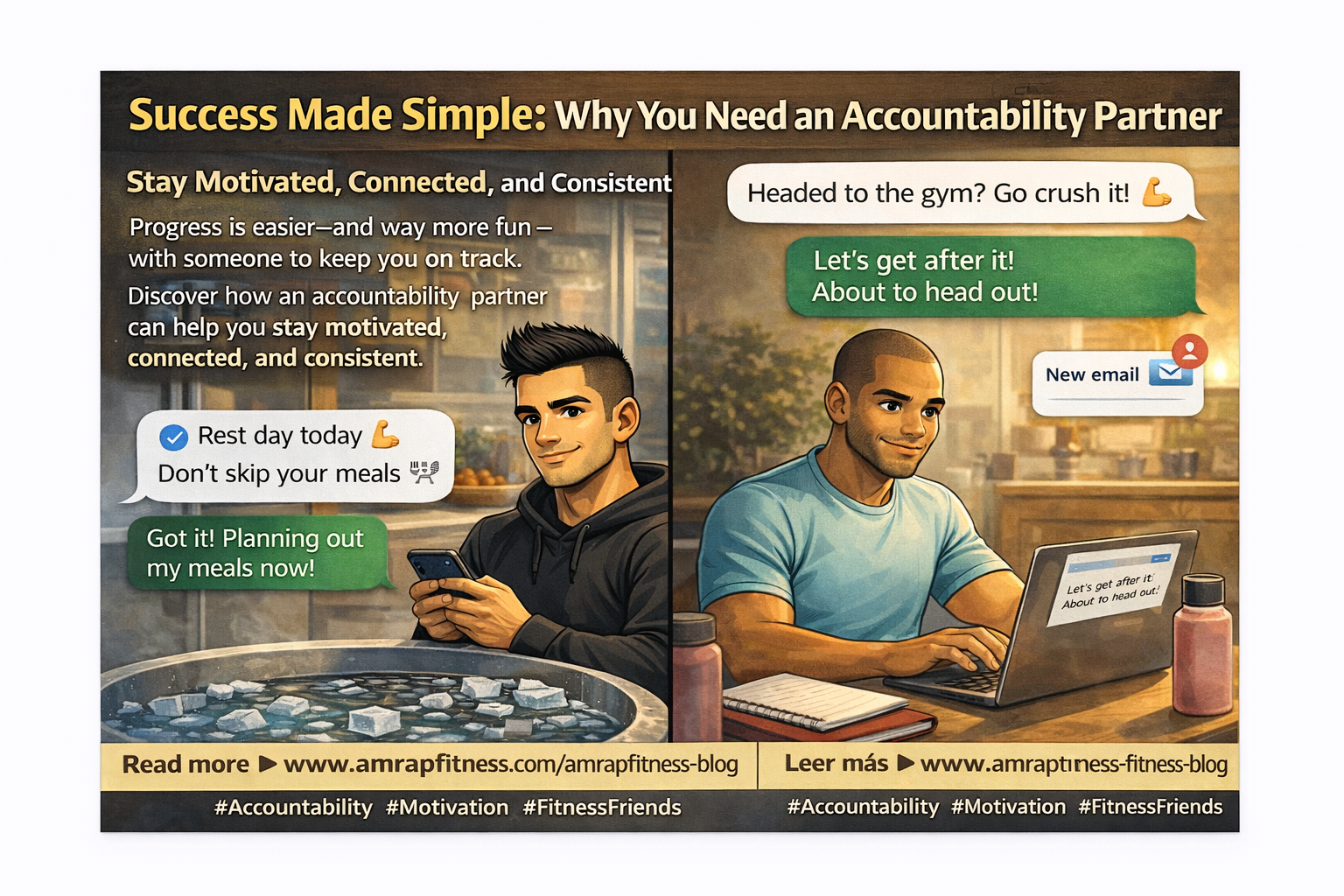
(AMRAP Longevity Series — Pillar Intro #3)
The best plan in the world loses to the wrong week.
Most adults don’t fail because they don’t know what to do.
They fail because:
life gets chaotic
stress rises
sleep breaks
the routine slips
and no one notices
Then the spiral starts:
“I missed a day.” becomes “I missed a week.” becomes “I’ll restart when things calm down.”
A professional doesn’t rely on motivation to survive chaos.
A professional builds infrastructure.
That’s what an accountability partner is:
a system that protects consistency when your emotions can’t.
This is an introduction pillar post. Later, we’ll deep-dive on accountability for nutrition, recovery, and performance — without repeating this foundation.
Opening Device: The Week You Didn’t See Coming
No one schedules the week that knocks them off.
It hits like:
a family situation
a deadline
a kid getting sick
a travel week
an emotional hit
And what collapses first isn’t usually training.
It’s structure.
Meals become random. Sleep gets irregular. Water disappears. Training becomes “later.”
Not because you’re lazy.
Because you’re alone inside the workload.
This is where accountability matters.
Not as pressure.
As support with a script.
What Accountability Actually Is (and What It Is Not)
Accountability is NOT:
shame
policing
guilt
a friend nagging you
Accountability IS:
a clear agreement
simple check-ins
a minimum plan for hard days
identity reinforcement
The best accountability systems are boring.
Boring is good.
Boring is repeatable.
Why Accountability Works (The Science Signal)
Across behavioral science and health behavior research, social support and structured follow-up are consistently associated with improved adherence.
In clinical and lifestyle interventions, accountability (regular monitoring, feedback, and social support) is a common ingredient in improving consistency over time.
Also, large meta-analyses show that stronger social relationships are associated with improved survival, while social isolation is associated with increased mortality risk. That doesn’t prove “an accountability partner extends life” on its own — but it strongly supports the idea that connection and support influence health outcomes through behavior, stress physiology, and sustained habits.
Coaching translation: Accountability doesn’t just make you show up.
It changes your identity:
“I’m the kind of person who returns.”
The AMRAP Accountability Framework
We’re going to keep this clean.
A partner is only valuable if it reduces friction.
Principle 1 — One channel only
Pick ONE:
text
WhatsApp
Instagram DM
coaching app
Multiple platforms = confusion.
Confusion kills adherence.
Principle 2 — Two check-in days
You don’t need daily essays.
You need rhythm.
Best default: Monday + Thursday.
Why?
Monday sets the week.
Thursday prevents the “weekend slide.”
Principle 3 — One metric per category
If you track everything, you track nothing.
We use three categories:
Training
Nutrition
Recovery
One metric each.
The 3 Metrics That Matter
1) Training: “Did you complete the minimum?”
Minimum counts.
Minimum is how you win hard weeks.
2) Nutrition: “Protein at each meal?”
You don’t need macro obsession to stabilize.
You need a protein anchor.
3) Recovery: “Sleep window protected?”
Not perfect sleep. A protected window.
These three metrics catch most spirals early.
The Minimum Plan (The Anti-Spiral Tool)
Your partner system must include a minimum plan — or it becomes shame-based.
The minimum plan for a bad day:
20–30 minute walk (or Zone 2)
protein + water
lights down 30–60 minutes earlier
That’s it.
If you do that, you didn’t fail.
You executed the protocol.
Protocols beat motivation.
The Check-In Script
Message format
“Done ✅”
or “Not done — doing minimum at :.”
No explanations.
No shame.
Just behavior.
Example Monday check-in
“Week anchor: strength session + protein at each meal. Done ✅”
Example Thursday rescue
“Rough week. Running minimum plan tonight at 7. ✅”
The partner’s job is to respond with:
“Proud of you. Minimum counts. Report back.”
That’s it.
How to Choose the Right Accountability Partner
This matters.
A partner is not just someone you like.
It’s someone who supports the behavior you’re building.
Choose someone who:
respects honesty
doesn’t shame slips
values consistency over intensity
can respond simply
Avoid someone who:
competes with you
turns everything into drama
disappears for weeks
Professional rule:
Choose steady, not hype.
Accountability Beyond Training (The Longevity Version)
Most people only use accountability for workouts.
That’s incomplete.
Longevity accountability includes:
training
nutrition
sleep
recovery routines
stress management
Because one weak area can collapse the whole system.
That’s why we keep the three metrics.
Common Mistakes (and the Pro Fix)
Mistake 1: Using accountability as pressure
Fix: use it as structure + minimum plan.
Mistake 2: Checking in only when you’re doing well
Fix: check in especially when you’re slipping.
Mistake 3: Tracking too much
Fix: one metric per category.
Mistake 4: No default schedule
Fix: same days, same time.
Mistake 5: No rescue protocol
Fix: minimum plan + two-message rescue.
Self-Assessment (Reader Tool)
Answer honestly:
Would anyone notice if I disappeared for two weeks?
When I slip, do I return in days — or months?
Do I have a minimum plan for bad days?
Do I have one channel and two check-in days?
Do I use accountability for recovery and nutrition — or only training?
Your answers aren’t judgment.
They’re your build list.
Closing: The Advantage Is Return Capacity
Accountability is not about being watched.
It’s about being supported.
It’s the difference between:
“I fell off.”
and
“I got hit — and I returned.”
That’s longevity.
Not perfection.
Return capacity.
Resources
Holt-Lunstad J, Smith TB, Layton JB. Social Relationships and Mortality Risk: A Meta-analytic Review. PLOS Medicine. 2010. https://journals.plos.org/plosmedicine/article?id=10.1371/journal.pmed.1000316
Holt-Lunstad J, Smith TB, Baker M, Harris T, Stephenson D. Loneliness and Social Isolation as Risk Factors for Mortality: A Meta-Analytic Review. Perspectives on Psychological Science. 2015. https://pubmed.ncbi.nlm.nih.gov/25910392/
National Academies of Sciences, Engineering, and Medicine. Social Isolation and Loneliness in Older Adults: Opportunities for the Health Care System. 2020. https://nap.nationalacademies.org/catalog/25663/social-isolation-and-loneliness-in-older-adults-opportunities-for-the