

*Most people don’t fail at health because they lack discipline.
They fail because they’re overdosing on effort their life can’t support.*
A Different Way to Start This Conversation
Two people decide it’s time to “get back in shape.”
The first goes all in:
Five to six workouts per week
Strict nutrition rules
Early mornings, late nights
No margin for stress, travel, or life
The second does something far less impressive:
Three structured strength sessions
Walks most days
Prioritizes protein
Protects sleep when possible
A year later, only one of them is still training.
That outcome isn’t about motivation.
It’s about dose.
What Coaches See That Programs Don’t
After years of coaching adults with demanding lives—parents, professionals, former athletes, people under chronic stress—one pattern shows up consistently:
The people who start with the most intensity are rarely the ones who last.
The people who stay consistent aren’t lazy or unmotivated.
They’re realistic about:
Recovery capacity
Stress load
Time constraints
Nervous system fatigue
This isn’t theory. It’s observation.
Most bodies don’t break because they’re weak.
They break because the stimulus exceeds their ability to recover.
The Science Behind the “Minimum Effective Dose”
In physiology, the Minimum Effective Dose (MED) refers to the smallest amount of stress required to trigger a positive adaptation.
Below it → no meaningful change.
Above it → diminishing returns, rising fatigue, higher dropout risk.
For adults balancing work, family, sleep debt, and stress, the margin for error is smaller than it used to be. The body adapts more slowly—but it still adapts exceptionally well when the dose is right.
Did You Know?
Research shows that 2–3 resistance training sessions per week are sufficient to maintain—and often increase—muscle mass and strength in adults over 30 when paired with adequate protein intake.
More volume does not automatically equal better results.
Why “More” Often Backfires
When training volume ignores real-life stressors, the body responds defensively:
Elevated cortisol
Impaired sleep
Increased inflammation
Appetite dysregulation
Higher injury risk
From the outside, it looks like “burnout” or “lack of discipline.”
Physiologically, it’s overreaching without recovery.
Did You Know?
Studies on training load show that excessive volume without adequate recovery can reduce performance and suppress immune function—even in experienced athletes.
Doing Less Is Not the Goal — Precision Is
This is where the message often gets misunderstood.
The goal is not minimal effort.
The goal is precise effort.
Longevity-focused training asks different questions:
What’s the least I need to do to maintain strength?
What dose improves cardiovascular health without draining me?
What can I recover from even during hard weeks?
When training aligns with those answers, consistency stops feeling heroic—and starts feeling normal.
Coaching Application: The 3-Anchor Framework
This is a structure I return to often because it survives stress, travel, and imperfect weeks.
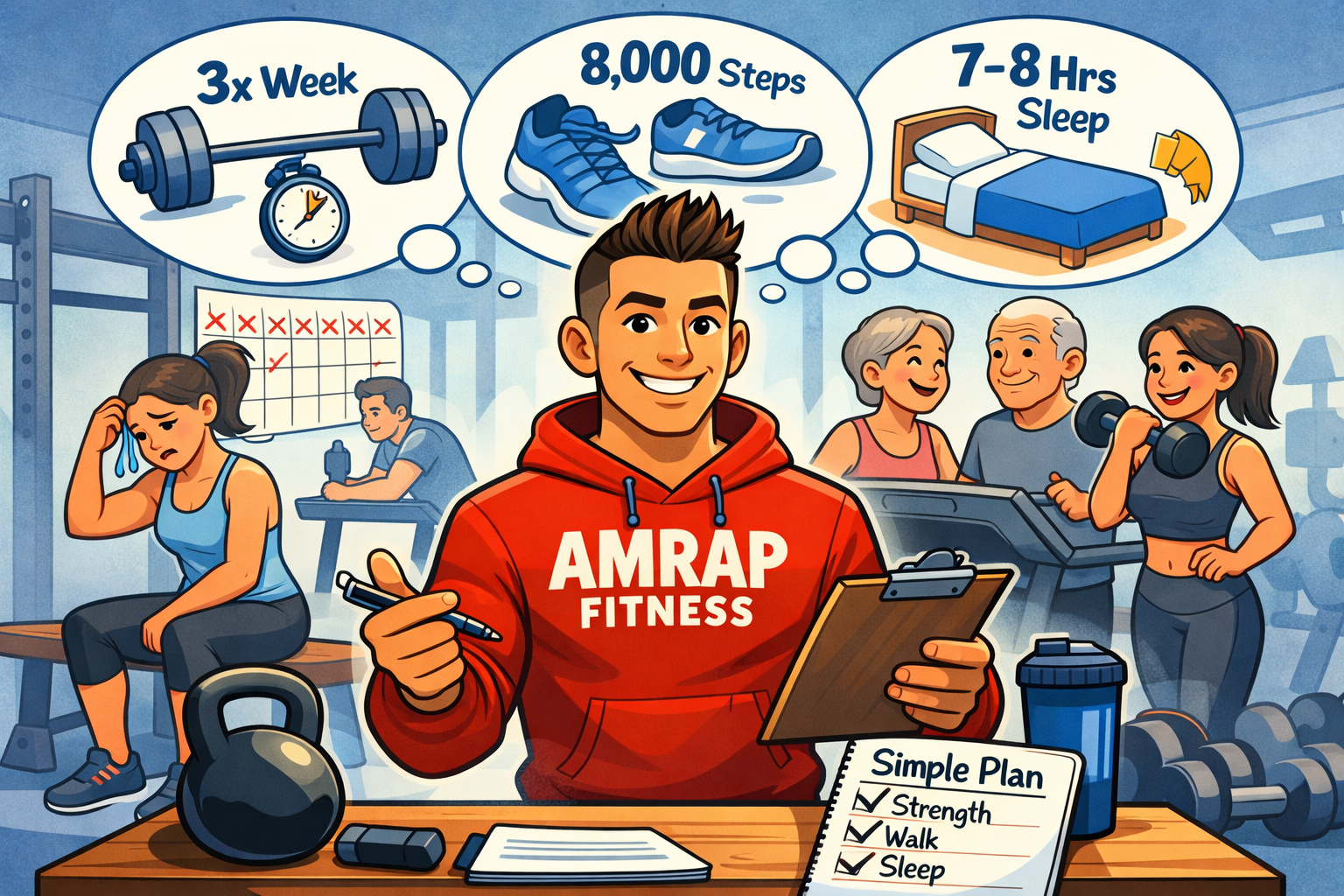
Anchor 1: Strength (3x/week)
Full-body or upper/lower splits that preserve muscle and bone density.
Anchor 2: Daily Movement
Walking, cycling, or light aerobic work to support cardiovascular health and metabolic function.
Anchor 3: Recovery Protection
Sleep windows, breath work, or intentional downshifts that allow adaptation to occur.
Miss perfection. Keep the anchors.
Did You Know?
Adults who average 7,000–9,000 steps per day show significantly lower all-cause mortality—even without structured cardio programs.
Why This Matters for Longevity
Longevity isn’t built during perfect weeks.
It’s built during:
High-stress seasons
Travel-heavy months
Low-energy days
Periods when motivation is absent
The body doesn’t remember your hardest week.
It adapts to what you do most consistently.
Precision beats intensity over decades.
A Reframe Worth Keeping
Instead of asking:
“How much can I push?”
Ask:
“What can I repeat—even when life gets heavy?”
That question alone changes outcomes.
Did You Know?
Consistency in moderate training is more strongly associated with long-term health outcomes than sporadic bouts of high-intensity exercise followed by inactivity.
Closing Thought
Health isn’t built through heroic effort.
It’s built by respecting biology, managing stress, and applying just enough stimulus to grow—without breaking.
That’s not weakness.
That’s intelligence.